Category Archives: Business

Princeton Regional Chamber Events, useful tips from U.S. 1 Newspaper

Bad Deeds Will Out

It wasn’t murder, because nobody died, but the now infamous hacking by News Corp effectively killed the dream of an entrepreneur in Princeton a half-dozen years ago. Then it went under the radar of world news. Now it’s coming back to haunt the perpetrators.

Today’s Star Ledger and Times of Trenton dug up another grave, the sale of FLOORgraphics to the News Corp. The spade work had been done by by Jim Edwards of bnet.com and the New York Times’ David Carr.

I remember interviewing the founder, Richard Rebh, soon after the company began. He was still on Vaughan Drive, before he expanded to American Metro Center.
As below from U.S. 1 Newspaper files: The company started in 1996 when founder Fred Potok was working for a Montclair-based fleet graphics business, which had just come across a decal that could be protected from road hazards by a bullet-proof laminate. This laminate, less slippery than the floor itself, could make floor advertising viable, Potok realized.

Potok turned to a graphic artist, George Rebh, a Williams College alumnus, Class of 1973. For the CEO job they brought in George’s brother, Richard, who has a 1976 degree from Princeton University’s Woodrow Wilson School, and business and law degrees from Stanford.

Because the partners positioned the floor ads as media, manufacturers could pay for the floor space, not from display budgets, but from their advertising budgets — funds that might otherwise be used for print advertising or direct mail. This represented extra income for the store. “By creating an advertising medium that could be purchased, retailers could monetize the media value of their stores,” says Rebh.

With venture capital funding FloorGraphics bought a division of 3M that makes strong vinyl film for the decals. It was a textbook case of successful innovative marketing.

In 2006 I spoke to Rebh again. He was embroiled in a law suit with News Corps. As the inventor of a new advertising medium, he was trying to prove that News Corps had hacked his computer files to get proprietary information. Off the record, he told of his competitor threatening to destroy him.

“Our business is challenged by the fact that we compete with News America, and News America has not competed fairly,”
said Rebh, for the record, then. “We invented a great medium, and a lot of advertisers like us, but their buys get split across News America and ourselves.”

Rebh is silent now, thanks to the $30 million that News Corps paid for his company. Considering that his profit was only $1 million per year at the time, that’s a revealing admission of guilt. Presumably he had to pay his lawyers and split the remainder among his two partners, but still that’s a sufficient amount to buy silence. That would keep me quiet too. The usually loquacious Rebh told the Star Ledger reporter he had to “sit this one out.”

FLOORgraphics is still at American Metro Center. Scott Morgan’s U.S. 1 Newspaper/Princetoninfo.com story offers more tantalizing details. Morgan notes that Richard Rebh (far left in the photo with his brother and Potok) is still the CEO (a surprise to me) and that the name has changed to Entry Point Communications.

As they said as far back as Chaucer’s time, “murder will out,” meaning that a murderer’s presence would cause the corpse to emit fresh blood.

As heads roll from Murdoch’s empire, fresh blood indeed.

The image is a U.S. 1 file photo by Craig Terry. I made some changes in this post after I read the U.S. 1 Newspaper story at 6 p.m. July 19. From what I can figure out from scanty web entries, Entry Point Communications does point of purchase video displays, though I would welcome a correction or more information.
The Next Generation — At NJEN

It’s gotten to be an annual event, for Princeton University’s Friend Center to co-host NJEN’s poster session.

Here is an account of last year’s and yet another post on it Notice that last year much was made of how the New Jersey Commission on Science and Technology could help tech businesses. Now the NJCST is no more and some of its portfolio has been taken over by the NJEDA, as explained this year by the NJEDA’s Mike Wiley, a former Marine who is using his skills and determination to foster business in New Jersey.

Wiley announced today’s launch of Choose NJ, a $7 million public private partnership headed by PSE&G;’s Dennis Bone, It sets up meetings of current NJ CEOs with CEOs of companies that might move to the state. Wiley pointed to the availability of Lt. Gov. Kim Gaudagno, who gives out her cell phone number to business groups, and he gave out his own phone numbers and email (mwiley@njeda.com). Two state funds provide investment capital. The Edison Innovation fund has $25 million in investment capital and partners with 8 venture capital funds. The Clean Energy Manufacturing Fund has $11 million in four companies, including Princeton Power systems. Wiley also said that the tax loss program, expansion incentives, and retention incentives are are still in place. The NJEDA funded three companies founded by Princeton undergraduates and recent graduates: Princeton Power Systems, StairClimb, and Terracycle.

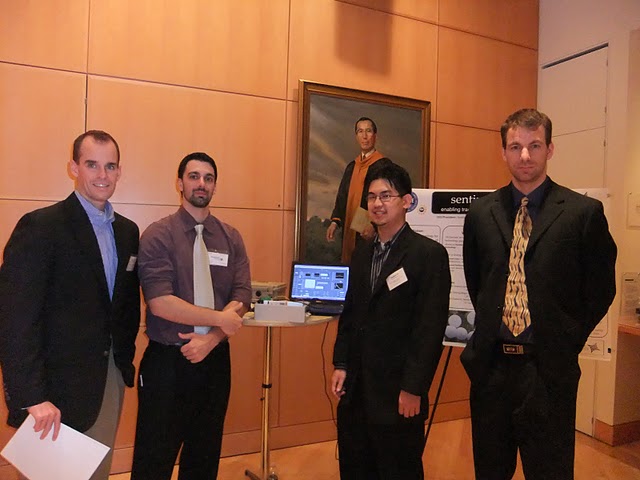
Sensor technology was prominent last year, as it is again this year. Richard B. Miles has a new kind of detector which could replace explosive-sniffing dogs. Two from Princeton University (post doc Stephen So and master’s candidate Jon Bruno) are working along with David Thomas on a promising new firm, Sentinel Photonics. It has a cheaper, more effective, lower maintenance way to sense air particles. Pictured: Mike Wiley of EDA, David Thomazy, Stephen So, and Jon Bruno, all of Sentinel Photonics.

Last year Ekua Bentil represented a solar firm that is testing its product in Ghana, and this year Eden Full of Roseicollis Technologies offers a solution for rotating solar panels that could work. She says she has been tinkering with her idea since she was nine, and she is all over YouTube with her animated account of hoping to found a nonprofit to help those in third world countries.

Steven Gifis represented another solar company, Amelio Solar founded by renowned solar tech pioneer Zoltan Kiss.

I also met Marc Bazin of HepatoChem, which has labs at Princeton and in Boston, William Pfister of Aexelon Therapeutics, which is based in Exton, PA but has an office in Robbinsville, and Mark T. Flocco, who came to represent Joannes Dapprich of Generation Biotech. I was intrigued by Peter Gordon’s answer to a tough problem — how to keep hands clean in a hospital. Gordon’s Dover, NJ-based firm is Germgard Lighting.

Some of these photos are on my Picasa web album.


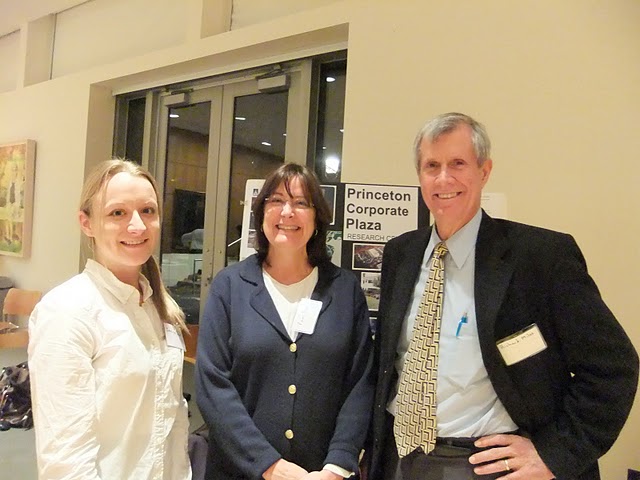
In addition to Einstein Alley’s Katherine Kish, I encountered four more intriguing women. Pam Kent, the real estate rep for Princeton Corporate Plaza and the daughter-in-law of architect/owner Harold Kent. The Kents are real friends to the technology community because they have dedicated themselves to providing affordable office space for small and growing companies. And they are expanding the park, even in this environment. I never realized that Kent owned the Wyeth lab on Raymond Road. Wyeth was sold to Pfizer, Pfizer vacated it, and now that space will be converted to serve smaller tech businesses. Even better, Pam’s daughter Jessica, a recent graduate of the University of Colorado, is working in the family business. (Pictured, daughter, mother, and Richard Miles)


The third intriguing woman was Maria Klawe, present in a portrait on the paneled wall of the Friend Center. Klawe was the first women engineering dean here and made a few waves, changing the culture of the EQuad and being visibly artistic. I think I remember her saying she brought her sketch pad — or was it her needlework? — to staff meetings.The male deans are pictured in their academic robes, in oil, surrounded by gilt frames. Klawe is dressed informally, in pants and clogs, sitting on a bench in the E-quad, as students pass by. It certainly makes a different statement; and I’m going to find out if it is a self portrait.

Perhaps the most useful take-away came from Lynne Wildenboer of Red Wolf Design. As we were leaving, I mentioned that I was walking home and, no thanks, I didn’t want a ride because I needed the exercise. She told me of a fabulous Android app, Cardio Trainer. It acts as both a GPS, a pedometer, and a workout recorder, and it’s free. I can’t wait to try it.