All posts by bfiggefox

Where there’s smoke, there’s hope — for journalism

Richard Bilotti, former publisher of the Times of Trenton, spoke to the Princeton chamber at the Princeton Marriott yesterday, and remembered speaking to the same group at the same hotel two decades ago, when it was still called Scanticon. He had pulled a Palm Pilot out of his pocket and predicted we would all be reading our news on Palm Pilots. Yesterday he brandished his iPhone. He reads all his news on either an iPhone or a Kindle, electronic book.

Optimistic about the transition from print-based news to new media, he compared it to how the printing press wrested control of information from the Catholic church. Now online media and social media are grabbing control from print editors. ”After watching the news for 50 years and spending a lot of time surfing the net, reading, and thinking, I have come to believe that new ways of passing news will be more democratic, will give us more viewpoints, will provide more information and make our democracy more robust and more responsive to the people.”

He answered the credibility and bias questions.

“The information will be no more or less credible than what we have received from the usual media. Of necessity, newspapers have had to skew the news, based on space and reporters and resources available. Reporters cannot help but bring the biases of their race, upbringing, and education. I constantly received complaints about bias, from the straightforward accident story to the most complex investigations, but I probably received more complaints about stories we didn’t publish or that we overlooked.”

Journalists need to get proficient with online reporting opportunities, he warned, noting that the New York Times pays $750 a year to deliver a paper to one driveway.” Reporters will go to work on online sites. Some started by newspapers, before they stop printing, others new. Some will provide news on a host of topics. Some on geography, such as in Plainsboro. On interest, local soccer. Or on advertising, that offer money for clicking on an ad. Or from a nonprofit, like Kaiser.org, which provides health related news and information. Reporters will set up offices in Wegman’s, talk to people and spread the news. Other journalists will comb for news, then blog about it.

The current daily paper business model “grew almost by happenstance. As markets changed and developed, newspapers monopolized advertising in their communities.” This “marriage of convenience” began to break down more than a decade ago, when Internet sites began to siphon off classified ads. “Advertisers began cheating on newspapers in wild sexy ways. Having lived on the wild side they are not going back to boring homes. Newspapers can no longer count on the advertising dollars to pay reporters and photographers. The readers changed too. They are not satisfied with news that is 12 hours older than what they have seen on the screen.”

To illustrate the current state of confusion Bilotti told about a photographer, assigned to cover a forest fire, who called the city desk because he couldn’t shoot from the ground because of the smoke. He was told to go to the airport and a plane would be waiting. At the airport, a plane was gunning up on the tarmac. He hopped in, said “Let’s go,” and the plane took off. He directed the pilot to fly low over the fire. “Why?” said the pilot. “Because I want to take pictures.” “You mean, you’re not the instructor?”

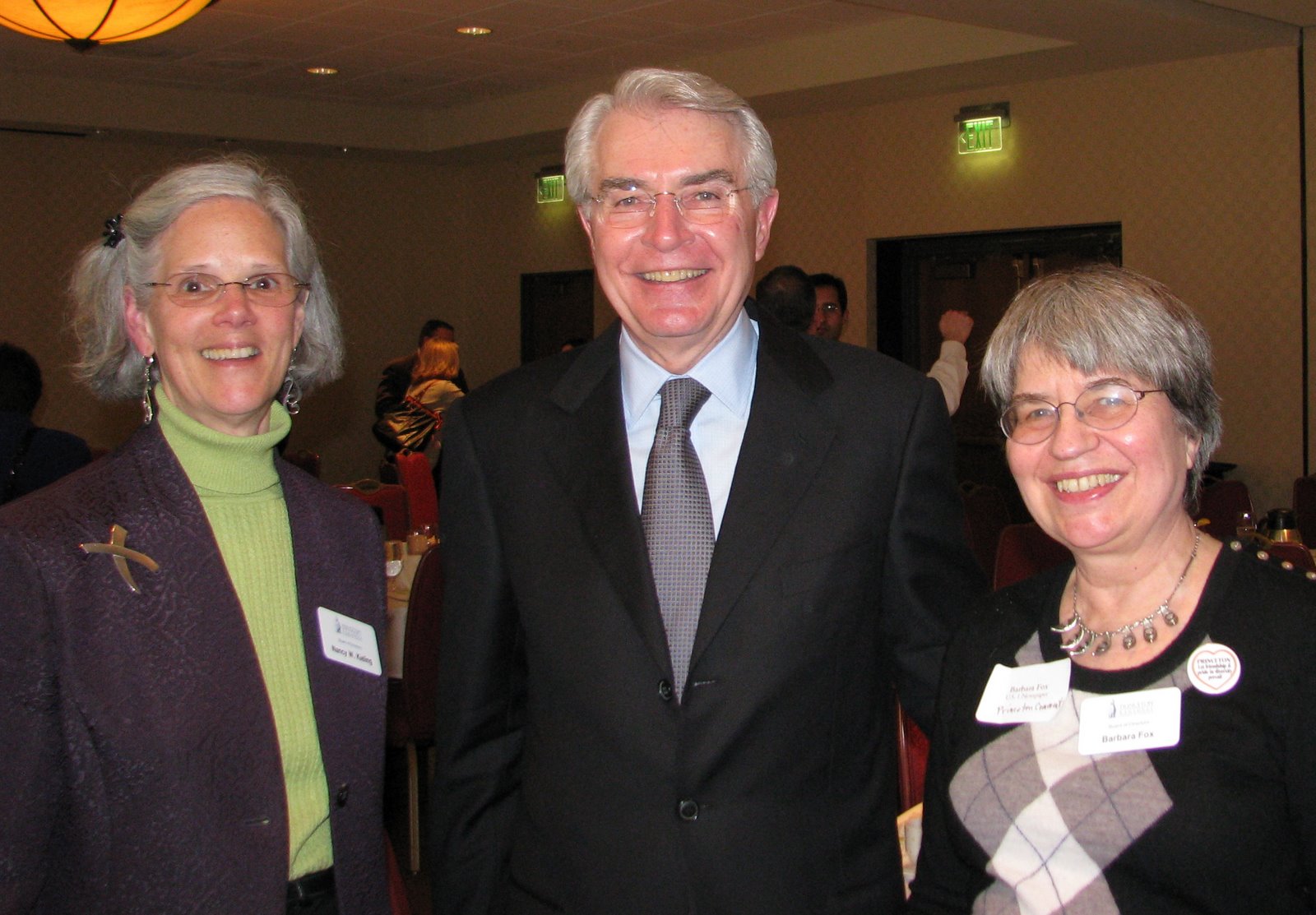
Full disclosure: I used to work for Richard Bilotti (shown above with me on the right and Nancy Kieling of the Princeton Area Community Foundation, left). Before I joined the staff of U.S. 1 Newspaper, I was a freelance dance writer for the Trenton Times from 1981 to 1986, and I remember when he changed the business model for nonprofit ads, offering free display ads on an as available basis. Part of his wonderful support for the arts was his championing of the Trenton Education Dance Institute,, a fabulous project that brings dance to public school children. I support his daily newspaper accomplishments.

But I had hoped to hear an answer for how to get the public to pay for what they are used to getting for free. U.S. 1 Newspaper changed the print paradigm when it offered a serious newspaper at no charge to readers. With one exception, Dow Jones, print newspapers are still offering their work online for free, and they are still figuring out how to monetize it.

“When people ask me about the future of newspapers, I tell them that the thick smoke is creating confusion, turmoil, and nervousness,” he said. Nor did he predict who would put food on the reporters’ tables while they are trying to monetize their blogs and websites.

“After all,” he said, “I am still looking through the big clouds of smoke without my instructor. After the printing press, there was confusion and chaos as the printing press owners change society. Confusion and chaos will reign in the information marketplace until we figure out what works. But something will work and money will be made. No one ever knows what will work until it works.”
Two for Entrepreneurs

Two Princeton University events on Thursday, April 2, are potentially useful to area entrepreneurs in Einstein’s Alley. One is on executive ethics, and the other is more like a game show, where the winning ideas walk away with $40,000.

David F. Eisner, CEO of The Markets.com, speaks on “A Jewish Perspective on Ethics in the Executive Suite” at 4:30 p.m. in the Lewis Library, Room 138, on Washington Road. David W. Miller, director of the Princeton University Faith & Work Initiative, moderates the free talk sponsored by the Center for the Study of Religion and the Center for Jewish Life.

Billed as a “single-source destination site for comprehensive and real-time equity capital markets information and research from leading global investment banks,” it has a portal that allows institutional clients to access the web-sites of member banks. A graduate of American University with a law degree from Boston University, Eisner has been CEO of The Markets LLC since it was founded in 2000 by 11 leading banks.

Over at the E-Quad, the Keller Center for Innovation in Engineering Education is holding it Winners Take All Evening, the 4th annual Innovation Forum. The Jumpstart NJ Angel Network offers a total of $40,000 in prize money to three companies at 6 p.m. on Thursday, Computer Science 104. After the three-minute presentation from each of 12 companies you can place your bets for which the judges will choose. Among the entrants (all from the university) are a multiple-people MRI scanner that can simultaneously scan more than one person for studying brain responses of inter-person communication and physical contact, a monetary system for online content trading, and an ultra efficient energy laser spectroscopic trace gas sensor for sensor networks and portable chemical analysis.

It is free, and so is the reception afterward

Who Cares — if it’s not Baryshnikov?


You wouldn’t find a better looking bunch of dancers than American Repertory Ballet’s, and Friday night, at the premiere of Graham Lustig’s 10th anniversary piece, they danced their hearts out. One of his newest dancers, Max Levy, “said” it all. Near the end of “Rhapsodia,” set to Rachmaninoff’s Rhapsody on a Theme of Paganini, is that familiar tune that puts rainbows in the sky. Levy, ingenuously boyish, turns to the audience with a jubilant grin, arms overhead, opening wide – it made my heart leap with joy.

Michael Crawford and Pedro Gamino also get to bless the finale with their pyrotechnics. We’ve seen these eight dancers invest the variations with all kinds of moods, but joy is the capstone.

Lustig is known for telling stories, and he found a unique way (I don’t use that word lightly) to give us a glimpse of hidden smidgens of a story. The dancers wore red (sequined pants for the men with stretch chiffon tops, the same chiffon for the women, but with two piece flared tunics). Graham used that stretchy fabric as a prop to add an extra emotional dimension to a movement. The women hold their tunics up and flirt behind them, or they saucily hold their skirts like aprons, or they stretch it into V patterns. At one point, to stormy music, they cover their faces, channeling Martha Graham. It’s not overstated, sometimes just a touch of collar or a hem, and you found yourself watching for it, the way you listen for the undertones in your friend’s voice.

The costume credits include Sarah Romagnoli, who also designed the fun pajama attire for Lustig’s opening romp, Stardust, set to Mozart’s piano variations of “Twinkle Twinkle.”

It was fun, and certainly a great piece for children, but after watching a bunch of adults pretending to be rambunctious children I was more than ready to see dancers acting like adults in Twyla Tharp’s’ “Baker’s Dozen.”

With me was my friend Mary, who had never seen anything like Tharp before, and of course she was astounded. Because we sat near the front (I’m usually in the balcony) I could see how Always On they were. Tharp’s work shimmers with presto details that look tossed off. These are gorgeous dancers, and Crawford, in particular, captured the easy elegance and the insouciance of Tharp’s style.

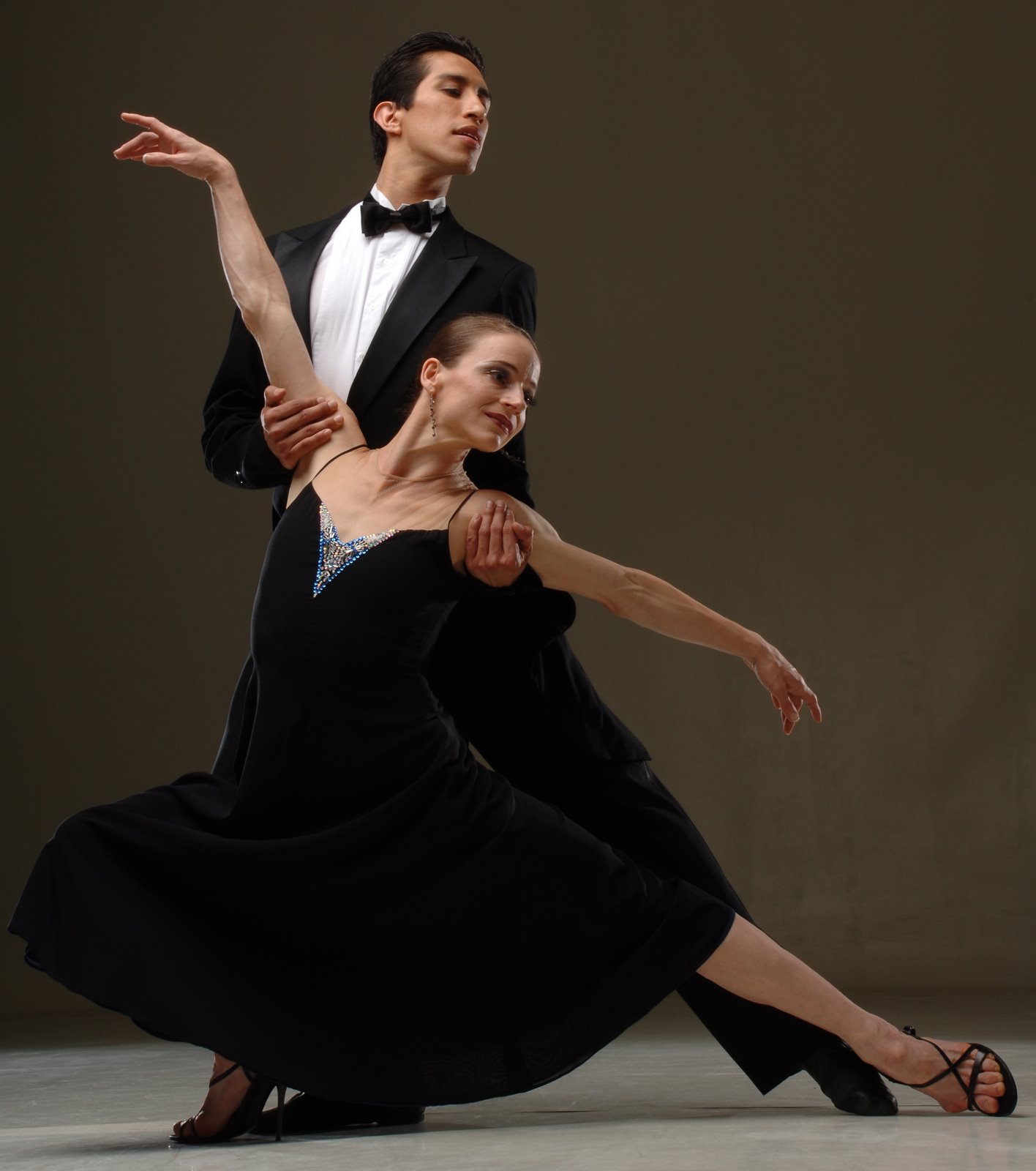
The perfect segue to dancing by Willie “the lion” Smith was Sinatra Suite (photo by Eduardo Patino). I am handicapped, when I see this wonderful duet, by having seen Baryshnikov do it. No matter who else is dancing, I spend the first half appreciating the woman (in this case the wonderful Jennifer Cavanaugh) and trying not to look at the man. By the end, Baryshnikov’s solo – difficult not so much for the obvious technique but for the inner pulse of the movement – I have almost forgiven the male dancer for not being Baryshnikov. But not quite.

On this night I was so glad to be with Mary, who in her day had filled her life with dancing, and who fell totally in love with Pedro Gamino. I imagined her imagining herself being whirled through the air by the glamorous Gamino as Sinatra crooned in their ear. I imagined myself being loved, and tossed, and knocked about. Goodbye Misha. I’m over you – almost.

ARB is performing at Stuart School, a wonderful new hall (both chapel and theater) with state of the art lighting and acoustics. This could be a wonderful new home for them. Start figuring out how to get there. Details on this performance – and on the two other dance concerts tonight (women choreographers at Rider, students at McCarter’s Berlind) are on the events calendar at http://www.princetoninfo.com. The front page lists “What’s going on tonight.”

Entering Into Dance — Again


Entrances, innovative, fun, dramatic, stud the student dance concert at Princeton University. for Pleiades, dances by seven senior certificate students, on Thursday at McCarter’s Berlind Theatre. It repeats Friday and Saturday at 8 p.m.
Tickets are $15, $10 for students and seniors, Call 609.258.9220 or 609.258.2787.

I love watching student choreography because it’s often very original and challengingly cerebral. For this concert Aimee Fullman and I went to the dress rehearsal because so much else is going on. American Repertory Ballet performs at Stuart School on Friday afternoon and evening and Saturday night, while a group of female choreographers present new work on Friday and Saturday at Rider University in the annual “I’ll Have What She’s Having” concert. Then a Jersey City troupe performs at Passage Theater in Trenton at 7 p.m. Whew!

I haven’t written on deadline in years, but here goes. Maybe I’ll get a chance to fix stuff, add details, or add links later. Other opinions welcome!

The first dancer we see, in red spangles and fishnet stockings, teeters on a tightrope in front of the closed curtain. Two more dancers tumble out from behind the curtain as it begins to rise. What an unforgettable entrance! “From the Tumult, Caravan Up” is by history major Elizabeth Schwall, set to a score by Sigur Ros.

The curtain continues to rise and a total of nine dancers tensely try to keep their balance to incessant thrumming. Each is alone in a space. Then they begin to veer from one side to the other, sometimes grabbing for a rope that hangs, puzzlingly, from the rafters, progressively gaining confidence. At the end, they have coalesced as a group.

In “Gradient,” yellow-clad Julie Rubingenters stage left and fixes the audience with her gaze. She dances. Caught up in emotion she lunges toward the audience, downstage left, arms extended, stare fierce. With passion, she scans the horizon, then turns aside, and takes her gaze back. Face turned away, she exits stage right, the converse of her entrance.

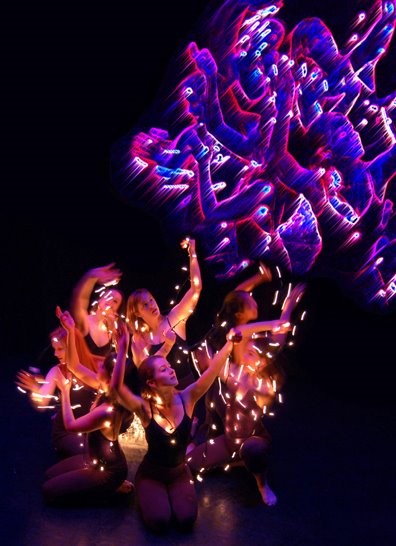
In the middle of Jennie Scholick’s “For One to See the Other,” (co-choreographed with Kelsey Berry to a dreamy George Winston melody) the stage goes dark. The two dancers, who have been moving alongside each other but separately, entwine each other with a string of white lights in the darkness. Back to normal lighting, the lights replaced, the pair resumes. They seem freer which each other. Often they have been seated, one with her arms around the other. Now they thump each other into that pattern, then relax back into it. It’s as if “I know you now, it’s OK to have a conflict.” It was sweet, human, lyrical, inventive.

The rest of the program promises to be equally inventive. Sadly, I could only see the first half. Also presenting are Sarah Outhwaite, whose solo “Signal and Noise,” to a score using text and sound sent from Cambodia by Vince di Mura, presents a theoretical problem. According to a release, “does a voice sent in pieces from the opposite side of the earth make the living body who receives it more or less alone? “

In computer science major Stephanie Chen’s solo, says the release, “wireless accelerometers attached to the dancer interface with a computer that processes data about the dancer’s motion and renders graphics based on her efforts.” Chelsea Kolff, an ecology and evolutionary biology major, explores “the myriad of movement qualities seen in nature and the forces of the underwater world: each movement requires specificity and efficiency that is tailored to the evolutionary purpose and behaviors of each creature.” Kolff had spent the summer observing bottlenose dolphins at the National Aquarium in Baltimore

The entrance that is just before the intermission is a delightful surprise. Amy LaViers trumped the evening, for me, with her juxtaposition of dance with her academic studies of human movement and dance; she is an engineering major.

We’d been chitchatting with students in front of us in between numbers. Then came LaViers’ stunning solo, done last night in silence, though it was supposed to be jazz improve on a traditional Nigerian hymn. (Turns out the composer, Vince di Mura and his son Dre’ were en route from Thailand.)

LaViers started on a long diagonal, calm, then progressed to deeper levels of emotion, economical with her material. Memorable was her fending off movement. As she walked forward on a straight line, her elbows close, she would jerk her head and forearm to one side, then the other.

Suddenly the students in front of us jumped up and walked down, onto the stage, taking LaViers movement themes into their bodies. It was a peak moment for me. So many times, when watching a dance concert, I imagine myself joining the dance. “I can do that,” I would say to myself, knowing that – no, sorry, I might try to do that, but it wouldn’t look as good.” Now these non-dancers in mufti, just like me, are my avatars.

First on the dress rehearsal program (last on the program) is the only faculty choreography, danced by students, Rebecca Lazier’s “Vanish,” The Brentano String Quartet played the Schoenberg score. I found it difficult listen to, right off the bat. but exciting to watch. With one dancer on stage at curtain, the other dancers hurtled onto the stage from the wings, fairly bubbling with angst. Then came that fabulous moment that I wait for in Schoenberg, a haunting graceful melody, mirrored by lyrical legato movement. It’s like hitting yourself on the head, it’s so nice when you stop, and it so exemplifies the stresses and delights of one’s harried schedule.

On first viewing, the dance seemed to be too long. The dance could have ended several times, but the music kept going. But Lazier had a wealth of movement material, and it was indeed satisfying to see each theme come round again. At the end, I got the feeling of resolution that I get when a work is masterfully choreographed. And the students danced it gorgeously.

This is the weekend to see dance! You still have three nights left.

Purloined Paper Records: the solution is digital

Today’s Times of Trenton tells about the theft of children’s medical records, how it sent the mother into a panic when they were taken from her car in the driveway. She had carefully catalogued each and every doctor visit for 15 years, and now her records are gone. She is particularly concerned because her children have a disability, and her careful record keeping functioned as her lifeline to helping them “be all that they could be.”

This story is another opportunity for me to advocate for online digital health records. Anyone who uses one of these services will never lose their records, and the records can be called up in any doctor’s office or emergency room, as well as at home.

My interest was triggered by an article I did about Zweena, a Princeton-based pioneer in this area, and I also follow an epatients blog.

Online medical record storage will be jumpstarted by the switch from paper to digital. At a recent doctors’ visit, I saw the physician in a formerly paper-bound office meticulously typing in his notes into a laptop. It’s more work for him and i must have taken untold hours for this 20-doctor practice to convert from paper to computers. Before, the doctor could just dictate his notes. But it was a doctor’s bad handwriting that almost gave my husband the wrong prescription in the hospital. The pharmacy misread his script. Only my notes saved the wrong solution from being administered. If he had had to type in that prescription, this mistake might not have happened.

Alas, it will be another generation of doctors until they are all totally comfortable on the keyboard.

Genentech IT Exec: Remaking the Future

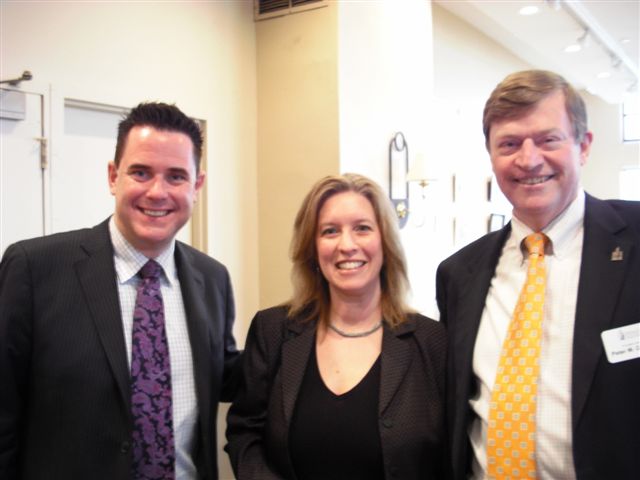
As we look at challenges that face the world, technology is going to play a crucial role, said Todd Pierce, speaking this morning at the Nassau Club for the Princeton Chamber. (Photo: Pierce, far left, with Marion Reinson and Peter Crowley of the chamber.) At least until Genentech’s buyout by Roche goes through, Pierce is vice president of corporate information technology at Genentech, known for being the founder of the modern biotechnology industry. He congratulated those present for their commitment to making their community a better place.

“Genentech was founded in 1976, by somebody who was unemployed,” said Pierce. He pointed out that, with the unemployment rate so high, the future could be created by someone who is now unemployed.

How it happened: Bob Swanson, who had been working for a venture capital firm but was unemployed, was working every day, networking looking for the next opportunity when he came across the idea that recombinant DNA might be a business. “A scientist, Herbert Boyer, promised to see him for 10 minutes and that led to a few beers and starting the company. Kleiner Perkins made a $100,000 investment for 25 percent of the company that we expect will sell, soon, for $100 billion.”

“Changing the practice of medicine began with Genentech’s substitute for human insulin, which had to come from the pancreas of cows and pigs. To help 700 diabetics required the slaughter of 26,000 animals. To supply US patients required 56 million animals. Two other organizations were competing. They worked day and night, but in three years we licensed it to Lilly. It took 14 years from idea to realization, a typical timeline for new drugs.”

“Now we are most known for being the Number 1 cancer fighting company. This week at Nature magazine, our scientists published a seminal theory for the cause of Alzheimer’s. We could change the course of Alzheimer’s disease.”

“I love doing IT at a technology company because every idea I have is challenged, yet it is integral to any business function. In fact 10 percent of Genentech employees are in IT,” said Pierce who then listed five factors that helped IT contribute to Genentech’s success.

1. Innovation and efficiency go hand in hand. “We realized we could not continue to be innovative if we were not incredibly efficient. For instance, we have 95 new molecules to bring to market over 6 years without growing the company. Yet IT can make things harder–for instance, with the switch to online ordering of supplies. Whatever we introduce has to make things easier.“

2. Combine urgency with originality. Pierce managed to gets his hands on enough early copies of the iPhone to do a pilot study to figure out if it was a toy or business tool for collaboration and sharing. “We had them within a week at Genentech.That is how urgency plays out. The iPhone made people respond very very quickly. It cut down the latency of decision making and information sharing. We can reach people anywhere any time. Now 80 percent of our workforce is mobile enabled.”

3. You can’t avoid failure if you want to be creative. .We have a passionate commitment to Single Decision Makers versus committee decisions, which promote a play it safe mentality. and Death by Power Point. Example, Avastin, a revolutionary cancer therapy. The marketing people, acting by committee, killed it because they didn’t want to have to sell a drug that costs more than $2,000 a year… Had we gone with that, cancer therapy would be different today. Now it is the only drug that keeps colon cancer patients alive. A scientist objected and the CEO reversed the decision.”

Example: Google’s “cloud computing,” a whole new way of buying services. I was the single decision maker.” The firm has moved 95 percent of its work to the Internet, device independent, and has 16,000 people around the world collaborating through Google.
Example: improvement of wireless connectivity. Genentech’s building is all wireless. “A revolution will happen in the next two years. After the switch to digital TV, that ‘beachfront’ (amazingly beautiful) bandwidth The speeds that you have at home will now be accessible through mobile devices, and having it in the cloud will allow you to share that information much easier. Now over 5 million businesses are on Google. We didn’t let the risk of failure keep us from doing it.”

4. New ideas often don’t look like good ideas. The iPhones, at the beginning, could be bought only by individuals. We were working with AT&T; to change the business model. Same thing with Google. We partnered with Google, saying that the tools for managing meetings were not good enough. We would meet them on Friday and Tuesday we would have a solution. We moved 2.5 million meeting appointments when we converted our calendar to Google. In the average month, the average manager at Genentech has 123 meetings per month.

That’s another major trend in cloud computing. Most major organizations take a long time to move from one to the next – we just retired Windows 2000. It is a cumbersome change. But when you move to the cloud, it just – changes! It requires a different mindset because you come in Monday morning and your calendar looks different and on Tuesday it was taken away. If Monday didn’t work out well, they roll it back. Then it appears again the following Tuesday. In just one month in Google we had over 139 improvements, all that we had asked for. If I were to call Oracle or Microsoft, it would take years, as opposed to weeks. If it can make work cheaper, easier, or faster, we want it.

The iPhone now has 25,000 applications, zero written by Apple. Apple built the platform that small business can use, reach 17 million people, they keep 30 percent, and they don’t charge to deliver the app. Soon there will be an application to monitor your blood sugar on the iPhone. The level of creativity is a major trend in IT.

In Google maps, some countries don’t have street directions, but end users can define maps. In Islamabad, Google allowed end users to define the streets. Trend: collective action creates whole new levels of value. In California, local PBS station used Google maps to locate where the fires were, and millions of people could contribute, and everyone, including the fire fighters, could use the info to plan escape routes.


5. The future is created by people that see opportunity and make it happen.
Islamabad. They saw the need and made it happen. California forest fires. They made it happen. At Genentech, we saw the opportunity to form a company and change the practice of medicine. The future of technology IS business. Without it, we won’t be able to address the challenges that we face. We have the urgency. We are willing to fail. We can support the creativity to make it happen. I firmly believe that nothing of significance can happen by people who want to take risk. We will live or die by innovating. We have no back up plan. In pharma, if you don’t innovate, you don’t survive. That excites me. We want to be forced to innovate. We see cancer as the competition. We want to always be first. Until we have cured cancer, we’re not done. Until we have cured Alzheimer’s we’re not done.”


In answer to a question about whether the Roche buyout will kill the goose that laid the golden egg, Pierce said, “We’re the geese. We are in charge of our eggs. Roche would need to give us food but just because we are not listed on the NYSE, our commitment to our mission goes way beyond who owns the stock
.”

Economic Summit: Plans B and C


Herb Taylor, of the Federal Reserve Bank of Philadelphia, gave the bad news.
The loss in household wealth is on the order of $10 trillion. It’s as if the market took a year of income and made it evaporate.

He keynoted the Mercer County Economic Summit Program this afternoon.

The four hour event, staged by the Princeton Regional Chamber and attended by 250 people, also had two breakout sessions, including one on hot topics in energy management and a workshop on Thinking Outside the Box.

Full disclosure, I’m on the Princeton chamber board, but I thought this event was a great success, even at a $60 price tag. Lots of info, lots of networking. Perhaps the best advice came from Jerry Fennelly including “figure out what you weren’t doing that you can do now.”

I’m doing a “quick and dirty” post from this event, using the wireless connection from Mercer County Community College’s conference center. It’s a first for me to do this — to take notes at an event and post them immediately, without fancy links (to the U.S. 1 Newspaper article, though I might add that later) or photos (possibly added tonight), not even well spell checked. Corrections welcome. But this is the new world. As Jerry says, it’s the George Costanza principle. Do the opposite of what you are doing. And I don’t even have time to Google to see who is George Costanza…

It’s 6 o’clock. Time for the event to be over though the “the band’s still playing..”

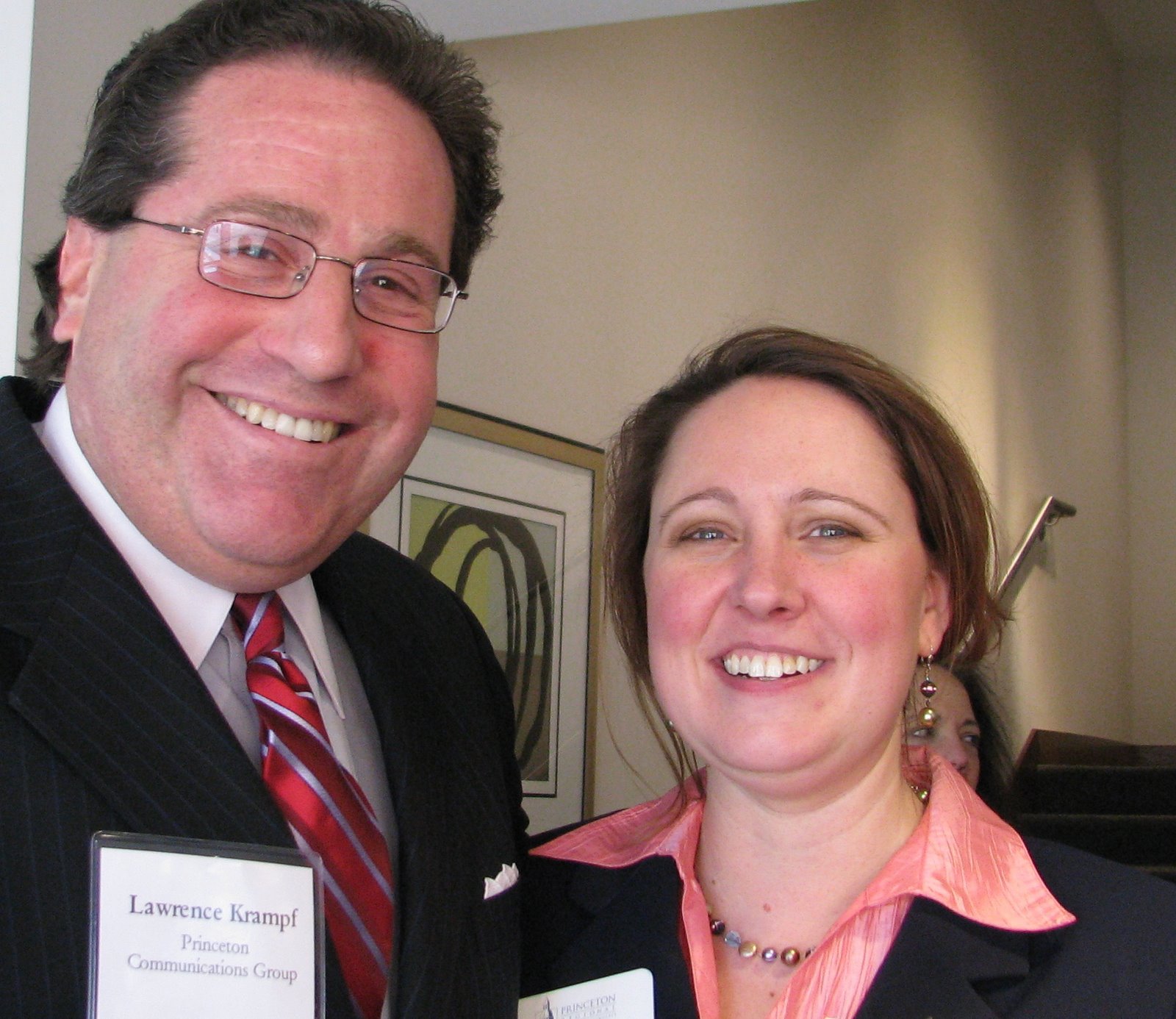
Pictured: Larry Krampf, president of the chamber board, with Cheri Durst of the chamber staff.

Einstein’s Alley Spotlight

John Romanowich, one of Princeton’s most successful entrepreneurs, held court this morning in the name of Einstein’s Alley. More than three dozen people – officials and well-wishers gathered at his place on Alexander Road to take formal note of the fact that his company, SightLogix, is doing well and for good reason.

Romanowich credits his success, in large part, to the availability of world class talent for video innovation, derived from such giants as AT&T; Bell Labs, IBM, Intel, and the Sarnoff Corporation. It doesn’t hurt that state government, in the person of Caren Franzini and the New Jersey Economic Development Authority, has backed up private investors and the federal government, as championed by Rep. Rush Holt, to fund the firm

The company’s recent contracts include major perimeter security deployments in the Middle East, contracts with NJ Transit, Port Authority of NY & NJ, Lockheed Martin, and several national air and seaports. It also has new offices in London and Bangalore. Romanowich was also able to talk about finishing a large U.S. Dept. of Homeland Security contract that places rapid-response surveillance equipment in the hands of first responders across the nation.

Romanowich has co-founded an ad hoc support group for high tech entrepreneurs in the Einstein’s Alley area, loosely defined as central New Jersey. But it is the official Einstein’s Alley group, led by Katherine Kish and Lou Wagman, that invokes the Albert connection to actively market the five-county area as The Place for high-tech technology firms to settle and/or to expand.

Pictured, left to right: James Hahn, Chairman/Founder SightLogix, Katherine Kish, Co-Executive Director Einstein’s Alley, Eric Heller, Marketing Director SightLogix, John Romanowich, President/CEO/Founder SightLogix, Lou Wagman, Co-Executive Director Einstein’s Alley.

Rail Travel: Making Friends of Strangers


My husband chuckled as he handed me the travel cover of Sunday’s New York Times, knowing that Andy Isaacson’s story, “Riding the Rails,” would be dear to my heart. My late mother, Rosalie Yerkes Figge, loved loved loved riding the train. Every summer she and her mother would take the train from Philadelphia to Henderson, North Carolina, to visit her Harris and Hicks relatives, and, an avid traveler until the year before her death at 96, she trained everywhere possible. Returning with her from a family vacation in Orlando (she was 92 at the time) I was amazed at how she could predict when the train would slow, passing whistle stop towns, so she could edge her ponderous way into the dining car.

So I’ve been badgering my husband for years, “Let’s take a cross country railroad vacation,” and he has resisted for years. We’ve put our toe in the water by taking rail trips to Richmond and Durham, but no overnights comparable to when we trained to Montreal for the 1967 World Expo, our last child-free fling before we were to have our second child. Because I was 7 1/2 months pregnant, I couldn’t go by air (I’m no Sarah Palin), and the sleeper enabled me to travel horizontally.

And I did go off on my own train trip last spring, to celebrate my not-working-full-time status, taking the train from Princeton to Cleveland and continuing by Amtrak bus to Detroit. What I thought would be a pleasant adventure turned out to be a pleasant though harrowing adventure, which I wrote about for U.S. 1 Newspaper.

Isaacson has a talent for description (“In dawn’s light, the train streaked across the Great Basin Desert, blurring the view of tufted yellow shrubs flanking the rails but framing the white dusted, mineral-stained mountains beyond in an unfolding panorama…”) and in the microcosm of his four-day journey he conveyed the macro picture of America’s railroad future. (I’m pinning my hopes for Amtrak on our rail-riding vice president). He also told honestly of his own harrowing time; en route to Chicago he froze when the heat went off in his roomette.

But he and I both came away with the same opinion, that traveling long distances by rail has its own special rewards, not least among them the opportunity to meet and get to know one’s fellow travelers, making friends of strangers. I’m still corresponding with the friend I made enroute to Cleveland.

And, as Isaacson notes, the slower pace, the “rocking cradle, and that hushing sound, choo-k-choo-k choo-k-choo-k –” can act as a “salve for our modern psyche.”

Beyond Cameron: School Spirit in Gotham


It was called the DukeIdea, held on Thursday, March 5, in New York. The hits were Gotham Hall, a seven-story elliptical ballroom with a gold leaf dome in the former Greenwich Savings Bank, the sumptuous food, and the people I met – including several with ties to Princeton.

If Judy Woodruff (of the McNeil Lehrer report) and John J. Harwood (of the New York Times and CNBC) ended up having to rehash the problems of the old media rather than stick to the previously announced topic (the new media), oh well. I had a fabulous time doing my buttonholing photographer thing, snapping shots of folks who looked interesting in order to have an excuse to find out who they were. (The photographs are online, and here is a good Harwood/Woodruff anecdote.) Our engaging ex-Yalie college president, Richard Brodhead, made everyone feel good about having attended – or paying for their children to attend – Duke.

The collation — mussels, carved roast beef morsels, and more kinds of appetizers than I’ve ever seen in one place, plus an open bar – was lavish. Guests had been asked to pay $25 for this shindig (less if you were a recent grad), but it must have cost quadruple that amount. Perhaps I should add an extra digit to my measly two-digit annual contribution.

Young grads and parents predominated, but there were lots of baby boomer alums, including my prize find, New York Times columnist Peter Appelbome, alumnus and parent. I located a couple of women from the Class of ’62 but searched vainly for anyone older than I.

Then I spotted an elderly gentleman near the door. Aha. I zeroed in with the small talk. He said wasn’t a Duke grad, but was a Princeton grad, so we talked about my home town and joked about how Princeton was the Duke of the North. Finally I realized I was speaking to Anthony Drexel “Tony” Duke, the trustee emeritus who, it had been announced, was in attendance.

That really made my evening, because I have a thing for Duke family history. I’ve written about Doris Duke and her father at Duke Farm in Somerville, and last fall Hawaii we made sure to visit her Shangri-La enclave.

Mr. Duke told how he had been recruited by Terry Sanford to the Duke board, and how much he loved the university and was proud to be a Duke and to be wearing a Blue Devil tie. Later I learned that he had founded his own charity, Boys and Girls Harbor, when he was just out of high school. In this original summer camp, for immigrant boys, the counselors were his friends and classmates — Senator Claiborne Pell, Mayor Robert Wagner, Bishop Paul Moore.

The other Princeton connection was Richard S. (Dick) Miller and his son. Russell grew up at my Methodist church, followed his older brother to Duke, and is now working in the city.

Near the very end of the evening, I did find a classmate whose name I recognized from the Class of ’61, Shelly Conklin Ostrowski, who also had been a reporter and writer. And I recruited a woman from the Class of ’07 to do admissions interviews. Not a bad investment for $25 plus a $7 senior citizen train ticket to Manhattan.

Speaking of investments, you couldn’t forget you were in a bank, a very grand bank, built in 1922 in Classical Revival style. The brass bars of the teller windows encircle the back rows of chairs, and the granite writing shelves still line the walls, studded with candles for this evening. Overhead, four cautionary sayings (epitaphs for a drowned economy, it might seem now) are carved in limestone, like commandments. Each is better than the next:

“It’s what we save rather than what we earn that insures a competence for the future.”
“Having little you cannot risk loss. Having much, you should the more carefully protect it.”
“Waste neither time nor money but use both for your own and your neighbor’s good.”

Washington Duke would approve.