Category Archives: Dance and the other arts

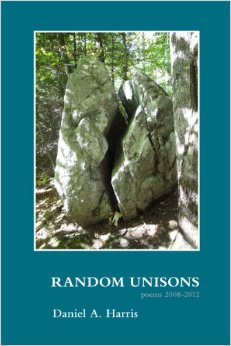
random unisons

Best of all, I like the way he tells stories. In “Random Unisons,” the poems of Daniel Harris have a beginning, a middle, and an end, and I’m always eager to find out how they end.

For instance, Class Project,

Imagine their surprise, those four second-grade children grouped
at a classroom table. With a little hand each one grips
the single, fat, foot-long pencil the teacher’s brought today for a project — its yellow shaft almost hid under fists.

At the end —
. . . the kids (grown up), their hands and wrists maybe interlocked
for a fireman’s carry, or other random unison.

Harris puts his writerly technique to saying things that are worth saying, like chronicling the poignant arc of a life. Dancer opens with

His day job? “It’s just blech,” he natters, crap
to pay for his nightlife: work at the barre,
taking class, my lines.” But his feet can’t skip
past his plod on the cold concrete at the store;

The poem follows the man’s performing career, but then his physical powers dwindle so at the end he is a teacher of the next young dancers:

Inheritors, his; from counter or desk
they come, tingling to practice arts of risk.

He talks of death, and love, and common things, like bees, as in Driving Home from Stockton, New Jersey:

All summer we see them: honeybees
under brightest suns toiling, well into dusk;
they scout, tinker with blooms of lavenders,
sunflower, mint — then bear the rich daubs
of nectar back to the common hive.
So too,
these long black nights, workers fix roadways,
in heavy black jackets striped with yellow…

My favorites are the poems of love. They allow a place for imagining.

Though I have heard of Daniel Harris, and his passion for social justice, we have never actually met — except through these poems. I recommend it for bedside table contemplation.

Buttons Help Quilts Tell Stories

Large 1 3/8 inch Bakelite carved Turtle $55 Left a turtle carved of Bakelite. These are online references for quilting talks

Every Button Has a Story: Buttons Help Quilts Tell Stories
Barbara Figge Fox and Jane Albanowski
New Jersey State Button Society
for Turtle Creek Quilters Quild
November 17, 2013

National Button Society: membership @$35 includes handbook and five journals per year.

New Jersey State Button Society:
Membership @$10 includes newsletters. Semiannual shows, open to the public, at the Union Fire Company building on Route 29 in Titusville on May 9, 2015 and September 12, 2015. 9 a.m. to 4 p.m., program at 1:30 p.m. Admission $2.

Central Jersey Buttoniers, lunches on third Mondays, in member’s homes. Contact Sonia Force, 908-782-5716 or SOJON@comcast.net

Button Country
website with many useful links
How to mount buttons: http://www.buttonsintime.com/howto.htm
How to classify different materials.

Ways to identify different materials

Basics of Button Collecting: Pam Vasilow

Button Button: Identification and price guide, Peggy Osborne (print book)

Field Guide to Buttons and Antique Glass http://www.grandmothersbuttons.com/blog/wp-content/uploads/2014/05/gran_fieldguide_web2011.pdf

Contacts for info about membership:
President: Sara Mulford, 205 Lafayette Drive, Logan Township, NJ 08085-1426
 slmulford@verizon.net; 856-275-6945
Northern, NJ: Gloria Chazin 908-889-8970
Ocean & Monmouth County:
Lil Buirkle 732-793-4555
Hunterdon & Mercer County:
Carol Meszaros 609-737-3555
DUES: Send $10 check made out to the New Jersey State Button Society c/o Ann Wilson, Treasurer, Box 92, Maplewood, NJ 07040

Charles Dickens on buttons:

“There is surely something charming in seeing the smallest things done so thoroughly, as if to remind the careless, that whatever is worth doing at all is worth doing well. . . It is wonderful, is it not? that on that small pivot turns the fortune of such multitudes of men, women, and children, in so many parts of the world; that such industry, and so many fine faculties, should be brought out and exercised by so small a thing as the Button.” Household Matters . 1852

JohnSymonsNotQuiteStillLifeThis great photo, entitled “Not Quite Still,” by my U.S. 1 cohort John Symons, makes me want to revist Grounds for Sculpture. It is in a photography exhibit juried by Michael Mancuso, photographer extraordinaire, with whom I used to work at the Trenton TImes (when it was the Trenton Times, not the re-jiggered “Times of Trenton.) Mancuso is still there. The exhibit at Mercer County Community College opens with a reception on November 20.

Jazz for Congo Charities

karrin AllisonThe Democratic Republic of Congo is one of the worst places in the world to be a woman. But as peace talks begin there, a concert in Princeton offers a glimmer of hope to women in the DRC. Karrin Allyson, a Grammy award-nominated artist, presents jazz ranging from John Coltrane to Elton John in “A Song for Congo” on Thursday, November 14, at 7 p.m. The concert, which takes place at a private Princeton clubhouse, benefits charities in the DRC, including Women, Cradle of Abundance, and UFAR, United Front Against Riverblindness. Refreshments will be served. Tickets are $60, $30 for students, and $250 for sponsors and may be reserved at http://www.womancradleofabundance.org/getinvolved.

Based in the capital city of Kinshasa, Woman, Cradle of Abundance provides a community where women gather to share their stories and envision breaking the cycle of poverty and violence. Founded in 1999 by an ecumenical group of Congolese women. it supports a sewing school where girls learn a marketable trade, enabling them to earn a living wage, support a family, and educate their children. Other projects include education in reading and writing as well as economic literacy, micro-finance opportunities for women, school uniforms and tuition fees for destitute children. medical care and support for women and children living with HIV / AIDS, and counseling for survivors of rape and forced prostitution.

Founded by Lawrenceville resident Daniel Shungu, UFAR is the African-inspired, nonprofit charitable organization that aims – in partnership with other organizations — to eradicate onchocerciasis, a major public health problem in the Democratic Republic of Congo (DRC). Though the medicine for riverblindness is provided free by Merck & Co., distributing it to remote villages costs 58 cents per person per year for 10 years. One-third of the 60 million people in that country are at risk for getting riverblindness, which starts with a rash and leads to sight loss, forcing children to leave school to care for parents.

It’s a rare opportunity to hear the Karrin Allyson, whose latest album, Yuletide Hideway, was just released. The New York Times said she was “a complete artist — one of the jazz world’s finest.”

If you are concerned about excess (the excessive proliferation of goods in Western society)

If you like to discuss and participate actively in the creation of a piece of art —

come to the Princeton University School of Architecture between November 20 and 24 for a contemporary salon, “This Situation,” staged by art/dance/aesthetics rebel Tino Sehgal.

What constitutes a work of art? the art experience? For Sehgal, quoting the press release, it entails a direct engagement, in the here and now, between visitors and players in carefully choreographed situations. The visitor is conceived as a fundamental part of the work and may, if he/ she chooses to participate, dramatically alter its unfolding.


Making Music and Money

Just off Alexander Road, escaping most notice, is a prosperous commodities hedge fund, Caxton, founded in 1983. I thought of it when reading “Is Music the Key to Success” in the arts section of the New York Times, yet another tribute to how music lessons seem to promote intelligence. Caxton’s co-founder, Bruce Kovner, was quoted on the importance of music to developing mental acuity.

I’ve never interviewed Kovner, though I have followed the progress of Caxton with eagerness and amazement. Such hedge funds are like a forbidden mystery to me. How do they make so much money so quickly?

His name came up in the pages of U.S. 1 on March 8, 2006, when he donated his valuable music manuscript collection to Juilliard. It was a paparazzi-like opportunity to summarize his biography, excerpted from a book. He had been hired by Helmut Weymar to be a trader at Commodities Corporation but had moved to Manhattan after founding the firm. But U.S. 1 Newspaper doesn’t care where you live, only where the business is located.

The link to the U.S. 1 article is here but, since the story is way down on the page, here is the gist of the Kovner part.

excerpt from U.S. 1:

. . .As a collector of rare books and manuscripts, Kovner named his company after the English printer. It grew from incubator space at Commodities Corp. on Mount Lucas Road to its own quarters on Morgan Lane and Enterprise Drive before moving to Alexander Road.

As told by Jack Schwager in his “Market Wizards” book, Kovner was a harpsichord-playing taxi driver when he began trading commodities in 1977 by borrowing $3,000 on his credit card. He did have a blue collar background, but he also graduated cum laude from Harvard (Class of 1966), pursued a PhD at Harvard, managed political campaigns (thinking he might eventually be a candidate himself), hobnobbed with such celebrities as Henry Kissinger and Pat Moynihan, and served as consultant for various government agencies.

Kovner joined Commodities Corp. in 1977 and settled in Princeton with his wife, Sarah, a craftsperson who made violas; they have three children. He left in 1983 with $7.6 million to found his own company. According to the New York Times the family is living in New York on Fifth Avenue at 94th Street. Forbes magazine says Kovner is worth $2.5 billion, and with $10.8 billion under management last year, Caxton is the seventh largest hedge fund company.

Within three years the manuscripts will have their own climate-controlled room at Juilliard, which hopes to make some of them available on the Internet. Kovner is chairman of the board at Juilliard.

Note that these figures are from 2006. Kovner has relinquished the CEO’s job. I am still waiting for my excuse to interview Kovner.

In Princeton and DC: Old Girl Networks at Work

The WIBA Leadership Conference was a delightful success, and on an appropriate day, when Congressional women did an endrun around recalcitrant men to lead-broker a compromise.

From Time magazine:

It’s quite an irony that the U.S. Senate was once known for having the worst vestiges of a private men’s club: unspoken rules, hidden alliances, off-hours socializing and an ethic based at least as much on personal relationships as merit to get things done. That Senate—a fraternal paradise that worked despite all its obvious shortcomings—is long gone. And now the only place the old boys’ network seems to function anymore is among the four Republicans and 16 Democrats who happen to be women.

At the WIBA conference, woman after woman told of battling the old boy networks. “Women can’t direct theatre,” Emily Mann was told, yet McCarter hired her. She knew what she could do. Asked: “Did you ever think you would get a Tony? breathless pause expecting modest no”

Mann’s answer: YES.

I think the operative slogan is: “Never underestimate the power of … ”

Practice Your Way to a Nobel Prize

As the new Nobel winners are being announced, here’s a testimony from a previous one about the value of studying an instrument — to develop concentration.

Another Juliet! Another Romeo!

facetoface_Credit-George_Jones

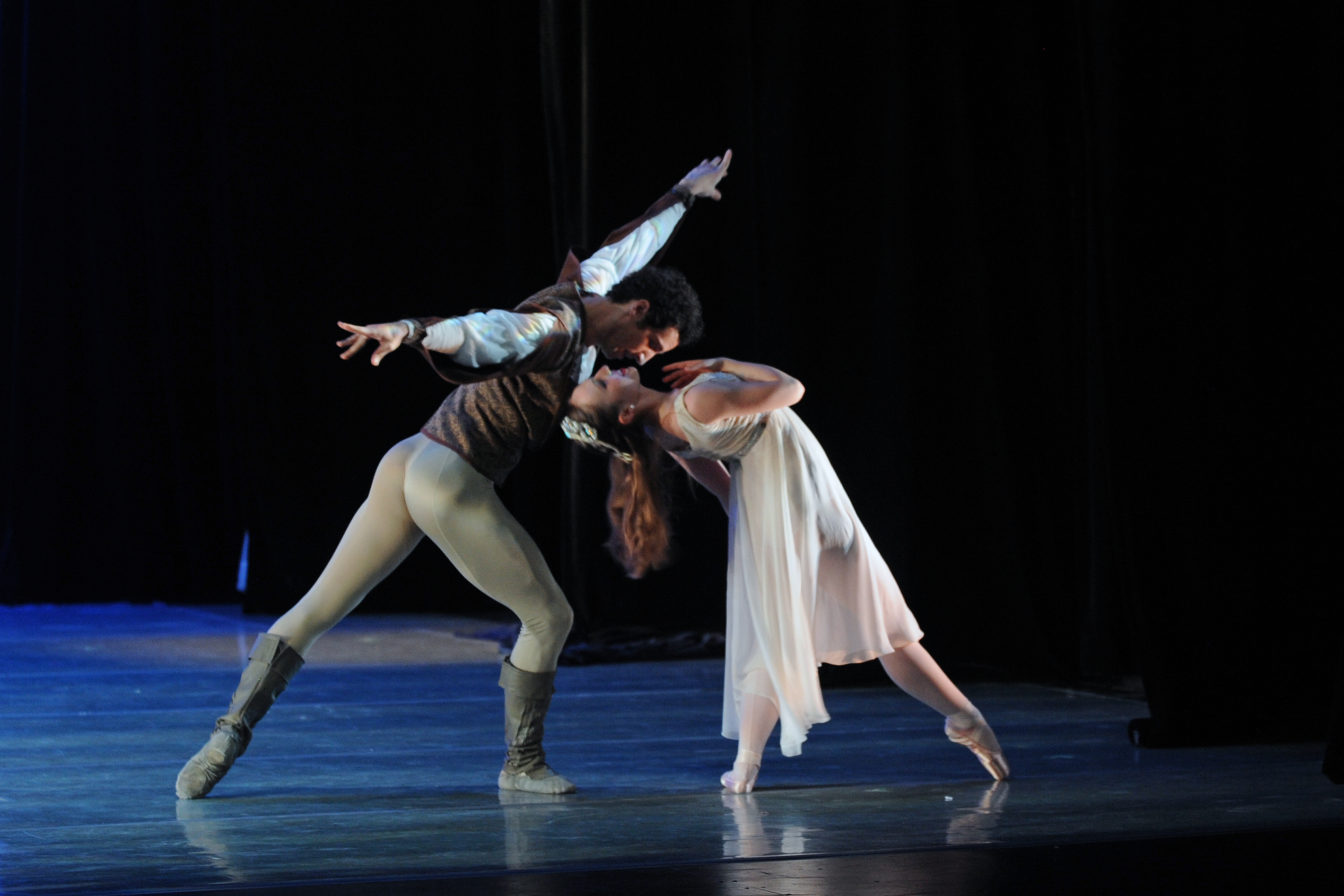
I’ve seen four versions of the ballet Romeo and Juliet — the Kenneth MacMillan choreography for American Ballet Theatre, the Cranko version for the Stuttgart, also on the Joffrey Ballet, Rudolph Nureyev’s for the Paris Opera Ballet, and Septime Webre’s choreography, now at Washington Ballet but originally for American Repertory Ballet. Nureyev and Webre are tied for my favorites so far, but I’m eager to see number five. American Repertory Ballet premieres Douglas Martin’s Romeo and Juliet on Friday, October 11, with orchestra. Here’s my article in this week’s U.S. 1

Photo:  Karen Leslie Moscato as Juliet and Mattia Pallozzi as Romeo ; Photo Credit: George Jones

Dancing the Gamut

RoS Chosen One Small

This post is to recommend seeing American Repertory Ballet at Rider’s Bart Luedeke theater on Saturday, September 21st (tonight, as you receive this). Tickets are $20 ($10 for seniors). We went on Friday. The company is in great shape and the program runs the gamut of emotions from romantic love to joyful camaraderie to tender affection, to despicable, ugly hate. Rarely do ballet dancers get to ‘do nasty’ as here.

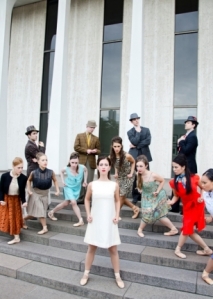
The piece was, you might guess, Stravinsky’s Rite of Spring, choreographed by company director Douglas Martin, who has danced quite a few Rites in his time. In the original Nijinsky version, recreated when Martin was with the Joffrey Ballet, staccato thrusts and poundings build up to the sexual sacrifice of a virgin. Martin’s serious satire was equally full of lust for sex and lust for power, but it was set in an office. Half the women were typists, half were “personal secretaries” verging on geishas, all undulating and preening. Cast as ‘ad men,’ the males mimed every macho cliche, including riding a horse, all pumped up and competing for power. I was tempted to giggle but I graduated from college in 1961 when women were expected to be secretaries not salesmen and it aggravated rather than amused. At the end of that section, in comes the boss from hell, Joshua Kurtzberg. The males kowtow and the female objects are flung around and tossed down.

angst_Credit-George_Jones_0

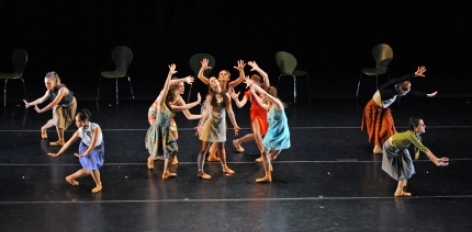
The Stravinsky score, you may remember, is pound/pound/pound/pound loud/loud/loud/loud, all sharp edges and staccato. Seated typists percuss with their toe shoes. Men jump with two feet. It’s similar to the angst in Nijinsky’s tribal version but — wait — now it’s not them, it’s US. WE are the ones in the competitive workplace, elbowing our way to the top or wishing we had the nerve to do that. We are the ones who say “It’s not enough to succeed, your cohorts have to fail.”

One ad man, Stephen Campanella, gets tossed to the side, and the staccato jubilation of deals made goes on. During the lengthy pianissimo, the choreographer takes up time and adds comic relief having the maintenance guy, Jacopo Jannelli, rearrange the chairs. Then it’s a restart of angst, this time with the “Chosen One,” Shaye Firer, on stage.
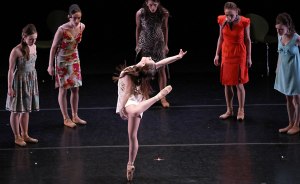
rite chosenone_Credit-Leighton_Chen

In the original, she would be a virgin headed for sacrifice. Here she is a rebellious woman turning against type to snatch male power, represented by a man’s jacket. Decide for yourself what the end means. Here are video excerpts.

It was strange to watch Samantha Gullace lead the nasty crew of vamping women, when just 20 minutes ago she had played a luminous Juliet to Edward Urwin’s tender Romeo. Only the pas de deux is on this mixed bill, and I look forward to the full length version on October 11 in New Brunswick, with orchestra.

In between the “hate” and the “love” was a bravura piece of baroque fluff, choreographed to Vivaldi by Martin’s wife and former dance partner, Mary Barton, titled “Five Men and a Concerto.” She challenged them with some very fast classical footwork. Campanella, Cameron Auble-Branigan, Alexander Dutko, Joshua Kurtzberg, and Marc St.Pierre met the challenge with brio. Barton tapped Campanella’s Gene Kelly-like ability to look like an average Joe while doing hard things with his feet, Dutko’s exceptional talent for legato phrasing and St. Pierre’s penchant for teasing humor. A delight.

After the opener, Patrick Corbin’s “Caress,” I found out at intermission why it seemed so “all of a piece.” Set to Schubertian piano music by Kate Jewel, it uses three basic movements from a postmodern technique called Contact Improvisation, in which body contact is the cue for making up movement as you go along.

Without knowing that, this is a charming work, because one senses the spirit of Contact Improv — dancers pay close attention to each other instead of looking in the mirror or playing to the audience. Monica Giragosian and Urwin led Transformation Song, Samantha Gullace did the sharp-edged Storm; Alice Cao and Auble-Branigan were in Meditation, and Karen Leslie Moscato and Mattia Pallozzi ignited each other in Fire. Kurtzberg sinuously caressed the air in Amabile and had an interesting duo with Gullace with their four arms as one bird’s wings. Most memorable was the pair of same-sex duos, Dance with Me. Campanella and Dutko danced downstage left, Firer and Claire van Bever downstage right. first one couple moved, then the other. It answered the question, what does a love duet look like when there are two of each kind. The men were tender but not feminine. The women were female but strong. The piece ended with everyone on stage, in silence, with a last caress.

Please note: This is the new theatre at Rider, NOT the Yvonne Theatre. Above: photos of The Chosen One, in white, staged (credit Kyle Froman), and in performance, middle photo: George Jones. Third photo: Leighton Chen.