From attorney Hanan Isaacs, a review of the Ban the Box proposed law. As you may know, as a supporter of Not in Our Town and The New Jim Crow movement, I am in favor of it. It is called the Opportunity to Compete Act (A3837).
Category Archives: Around Town
McPhee Shines His Flashligiht: Stephen Ornes quotes the redoubtable John Mcphee in a December 6 blog post about how science writers can fashion their opening sentence. About how in a 2010 interview in the Paris Review McPhee says the right lead shines a flashlight into a dark well etc. etc.
McPhee has been using that metaphor for long time. I quoted him on it at least 20 years ago. It’s still about the best one around.

Christmas in Germany: On Friday, December 6 (it is St. Nikolaus Day) the Princeton German Teacher’s association and infi cafe’ offer an Adventssingen (Christmas caroling) session, with carols in French and Spanish as well as English and German.
If you’d like to recreate some old-world Christmas spirit, RSVP. Come at 6 p.m. and bring a plate of German Platzhen (any kind of cookies, nuts, or clementines) and a bottle of red wine to make Gluhwein (German mulled wine). Bratwurst and Brezeln will be available for purchase, and other drinks besides. But please RSVP to PrincetonGermanTeacher@gmail.com (609-356-2438).
Two years ago my husband and I returned to Nurnberg, where we had lived in the ’60s, and connected with our friends, Elise and Wilhelm. They took us to a village church, St. Johanis, for a carol service (pictured above). It warms my heart to think of it.
From Bejing, to Princeton — to Alcatraz. The zodiac animals of Chinese artist and political dissident Ai Weiwei enliven the plaza at the Woodrow Wilson School. Soon visitors to Alcatraz will see his art. As in today’s New York Times.
That’s the good arts news from Princeton today. The bad news is that the funds of the Triangle Club have been embezzled to the tune of more than $100,000. Robin Lord will be the attorney for the defense and this is one case I hope she doesn’t win.
Or is it good news that an arts organization could make that much money and it wasn’t missed?
Why is the White doll the good doll?
Why is the white doll the good doll? In a study of kindergarten children, both black children and white children chose the white doll as their favorite.
Blacks and whites alike have been programmed since birth to think that whites are better. Black children are taught to be aware of their behavior at all times, because of possible danger, while white kids have the privilege of just being kids.
Tonight (Monday, December 2, at 7:30 p.m.) I will join Debra Raines, Director of Mission Advancement at the Princeton YWCA, in facilitating another in the series of Continuing Conversations on Race and White Privilege at the Princeton Public Library.
Continuing Conversations on Race and White Privilege are a friendly, safe, confidential opportunity to share ideas and voice concerns. They are planned and facilitated by Not in Our Town Princeton and held on first Mondays, from October through May, in partnership with the Princeton Public Library.
We will consider the particular cases of two men and two women. The men: George Zimmerman (trigger happy and violent against both blacks and  women) and George Stinney (at left, 14, the youngest male executed in the 20th century). Also the case of Eleanor Bumpers (fatally shot in New York in 1984 during an attempted eviction) and Reneisha McBride (shot by a Detroit man when she knocked on his door in the middle of the night.)
 women) and George Stinney (at left, 14, the youngest male executed in the 20th century). Also the case of Eleanor Bumpers (fatally shot in New York in 1984 during an attempted eviction) and Reneisha McBride (shot by a Detroit man when she knocked on his door in the middle of the night.)
Then we will discuss what you THINK is helping
and what you think is HURTING. What is your role on either side?
All are invited — we meet in one of the conference rooms on the second floor, either the Princeton room or the board room.
(This post first appeared on the Not in Our Town Princeton blog).
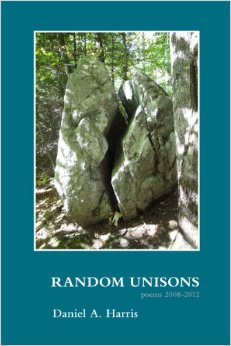
Best of all, I like the way he tells stories. In “Random Unisons,” the poems of Daniel Harris have a beginning, a middle, and an end, and I’m always eager to find out how they end.
For instance, Class Project,
Imagine their surprise, those four second-grade children grouped
at a classroom table. With a little hand each one grips
the single, fat, foot-long pencil the teacher’s brought today for a project — its yellow shaft almost hid under fists.
At the end —
. . . the kids (grown up), their hands and wrists maybe interlocked
for a fireman’s carry, or other random unison.
Harris puts his writerly technique to saying things that are worth saying, like chronicling the poignant arc of a life. Dancer opens with
His day job? “It’s just blech,” he natters, crap
to pay for his nightlife: work at the barre,
taking class, my lines.” But his feet can’t skip
past his plod on the cold concrete at the store;
The poem follows the man’s performing career, but then his physical powers dwindle so at the end he is a teacher of the next young dancers:
Inheritors, his; from counter or desk
they come, tingling to practice arts of risk.
He talks of death, and love, and common things, like bees, as in Driving Home from Stockton, New Jersey:
All summer we see them: honeybees
under brightest suns toiling, well into dusk;
they scout, tinker with blooms of lavenders,
sunflower, mint — then bear the rich daubs
of nectar back to the common hive.
So too,
these long black nights, workers fix roadways,
in heavy black jackets striped with yellow…
My favorites are the poems of love. They allow a place for imagining.
Though I have heard of Daniel Harris, and his passion for social justice, we have never actually met — except through these poems. I recommend it for bedside table contemplation.
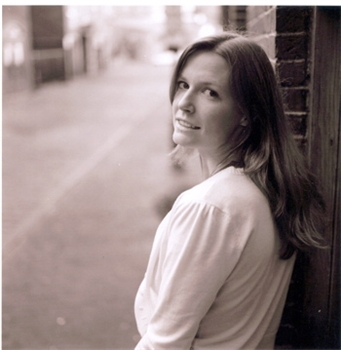
Singer songwriter Charlotte Kendrick is my new fave. You’ll find out why in a future issue of U.S. 1.
Take these sweet domestic lyrics to “Thank You”
I didn’t sleep that well, neither did you
But I’m the one who gets to take a nap
It never seems to balance out quite right
You pump the gas while I stay warm and read the map
I’m gonna love you when you’re 45
I’m gonna love you when you’re 93
Maybe by then I will be
As good to you as you have been to me
Or this one, from a song called Yellow.
Take a minute, take an easy step back
There’s no secret password, no code to crack
It’s not a race or a contest, but if you’re still keeping score
You will always have less, they will always have more
This Princeton-based singer has a website that links to a nine-song loop from her three albums. Good listening…
Bayard Rustin: The proof that one truly believes is in action.
Civil Rights historians know that John F. Kennedy was a latecomer to celebrating the March on Washington, and that Lyndon Johnson was the one who accomplished significant civil rights goals. They also know that Bayard Rustin was the unsung hero of the civil rights movement. Finally, now that he is going to receive a posthumous Medal of Freedom, Rustin is getting at least part of his due.
Princeton’s Ann Yasuhara tells how, on several posts at Not in Our Town Princeton.
Get the Facts on Obamacare

GET THE FACTS on the Affordable Health Care Act. The Princeton Human Services and Princeton Health Departments are staging a very useful workshop on how to sign up for healthcare coverage — Tuesday, November 26, at 6 p.m., free. Among the sponsors is Not in Our Town, which I work with.
Get your questions answered: Are you eligible? How do you apply? What documentation will you need? How to sign on to the website.
It’s not rocket science but it helps to get advice.
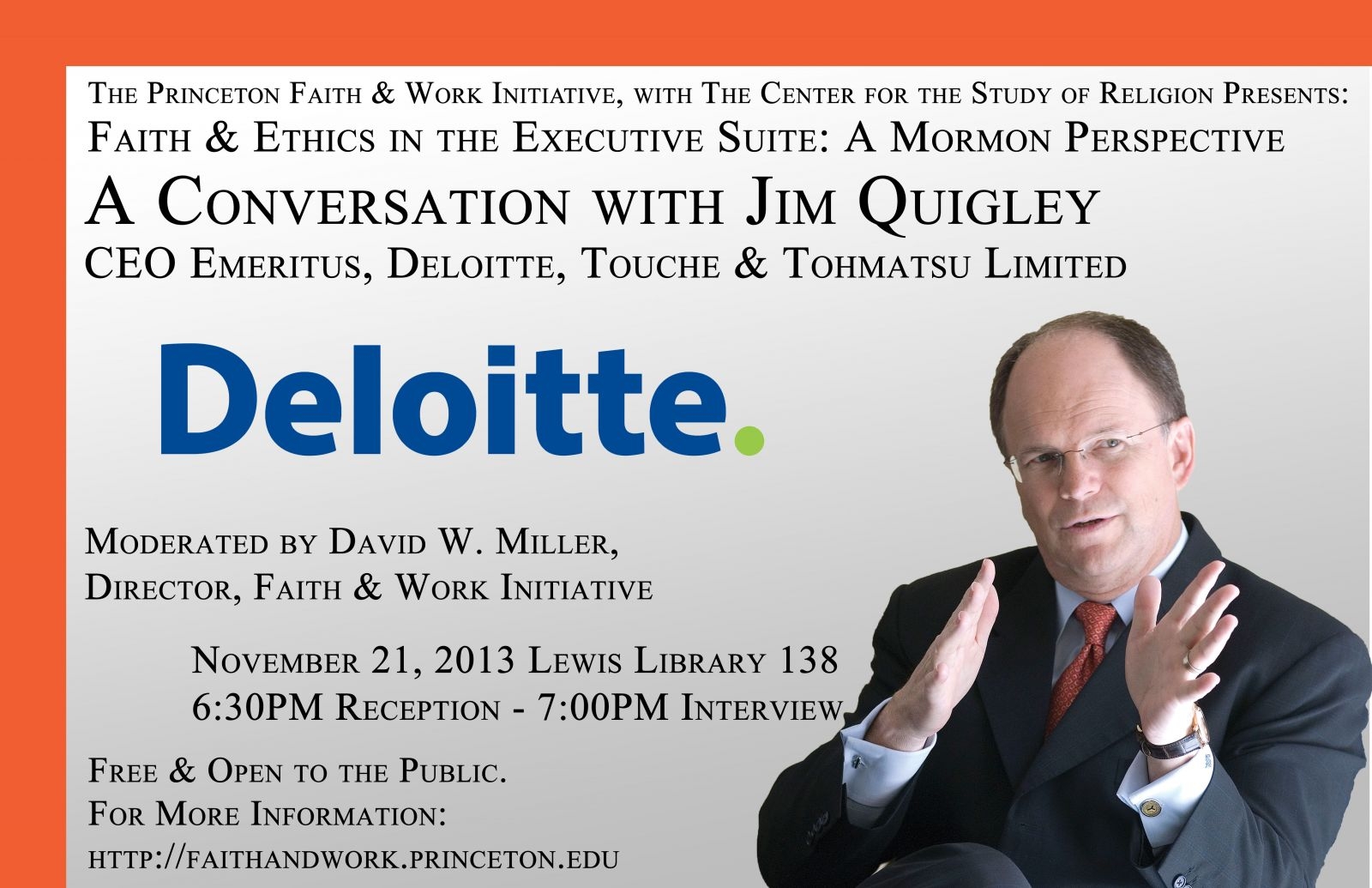
A Mormon in the corner office: Here is a press release about a free event sponsored by the Princeton University Faith & Work Initiative — a conversation with Jim Quigley, CEO Emeritus, Deloitte, Touche & Tohmatsu Limited, on November 21, 2013 at 7:00 pm, on the Princeton University campus in Lewis Library 138 (the modern building, near the intersection of Ivy Lane and Washington Road in Princeton). The event will be preceded by a reception from 6:30 – 7:00 pm.
Quigley will be interviewed by Prof. David W. Miller, Director of the Princeton University Faith & Work Initiative, on his Mormon perspective on business, leadership, and faith.
 Princeton Comment