Category Archives: Technology & Innovation

For all my techie friends — in the Einstein Alley groups, NJEN, the Keller Center, and the E-Quad — event notices, items from U.S. 1 Newspaper and the NYT

Nice Guys Can Finish First

Though I won’t be at the Alumni Day lunch on Saturday, February 23, I’ll be cheering “off site” for a church friend who is one of four to get the prestigious Porter Ogden Jacobus Fellowship. It’s the university’s top honor for graduate students, and my applause will be for George Young, who is finishing up his doctoral degree in the Department of Mechanical and Aerospace Engineering. He studies group dynamics in nature (such as the flying patterns of birds) to develop algorithms that can automate biologically inspired robots. 

George shares an office at the E-Quad with his wife, Elizabeth, who also had some recent good news. She has been offered a tenure track faculty position at Rhodes College in Tennessee. The Youngs were married at Princeton United Methodist Church and are both in the Handbell Choir. .

Elizabeth also contributes her talents as an oboe player to ensembles in PUMC worship services and to the Princeton University Orchestra. A National Science Foundation Graduate Fellow who works in the High Contrast Imaging Laboratory she studies advanced instrumentation and imaging analysis for the detection of earthlike planets in nearby solar systems.
Congratulations to them both, and to all four of the graduate fellowship winners. Interesting, isn’t it, that none of the four did their undergraduate degree in the United States. George, who grew up in Kalangadoo, Australia, went to the University of Adelaide. The other winners  went to college in Dublin, Paris, and Trieste.  
The awards luncheon ceremony will be streamed live  from Jadwin Gymnasium. 


Chris Kuenne: An Idea Is Not Enough

When you find one thing that you are passionate about, says Chris Kuenne, founder of Rosetta, explore it — academically or professionally. I talked to Kuenne for U.S. 1 last year, when he had just bought another firm and had 175 employees at American Metro and 725 people worldwide.

Just 10 weeks later he sold his digital agency to the giant conglomerate Publicis for $575 million. And no, he didn’t leak that. But it must have been in his mind. Ten years before he had evaded a Publicis takeover by buying out his division of another firm.

Read the U.S. 1 story to learn about his father, a Princeton University professor who died of Lou Gehrig’s disease. “He taught me that an idea is just not enough, you have to work it, develop it, and ultimately master it, for it to have relevance in the world,” said Kuenne then. Kuenne started out at Johnson and Johnson and got the idea of interactive marketing — working it, developing it, and mastering it.

Check out the short form of his bio on the Princeton Regional Chamber website. And sign up to hear Kuenne tell the secrets of entrepreneurial success at the Princeton Regional Chamber lunch on Thursday, November 3. His topic: “Marketing with Personality: Identify & Understand What Drives Consumers to Buy Your Product.” He has an amazing story.

The Next Generation — At NJEN

It’s gotten to be an annual event, for Princeton University’s Friend Center to co-host NJEN’s poster session.

Here is an account of last year’s and yet another post on it Notice that last year much was made of how the New Jersey Commission on Science and Technology could help tech businesses. Now the NJCST is no more and some of its portfolio has been taken over by the NJEDA, as explained this year by the NJEDA’s Mike Wiley, a former Marine who is using his skills and determination to foster business in New Jersey.

Wiley announced today’s launch of Choose NJ, a $7 million public private partnership headed by PSE&G;’s Dennis Bone, It sets up meetings of current NJ CEOs with CEOs of companies that might move to the state. Wiley pointed to the availability of Lt. Gov. Kim Gaudagno, who gives out her cell phone number to business groups, and he gave out his own phone numbers and email (mwiley@njeda.com). Two state funds provide investment capital. The Edison Innovation fund has $25 million in investment capital and partners with 8 venture capital funds. The Clean Energy Manufacturing Fund has $11 million in four companies, including Princeton Power systems. Wiley also said that the tax loss program, expansion incentives, and retention incentives are are still in place. The NJEDA funded three companies founded by Princeton undergraduates and recent graduates: Princeton Power Systems, StairClimb, and Terracycle.

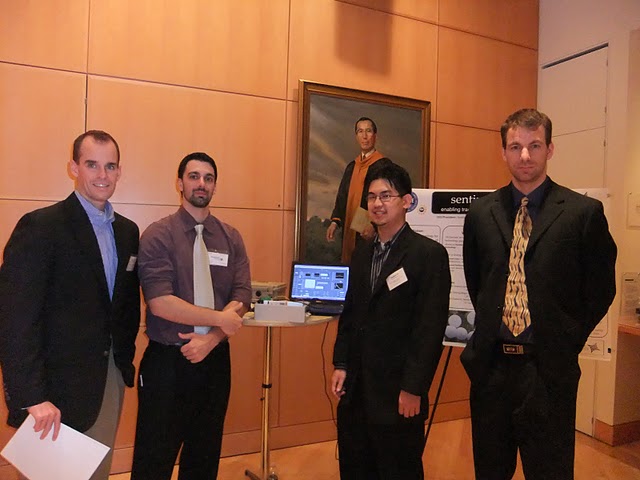
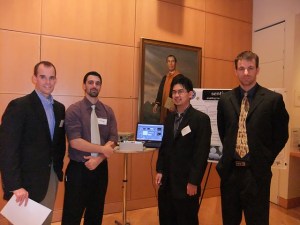
Sensor technology was prominent last year, as it is again this year. Richard B. Miles has a new kind of detector which could replace explosive-sniffing dogs. Two from Princeton University (post doc Stephen So and master’s candidate Jon Bruno) are working along with David Thomas on a promising new firm, Sentinel Photonics. It has a cheaper, more effective, lower maintenance way to sense air particles. Pictured: Mike Wiley of EDA, David Thomazy, Stephen So, and Jon Bruno, all of Sentinel Photonics.

Last year Ekua Bentil represented a solar firm that is testing its product in Ghana, and this year Eden Full of Roseicollis Technologies offers a solution for rotating solar panels that could work. She says she has been tinkering with her idea since she was nine, and she is all over YouTube with her animated account of hoping to found a nonprofit to help those in third world countries.

Steven Gifis represented another solar company, Amelio Solar founded by renowned solar tech pioneer Zoltan Kiss.

I also met Marc Bazin of HepatoChem, which has labs at Princeton and in Boston, William Pfister of Aexelon Therapeutics, which is based in Exton, PA but has an office in Robbinsville, and Mark T. Flocco, who came to represent Joannes Dapprich of Generation Biotech. I was intrigued by Peter Gordon’s answer to a tough problem — how to keep hands clean in a hospital. Gordon’s Dover, NJ-based firm is Germgard Lighting.

Some of these photos are on my Picasa web album.


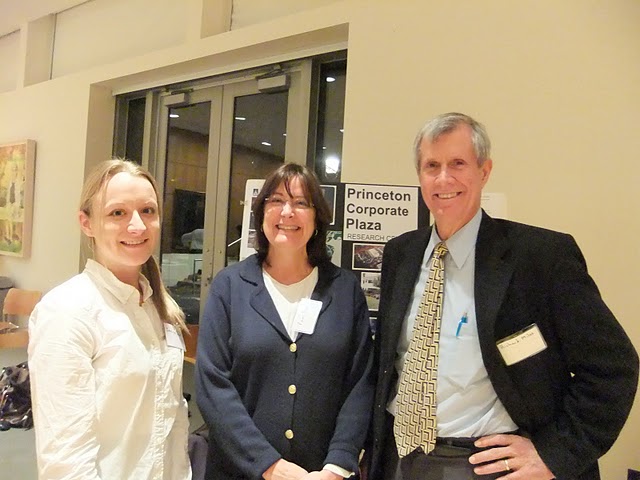
In addition to Einstein Alley’s Katherine Kish, I encountered four more intriguing women. Pam Kent, the real estate rep for Princeton Corporate Plaza and the daughter-in-law of architect/owner Harold Kent. The Kents are real friends to the technology community because they have dedicated themselves to providing affordable office space for small and growing companies. And they are expanding the park, even in this environment. I never realized that Kent owned the Wyeth lab on Raymond Road. Wyeth was sold to Pfizer, Pfizer vacated it, and now that space will be converted to serve smaller tech businesses. Even better, Pam’s daughter Jessica, a recent graduate of the University of Colorado, is working in the family business. (Pictured, daughter, mother, and Richard Miles)
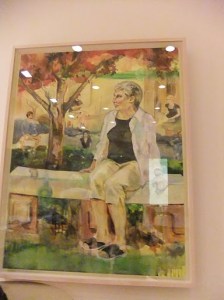

The third intriguing woman was Maria Klawe, present in a portrait on the paneled wall of the Friend Center. Klawe was the first women engineering dean here and made a few waves, changing the culture of the EQuad and being visibly artistic. I think I remember her saying she brought her sketch pad — or was it her needlework? — to staff meetings.The male deans are pictured in their academic robes, in oil, surrounded by gilt frames. Klawe is dressed informally, in pants and clogs, sitting on a bench in the E-quad, as students pass by. It certainly makes a different statement; and I’m going to find out if it is a self portrait.
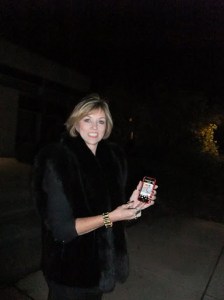
Perhaps the most useful take-away came from Lynne Wildenboer of Red Wolf Design. As we were leaving, I mentioned that I was walking home and, no thanks, I didn’t want a ride because I needed the exercise. She told me of a fabulous Android app, Cardio Trainer. It acts as both a GPS, a pedometer, and a workout recorder, and it’s free. I can’t wait to try it.
The $2 Billion Mouse


I’ve always had a soft spot in my heart for Medarex (just bought by Bristol-Myers Squibb for nearly double the stock price) because Medarex has a transgenic mouse that can produce therapeutic antibodies that mirror a human’s antibodies. .

Mice are my favorite critters anyway, because I literally grew up in the Frank H.J. Figge mouse lab. The lab had 5,000 mice, who owed their existence to my father’s cancer research efforts, and my late mother, Rosalie Yerkes Figge, ran the breeding colony. My sister and I helped out in the family business with such age-appropriate tasks as filing records and filling glass bowls with cedar shavings (at five years old), transferring mice by their tails to clean bowls (age seven), and separating and marking the adolescent mice (age 10).

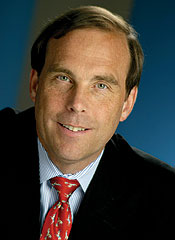
So when Donald Drakeman (left) started Medarex as a monoclonal antibody company in 1987 and 10 years later bought Genpharm with its transgenic HuMAb mouse, developed by Nils Lonberg, I was personally and professionally intrigued. Given the cost and time needed to administer clinical trials to humans, the Medarex mouse can help bring important drugs to market quickly and cheaply. I thought Drakeman was pretty smart to wend his way through some nasty patent disputes and emerge, owning the mouse.

Drakeman and his wife, Lisa Drakeman, have been on the cover of U.S. 1 at least three times, starting in 1987 when it was a pop-and-mom shop with offices at 20 Nassau Street. She came to Medarex as SVP of business development and moved on to be CEO of Genmab. He is no longer with Medarex but she is still at Genmab, based in Denmark but with an office here in Princeton.

Yesterday Bristol-Myers Squibb bought Medarex for what amounts to $2.1 billion, and this morning the stock of both companies shot up, with Medarex nearly doubling to $15 plus.

What does this do for GenMab? Nothing, GenMab claims. Medarex has sold most of its GenMab stock, earned in return for granting 16 prepaid licenses to use the special mouse for drug development. Medarex still owns 5 percent of GenMab, says GenMab’s PR person, Lucy McNiece. Of the 16 licenses, 13 have been used.

And now, of course, I kick myself for not having bought Medarex stock. Before I left my job at U.S. 1 in 2008, it would have been a conflict of interest for me to own it and also report on it. After that, naysaying from a stock broker (who shall remain nameless) deterred me.

But as my doc brother in law says, the Retro Spectroscope is never wrong. And congratulations to the prescient Medarex stockholders, the Drakeman family, and New Jersey’s biotech community. A rising tide raises all boats.

Family Values


My father, Frank H. J. Figge, was a cancer research scientist, and he used to tell me that “Nothing is ever completely true or completely false.” A useful mantra for a reporter. When he died, I was a 34-year-old stay-at-home mom with three children and an intense desire to tap his creative legacy. I learned by doing, as a stringer for a daily paper, and then specialized in dance.

After 10 years of freelancing as a dance writer, I got my dream job, working for Rich Rein at U.S. 1 Newspaper, Princeton’s business and entertainment journal, then a monthly, now weekly (www.princetoninfo.com). Covering business or technology, I discovered, was like covering dance. You present a personality, and you translate the technical terms into words that a layperson can understand. Whether writing about a choreographer, an entrepreneur, or a scientist — they are all “people” stories.

Two decades later I’m freelancing for U.S. 1, on a less stringent schedule. Freed from editing responsiblities, I am “out and about,” meeting business people and attending concerts. Virtually every day, someone I meet or something in the news reminds me of a person I’ve interviewed or an article I wrote, two or 20 years ago. I resisted blogging (what? put stuff up on the web that no one else has edited? do wordsmithing for free? make my reporter’s life public?) Why not just keep a journal?

Because journaling is private, and I’ve been putting words out for public consumption for so many years that it feels right to keep doing it. Perhaps my perspective will be useful — and provoke you to add yours. The comments page is open, and you don’t have to “join” or “sign up” though any identification you might provide would be most welcome. What did your father or mother tell you that affects how you do your work today?