Category Archives: Uncategorized

Bells Can Sing — And Dance


Handbells, I’ve decided, are the only percussion instrument that sounds like a human person singing. And when a soloist plays the bells, it’s like a dancer who sings but does not have to worry about saving her breath.

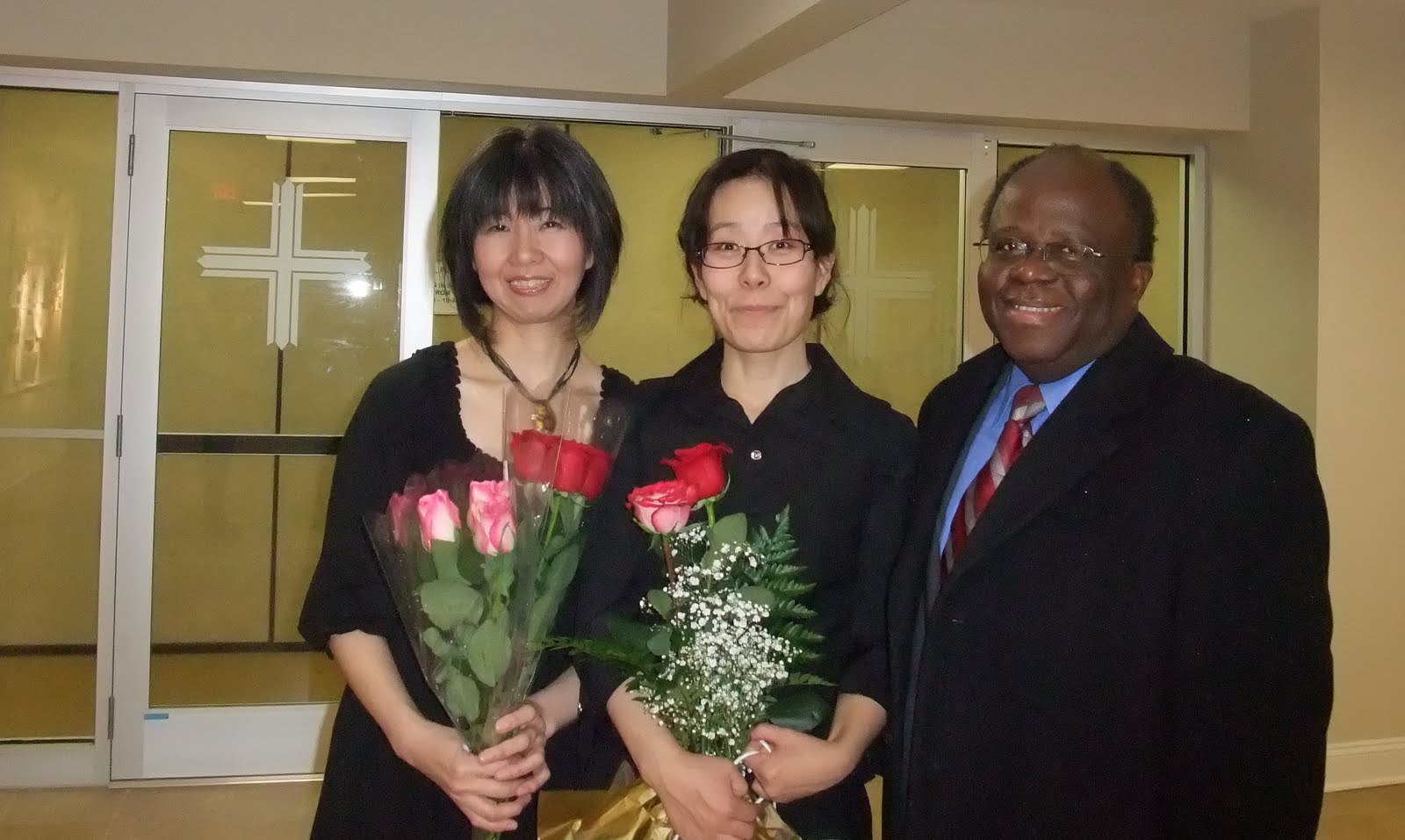
I just heard the most amazing concert, played by pianist Akiko Hosaki (on left), and handbell soloist Hyosang Park (center) to benefit United Front Against Riverblindness, headed by Daniel Shungu, shown on right. It was at St. Paul’s Lutheran Church, a beautiful contemporary church in East Windsor.

Park and Hosaki collaborated on Lenten hymns, using rubato (pauses, ever-so-slightly varying tempos) that twanged the heartstrings. Some were their own arrangements (solo handbell is so difficult that it can be hard to find good ones, they say). Especially wonderful were their arrangements for Jules Massenet’s “Thais,” Vivaldi’s “Winter,” and my absolute favorite, Erik Satie’s “Gymnopedie” #1. Especially in the Satie, the bells seemed to crescendo and decrescendo on the same note. The telecommunications engineer/musician who was sitting with me informed me that this was the Doppler effect, that if the sound-producer is moving, it makes a different sound. (Did I get that right, John MacDonald?).

Disclosure, I’m a member of Princeton United Methodist Church, where Park directs the handbell choir. I never had the ambition to ring, but now I do. To watch her is to be amazed at her tour-de-force, but to listen is to hear an exquisite voice.

The next handbell concert in this series will be at Princeton United Methodist Church on Saturday, May 15, 7 p.m. Here is a link to a YouTube excerpt that will charm you.

In spite of the storm

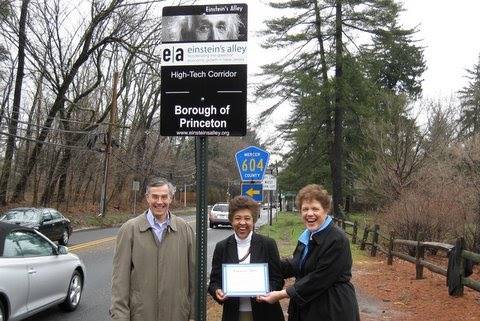
In spite of the tree-felling storm the night before, they un-bagged the Einstein Alley sign at noon on 3-14, Pi-Day, also Einstein’s birthday. Shown: Rep. Rush Holt, Mayor Mildred Trotman, and Katherine Kish.

Going All-Out on Einstein’s Pi Day Birthday


Princeton’s first annual Pi Day, celebrating Einstein’s 3-14 birthday, will survive the potential bad weather, we predict, because so many people and merchants are involved. Everything but the pie throwing is inside, points out Mimi Omiecinski of Princeton Tour Company, profiled in this week’s issue of U.S. 1. She worked with the Princeton Merchants Association, the Princeton Public Library and a host of others to make it happen.

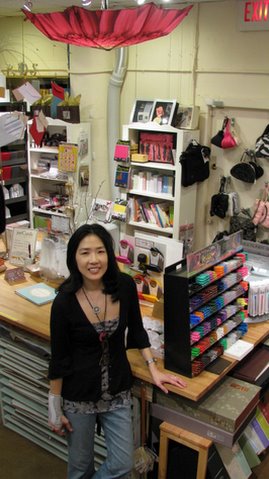
And here’s a special shoutout to Joy Chen (shown here) who designed the clever but respectful logo for PiDay, a rumpled portrait of the great man himself with the Pi symbol and a birthday cake. Joy and Earl Chen own the “studio for social expression,” JOYcards, at 6B Chambers Street. They may have a few of the 60 cent buttons left. It’ll make a terrific souvenir. They also offer a one-price discount on all their beautiful cards, even their $10 ones. Each will sell for, you guessed it, the price of the day, $3.14.

The day begins at noon with a signraising for Einstein’s Alley, a private, non-profit branding and economic intitiative for central New Jersey. “What more fitting day for officials to gather and raise a sign recognizing Princeton as a key municipality in the research/technology center that is Einstein’s Alley than Einstein’s Birthday,” says Katherine Kish, EA honcho. The sign will go up on Stockton Street at Lover’s Lane, and there will be parking down the street at Marquand Park.

Stores with banners offer Pi Day discounts, stuff selling for $3.14. In one long block on Nassau Street you can make three Einstein stops: The Einstein museum at Landau’s store, the Einstein souvenirs and artifacts at the Historical Society of Princeton, and the Princeton University store, which offers a 23.14 percent discount on Alice Caprice’s “Quotable Einstein” book and its other books on Einstein.

Then head for the Princeton Public Library: After the 1 p.m. pie judging at the library, help recite the complete string of Pi numbers, led by Princeton University students. At 1:59 p.m. (the next three digits of Pi) the Princeton Plasma Physics Lab will conduct science experiments.

For $3.14 take the Einstein tour, led by six costumed re-enactors, telling about Einstein’s life; you will follow the treasure hunt trail.

Pie throwing on Palmer Square is at 3:14 p.m. (natch) sponsored by PNC Bank and McCaffrey’s which will serve free birthday cake.

Let the party begin.

Ring Out Riverblindness


Just $65,000 will guard one million people in the Congo from going blind, says Daniel Shungu, founder of the United Front Against Riverblindness (UFAR). Hyosang Park, a solo handbell artist from Princeton United Methodist Church, will start a series of fundraising events to help conquer the disease by giving a concert on Sunday, March 14, at 7 p.m. in East Windsor.

Riverblindness, transmitted through the bite of a small black fly, is a socially disruptive disease that infects 23 million of the 60 million people in the Democratic Republic of Congo. It starts with a rash and thickening of the skin and leads to sight loss. In addition to unbearable itching that drives some people to suicide, it is hard for victims, especially for women, to either find a mate or if already married to keep one. Tragically, children – who usually remain symptom-free until adulthood – are forced to become full-time caregivers for blind relatives, foregoing their own education, resulting in illiteracy and increased poverty.

The drug for Riverblindness, Mectizan, is being provided free by Merck & Co., but it is a challenge to get the drug to where it is needed and ensure that every person takes the drug once a year for at least 10 years.

As part of a series of fund-raising events for the Princeton United Methodist Church/UFAR mission trip to the Democratic Republic of Congo this summer, solo handbell artist Park and pianist Akiko Hosaki will present a Riverblindness Benefit Concert on Sunday, March 14, at 2 p.m. at St. Paul Lutheran Church, 79 One Mile Road, in East Windsor. Park is the organist and handbell choir director at PUMC and Hosaki is the organist/choir director at Hillsborough Reformed Church in Millstone. They will perform works by Massenet, Vivaldi, McChesney, and Sherman. For information call St. Paul’s at 609-448-1113.

Other planned fundraisers for the mission trip: On Sunday, April 25, at 2 p.m., there will be a tea at PUMC. Call 609-924-2613 for $15 reservations. The PUMC “May Day 5K to Conquer Riverblindness” will be Saturday, May 1. Park will give another solo handbell concert on Saturday, May 15, at PUMC in Princeton. A community-wide African Cultural Evening and Dinner will be held on Saturday, May 22, at Princeton University’s Carl A. Fields Center, at Prospect and Olden Avenues. Tickets are $50, $25 for students.

Take a look at the UFAR logo of a child leading her parent. Here’s the good news, according to UFAR: “Through UFAR’s efforts since 2007, 727,583 people living in 1,659 villages have received at least one annual dose of the drug with remarkable results: no more itching, rejuvenation of the skin, improved low or impaired vision, reduced infections, and improved ability to concentrate. Children and young adults can resume schooling. There is an obvious renewed energy and happiness in the community, with everybody looking forward to getting the drug the following year.”

Park’s solo handbell concerts are amazing to see and hear. Imagine one person playing all the bells in three octaves! Help PUMC ring out Riverblindness and ring in hope!

Promising Spring for Dance


Spring this year feels like spring nearly 30 years ago when a handful of active companies made Princeton’s modern dance scene fascinating to watch. Now here comes a series of concerts that promise relief from a two-decade drought. I just saw “Rider Dances” at the Yvonne Theater (Sunday, March 7) and the Princeton YWCA’s “I’ll Have What She’s Having” is scheduled for the same venue on March 19 at 8 p.m. and March 20 at 2 p.m. Then there’s the Outlet Dance Project on April 10 and 11, the Mercer Dance Ensemble on May 22 and 23, and the student programs at Princeton University, the April 3 Ze’eva Cohen tribute at the university, and Rutgers’ Mason Gross — suddenly it seems like there’s lots to see.

Kim Chandler Vaccaro, director of the Rider University/Princeton Ballet School dance program, cajoled choreographers and fashioned production elements to come up with a praiseworthy concert that went from one inventive surprise to another. For instance, a wonderfully outrageous dance, evocative of Pilobolus, is Christine Colosimo’s “What Happens Next.” It opens with an upside-down dancer, her head and shoulders covered by a stage-wide cloth, her bright red boots kicking to the music of Bubba Sparxx “Miss New Booty.” Trust me, it works.

Then human moles burrow under the huge white cloth and soon four more pairs of red boots on upside-down people are dancing. They exit, the cloth billows with air, and from the center emerges a dancer who, rooted under the cloth, does an adagio for the back and arms (shown in photo). As she begins to move around the stage, the giant cloth takes on its own personality. The dance ends with four pairs of red boots lying empty on the stage.

Another very successful prop-feature dance was Laney Engelhard’s “Recurring,” which opens with dancers lying down, blanketed with 30 pounds of white feathers. If you think “Nutcracker” snow, think again, because the white stuff didn’t stay on the floor. Seven sleek dancers, costumed with white on their backs and white with black spots on their fronts, deftly wade through it, scoop it up, and toss it to flutter down again. At the startling, sudden end, the dancers bend forward, arms outstretched like bird’s wings.

In “Potent Remedy,” Jennifer Gladney, with help from Danielle Nolen, fashioned her own mythological world, starting with Niko Paleologus’s projected video of a boy and girl (Princeton Ballet School students Emilia and Jayden Kraft) who walk in the woods and encounter fantastical creatures, all dressed in bright colors except for one in black. All those characters plus 10 more then appear on stage, dancing to “Mr. Magorium’s Wonder Emporium” by Zigman and Desplat. Most of the time the children sit on the side and watch but occasionally they join in. One of the two lead dancers, the one dressed colorfully, circles in a spotlight of glitter.

I can’t discern the plot or meaning on first viewing, but at the very end – when the children have reappeared in a video as young adults – the black creature seems to be morphing into full color, as she circles in the glitter spotlight. J.R.R. Tolkien eat your heart out.

College dance concerts are rightfully about the students, and these students have the good fortune of being able to train at Princeton Ballet School as well as take academic work at Rider. It’s the job of the director to put every student onstage and make them look good, and Vaccaro deftly did that, in the opener “Web? Where Exactly?” To a “layered” guitar score by student composer Michael Dylan Ferrara, cleverly using economical movement material, sixteen students strut jauntily, on stage and in the aisles, having the time of their lives.

Also here, the dance equivalent of the torch song (by student Elizabeth Zelesny), the requisite hip hop number (a fun piece by Shakia Johnson), and Cherilyn Barbone’s “Internal Static,” a well-performed tap dance with a seemingly endless variety of call-and-response percussion rhythms.

All but one of the choreographers was a professional, and the dancers were mostly students and alumni. What set this concert apart is the student’s opportunity to share the stage with, and learn from, seasoned pros who have had distinguished careers. Cheryl Whitney Marcuad’s Sarabande, a modern work choreographed to Bach by Mary Barton, gave new meaning to the words “elegant” and “fluid.” And Diane Kuhl’s sparkly solo (also by Barton) is a better-than-textbook example of “epaulement,” the well-trained ballet dancer’s carriage.

When Marcuad and Kuhl joined Janell Byrne for a trio by Byrne, it seemed I was back in the 1980s when Byrne was dancing in three companies – Teamwork Dance and Geulah Abraham’s Danceworks, and the Mercer Dance Ensemble. Ah those were the days. Over the past decade I have seen Byrne dance only through her choreography as director for the Mercer Dance Ensemble, three or four new pieces every year. (Her 30th anniversary concert for MDE is May 22 and 23 at the Kelsey Theatre.) Now here was the real her, understated, fluid, joyous. Revealing that you don’t have to have eccentric movement, histrionics, or props to make an effective dance moment, the three veterans showed the kids how it’s done.
Traditional Media Not Dead Yet


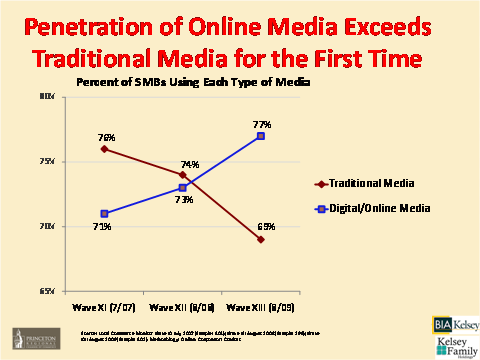
It’s here – the tipping point. Online media usage penetration exceeded usage of traditional media for the first time last year, said John F. Kelsey III, the interactive media guru who spoke to the Princeton Chamber on Thursday.

But don’t toll the bells for traditional media just yet, because digital media is getting just six percent of the local marketing dollars, according to Kelsey’s research. “Businesses are using digital media for local advertising, but they are not paying a lot of money for it,” said Kelsey. Direct mail leads traditional media’s dollar share at 28.0 percent of spending, with newspapers at 21.5 percent, and online and interactive at 5.4 percent.

His charts are on the Princeton Regional Chamber website. They showed that traditional media is not going away, just getting a smaller share of the market. (Traditional media includes direct mail, yellow pages, and broadcasting, not just newspapers and magazines.) It dropped from $141 billion in 2008 to $115 billion in 2009.

That’s the bad news. But it won’t drop much more (only to $108 billion) by 2014. Good news? Maybe not. Kelsey says the economy “hit the reset” button last year. Unlike recessions in recent memory that bounced right back, this one won’t bounce back. Where we are now is where we are going to be for a good long while.

Kelsey has sold his company to BAI (now called BAI/Kelsey), but he has access to, and shared, some valuable statistics. By 2014 interactive media will get 25 percent of the market share, and this is an industry that will not grow.

How are small- to medium-sized businesses choosing media? Interactive media is the choice for 44 percent of new companies, and 32 percent of SMBs over all. Just 18 percent of the older companies – probably the bigger ones – are using it. “SMBs believe that interactive media has a better return on investment,” he said.

I was surprised at Kelsey’s claim that 80 percent of products and services are bought within 20 miles of your home, and that won’t change. I thought more people were buying online. I guess he counts groceries and dry cleaning.

His advice: Use the new media to communicate so you can exceed the expectations of your current clients, so they want to come back.

Kelsey comforted those who are daunted by change: “The basic tenets of the marketing mix haven’t changed, but the elements are evolving. Hire people/vendors who will move you out of your comfort zone.”

And if regional newspapers will falter, local newspapers will do just fine. “Traditional media is alive and well,” said Kelsey, “at least for now.” What about all the reports of layoffs? Other companies do layoffs quietly. “When media does layoffs, they write about it.”

Click here for the PDF file.

Tomorrow: Four Hours, 23 Books at PPL


Self-published books used to have a bad reputation (somebody’s ill-edited memoir, somebody’s ill-conceived doggerel) but in today’s publishing environment, that can be the best way to get your book into the hands of people who want it.

But try getting an author appearance for a self-published book in a brick-and-mortar bookstore and you will learn the meaning of frustration. Most bookstores (and I can’t say I blame them, given the volume of self-publishers) won’t schedule them.

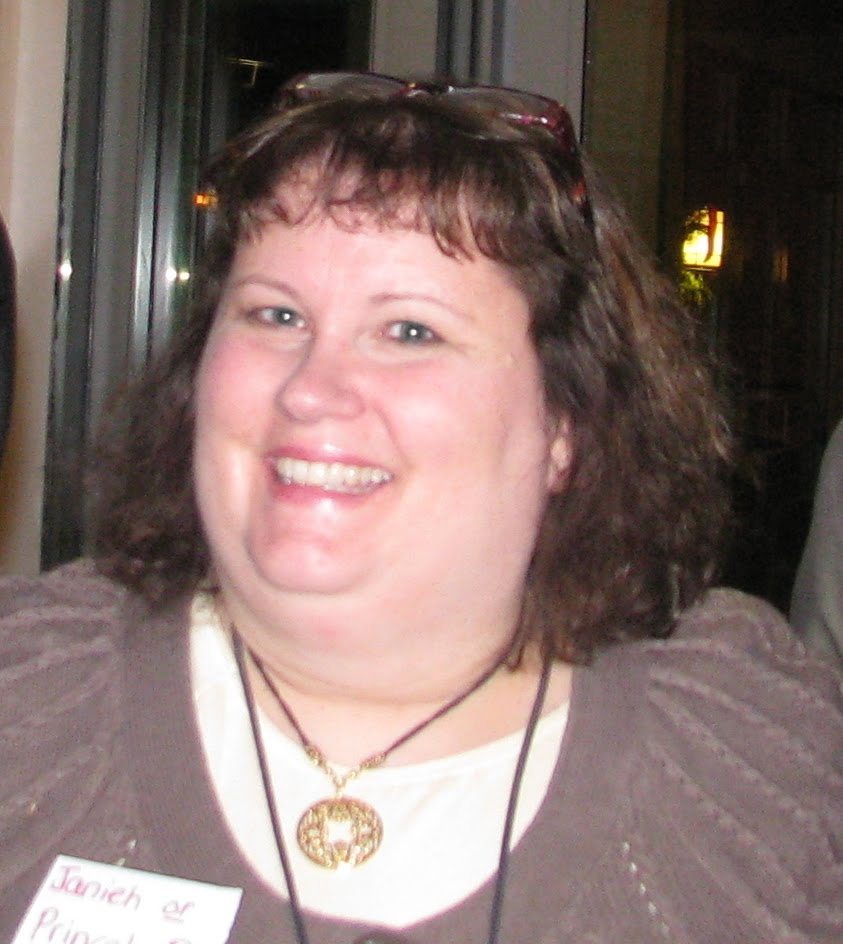
Janie Hermann, the ringmaster of the Princeton Public Library (shown here), has stepped into the breach and scheduled a “Local and Independent Author Day” tomorrow (Saturday, March 6, from noon to four). It’s a fun format. Six authors per hour read or speak in a 50 minute time slot, with a 10-minute break for buying the books and getting a cup of coffee. If the audience consists only of each author’s entourage, they’ll have an audience.

At least three of the books are worth hearing about or buying. Two were written by friends of mine – Ed Tseng and Wayne Cooke, and I know that the third, Angela Chang, is an excellent cookbook writer.

The event starts with introductions by Hermann at noon. In the 1 to 1:50 time slot are Tseng, a well known motivational coach focusing on the mental side of sports and life, who wrote “Game. Set. Life – Peak Performance for Sports and Life” and Cooke, who wrote “On the Far Side of the Curve: A Stage IV Cancer Survivor’s Journey.” That hour also features Tom Waldron, Renee Gatz, Ronald Allen, and Gayle Crist Shisler – they all seem to be non-fiction writers.

The afternoon closes with Angela Chang, the last speaker in the 3 to 4 time slot. I’m betting that the personalities alone will provide a good show. Click here for the complete schedule.

Blogger disclosure: Tseng and Cooke gave me copies of their books but I have also bought copies to give to friends.

Let Your Ears Do the Hearing: Are Yellow Pages Obsolete?


Should you advertise in the newspaper or the yellow pages? On the radio or TV? Or put all your marketing budget into social media and hire somebody to Twitter for your business?

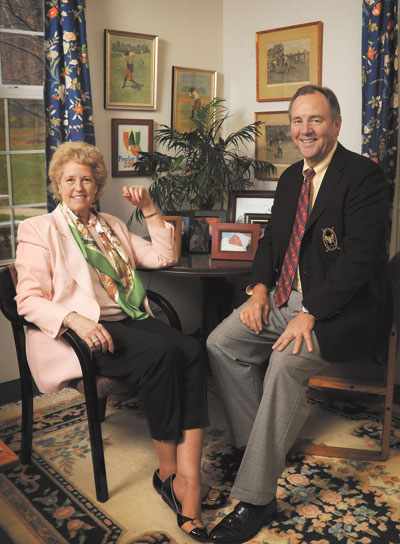
No better person to answer that question than John F. Kelsey III, who has been researching it for three decades. The founder of The Kelsey Group (TKG), will speak on “The Changing Marketing Mix: how can you attract business in the new decade?” for the Princeton Regional Chamber this week, Thursday, March 3, 11:30 a.m. at the Forrestal Marriott. This picture shows him with his wife Pam, in a November 26, 2008 cover story for U.S. 1 Newspaper.

“John Kelsey anticipated the rise of electronic media and its impact on the Yellow Pages and small-business marketing around the world,” according to a company spokesperson. “He worked tirelessly to help incorporate Yellow Pages into the world of contemporary online and mobile marketing. And he created a community that brought traditional media and new media together.”

“The Kelseys built a company that researched and analyzed data on print and electronic Yellow Pages, local search, small-business marketing, and local media,” wrote Scott Morgan in the U.S. 1 article. “They had weathered the days when they made no money, and scored big.”

When they sold the company in 2008, conferences made up 40 percent of its business. TKG focuses on Internet, mobile, and Yellow Pages, and the buyer, Virginia-based BAI, specialized in radio, television, and consulting — a good fit.

In his own blog Kelsey quoted an article in the NY Times (”Mom and Pop Operators Turn to Social Media“) that shows how even the smallest of companies can grow rapidly using Twitter as a promotional vehicle. “No, there’s no advertising money associated here … yet. The old saw “where there’s a will, there’s a way” comes to mind.” Kelsey promised that advertisers will find those using smartphones. “The money is not likely to be new advertiser dollars, but rather expenditures coming from other media that are looking for the most efficient way to drive conversions within geotargeted areas.”

Full disclosure: I’m on the chamber program committee and I’ve been wanting to hear John Kelsey’s wisdom for some 20 years. See you there!

Surreal: From HomeFront to Wealth Planning


In the space of three hours today, I have picked up provisions from a food pantry (on someone else’s behalf) and gone to a conference on how to donate wealth, whether to use a gift annuity or a charitable remainder trust.

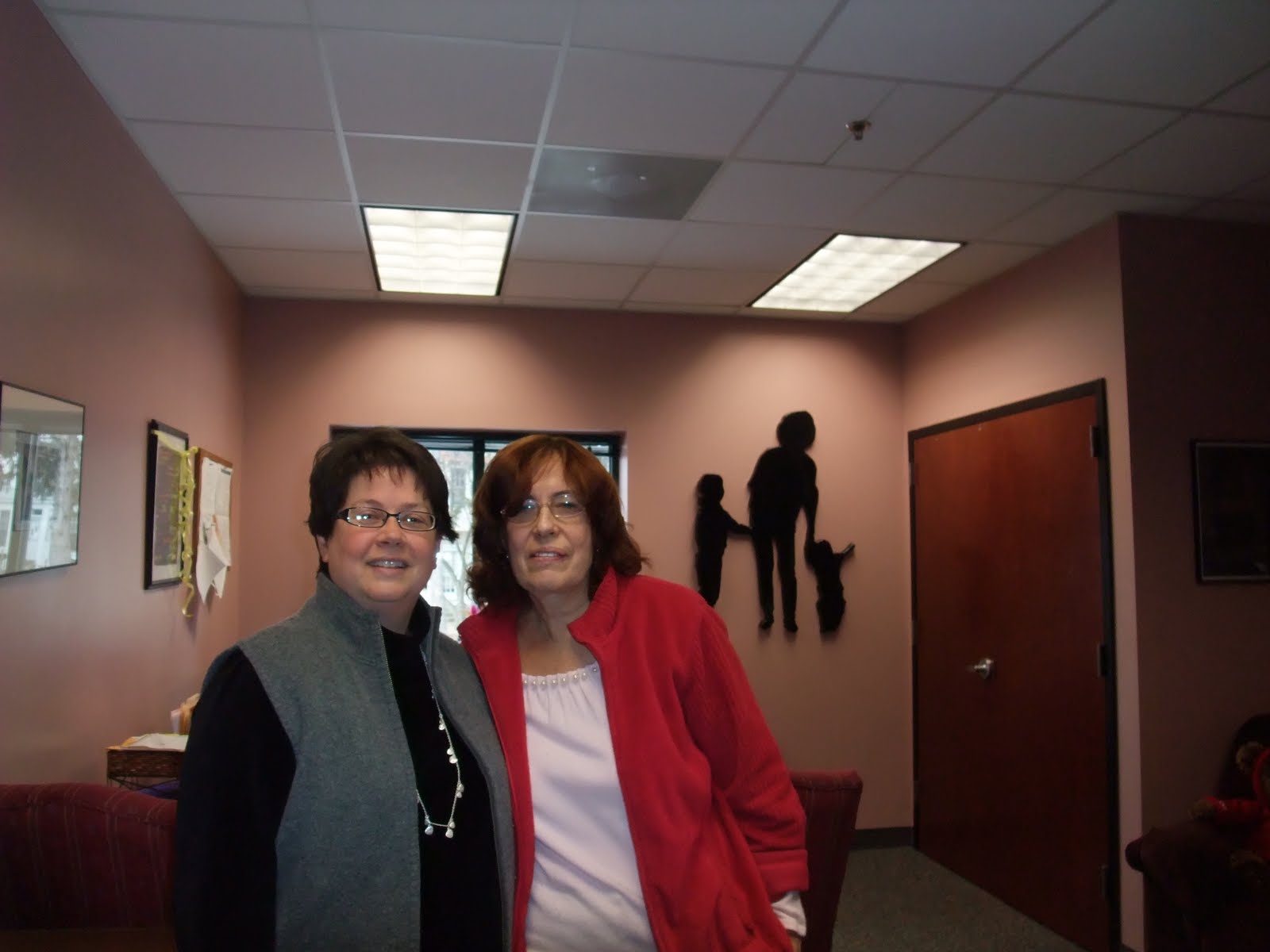
Pictured above, top, are Celia Bernstein (CFO and operations director, left) and Connie Mercer (founding CEO) of HomeFront, the wonderful 30-year-old nonprofit that offers all kinds of services to the poor and homeless. I had offered to pick up food for one of their clients, a friend of mine who does not have a car.

I’d been to HomeFront’s offices on Princeton Avenue before, at the grand opening, as a matter of fact. I’d written about HomeFront on numerous occasions for U.S. 1 Newspaper, starting when Mercer started the organization in 1990. To quote from the website, “the average HomeFront client earns $8 per hour and works forty hours per week. The average rent for a two-bedroom apartment in Mercer County is $1,022.00. You do the math.”

Now that I know someone who needs HomeFront’s wonderful services, I’m getting to know this organization on an under-the-skin basis. Perhaps I’ll be able to write more later, right now it’s enough to know that it’s there.

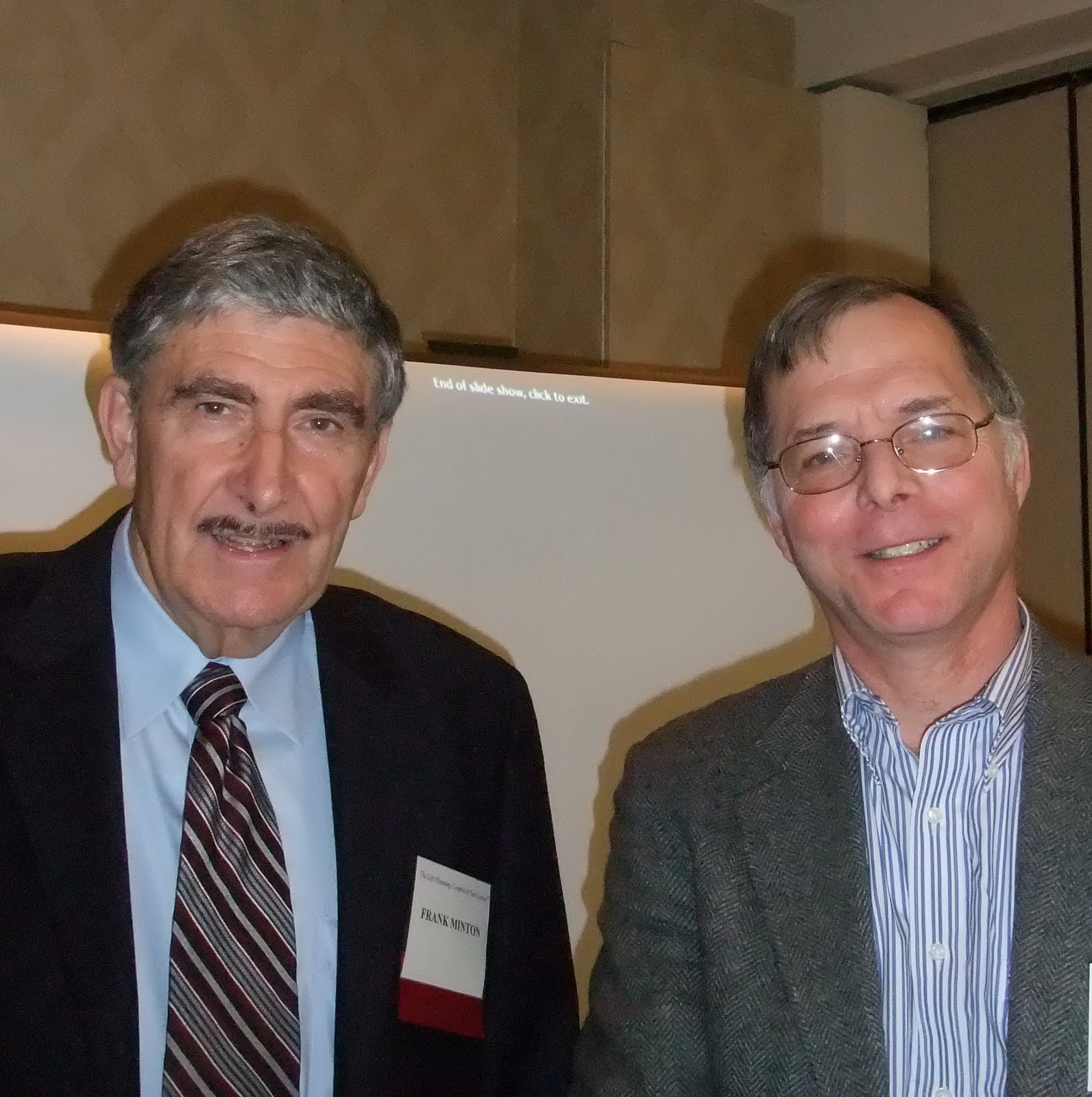
From there, it was up Route 1 to the Doubletree Hotel to sign in for the Gift Planning Council of New Jersey’s morning seminar, where Frank Minton (far left, shown with Joe Pistell of United Methodist Homes) spoke to a large group of folks who help rich people donate money, while retaining some income. The question for the morning: which is better, a gift annuity or a charitable remainder trust?

I’m not a financial planner or anything like that, and much of it was over my head. I just wanted to get an insight in how the financial planners think. Sure enough, which they recommend to their clients often depends on they work for. If they work for a charity, they are more likely to recommend a gift annuity, if the donor is their client, the charitable remainder trust is often favored.

It was a surreal juxtaposition.

Ed Zschau and Friends: Tech Transfer

 
Posted by Picasa

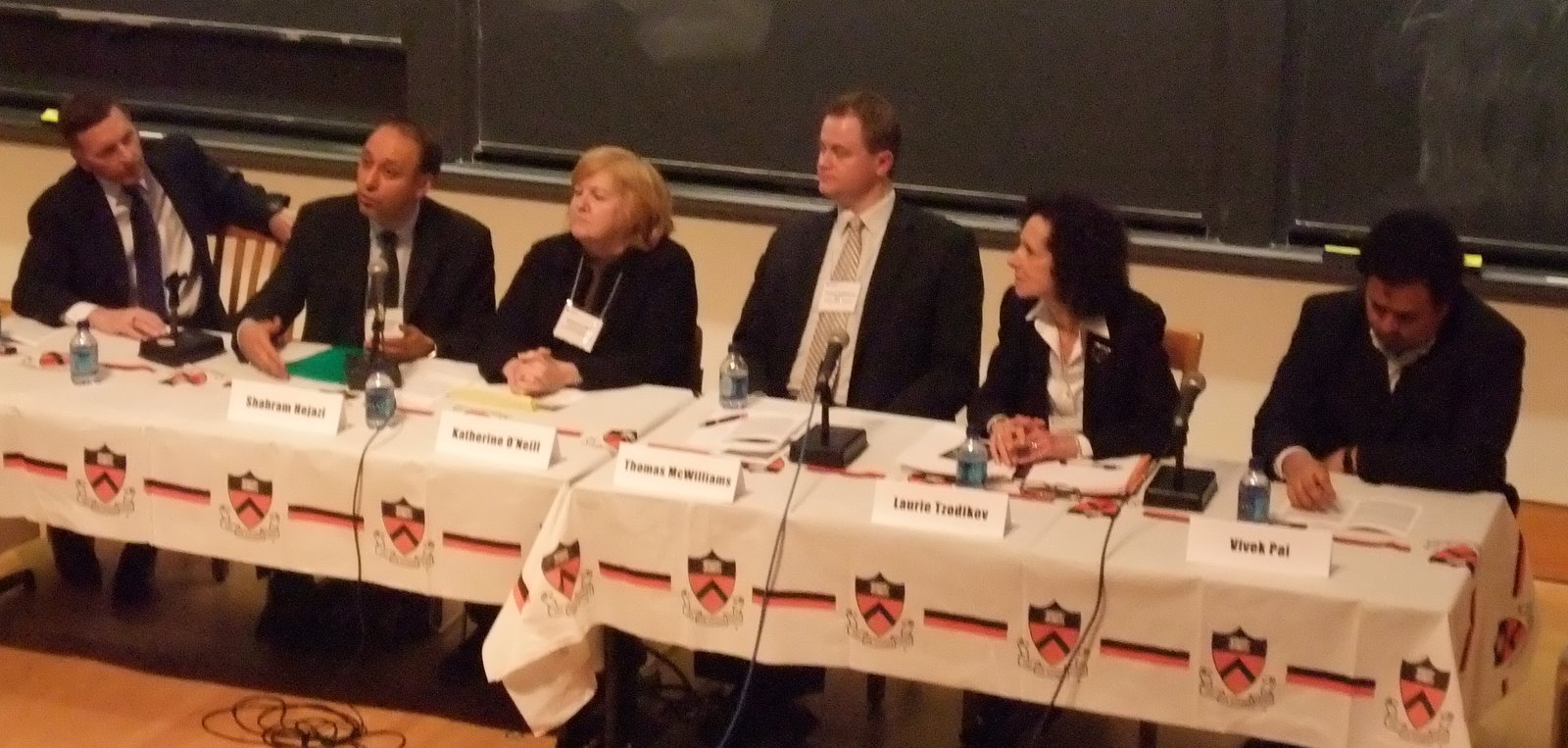
“There are great ideas and there are ideas that will sell and they are not always the same thing,” said Thomas McWilliams of Drinker, Biddle & Reath. He spoke at Princeton University’s Keller Center Technology Commercialization Panel, chaired by Ed Zschau, on Tuesday, February 16, at 5:30 p.m. (From left: Ed Zschau, Shahram Hejazi, Katherine O’Neill, Thomas McWilliams, Laurie Tzodikov.)

Shahram Hejazi, venture partner of BioAdvance and former CEO of Zargis Medical Corporation, had a similar warning: Is the business idea merely a solution that is looking for a problem? Even if you do what you say you can do, does anybody care?

The business idea must be able to make three times the required investment, said Hejazi. If you need $100 million to prepare for the company’s sale, can it sell for $300 million, and can you show any company in this space that will sell for that?

But angel investors have realistic expectations, said Katherine O’Neill, executive director, Jumpstart NJ Angel Network. When they put their money in pre-revenue companies, they expect revenue from just one out of 10 companies. Three may live, six will die.

What type of company attracts investors? They look for innovative patent technology, solutions to real problems, a low level of initial capital to bring the business to fruition, and an enthusiastic representative (which could be a graduate student) who can communicate the value of the technology.

Angels also look for a technology in which they have expertise. They don’t want to contribute just money; they want to add value to the firm.

All of this information applies to any young company but taking university inventions to market has its own problems, she said. Academic inventors get distracted by their other responsibilities. “An amazing number of academic scientists don’t return calls from potential investors,” said O’Neill. She pleaded with professorial entrepreneurs. “If you’re busy and don’t have time to meet, at least return the call and say so.”

Vivek Pai,
associate professor of computer science, experienced the conflict between his entrepreneurial and academic pursuits. He helped architect and develop iMimic Networking, the fastest Web proxy service in the world. It was bought out by a company that was bought out by Cisco, then he cofounded CoBlitz, a content distribution firm.

Pai said that if he hadn’t needed to concentrate on getting tenure, his company might have gained better market share. “Be prepared for your new company to consume all your free time. If you aren’t willing to spend that time, then license your technology. “

Laurie Tzodikov
told how the Princeton University office of Technology Licensing and Intellectual Property works closely with professors and graduate students to commercialize their ideas. Each year the office gets 80 to 100 invention disclosures, files 60 provisional patents, makes 15 to 20 agreements per year, and helps two to three startups per year.

Some examples: Alympta, the Eli Lilly cancer drug; protection equipment from TigerOptics; Universial Display Laboratory, mice models sold through Taconic Artemis.

“We need a partnership with the inventor. We need to be very persistent,” she said.

But by far the most surprising observation came from McWilliams. In the USA Inventors have just one year to file a patent after they first publish their research. Elsewhere in the world, it’s a much shorter fuse, and for China you need to get the patent almost before you publish.

Amazingly, what constitutes “publishing” can be just giving a slide presentation, or giving any kind of presentation where someone has the opportunity to take notes. That’s a strong warning to keep your mouth shut until you have hired a lawyer.

Future events: a Keller Center entrepreneurs’ panel on Friday, February 26, at 2 p.m.

And the New Jersey Entrepreneurial Forum hosts a seminar on intellectual property, effective low-cost protections and portfolio strategies, with Elliott Stein of Stevens + Lee and David Gange of Chemistry Patent Search, on Thursday, March 11, at 4 p.m. at the Technology Center of New Jersey.