Category Archives: Uncategorized

Economic Summit: Plans B and C


Herb Taylor, of the Federal Reserve Bank of Philadelphia, gave the bad news.
The loss in household wealth is on the order of $10 trillion. It’s as if the market took a year of income and made it evaporate.

He keynoted the Mercer County Economic Summit Program this afternoon.

The four hour event, staged by the Princeton Regional Chamber and attended by 250 people, also had two breakout sessions, including one on hot topics in energy management and a workshop on Thinking Outside the Box.

Full disclosure, I’m on the Princeton chamber board, but I thought this event was a great success, even at a $60 price tag. Lots of info, lots of networking. Perhaps the best advice came from Jerry Fennelly including “figure out what you weren’t doing that you can do now.”

I’m doing a “quick and dirty” post from this event, using the wireless connection from Mercer County Community College’s conference center. It’s a first for me to do this — to take notes at an event and post them immediately, without fancy links (to the U.S. 1 Newspaper article, though I might add that later) or photos (possibly added tonight), not even well spell checked. Corrections welcome. But this is the new world. As Jerry says, it’s the George Costanza principle. Do the opposite of what you are doing. And I don’t even have time to Google to see who is George Costanza…

It’s 6 o’clock. Time for the event to be over though the “the band’s still playing..”

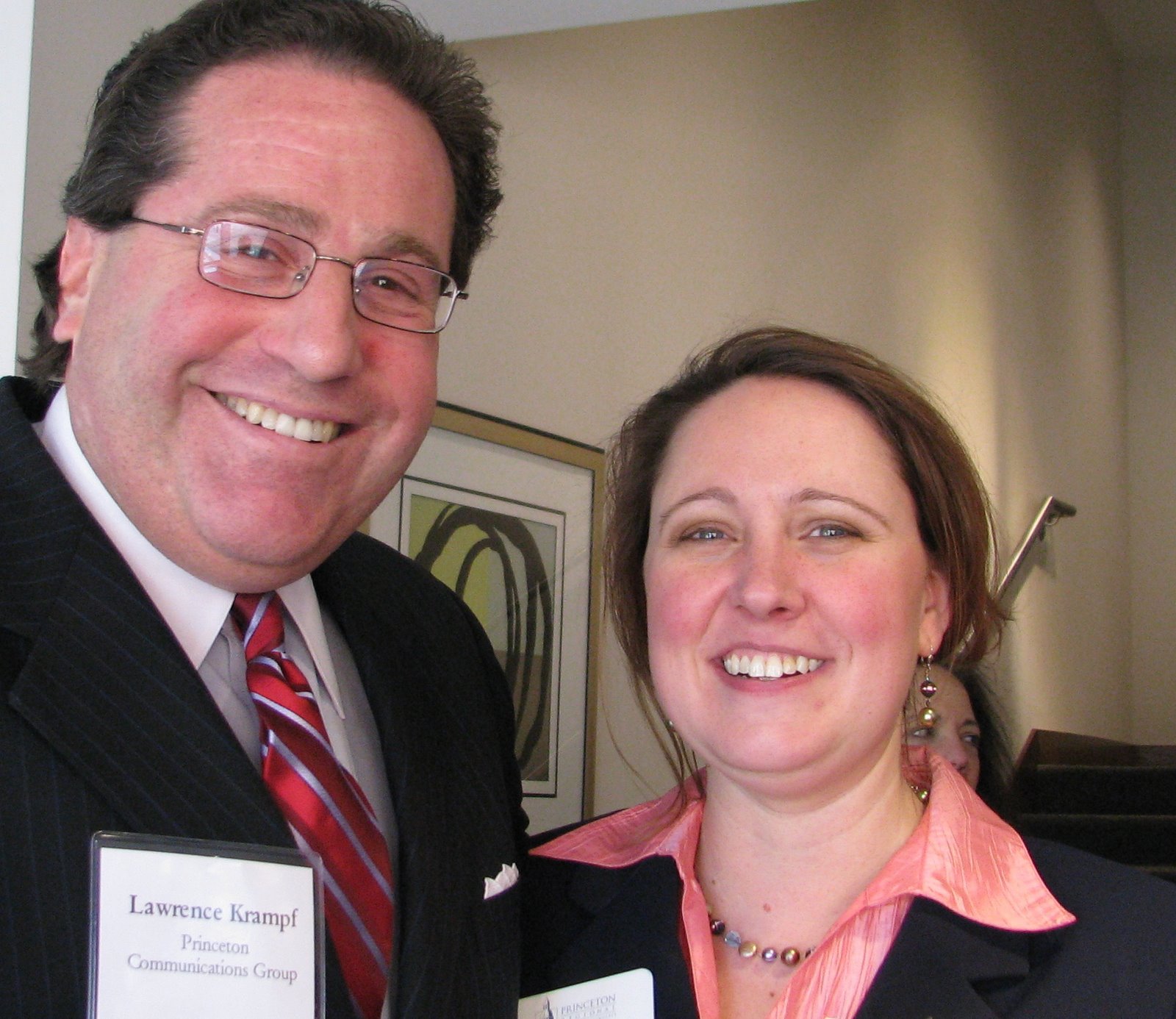
Pictured: Larry Krampf, president of the chamber board, with Cheri Durst of the chamber staff.

Einstein’s Alley Spotlight

John Romanowich, one of Princeton’s most successful entrepreneurs, held court this morning in the name of Einstein’s Alley. More than three dozen people – officials and well-wishers gathered at his place on Alexander Road to take formal note of the fact that his company, SightLogix, is doing well and for good reason.

Romanowich credits his success, in large part, to the availability of world class talent for video innovation, derived from such giants as AT&T; Bell Labs, IBM, Intel, and the Sarnoff Corporation. It doesn’t hurt that state government, in the person of Caren Franzini and the New Jersey Economic Development Authority, has backed up private investors and the federal government, as championed by Rep. Rush Holt, to fund the firm

The company’s recent contracts include major perimeter security deployments in the Middle East, contracts with NJ Transit, Port Authority of NY & NJ, Lockheed Martin, and several national air and seaports. It also has new offices in London and Bangalore. Romanowich was also able to talk about finishing a large U.S. Dept. of Homeland Security contract that places rapid-response surveillance equipment in the hands of first responders across the nation.

Romanowich has co-founded an ad hoc support group for high tech entrepreneurs in the Einstein’s Alley area, loosely defined as central New Jersey. But it is the official Einstein’s Alley group, led by Katherine Kish and Lou Wagman, that invokes the Albert connection to actively market the five-county area as The Place for high-tech technology firms to settle and/or to expand.

Pictured, left to right: James Hahn, Chairman/Founder SightLogix, Katherine Kish, Co-Executive Director Einstein’s Alley, Eric Heller, Marketing Director SightLogix, John Romanowich, President/CEO/Founder SightLogix, Lou Wagman, Co-Executive Director Einstein’s Alley.

Rail Travel: Making Friends of Strangers


My husband chuckled as he handed me the travel cover of Sunday’s New York Times, knowing that Andy Isaacson’s story, “Riding the Rails,” would be dear to my heart. My late mother, Rosalie Yerkes Figge, loved loved loved riding the train. Every summer she and her mother would take the train from Philadelphia to Henderson, North Carolina, to visit her Harris and Hicks relatives, and, an avid traveler until the year before her death at 96, she trained everywhere possible. Returning with her from a family vacation in Orlando (she was 92 at the time) I was amazed at how she could predict when the train would slow, passing whistle stop towns, so she could edge her ponderous way into the dining car.

So I’ve been badgering my husband for years, “Let’s take a cross country railroad vacation,” and he has resisted for years. We’ve put our toe in the water by taking rail trips to Richmond and Durham, but no overnights comparable to when we trained to Montreal for the 1967 World Expo, our last child-free fling before we were to have our second child. Because I was 7 1/2 months pregnant, I couldn’t go by air (I’m no Sarah Palin), and the sleeper enabled me to travel horizontally.

And I did go off on my own train trip last spring, to celebrate my not-working-full-time status, taking the train from Princeton to Cleveland and continuing by Amtrak bus to Detroit. What I thought would be a pleasant adventure turned out to be a pleasant though harrowing adventure, which I wrote about for U.S. 1 Newspaper.

Isaacson has a talent for description (“In dawn’s light, the train streaked across the Great Basin Desert, blurring the view of tufted yellow shrubs flanking the rails but framing the white dusted, mineral-stained mountains beyond in an unfolding panorama…”) and in the microcosm of his four-day journey he conveyed the macro picture of America’s railroad future. (I’m pinning my hopes for Amtrak on our rail-riding vice president). He also told honestly of his own harrowing time; en route to Chicago he froze when the heat went off in his roomette.

But he and I both came away with the same opinion, that traveling long distances by rail has its own special rewards, not least among them the opportunity to meet and get to know one’s fellow travelers, making friends of strangers. I’m still corresponding with the friend I made enroute to Cleveland.

And, as Isaacson notes, the slower pace, the “rocking cradle, and that hushing sound, choo-k-choo-k choo-k-choo-k –” can act as a “salve for our modern psyche.”

Beyond Cameron: School Spirit in Gotham


It was called the DukeIdea, held on Thursday, March 5, in New York. The hits were Gotham Hall, a seven-story elliptical ballroom with a gold leaf dome in the former Greenwich Savings Bank, the sumptuous food, and the people I met – including several with ties to Princeton.

If Judy Woodruff (of the McNeil Lehrer report) and John J. Harwood (of the New York Times and CNBC) ended up having to rehash the problems of the old media rather than stick to the previously announced topic (the new media), oh well. I had a fabulous time doing my buttonholing photographer thing, snapping shots of folks who looked interesting in order to have an excuse to find out who they were. (The photographs are online, and here is a good Harwood/Woodruff anecdote.) Our engaging ex-Yalie college president, Richard Brodhead, made everyone feel good about having attended – or paying for their children to attend – Duke.

The collation — mussels, carved roast beef morsels, and more kinds of appetizers than I’ve ever seen in one place, plus an open bar – was lavish. Guests had been asked to pay $25 for this shindig (less if you were a recent grad), but it must have cost quadruple that amount. Perhaps I should add an extra digit to my measly two-digit annual contribution.

Young grads and parents predominated, but there were lots of baby boomer alums, including my prize find, New York Times columnist Peter Appelbome, alumnus and parent. I located a couple of women from the Class of ’62 but searched vainly for anyone older than I.

Then I spotted an elderly gentleman near the door. Aha. I zeroed in with the small talk. He said wasn’t a Duke grad, but was a Princeton grad, so we talked about my home town and joked about how Princeton was the Duke of the North. Finally I realized I was speaking to Anthony Drexel “Tony” Duke, the trustee emeritus who, it had been announced, was in attendance.

That really made my evening, because I have a thing for Duke family history. I’ve written about Doris Duke and her father at Duke Farm in Somerville, and last fall Hawaii we made sure to visit her Shangri-La enclave.

Mr. Duke told how he had been recruited by Terry Sanford to the Duke board, and how much he loved the university and was proud to be a Duke and to be wearing a Blue Devil tie. Later I learned that he had founded his own charity, Boys and Girls Harbor, when he was just out of high school. In this original summer camp, for immigrant boys, the counselors were his friends and classmates — Senator Claiborne Pell, Mayor Robert Wagner, Bishop Paul Moore.

The other Princeton connection was Richard S. (Dick) Miller and his son. Russell grew up at my Methodist church, followed his older brother to Duke, and is now working in the city.

Near the very end of the evening, I did find a classmate whose name I recognized from the Class of ’61, Shelly Conklin Ostrowski, who also had been a reporter and writer. And I recruited a woman from the Class of ’07 to do admissions interviews. Not a bad investment for $25 plus a $7 senior citizen train ticket to Manhattan.

Speaking of investments, you couldn’t forget you were in a bank, a very grand bank, built in 1922 in Classical Revival style. The brass bars of the teller windows encircle the back rows of chairs, and the granite writing shelves still line the walls, studded with candles for this evening. Overhead, four cautionary sayings (epitaphs for a drowned economy, it might seem now) are carved in limestone, like commandments. Each is better than the next:

“It’s what we save rather than what we earn that insures a competence for the future.”
“Having little you cannot risk loss. Having much, you should the more carefully protect it.”
“Waste neither time nor money but use both for your own and your neighbor’s good.”

Washington Duke would approve.

Carpenters and Surgeons: Measure Twice

Surgeons are like carpenters says orthopedic surgeon Lauren Forese, speaking for the Princeton University’s Keller Center for Innovation in Engineering Education. Both surgeons and carpenters use a lot of the same equipment. and they make people and things better. Forese is senior vice president, COO, and chief medical officer of New York-Presbyterian Hospital/Weill Cornell Medical Center. She is responsible for 1,000 beds on two campuses. The daughter of an IBM corporate vice president she graduated summa cum laude from Princeton in 1983, went to Columbia Medical School, and has a degree in health services management from Columbia.

Forese had just given birth to twins when she finished her residency and was advised, to her consternation, to go back to school for additional skills that would help her get the right job down the road. Her husband was also an orthopedic surgeon, and her mentor predicted that, in the geographical politics of medicine they both might not be able to find jobs in the same place. With additional skills on her resume she would have more flexibility. She followed that advice and now she no longer enters the OR as a surgeon. “I miss the interaction with patients and families” she said “but now I run a hospital.”

With surgical illustrations she recommended the same principles for leading a two-person team as for leading 1,000 people.

Act like a leader. In an operating room, no matter how complicated the procedure, just one surgeon is in control. Set the tone. Leading is not the same as managing. At least by the end of the day, say your opinion.

Delegate praise to the team but shoulder personal responsibility for mistakes.

Snap out of analysis paralysis. Yes, measure twice and cut once. But perfect is the enemy of good. You never have all the information you want.

Communicate optimism. No surgeon enters the OR without the sense of “I’m going to make this better.”

Admit mistakes immediately. You have a very brief window to do that and teams can die from dishonesty.

Use precision to cut out the toxic. As a leader you may need to remove someone or some thing that does not allow things to go forward.. Use a scalpel not a machete. It’s about the health of the patient or the greater good of an organization.

A video record of this talk will be posted at the Keller Center. The photo on this blog was taken by Frank Wojciechowski.

Battening Down the Philly Region’s Hatches


“We need all hands on deck,” said Mark Schweiker, CEO of the Greater Philadelphia Chamber of Commerce, at the breakfast for Mercer and Princeton chambers this morning at ETS’s Conant Hall. Pitching regional marketing versus fighting tooth and nail to keep businesses from crossing the Delaware into Pennsylvania, Schweiker pointed out that rush hour traffic is heavy in both directions on the Scudders Falls bridge. “As we build our brand, we need to remember this is a global marketplace. No one city or county has ‘got it.’”

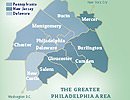
More than $17 million was raised for an organization called Select Greater Philadelphia to promote the three state, 11-county region. That’s the good news. The bad news is that Atlanta has raised $50 million for the same purpose. Also unsettling is that Mercer County is just one of the 11 counties – the northernmost county — that this organization touts.

Some of the money helps court the 700 site selection consulting firms that virtually control corporate moves worldwide. Brandishing the Philadelphia name, Select Greater Philadelphia says that global companies shrug their shoulders at a mention of “Robbinsville” or “Bucks County,” but they perk up at a mention of “greater Philadelphia.”

Wait a minute, Greater Philadelphia folks. You are forgetting the huge name recognition that Princeton has in the area that some are trying to brand as Einstein’s Alley.

Maybe you sidestep the Princeton connection because much of the “greater Princeton area’ is out of your bailiwick — in Middlesex & Somerset counties? Or maybe you want the Robbinsvilles of the region to sign on to the Greater Philadelphia’s efforts, rather than clinging to the Greater Princeton region.

Given that Greater Philadelphia has $17 million, Greater Princeton has a small budget, and Einstein’s Alley has zilch, maybe that would be a smart choice after all. Or maybe New Jersey should rethink how much funding it gives to the Einstein’s Alley initiative.

No matter how you map it, a regional approach can help provide what Schweiker calls “political cover” for government officials when chauvinistic voters and churlish bloggers resist losing jobs to a neighboring state.

And this was a valuable conference. Tom Morr, CEO of Select Greater Philadelphia, offered two useful options. Go to him for demographics and stats on this region, second in size only to greater New York. For instance, the region from Princeton to Wilmington has 46 million people making an average wage of $54k and a total of $1.3 trillion in total income. “We have the research, contact us,” he says.

You can also sign up for Morr’s database of “ambassadors,” people he can call on to talk to prospective move-ins. For instance, if you are in HR, sign up to speak to your opposite number at a company that might move here. You have the local knowledge they need to make the decision to move here.

Select Greater Philadelphia will release its annual report at the 11 county, three state “State of the Region” breakfast on Friday, May 8, at 8 a.m. at the Pennsylvania Convention Center, 12th & Arch Streets.

Moderated by Tracey Matisak of WHYY, the panel included Charles Cascio of ETS who presented ETS’s report “America’s Perfect Storm,” , noting that in three hours, 400 U.S. students will drop out of high school.

Elizabeth Maher Muoio of the Mercer County Office of Economic Development and Sustainability, quoted stats saying that a 10 percent increase in capital brings a 3.4 percent increase in productivity, a 10 percent increase in hours brings a 6.3 increase in productivity, but a 10 percent increase in education results in an 11 percent increase in productivity.

Edward Kurocka of Mercer County Workforce Investment Board and OnSight Advisors, quoted the equation “Ability plus motivation equals performance,” and notes that if students don’t have motivation, the results are zero.

Do we need all hands on deck for this education storm? We do. But instead of the traditional tasks, bailing and battening down the hatches, we can each volunteer to mentor students to help them get ready for the workforce. One of of the top three factors in choosing a new corporate location is the availability of a skilled workforce. How, when, and where can we do this mentoring? I don’t know, but I’ll try to find out.

All Hands on Deck

“We need all hands on deck,” said Mark Schweiker, CEO of the Greater Philadelphia Chamber of Commerce, at the breakfast for Mercer and Princeton chambers this morning at ETS’s Conant Hall. Pitching regional marketing versus fighting tooth and nail to keep businesses from crossing the Delaware into Pennsylvania, Schweiker pointed out that rush hour traffic is heavy in both directions on the Scudders Falls bridge. “As we build our brand, we need to remember this is a global marketplace. No one city or county has ‘got it.’”

More than $17 million was raised for an organization called Select Greater Philadelphia to promote the three state, 11-county region. That’s the good news. The bad news is that Atlanta has raised $50 million for the same purpose. Also unsettling is that Mercer County is just one of the 11 counties – the northernmost county — that this organization touts.

Some of the money helps court the 700 site selection consulting firms that virtually control corporate moves worldwide. Brandishing the Philadelphia name, Select Greater Philadelphia says that global companies shrug their shoulders at a metnion of “Robbinsville” or “Bucks County,” but they perk up at a mention of “greater Philadelphia.”

Wait a minute, Greater Philadelphia folks. You are forgetting the huge name recognition that Princeton has in the area that some are trying to brand as Einstein’s Alley.

Maybe you sidestep the Princeton connection because much of the “greater Princeton area’ is out of your bailiwick — in Middlesex & Somerset counties? Or maybe you want the Robbinsvilles of the region to sign on to the Greater Philadelphia’s efforts, rather than clinging to the Greater Princeton region.

Given that Greater Philadelphia has $17 million, Greater Princeton has a small budget, and Einstein’s Alley has zilch, maybe that would be a smart choice after all. Or maybe New Jersey should rethink how much funding it gives to the Einstein’s Alley initiative.

Chauvinism aside, this was a valuable conference. Tom Morr, CEO of Select Greater Philadelphia, offered two useful options. Go to him for demographics and stats on this region, second in size only to greater New York. For instance, the region from Princeton to Wilmington has 46 million people making an average wage of $54k and a total of $1.3 trillion in total income. “We have the research, contact us,” he says.

You can also sign up for Morr’s database of “ambassadors,” people he can call on to talk to prospective move-ins. For instance, if you are in HR, sign up to speak to your opposite number at a company that might move here. You have the local knowledge they need to make the decision to move here.

Select Greater Philadelphia will release its annual report at the 11 county, three state “State of the Region” breakfast on Friday, May 8, at 8 a.m. at the Pennsylvania Convention Center, 12th & Arch Streets.

Moderated by Tracey Matisak of WHYY, the panel included Charles Cascio of ETS who presented ETS’s report “America’s Perfect Storm,” which says we need to batten down the hatches for education.
Edward Kurocka of Mercer County Workforce Investment Board and OnSight Advisors, Elizabeth Maher Muoio of the Mercer County Office of Economic Development and Sustainability, moderated by WHYY host Tracey Matisak — had lots of good information Cascio presented the ETS report “America’s Perfect Storm. but that’s for another time.

Please note that though I am a member of the board of the Princeton chamber, representing U.S 1 Newspaper, this blog does not represent the views of either organization.

Write it yourself: “What You Will”


One of the joys of being a critic is that you get to pronounce judgment on a work of art. One of the burdens is that you have to pronounce judgment on a work of art.

My training is to be a dance critic, and when I was active in that arena, the burden sometimes outweighed the joy. I couldn’t simply say “Great performance. Loved it’ and just appreciate the good parts. Even now, when I’m not reviewing a company, that bothersome little voice is asking, “but what do you really think?”

So when I read Jonathan Elliott’s U.S. 1 Newspaper review of the same production that I had previewed for U.S. 1 the week before, I was grateful that I had been able to attend this performance as an audience member, not a critic.

Elliott thought the production, directed by Keith Baker and choreographer Donald Byrd, didn’t work, but I thought it did. Actually, I loved it! Almost everything he didn’t like, I either didn’t mind it, or I thought it was terrific. That’s the advantage that you and I have over everyone who does not have the chops and/or the obligation to be a working critic. We can sit back and enjoy.

This should not be cited as a review. I am not a critic, and though I have seen Shakespeare, I have not seen another Twelfth Night. But here is a shout out for:

The musical concept: Justin Ellington’s score — sometimes played from the DJ’s booth above the stage, sometimes by the strolling violinist, sometimes by the stage manager — did not get in the way of the lines for me. It’s too bad all this background stuff made it necessary to mike the actors in this tiny theater, but oh well. The opening production number worked and the seven songs were terrific, especially when sung by Trevor Vaughn as Festus, who was engaging, funny, and, clear. I could hear and understand (almost) every word.

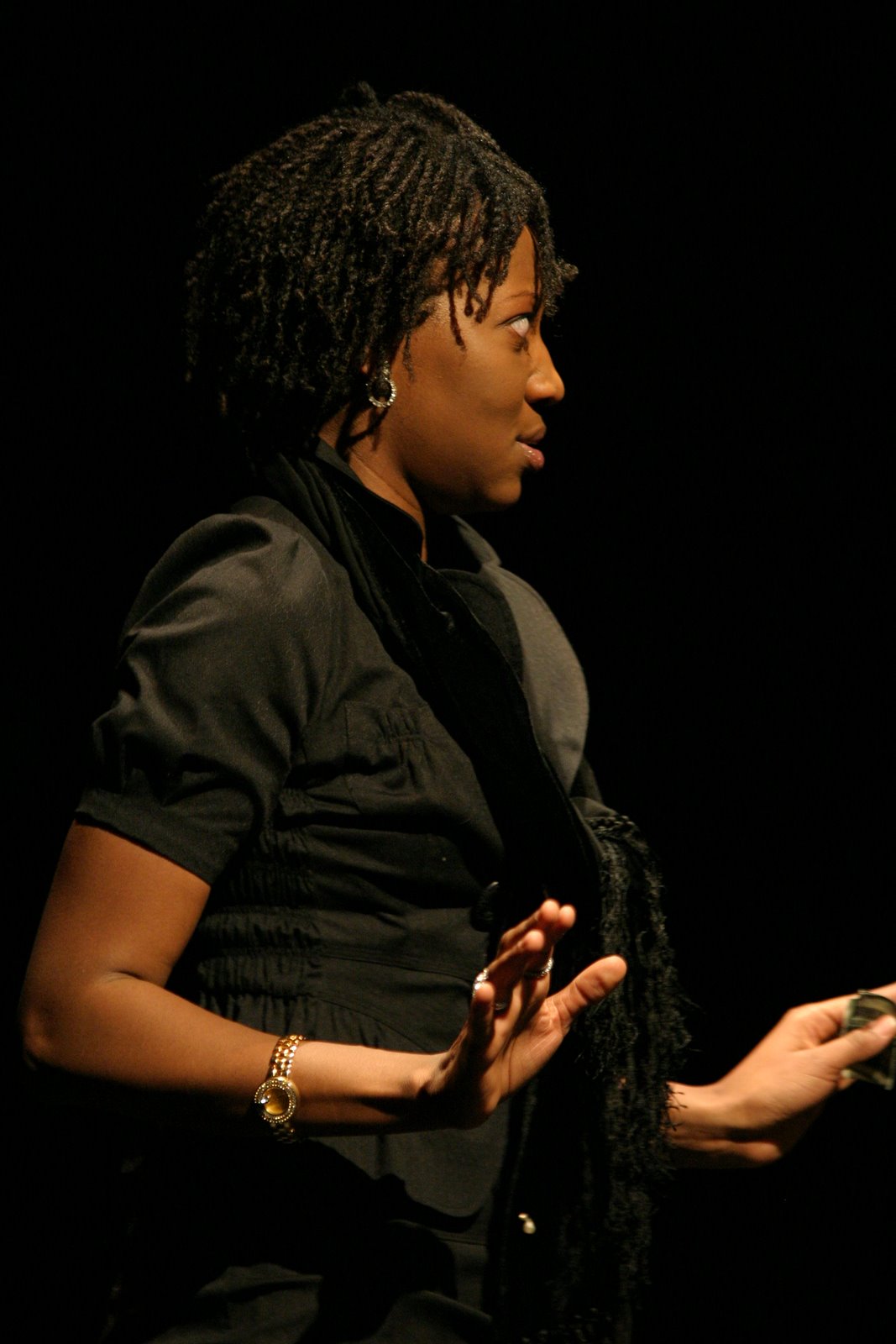
The character concept. Both reigning monarchs were African American. Miriam Hyman as Olivia (pictured) was styled to the hilt and glam behind those shades. She had SO much presence and authority that you believed she was in love with that twerp Viola, played by Christin Sawyer Davis with winsome clarity. RJ Foster was an oh-so-cool Orsino, though I was chagrined that he touched a basketball just once, whereas I’d given the impression he would be dribbling throughout. He also had charming authority and looked, shall I suggest, presidential?

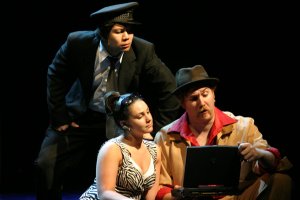
The bawdy shenanigans as translated into today’s gadgets. Yes it was hokey when Valerie Issembert as Maria,Jackson Loo as Fabian, and Abe Goldfarb as Sir Toby Belch (pictured) pulled out their blackberries and computers, but I’m happy to suspend my disbelief.

Most of all, natch, I liked the stage movement and dances. Byrd used Gabriel “KwikStep” Dionisio brilliantly. Yes, he’s a pro break-dancer, but, especially in the first act, Byrd had him using break-style movement to accent the action, like a Greek chorus, adding emotion to the words. More important, especially at the start, the actors’ movements, in hip hop style, helped to portray their characters more vividly. And, as expected, the break-dance duel/duet was terrific. (Byrd’s contributions as co-director were apparently so significant that somebody forgot to note, in the program, that he was also the choreographer. Very unfortunate.)

“What You Will” continues at Bristol Riverside Theater, 35 minutes from Princeton, through March 1. In a splendid coincidence, McCarter’s traditional version of the play is coming up from the Shakespeare Theater Company in Washington DC starting March 10. So you have a chance to see both versions and decide for yourself on the merits of the BRT version.

The critics can say whether it’s Good Theater or Art. You get to say whether you liked it. Where? Respond to the review at U.S. 1 newspaper, comment on this blog, or comment on the play’s website, www.howwewill.org. Or look at the very favorable reviews in the Philadelphia Inquirer or Curtain Up. and respond.

I know how hard it is to comment, even anonymously, and I don’t expect many responses. Why? Because McCarter has gone to a great deal of trouble to set up an audience reaction website. Just one person has responded re the latest production, Mrs. Warren’s Profession.

But performers are hungry for feedback. So are funders. This production was heavily subsidized by the Pew Charitable Trusts.

So do the artists a favor, weigh in. Go. Then say whether you think this approach can help capture the hearts and minds of texting and Twittering teens? Or should we make the original version more appealing?

And PS, artists, if you want to keep on getting reviewed in print publications, send your letters of appreciation to the publishers. In this publishing environment, critics are an endangered species.
Wednesday: Wang Welcomes You to Your Brain

Sam Wang is one of the smartest, funniest, scientists you’ll ever meet. At least I think so — I’ve not met him, only talked to him on the phone, but he’s been interviewed all over the place, nationally, and he talks smart and funny and also blogs that way (www.welcometoyourbrain.com).

Plus his topic matters to us. Both you and I care about our brains, and Wang co-authored a book, “Welcome to Your Brain: Why You Lose Your Keys But Never Forget How To Drive And Other Mysteries Of Everyday Life.” which tells things you need to know, whether you are a parent with growing children or, like me, a grandparent who is not Going Gently Into That Good Night. Engagingly written for the general reader, reissued in paperback in December, it won the American Association for the Advancement of Science prize as the best science book for young adults.

Wang will speak at a Princeton Chamber breakfast on Wednesday, February 18, at 7:30 a.m. (program starts at 8) at the Nassau Club, 6 Mercer Street, Princeton. Cost: $30 ($20 if you are a member of Princeton United Methodist Church or are otherwise a member of the chamber). Register at 609-924-1776 or go to http://www.princetonchamber.org or email me for questions (bfiggefox@gmail.com) It’s not too late to sign up!

Here are some Welcome To Your Brain myth busters:

Playing classical music to babies doesn’t help their development. (Sorry, Baby Einstein).

Moderate drinking does not destroy brain cells.

Exercise, not puzzles, helps retain brain cells at any age.

To hear better on a cell phone, cover the mouthpiece, not your other ear

Vaccines don’t cause autism.

Wang got lots of coverage recently for his views on left handedness. He notes that southpaws have a better chance to be president of the United States than we right handers: “Six of the 12 chief executives since the end of World War II have been left-handed: Harry Truman, Gerald Ford, Ronald Reagan, the elder Bush, Clinton and Obama,” writes Wang.”That’s a disproportionate number, considering that only one in 10 people in the general population is left-handed.”

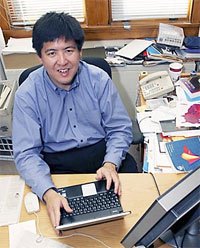
Wan is a graduate of Cal Tech and Stanford and has lots of scientific mojo, as seen in his lab’s blog. But he is also a man after my own heart because, judging from the photo, he is a smart guy with a messy desk. Messy desks are my specialty. I’m eager to hear what that says about my brain.

For Veterans: Music Alone Shall Heal


The Veteran’s Day service, staged last November by the Army ROTC’s Tiger Battalion at Princeton University Chapel, featured a speech by healthcare expert Uwe Reinhardt, the presentation of a check to the Wounded Warriors Project, and some perfectly beautiful music. Mary Rorro, a staff psychiatrist at the veterans’ affairs clinic in Brick, stood in the pulpit to play, unaccompanied, Amazing Grace and some other poignant melodies.

I had a brief conversation with her about how her music helps patients, and how she works with Give an Hour Foundation, which encourages mental health professionals to donate time to veterans and their families. She hopes that other health professionals will follow her lead to provide music.

Now Rorro has been featured in a PBS special “Healthy Minds,”, shown yesterday and repeating Tuesday, February 17 at 11:30 p.m. on New York’s WLIW 21. Michele Angermiller, a freelance writer, tells about Rorro’s life (she grew up in Lawrenceville and played with the Greater Princeton Youth Orchestra) in the Times of Trenton in “An Overture to Treatment,” published today.

In times of grief or trauma, what comes to my mind are the lyrics to a Girl Scout song, a canon, “Music Alone Shall Live.” Sometimes music is the only thing that helps.