Category Archives: Uncategorized

Celebrity Admiral


The last time I saw this much excitement about a celebrity speaker in Princeton’s venerable McCosh Hall was when Cindy Crawford came, some 20 years ago, to talk about women’s body images. Admiral Mike Mullen, the four-star admiral who heads the Joint Chiefs of Staff, the man who advises the president on war and peace, visited the university’s Woodrow Wilson School on Thursday, February 5, when more than 300 people lined up in the cold to hear a major policy address, “Global Trends and National Security.”

They were – and I was – eager to hear his thoughts on Iraq, Afghanistan, Gaza, Pakistan, China, NATO, Mexico, Korea, wherever – to hear anything that could put this mixed-up world in perspective.

And as a former Army wife, I was eager to see how a four-star admiral would address a potentially hostile civilian audience. Mullen was Class of ’68 at the Naval Academy, which makes him a half-dozen years younger than my husband’s West Point classmates. I guessed that the man who holds the highest military rank in the nation (second only to the President and the Secretary of Defense, and those guys don’t wear uniforms) would look like a Greek god and talk like John F. Kennedy.

In came the entourage. The least-likely looking naval officer took the stage, not the blonde, handsome one, but the one with the thinning hair and glasses. Lithe like an athlete (which he is, a swimmer and lifter), he had the look of a professor (thoughtful, mild), and the aplomb of, well, an admiral (photo by Navy Petty Officer 1st Class Chad J. McNeeley.)

Without notes, he talked for 40 minutes, and took nearly a dozen questions. I admired his humanity, his common sense, his wide-ranging knowledge, his concern for the troops — and his style. I was also vastly relieved. Here was a Person in Charge who made sense.

Opening with an anecdote about how he’d always wanted to come to Princeton to play basketball with Bill Bradley, Mullen referred to his growing up in the Hollywood scene. According to an NPR interview, his mother was at one time an assistant to Jimmy Durante and his father was a press agent who hobnobbed with the stars and developed relationships with the likes of Hedda Hopper. I can see that in him. He kept talking about his relationship with his opposite numbers in Pakistan, in China, Korea, Russia, everywhere. Relationships (another word for that is charm) are the bread of butter for any good press agent, and he apparently learned about that at his father’s knee.

For all of what Mullen said, see my verbatim notes, online as a Google doc, but here’s what struck me.

Mullen’s most intriguing idea: That career government employers — beyond the military, the Peace Corps, and the diplomatic service – should have an opportunity for overseas service. Under what he calls a “whole-government approach,” careerists in such federal departments as commerce, transportation, or agriculture would be shipped out to contribute their expertise. Current examples include farmers in the National Guard, who are agriculture mentors, but they could just as well be civilians.

His scariest observation: That the global financial crises will produce unrest, and we have absolutely no idea where that will break out.

His most comforting point:
That he promises to take care of the soldiers and their families. He praises the current force, opposes the draft, and has reduced the 15 month tours to 12 months on, 12 months off.

(I’m also curious about how Mullen, as a Naval officer, experienced his own assignments where his family didn’t accompany him. In peacetime at least, Army and Air Force families generally get to have more time with their soldiers, because usually they can live near the duty station. But even in peacetime, Navy ships go to sea for long periods of time, and on Navy pay it’s nigh unto impossible to meet your sailor in every port.) Maybe stints of 12 months seem normal to him. They seem pretty tough to me.

Mullen emphasized to the civilian audience about how his job is to follow orders from the president, yet he has been accused of being too political. I say, when you are trying to win over a civilian audience in a time of war, you’d darn sight better come across as caring and earnest, and if that sounds political, so be it. That goes for his dealings with four-star officers in other countries. Glamor might sell lipstick and furniture, but when you are pitching a peaceful alternative to war, relationships count.
Einstein Alley: the Good News Bears


Here’s some good news for a change. At an informal get together for Central Jersey tech entrepreneurs, I kept running into guys whose companies are doing quite well, thank you, in part because their particular technologies are in high demand.

This group of entrepreneurs has been hanging out together for several years. The almost monthly happy-hour style meetings usually offer panels, speakers, and plenty of helpful networking. For this January party, a buffet at Charlie Brown’s in Kingston, it was all chat.

They call themselves the Einstein’s Alley Entrepreneurs Collaborative, not to be confused with the official Einstein’s Alley organization that evolved from meetings convened by U.S. Rep. Rush Holt and is now headed by Katherine Kish and Lou Wegman. The official organization certainly works with entrepreneurs, but has no exclusivity..

In contrast the collaborative’s founders, Steven Georges (former CFO of Princeton Server Group, sold to Telvue) and John Romanowich (founder of SightLogix) wanted to create the ambience, much admired, of a Silicon Valley bar, where insiders gathered and ideas got drawn on the back of a napkin. Steven and John keep the group small and focused.

Its mission statement: to be a Central NJ network of
entrepreneurs and service providers to entrepreneurs, built by entrepreneurs
for entrepreneurs. Says Georges: “It is not sponsored by any group, and we maintain a
culture of mutual trust and support by not allowing anyone to use our
network to sell anything to anyone.”

New members must be invited by someone who is already a member. Reporters (me) were welcomed at these gatherings, but the proceedings were off the record. Sometimes I did stories on people I met there, but never on the meeting itself.

So I didn’t go to the party thinking I would write about it. But I did take some photos. I kept running into interesting stories – and now I have dispensation to reveal their source. Here are some of the Good News Bears.

Art Suckewer, founder of Knite Inc. on Forrestal Road. His 12-year-old company has what Detroit wants – a Kinetic Spark Ignition System that produces a faster and more complete fuel burn.

Bob Gupta, CEO of Venaca at 4390 Route 1 North. Gupta moved this company to 4390 Route 1 North in order to do a turnaround. It does digital asset management systems – to store, search, edit, share and distribute content — across multiple distribution platforms.

Tor Dybest, CFO of HDlogix in Edison. Here’s another firm smack in the middle of the digital video revolution.

Bob Dombrowski, business development manager of the materials science division of EMSL Analytical Inc. in Westmont, NJ. It provides materials testing, characterization, and forensic laboratory services for commercial, industrial, regulatory, and law enforcement clients. One of its competitors, closer to home, is Chilmark Technology on Plainsboro Road, also doing well. Apparently no other companies do what they do.

Others are upbeat. An entrepreneur who can’t be named, because he goes to work every day on Washington Road, has started a mobile device software consulting firm, Radix2Solutions (Hugh@Radix2Solutions.com). That
website went live in January.

To get an invitation, check out the photos to see if you know someone in the group. Also attending were Rick Ober of Charis Pharmaceuticals, Doug Dixon (www.manifest-tech.com) who writes cover stories for U.S. 1 Newspaper, Lloyd George CPA of Financial Architecture, Stuart Malakoff of Merrill Lynch, Jeffrey Salton of UBS, Joanne Gere of Bioscience Collaborative, Kevin Howard of Oldwick Consulting, Bob Nicastro, Jeremy Kestler, an e-learning consultant, Dick Woodbridge (now of Fox Rothschild) and Nicholas Stevens of Siemens Communication. Or e-mail sgeorges3@comcast.net

Zweena: Finding the Sweet Spot for PHRs

Shake up the health care system, urges Janet Rae Dupre in her “Unboxed” February 1 New York Times column, “Disruptive Innovation, Applied to Health Care.” She hopes that the country will “innovate its way toward a new health care business model – one that reduces costs yet improves both quality and accessibility.” One way is to create what Princeton University’s Uwe Reinhardt calls a continuum of care that follows patients wherever they go and prevents needless tests and confusion about competing medications.

But even if President Obama follows through on his promise to use technology to improve healthcare and lower its cost, such change is a long way off, I fear. Until then, individual consumers need to figure out how to keep track of their own health records, and the best way I’ve found is to create a web-based Personal Health Record (PHR) through a Princeton-based start-up called Zweena Health (screen shot of home page shown).

PHRs are ideal for a scatterbrain like me, for whom digital everything is a godsend. I keep my calendar and address book on the web, so when I lose my paper copy for the umpteenth time, it’s still there. I get and pay my bills electronically, so when I forget what I paid to whom, it’s right there. Now that my personal health record is available through Zweena, I no longer have to worry about filing my mammogram, blood pressure, and colonoscopy records. When did I have that mammogram? It’s right there.

But I have a more important reason to value Zweena’s service: my husband’s two life-threatening conditions – heart disease (he had a triple bypass) and kidney cancer (he had a kidney removed plus chemotherapy). He’s fine now, but we make a regular circuit of six doctors’ offices and the occasional hospital visit, and he goes to three different hospitals. It’s crucial to his health that the nephrologist knows what the oncologist and cardiologist are doing, and the Zweena service will certainly help that. It could conceivably save his life.

Some object to the potential privacy invasion that PHRs might bring. The privacy of the health record is not that important to me because I don’t need to hide anything from an employer or anybody else. As someone commented on Matthew Holt’s Health Care Blog, “Is our energy truly best directed to worrying about 1) preventing a potential privacy violation or about 2) preventing getting killed or maimed in the health system due to lack of information technology and care providers having the right information at the right time?”

Some PHRs are being kept by insurance companies, some by employers. But I wouldn’t want to have to change services because my insurance changed, or because my job changed, and Zweena clients will own their own records and choose who gets access to them.

Zweena nurses do all the data entry, versus doing it yourself. Nancy Finn (who blogs on Healthcare Basics and was quoted on e-patients.net ) had success with entering her own information in Google’s answer to PHRs. I’m not sure I would be as successful. During the year of my husband’s cancer treatment I managed to keep track of his medical records, but now I’m back to being careless again. If typing in the data were left up to me, I’m might lose the records before I got around to entering them. I would be better off going back to my old system – stuffing everything in a briefcase. At least then I would know where they were. Zweena overcomes the laziness barrier.

I do not anticipate that my carelessness will improve as I age, nor will my health improve, and there may come a time when my children – in the so-called sandwich generation — will need to monitor my medical care. When I did this for my 96 year old mother, I traveled to Baltimore to accompany her to doctor’s appointments. But in the digital age, the doctor could put my daughter on a conference call in her office, and my daughter would have access to that day’s record of the office visit through Zweena.

Full disclosure: As a reporter for U.S. 1 Newspaper I had interviewed John Phelan, who founded Zweena to try to create a workable business and technical model for PHRs. Also a family member has a professional interest in e-health initiatives – but this background has alerted me to what other services are available. I’m eager to hear about alternatives, but so far I haven’t found another service where the service’s professional does the data entry, yet the patient owns the record.

There are oh-so-many other advantages to letting technology creep into the health care system, starting with improved doctor/patient communication, but digital personal health records will really come into their own when all the hospitals go digital. Case in point: my husband just had outpatient surgery at a fine hospital in Philadelphia. As he progressed through the system, seven nurses and doctors asked essentially the same questions seven times, each entered the answers on their own clipboards. In a hospital with digital records, entries could be made just once.

Two Chiantis equals One Martini

That a martini counts as two drinks, not one, was just one of the startling facts I learned from addiction doctor Arnold Washton at the Princeton Chamber breakfast on January 14. Washton counsels CEOs, doctors, and lawyers who realize they have a problem but who don’t want to declare themselves alcoholics. As financial problems rise, so will addiction rates, he predicts. Neither animals (lab rats) nor humans handle uncertainty well.

Washton is a substance abuse consultant for Princeton House Behavioral Health who has his own consulting practice, and he spent 10 years working with heroin addicts in Harlem. He says it is hard to pick out a substance or alcohol abuser in the workplace. “I can’t remember the last time somebody walked in my door looking high or drunk,” he says. Abusers build up tolerance.

It doesn’t matter what you choose – beer, wine, or distilled spirits – to relieve your anxiety, says Washton. The brain responds to the concentration of alcohol in your blood. “Every time you take a drink, you are playing with your brain chemistry.” Some alcoholics don’t drink every day – they go on binges, or maybe they drink on the weekends.

“People gravitate to substances that work, but the substance betrays them,” he says. Caffeine and nicotine are addictive, but they do not induced aberrant or psychotic behaviors that lead people to do crazy, self destructive things. For information, go to SAMHSA’s National Clearinghouse for Alcohol and Drug Information.

For those whose problem falls short of addiction, Washton offers the hope of continuing to drink in moderation. The upper limits for what can be considered a moderate drinker: For a man, three to four units of alcohol per day, but no more than 14 per week. A unit is 5 ounces of wine, 12 ounces of beer, or 1 shot of distilled spirits (martinis count for two). It’s that “14 a week” that’s key. You can’t drink three beers a day every day and still be counted as a moderate drinker.

For women, the moderate level is 2 to 3 drinks per day, and only 7 per week. (I’m such a cheap date that I’m pretty much done in by 4 ounces of wine.) Those with a family history of addiction should observe a lower limit. Medication affects the limits, and alcohol makes sleep problems worse.

To cut down to “moderate” levels, his patients must abstain for one or two weeks. He presents it as “an interim period of abstinence” versus requiring them to attend an AA meeting. “It doesn’t work to tell them to stop drinking for the rest of their lives. For my patients, that’s unthinkable. The more severe the problem, the more reluctant they are to give it up.” After the abstinence period, the patients help set their drinking rules. “When they fail miserably, they see it is what they did.”

Some eventually realize they need to abstain. “I pair them up with another high profile business executive who is already going to AA.”

The best advice: Don’t drink when you are upset. Break the cycle of self medication.

John Martinson’s Recession Lemonade

“Make lemonade with recession lemons” seemed to be John Martinson’s message on Thursday, January 8, when he spoke to ACG-NJ, a networking group for merger & acquisition pros, at an evening meeting at the Westin Princeton. (Pictured at right, attendees Katherine Kish of Einstein’s Alley and Market Entry, Grazina Crisman of Seniors A2Z and a sponsor of the evening, and Lisa Snyder of KT Benefits and NJAWBO).
Martinson is the managing partner of Edison Venture Fund, which made 11 new investments in 2008, and 14 follow-on investments. In Central Jersey, their portfolio includes Billtrust, CheckpointHR, Exclaim, Systech, and Voxware. Edison VCs expect to invest more than $100 million next year mostly in software firms, on the eastern seaboard. Martinson set the stage by saying that his top companies grow more than 40 percent a year, and then he proceeded to tell how to “Grow Your Company in a Down Economy.”

Of all his good tips, what stuck with me were his percentages. He and his VCs spend 80 percent of their time on the top companies in their portfolio, just 5 percent of their time on the worst performers.

Here’s the bitter lemon part: Each of their portfolio companies is required to prune the workforce by 10 or 20 percent every year. Decisions about who ranks at the bottom are made in October and November, and they are announced “at the worst time of the year,” Martinson admits, at Christmas. These cuts are spread out on all levels, not just junior staff.

Well no wonder Edison companies typically grow over 40 percent a year. If you knew that you might lose your job at the end of the year, you’d work really hard even in the dog days of August.

On the upside, when you cut your workforce you can upgrade your team at all job levels, and in 2009 you will have great opportunities to hire “stars” at bargain prices.

And Martinson likes to boost morale with increased commissions and incentives. ‘It thrills me, he said, “when very successful salesmen swagger around because they make a half million dollars.” Incent everybody else to find revenue as well. “It’s amazing what they will deliver.”

Another tip: “Sell what’s ‘on the truck,’ which may not be what the customer is asking for.

Don’t assume your potential customers can’t buy. Send unsolicited bids – you may have just what they didn’t know they needed. Leverage their compliance fears that they might not following regulations. (15 percent of Edison’s companies’ revenues come from software that helps financial and pharma companies stay compliant, and it’s the difference between 25 percent and 40 percent growth.)

(I would extend that advice to job seekers. Send unsolicited query letters to companies you’d like to work for, because these companies may be need an extra hand, yet be pinching pennies tightly and be unwilling to fork over employment agency fees. )

Those are a half dozen of the three-dozen excellent tips Martinson gave, but his main message is that savvy leaders take advantage of the down economy. Competitors are weaker, top sales talent is available, and success is sweeter.

Most of the attendees were lawyers, accountants, insurance agents, and other service providers, but there were a couple of dozen CEOS, and a raised-hand poll showed, indeed, that most of them had a growth year last year and expect to grow this year. I wonder how many of them are prepared to fuel their growth by firing two or three of their 20 employees – and then replacing them with “stars.”

It’s a good thing I don’t run a company. Success may be sweet, but that recipe for lemonade might upset my digestion.

Weighing in on Sustainable Energy, or, What is that cold draft on the back of my neck?

I just returned from Princeton Public Library, where a four-person panel from We Are BOOST (We are building open opportunity structures together) held forth for two hours on new approaches to community building and creating an environmental economy. They fielded questions from an excited and involved audience of about three dozen.

Pictured, from the left, are Jason Kliwinski of Spiezle Architectural Group, Elizabeth Slate of the Alchemical Nursery Project, Anastasia Harrison, an architect with WESKetch, and Tim Razzaq, the founder of Trenton-based BOOST. Razzaq was an excellent moderator and is the subject of a U.S. 1 Newspaper article to be published January 14, but I want to set down a couple of points before I forget them.

Slate, a young mother from Syracuse, New York, is working long-term on an “eco village” that will be self sufficient, but in the short term she tells about a warehouse to showcase all kinds of sustainable ventures, notably a store, run by Habitat for Humanity, that stocks donated building supplies from torn-down houses. What a great idea and why don’t we have it here? It reminds me of Geri La Placa’s recycling of durable medical goods through the Ewing-based organization called Your ReSource. (It has a good web page for all kinds of places to donate stuff, including oddities like unmatched shoes).

Harrison, who worked for a decade in Europe, told of a way to use trees that must be cut down in order to build an addition to your home. She knows of an entrepreneur who drives a wagon of Clydesdales (yes, like the beer ads) to the site, fells the trees, hauls the trees to Pennsylvania, mills them, and returns them to be used on your floors or in cabinets and furniture. She recommends, as a starter book, “Green Building and Remodeling for Dummies.”

Kliwinski, who is working on a “green” addition to the Nassau Inn, among other projects, told how New Jersey (despite protests from builders) has adopted a state-wide energy master plan calling for new construction to be 30% more energy efficient than the current energy code and through Executive Order 54 established a phased plan for reducing its carbon footprint significantly, as much as 80 percent reduction. Homeowners can look for ways to “build green” at the wholebuilding design guide (www.wbdg.org) and be carbon neutral at (www.architecture2030.org or http://www.earthlab.com) websites that aim to achieve a zero carbon footprint by 2030.

All kinds of job opportunities, including “sustainability consultants” are opening up. Contractors who want to better understand how to build “green projects” can take a course and pass a certification at Green Advantage.

The panel discussed solar energy solutions but warned, before you put in solar, do the basic stuff to seal your home. “Stop the bleeding first,” says Kliwinski. That’s what I decided when I talked to architect Bill Wolfe about how he rehabbed his old house to make it energy efficient. Before I tear my own house apart to install geothermal and solar panels, I need to replace the windows. It’s snowing right now, and with my back to those windows, I feel a very cold draft.

Here’s my idea to save greenhouse gas: organize neighborhood “hazmat carpools” to take advantage of the county’s drop off days.Mercer County collects old electronics and chemicals just three or four times a year, usually on a Saturday when I am out of town, and often the line of cars is so long that you wonder whether waiting in line will do more harm than good.

The next collection is March 28. If I’m in town, and if I get organized, I could offer take all my block’s recyclables this time, and maybe somebody else will help me out next time. (Cedar Lane folks, let’s do this!)

We should have a handier alternative, but until the county wises up, neighbors cooperating could save the day — and a few carbon credits.

Eric Maskin: on credit markets and potato markets

Eric Maskin, the Albert O. Hirschman professor of social science at the Institute for Advanced Study, has addressed several business groups in the last year, including chambers of commerce in Italy and China. Based on his theory of mechanism design – for which he shared the 2007 Nobel prize in economics – he explained the basics of this financial crisis to the Princeton Regional Chamber of Commerce today. His 20 minute lecture, at first, might have seemed almost elementary. But Maskin’s “elementary” is also “elegant” in its simplicity.

It reminded me of how my father taught human anatomy, presenting the information like a story, on a very basic level. Often the medical students thought they knew it already. Years later they would come back and say, “Remember that lecture you did on such and such? It really stayed with me.”

So although I considered myself ‘well-read’ on the sub-prime debacle, the credit crisis, and the bailouts, I realized — as Maskin took us through it, comparing the credit market to, of all things, the potato market — that I didn’t really comprehend the whys and wherefores. Then he introduced the economists’ term “externality,” the effect your actions have on others that you
don’t take into account. That added a whole new facet to my understanding.
I asked him for his Power Point notes, and he obliged.

Financial Crises: Why They Occur and What to Do about Them

Eric Maskin

Institute for Advanced Study

Princeton Regional Chamber of Commerce

January 8, 2009

• Current financial crisis

– only latest in long sequence

– history of credit crises goes back hundreds of years

• probably crises will continue in future

– each crisis somewhat different

– even if we “fix” mortgage loan market, something else will happen

• Today’s topic:

– why do credit market have repeated crises and other markets don’t?

– why does credit market require substantial intervention (and others don’t)?

Why is credit market different?

(1) credit lifeblood for rest of economy

− if crisis in market for potatoes, won’t bring down market for automobiles

− if credit market doesn’t work, enterprises in all markets will have trouble investing and meeting payrolls

(2) small shock to credit market often magnified

− if some potato growers fail, won’t cause other growers to fail

− if some banks fail, may well cause other banks to go under

(3) credit market not self-correcting

− if some potato growers fail, others will step into breach no outside intervention needed

− if some banks fail, credit market can get “stuck” – – no banks willing to lend

Elaboration on points 2 and 3

• Suppose drought wipes out potato crop in Idaho

• What will happen?

– immediate effect is fall in overall potato output

– but demand hasn’t changed – – fewer potatoes to go around

– so price of potatoes will be bid up

– induces other potato suppliers to grow and sell more

• So potato market “self-correcting”

– crop failure hurts consumers in short run – – higher prices

– but high prices induce suppliers to expand output

– so effect of drought mitigated in long run

• Government intervention not needed

• Government interference in potato market likely to make things worse

• Suppose puts cap on potato price or taxes “windfall” profits

– discourages expansion of output that can make up for crop failure

this creates potato shortage or black market in potatoes

• Credit market is just the opposite

• Suppose a few banks get into trouble

– make subprime mortgage loans

– borrowers can’t repay loans and housing prices fall, so can’t refinance

• these banks have other borrowers

– have to call loans in on these borrowers

– so borrowers have to scale back activities that depended on these loans

– thus will have harder time repaying loans from other banks

• so these other banks now may get into trouble

– may have to call in loans from their borrowers

– and refuse to make new loans

• what started as a local problem (subprime mortgage lending) spreads

to entire credit market

• initial problem not self-correcting (as in potato market)

– gets aggravated

end up with credit crunch

• in economics jargon, bank exerts an externality on other banks by calling in loans

– externality: effect your actions have on others that you don’t take into account

– when bank calls in loans, puts other banks in jeopardy

– but doesn’t factor this effect in when calls in loans (not harmed by it)

• markets with significant externalities often don’t work well on own

take clean air, for example

• Why isn’t there a market for clean air?

• in fact, there is such a market, but so limited we hardly see it

• suppose laundry next door to steel plant

– smoke from steel plant interferes with laundry

– laundry may offer to pay steel plant to reduce smoke (so market for smoke reduction exists)

– but smoke doesn’t just affect laundry – – affects many others

– by paying for reduction, laundry confers benefit on these others (externality)

– laundry doesn’t take this into account

– so likely to underpay for reduction – – smoke not reduced as much as should be

• solution: government imposes cap or fine on smoke emissions by steel plant

Solution for credit market:

If some banks get into trouble,

• government can bail them out

– infuse with capital so can continue to lend

• but bailout important primarily for other banks that would be hurt if bailed-out banks failed

Bailout policy comes at cost:

• if banks anticipate being bailed out when get in trouble

– have incentive to take on highly risky loans, e.g., subprime mortgage loans (moral hazard)

• so solution to financial crisis actually makes crisis more likely!

• Hence, bailout policy only partial solution

• Also need to regulate banks

– e.g., impose rules preventing subprime loans

bailouts and regulation go together

• Actually, two reasons why regulation needed

– prospect of bailouts induces banks to make too risky loans

– bank ignores externality imposed on other banks by too-risky loans – – undervalues cost of these loans

• If credit crisis allowed to spread to rest of economy, bailout policy may be insufficient

• just as important externalities in credit market, important externalities at level of whole economy

• Suppose one employer lays off workers (because it loses credit line)

– workers lose income

– demand less

– other employers get into trouble

– they lay off workers

• So, “stimulus” for real (nonfinancial) economy needed

– purpose: to prop up demand, so employment kept high

• temporary measure: until credit market healthy again

• Well-designed regulation/bailout package

– can prevent “many” crises from getting started – – rules against subprime loans would have prevented this one

– can resolve them if do occur

• stimulus package needed if bailout applied too late

• can’t hope to prevent credit crises completely and still allow for creativity

– can’t anticipate all possible innovations by banks

– so can’t have rules that prevent only harmful innovations

But can do a lot better than we’ve done this time.

College professors may tut-tut about their students’ writing these days, and I like to blame the Microsoft Word program for fostering mediocre grammar skills, but elderly laments about this are nothing new. I remember a particular Christmas Eve day when my father memorably complained about the composition skills of his first-year medical students.

December 24th was generally the day after the practical exam at the University of Maryland Medical School, where my father taught gross anatomy, edited an atlas of anatomy, and did cancer research. On that day my parents would surreptiously stow Santa’s treasures in the trunk of the 1948 two-door Ford and drive up Route 1 from Baltimore to my grandparents’ house near Philadelphia, enjoying the colored lights and singing Stille Nacht, in German, on the way.

But until dusk fell we would spend our time grading those exams – my father, my older sister, and I. That may seem shocking, but from an early age, we helped out. It was like being in retail and living over the store.You mixed business with pleasure, and you did what you could to contribute to the family business. A four-year-old can put handfuls of sawdust in a mouse bowl. A six-year-old can transfer mice from a dirty bowl to a clean bowl.

For the bluebooks, my sister and I, probably ages 10 and 7, were each responsible for one simple question, and our cue cards told how many points to award each of the possible answers. On one of those Christmas Eve days he turned the air blue when he read this answer: “The body is a mechanical mechanism.”

I didn’t really know the meaning of the vocabulary word “redundancy,” but that night I learned to avoid it. It was just one of the life lessons I learned that Christmas Eve. From my mother I learned that nothing is ever too much trouble to do to make loved ones happy — not just making wonderful presents for children, but also making the trips, unfailingly on Christmas, to grandparents.

Princeton Chamber at Jasna Polana


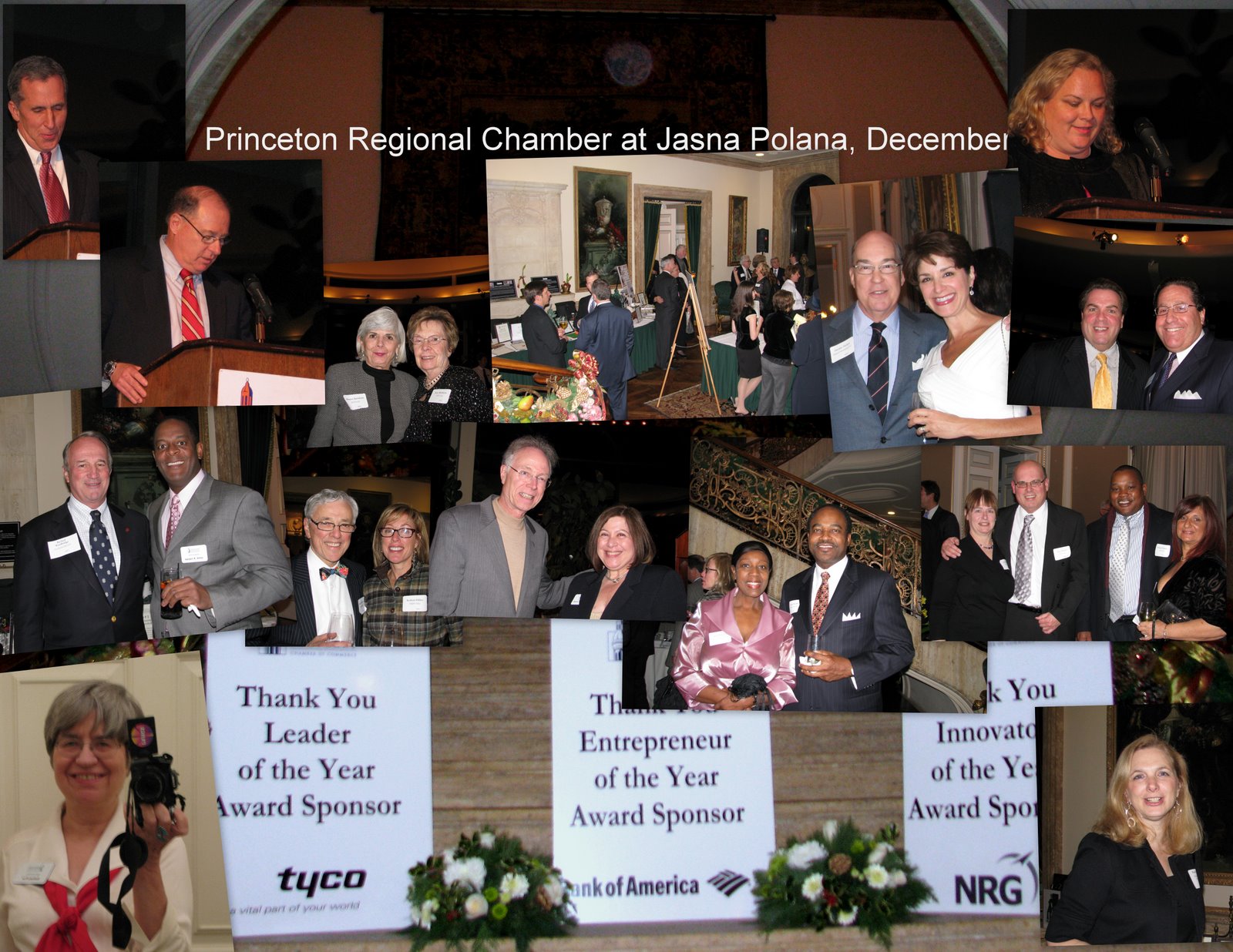
The Princeton Regional Chamber of Commerce finished up 2008 with a December 3 gala at Jasna Polana that honored Jack Morrison (the restaurateur), Kurt Landgraf (of Educational Testing Service) and Janet Vergis, of Janssen, McNeil Pediatrics & Ortho-McNeil Neurologics.

It was the first chamber gala I’ve attended, and I must say I was pleasantly surprised about what a delightful evening it was. It was twice as long as the usual chamber function, and in luxurious surroundings, and everyone was in quite a festive mood — in spite of the fact that eight of the people attending had had a grueling day (the previous day) interviewing potential candidates for the CEO job.

I am on the board of this chamber and thankfully not on that search committee, which was inundated with lots of highly qualified applicants. But I am quite happy with the search committee’s choice, voted on today, the name to be released next week.

Your Playing Small Does Not Serve the World


Odetta died, at age 77, on December 2. I’ll always cherish her music, but I will especially cherish the message that she delivered to me, directly, just to me.

It happened a couple of years ago at the Trenton War Memorial, in a weeknight “on stage” concert that was one of Molly Sword McDonough’s many triumphs at that venue. At these intimate concerts, tickets were limited to how many could fit on stage with the performer. My ebullient friend and I – the two of us are unquenchable extraverts – could barely contain our excitement at seeing, live and in person, our folk song idol, and we arrived early to get front row seats.

Obit writers do a better job of telling about Odetta Holmes than I can here. The New York Times notes that she was one of the most widely known folk-music artists of the 1950s and ’60s, and that she influenced Bob Dylan, Joan Baez, and Janis Joplin. Richard Corliss of Time magazine says, “In her commanding presence, charismatic delivery and determination to sing black truth to white power, Odetta was the female Paul Robeson.”

What I can tell is about this concert. Odetta walked onstage on the arm of pianist Seth Farber (a fabulous performer in his own right, by the way). She would sing her trademark spirituals and protest songs, plus some less well-known challenge blues, as “Rich man, you’re living in your mansions, you don’t know what hard times mean…. If it wasn’t for the poor man, mister rich man, what would you do?”

Her very first song, though, was “This Little Light of Mine,” and she opened with a quote from Marianne Williamson’s “A Reason to Love.” She looked right at me, saying “I want to bring you something about you.”

For unquenchable extraverts like me, these words are validating, liberating. They make it OK to be myself, and they make it OK for you to be yourself.

“Our worst fear is not that we are inadequate. Our deepest fear is that we are powerful beyond measure. It is our light, not our darkness, that most frightens us. We ask ourselves, who am I to be brilliant, gorgeous, talented, fabulous. Actually who are you not to be? You are a child of god. Your playing small does not serve the world. There is nothing enlightened about shrinking so that other people won’t feel insecure around you.”

“We were born to make manifest the glory of God within us. It is not just in some of us. It is in every one. And as we let our own light shine, we unconsciously give other people permission to do the same. As we are liberated from our own fear, our presence automatically liberates others.”

Odetta didn’t really speak just to me, of course. It just seemed so. Everyone in the audience – white, or black, at that moment, we all felt we were brilliant, gorgeous, talented, fabulous, children of God. That’s the power of a great performer. The power of a person with a great spirit is to inspire others to manifest the glory of God.