Tag Archives: Anthony Rabara Pilates

Joseph Pilates, Anthony Rabara — and Jacqueline Winspear

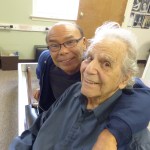
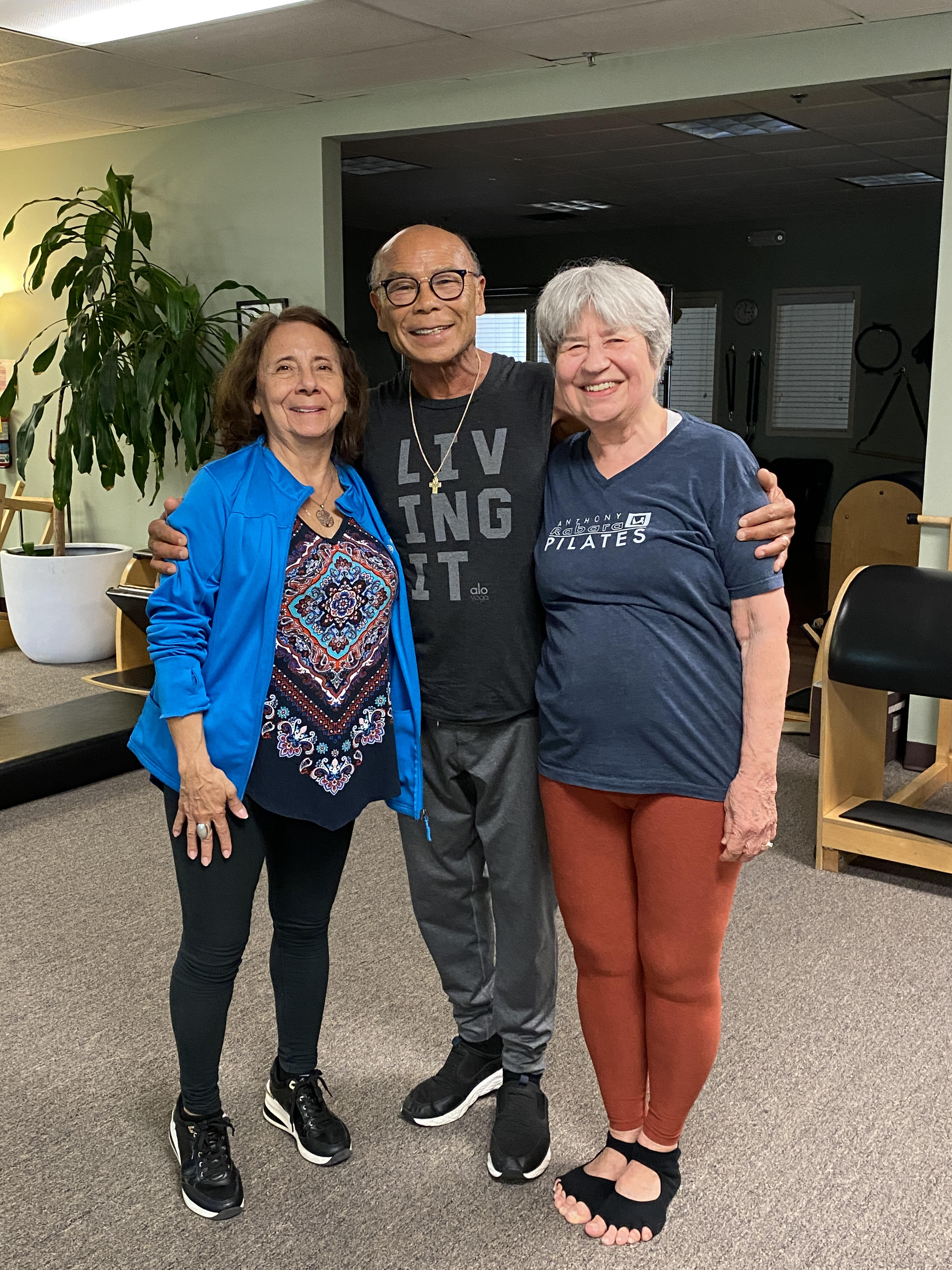
Sari Mejia Santo, Anthony Rabara, Me

I’ve been taking classes in the Pilates Method ever since Anthony Rabara brought it to Princeton in the ’90s. He teaches the purest form of the now famous body work devised by Joseph Pilates. Back then, this method was known mostly in the New York dance community. Rabara was one of the first eight trainers certified by Joseph Pilates’ protegee, the late Romana Kryzanowska.

Thanks to Rabara and his studio’s expert teachers – they go through more than 600 hours of training — my severe arthritis is held at bay. With discerning eyes they can spot the slightest misalignment and cue the corrections that prevent injury and strengthen muscles that you didn’t know you had.

This week I had the very exciting opportunity to study with Romana’s daughter, Sari Mejia Santo. She leads Romana’s Pilates International, which operates a global instructor network in 40 countries and 30 U.S. States. My lesson turned out to be a demo for a dozen instructors in the room. It was challenging, to say the least, but she made it fun.

In a delightful coincidence, I had just come across a passage in a Maisie Dobbs mystery by Jacqueline Winspear that mentions Joseph Pilates, who developed his technique on wounded soldiers during World War I. In “Birds of a Feather,” set in England between the wars, Maisie’s assistant, Billy, gets to “study exercises and movements to counteract the lingering effects of war time injuries.”

“What ‘e says, Miss, is that I’m increasing my core. . .

“Your core?” Maisie watched Billy brush out the mane of a mare with an enviable track record…

“There are all these different exercises, some to stretch me legs, some me arms, and me middle, and some are really small movements right ‘ere,” Billy pointed to his stomach with the curry comb, “which is me core.”

“Well, it seems to be doing you a lot of good. I saw you walk across the stable yard with barely a limp.”

“The main thing is that the pain ain’t what it was.”

So says Billy. The main thing, for me, is that going to the Rabara studio is fun – and the “really small movements,” as Billy puts it, keep me feeling young.

:
Not drinking the CrossFit Kool-Aid

In her inimitable wry style, Sara Hastings ‘reveals all’  about CrossFit, the rambunctious upstart of the Princeton fitness scene, in the January edition of Princeton Echo. 

I concur with the founder of Cross Fit who characterized the average gym as “predicated on a low to minimum wage, skill-less staff supervising hapless members. “ He concluded that “clients enjoyed a better workout environment, and he made more money, by training them in groups small enough that each athlete could get plenty of individual attention — rather than one-on-one. The shared suffering and shared satisfaction of completing a workout together transcends individual levels of fitness and forms the basis of the so-called CrossFit community.”

But Hastings failed to convince me that I — old enough to be her grandmother, with arthritic knees, a gimpy shoulder, and a back-that-sometimes talks-to-me — should join the CrossFit cult.

droppedimage
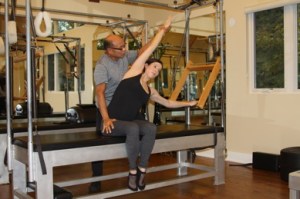
Anthony Rabara trains a client in the Joseph Pilates method. (I am not that client.)

I’ll stick to  Pilates at the Anthony Rabara studio where  I’ve been lucky enough to take lessons for more than two decades. Despite arthritis I’m sure not to get injured. When I walk into the studio I can say “my knee is tender today” or “my shoulder is out today” and the trainers adapt the equipment and the workout. Though I athletes and dancers train here, some clients are even more decrepit than I.

rabara-budmor
Anthony Rabara with Moshe Budmor

Ninety-two-year-old Moshe Budmor, for instance, worked out at the studio until just before he died.

I also value my “take it slow and easy” anti-aging yoga class taught by the amazing  Germaine Tartacoff . at Forrestal Village Fitness.  (Tartacoff has her own studio and also teaches a “rank beginner” class at Princeton Adult School. Anyone leary of joining a class with folks who already know the difference between Downward Dog and Tree — this is the class for you.)

In her enticement, Hastings touts the group experience. Plenty of people who have observed Crossfitters with a mix of what’s-the-point and never-in-a-million-years have tried it out and realized that not only does it work, it’s also pretty fun.

But at my age I cast a jaundiced eye at any training that has even a whiff of competitiveness. If I try to keep up I’m likely to injure myself. But — never say never. Maybe when I turn 80.

PS: Hastings suggests examples of CrossFitters who are more my speed — here and here