
Monthly Archives: February 2009

Battening Down the Philly Region’s Hatches


“We need all hands on deck,” said Mark Schweiker, CEO of the Greater Philadelphia Chamber of Commerce, at the breakfast for Mercer and Princeton chambers this morning at ETS’s Conant Hall. Pitching regional marketing versus fighting tooth and nail to keep businesses from crossing the Delaware into Pennsylvania, Schweiker pointed out that rush hour traffic is heavy in both directions on the Scudders Falls bridge. “As we build our brand, we need to remember this is a global marketplace. No one city or county has ‘got it.’”

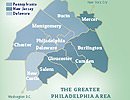
More than $17 million was raised for an organization called Select Greater Philadelphia to promote the three state, 11-county region. That’s the good news. The bad news is that Atlanta has raised $50 million for the same purpose. Also unsettling is that Mercer County is just one of the 11 counties – the northernmost county — that this organization touts.

Some of the money helps court the 700 site selection consulting firms that virtually control corporate moves worldwide. Brandishing the Philadelphia name, Select Greater Philadelphia says that global companies shrug their shoulders at a mention of “Robbinsville” or “Bucks County,” but they perk up at a mention of “greater Philadelphia.”

Wait a minute, Greater Philadelphia folks. You are forgetting the huge name recognition that Princeton has in the area that some are trying to brand as Einstein’s Alley.

Maybe you sidestep the Princeton connection because much of the “greater Princeton area’ is out of your bailiwick — in Middlesex & Somerset counties? Or maybe you want the Robbinsvilles of the region to sign on to the Greater Philadelphia’s efforts, rather than clinging to the Greater Princeton region.

Given that Greater Philadelphia has $17 million, Greater Princeton has a small budget, and Einstein’s Alley has zilch, maybe that would be a smart choice after all. Or maybe New Jersey should rethink how much funding it gives to the Einstein’s Alley initiative.

No matter how you map it, a regional approach can help provide what Schweiker calls “political cover” for government officials when chauvinistic voters and churlish bloggers resist losing jobs to a neighboring state.

And this was a valuable conference. Tom Morr, CEO of Select Greater Philadelphia, offered two useful options. Go to him for demographics and stats on this region, second in size only to greater New York. For instance, the region from Princeton to Wilmington has 46 million people making an average wage of $54k and a total of $1.3 trillion in total income. “We have the research, contact us,” he says.

You can also sign up for Morr’s database of “ambassadors,” people he can call on to talk to prospective move-ins. For instance, if you are in HR, sign up to speak to your opposite number at a company that might move here. You have the local knowledge they need to make the decision to move here.

Select Greater Philadelphia will release its annual report at the 11 county, three state “State of the Region” breakfast on Friday, May 8, at 8 a.m. at the Pennsylvania Convention Center, 12th & Arch Streets.

Moderated by Tracey Matisak of WHYY, the panel included Charles Cascio of ETS who presented ETS’s report “America’s Perfect Storm,” , noting that in three hours, 400 U.S. students will drop out of high school.

Elizabeth Maher Muoio of the Mercer County Office of Economic Development and Sustainability, quoted stats saying that a 10 percent increase in capital brings a 3.4 percent increase in productivity, a 10 percent increase in hours brings a 6.3 increase in productivity, but a 10 percent increase in education results in an 11 percent increase in productivity.

Edward Kurocka of Mercer County Workforce Investment Board and OnSight Advisors, quoted the equation “Ability plus motivation equals performance,” and notes that if students don’t have motivation, the results are zero.

Do we need all hands on deck for this education storm? We do. But instead of the traditional tasks, bailing and battening down the hatches, we can each volunteer to mentor students to help them get ready for the workforce. One of of the top three factors in choosing a new corporate location is the availability of a skilled workforce. How, when, and where can we do this mentoring? I don’t know, but I’ll try to find out.

All Hands on Deck

“We need all hands on deck,” said Mark Schweiker, CEO of the Greater Philadelphia Chamber of Commerce, at the breakfast for Mercer and Princeton chambers this morning at ETS’s Conant Hall. Pitching regional marketing versus fighting tooth and nail to keep businesses from crossing the Delaware into Pennsylvania, Schweiker pointed out that rush hour traffic is heavy in both directions on the Scudders Falls bridge. “As we build our brand, we need to remember this is a global marketplace. No one city or county has ‘got it.’”

More than $17 million was raised for an organization called Select Greater Philadelphia to promote the three state, 11-county region. That’s the good news. The bad news is that Atlanta has raised $50 million for the same purpose. Also unsettling is that Mercer County is just one of the 11 counties – the northernmost county — that this organization touts.

Some of the money helps court the 700 site selection consulting firms that virtually control corporate moves worldwide. Brandishing the Philadelphia name, Select Greater Philadelphia says that global companies shrug their shoulders at a metnion of “Robbinsville” or “Bucks County,” but they perk up at a mention of “greater Philadelphia.”

Wait a minute, Greater Philadelphia folks. You are forgetting the huge name recognition that Princeton has in the area that some are trying to brand as Einstein’s Alley.

Maybe you sidestep the Princeton connection because much of the “greater Princeton area’ is out of your bailiwick — in Middlesex & Somerset counties? Or maybe you want the Robbinsvilles of the region to sign on to the Greater Philadelphia’s efforts, rather than clinging to the Greater Princeton region.

Given that Greater Philadelphia has $17 million, Greater Princeton has a small budget, and Einstein’s Alley has zilch, maybe that would be a smart choice after all. Or maybe New Jersey should rethink how much funding it gives to the Einstein’s Alley initiative.

Chauvinism aside, this was a valuable conference. Tom Morr, CEO of Select Greater Philadelphia, offered two useful options. Go to him for demographics and stats on this region, second in size only to greater New York. For instance, the region from Princeton to Wilmington has 46 million people making an average wage of $54k and a total of $1.3 trillion in total income. “We have the research, contact us,” he says.

You can also sign up for Morr’s database of “ambassadors,” people he can call on to talk to prospective move-ins. For instance, if you are in HR, sign up to speak to your opposite number at a company that might move here. You have the local knowledge they need to make the decision to move here.

Select Greater Philadelphia will release its annual report at the 11 county, three state “State of the Region” breakfast on Friday, May 8, at 8 a.m. at the Pennsylvania Convention Center, 12th & Arch Streets.

Moderated by Tracey Matisak of WHYY, the panel included Charles Cascio of ETS who presented ETS’s report “America’s Perfect Storm,” which says we need to batten down the hatches for education.
Edward Kurocka of Mercer County Workforce Investment Board and OnSight Advisors, Elizabeth Maher Muoio of the Mercer County Office of Economic Development and Sustainability, moderated by WHYY host Tracey Matisak — had lots of good information Cascio presented the ETS report “America’s Perfect Storm. but that’s for another time.

Please note that though I am a member of the board of the Princeton chamber, representing U.S 1 Newspaper, this blog does not represent the views of either organization.

Write it yourself: “What You Will”


One of the joys of being a critic is that you get to pronounce judgment on a work of art. One of the burdens is that you have to pronounce judgment on a work of art.

My training is to be a dance critic, and when I was active in that arena, the burden sometimes outweighed the joy. I couldn’t simply say “Great performance. Loved it’ and just appreciate the good parts. Even now, when I’m not reviewing a company, that bothersome little voice is asking, “but what do you really think?”

So when I read Jonathan Elliott’s U.S. 1 Newspaper review of the same production that I had previewed for U.S. 1 the week before, I was grateful that I had been able to attend this performance as an audience member, not a critic.

Elliott thought the production, directed by Keith Baker and choreographer Donald Byrd, didn’t work, but I thought it did. Actually, I loved it! Almost everything he didn’t like, I either didn’t mind it, or I thought it was terrific. That’s the advantage that you and I have over everyone who does not have the chops and/or the obligation to be a working critic. We can sit back and enjoy.

This should not be cited as a review. I am not a critic, and though I have seen Shakespeare, I have not seen another Twelfth Night. But here is a shout out for:

The musical concept: Justin Ellington’s score — sometimes played from the DJ’s booth above the stage, sometimes by the strolling violinist, sometimes by the stage manager — did not get in the way of the lines for me. It’s too bad all this background stuff made it necessary to mike the actors in this tiny theater, but oh well. The opening production number worked and the seven songs were terrific, especially when sung by Trevor Vaughn as Festus, who was engaging, funny, and, clear. I could hear and understand (almost) every word.

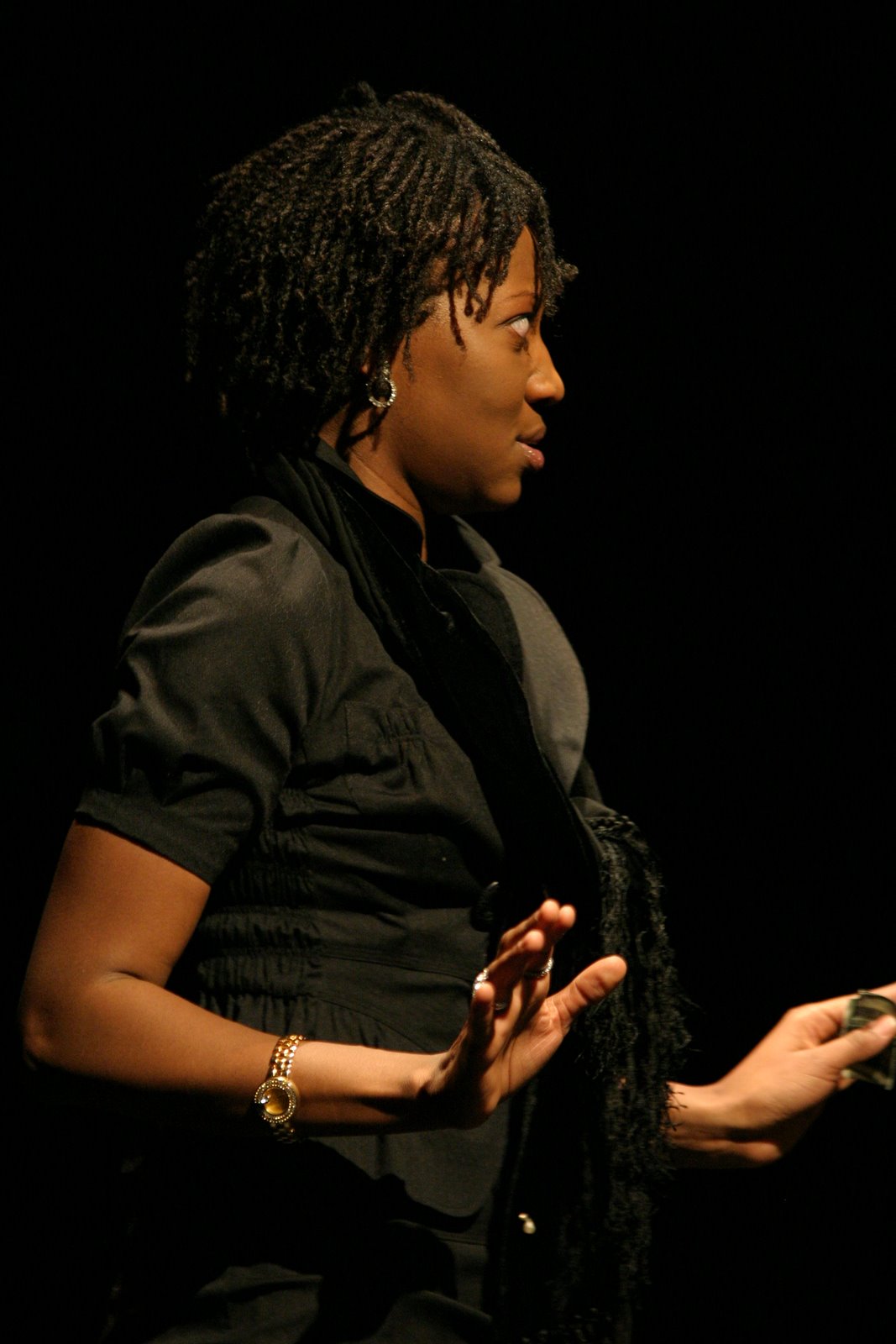
The character concept. Both reigning monarchs were African American. Miriam Hyman as Olivia (pictured) was styled to the hilt and glam behind those shades. She had SO much presence and authority that you believed she was in love with that twerp Viola, played by Christin Sawyer Davis with winsome clarity. RJ Foster was an oh-so-cool Orsino, though I was chagrined that he touched a basketball just once, whereas I’d given the impression he would be dribbling throughout. He also had charming authority and looked, shall I suggest, presidential?

The bawdy shenanigans as translated into today’s gadgets. Yes it was hokey when Valerie Issembert as Maria,Jackson Loo as Fabian, and Abe Goldfarb as Sir Toby Belch (pictured) pulled out their blackberries and computers, but I’m happy to suspend my disbelief.

Most of all, natch, I liked the stage movement and dances. Byrd used Gabriel “KwikStep” Dionisio brilliantly. Yes, he’s a pro break-dancer, but, especially in the first act, Byrd had him using break-style movement to accent the action, like a Greek chorus, adding emotion to the words. More important, especially at the start, the actors’ movements, in hip hop style, helped to portray their characters more vividly. And, as expected, the break-dance duel/duet was terrific. (Byrd’s contributions as co-director were apparently so significant that somebody forgot to note, in the program, that he was also the choreographer. Very unfortunate.)

“What You Will” continues at Bristol Riverside Theater, 35 minutes from Princeton, through March 1. In a splendid coincidence, McCarter’s traditional version of the play is coming up from the Shakespeare Theater Company in Washington DC starting March 10. So you have a chance to see both versions and decide for yourself on the merits of the BRT version.

The critics can say whether it’s Good Theater or Art. You get to say whether you liked it. Where? Respond to the review at U.S. 1 newspaper, comment on this blog, or comment on the play’s website, www.howwewill.org. Or look at the very favorable reviews in the Philadelphia Inquirer or Curtain Up. and respond.

I know how hard it is to comment, even anonymously, and I don’t expect many responses. Why? Because McCarter has gone to a great deal of trouble to set up an audience reaction website. Just one person has responded re the latest production, Mrs. Warren’s Profession.

But performers are hungry for feedback. So are funders. This production was heavily subsidized by the Pew Charitable Trusts.

So do the artists a favor, weigh in. Go. Then say whether you think this approach can help capture the hearts and minds of texting and Twittering teens? Or should we make the original version more appealing?

And PS, artists, if you want to keep on getting reviewed in print publications, send your letters of appreciation to the publishers. In this publishing environment, critics are an endangered species.

Wednesday: Wang Welcomes You to Your Brain

Sam Wang is one of the smartest, funniest, scientists you’ll ever meet. At least I think so — I’ve not met him, only talked to him on the phone, but he’s been interviewed all over the place, nationally, and he talks smart and funny and also blogs that way (www.welcometoyourbrain.com).

Plus his topic matters to us. Both you and I care about our brains, and Wang co-authored a book, “Welcome to Your Brain: Why You Lose Your Keys But Never Forget How To Drive And Other Mysteries Of Everyday Life.” which tells things you need to know, whether you are a parent with growing children or, like me, a grandparent who is not Going Gently Into That Good Night. Engagingly written for the general reader, reissued in paperback in December, it won the American Association for the Advancement of Science prize as the best science book for young adults.

Wang will speak at a Princeton Chamber breakfast on Wednesday, February 18, at 7:30 a.m. (program starts at 8) at the Nassau Club, 6 Mercer Street, Princeton. Cost: $30 ($20 if you are a member of Princeton United Methodist Church or are otherwise a member of the chamber). Register at 609-924-1776 or go to http://www.princetonchamber.org or email me for questions (bfiggefox@gmail.com) It’s not too late to sign up!

Here are some Welcome To Your Brain myth busters:

Playing classical music to babies doesn’t help their development. (Sorry, Baby Einstein).

Moderate drinking does not destroy brain cells.

Exercise, not puzzles, helps retain brain cells at any age.

To hear better on a cell phone, cover the mouthpiece, not your other ear

Vaccines don’t cause autism.

Wang got lots of coverage recently for his views on left handedness. He notes that southpaws have a better chance to be president of the United States than we right handers: “Six of the 12 chief executives since the end of World War II have been left-handed: Harry Truman, Gerald Ford, Ronald Reagan, the elder Bush, Clinton and Obama,” writes Wang.”That’s a disproportionate number, considering that only one in 10 people in the general population is left-handed.”

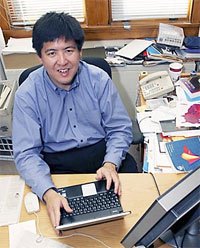
Wan is a graduate of Cal Tech and Stanford and has lots of scientific mojo, as seen in his lab’s blog. But he is also a man after my own heart because, judging from the photo, he is a smart guy with a messy desk. Messy desks are my specialty. I’m eager to hear what that says about my brain.

For Veterans: Music Alone Shall Heal


The Veteran’s Day service, staged last November by the Army ROTC’s Tiger Battalion at Princeton University Chapel, featured a speech by healthcare expert Uwe Reinhardt, the presentation of a check to the Wounded Warriors Project, and some perfectly beautiful music. Mary Rorro, a staff psychiatrist at the veterans’ affairs clinic in Brick, stood in the pulpit to play, unaccompanied, Amazing Grace and some other poignant melodies.

I had a brief conversation with her about how her music helps patients, and how she works with Give an Hour Foundation, which encourages mental health professionals to donate time to veterans and their families. She hopes that other health professionals will follow her lead to provide music.

Now Rorro has been featured in a PBS special “Healthy Minds,”, shown yesterday and repeating Tuesday, February 17 at 11:30 p.m. on New York’s WLIW 21. Michele Angermiller, a freelance writer, tells about Rorro’s life (she grew up in Lawrenceville and played with the Greater Princeton Youth Orchestra) in the Times of Trenton in “An Overture to Treatment,” published today.

In times of grief or trauma, what comes to my mind are the lyrics to a Girl Scout song, a canon, “Music Alone Shall Live.” Sometimes music is the only thing that helps.

Not in Our Town


When we moved to Princeton in 1981, I was lucky enough to have cousins already living here. One was my first cousin on my father’s side. On my mother’s side is Ann Harris Yasuhara, and if you go by the rules, she is my first cousin once removed. We feel lucky to be so geographically close, and so as soon as I was able (when I no longer worked full time at U.S. 1) I began to meet with one of the organizations she supports, a faith congregation-based group called Not in Our Town. Click on the links to see the mission statement, and here is the list of what individuals and groups can do to fight racism.

Not in Our Town, along with Princeton Public Library, will present a workshop “Engaging in an Exploration of White Privilege” on Monday nights, starting April 13 at 7:30 p.m. Among the presenters is Ann Yasuhara, pictured, and she hopes to make this “an inviting, friendly, and engaging experience.” Perhaps you’ll join us . . .

Celebrity Admiral


The last time I saw this much excitement about a celebrity speaker in Princeton’s venerable McCosh Hall was when Cindy Crawford came, some 20 years ago, to talk about women’s body images. Admiral Mike Mullen, the four-star admiral who heads the Joint Chiefs of Staff, the man who advises the president on war and peace, visited the university’s Woodrow Wilson School on Thursday, February 5, when more than 300 people lined up in the cold to hear a major policy address, “Global Trends and National Security.”

They were – and I was – eager to hear his thoughts on Iraq, Afghanistan, Gaza, Pakistan, China, NATO, Mexico, Korea, wherever – to hear anything that could put this mixed-up world in perspective.

And as a former Army wife, I was eager to see how a four-star admiral would address a potentially hostile civilian audience. Mullen was Class of ’68 at the Naval Academy, which makes him a half-dozen years younger than my husband’s West Point classmates. I guessed that the man who holds the highest military rank in the nation (second only to the President and the Secretary of Defense, and those guys don’t wear uniforms) would look like a Greek god and talk like John F. Kennedy.

In came the entourage. The least-likely looking naval officer took the stage, not the blonde, handsome one, but the one with the thinning hair and glasses. Lithe like an athlete (which he is, a swimmer and lifter), he had the look of a professor (thoughtful, mild), and the aplomb of, well, an admiral (photo by Navy Petty Officer 1st Class Chad J. McNeeley.)

Without notes, he talked for 40 minutes, and took nearly a dozen questions. I admired his humanity, his common sense, his wide-ranging knowledge, his concern for the troops — and his style. I was also vastly relieved. Here was a Person in Charge who made sense.

Opening with an anecdote about how he’d always wanted to come to Princeton to play basketball with Bill Bradley, Mullen referred to his growing up in the Hollywood scene. According to an NPR interview, his mother was at one time an assistant to Jimmy Durante and his father was a press agent who hobnobbed with the stars and developed relationships with the likes of Hedda Hopper. I can see that in him. He kept talking about his relationship with his opposite numbers in Pakistan, in China, Korea, Russia, everywhere. Relationships (another word for that is charm) are the bread of butter for any good press agent, and he apparently learned about that at his father’s knee.

For all of what Mullen said, see my verbatim notes, online as a Google doc, but here’s what struck me.

Mullen’s most intriguing idea: That career government employers — beyond the military, the Peace Corps, and the diplomatic service – should have an opportunity for overseas service. Under what he calls a “whole-government approach,” careerists in such federal departments as commerce, transportation, or agriculture would be shipped out to contribute their expertise. Current examples include farmers in the National Guard, who are agriculture mentors, but they could just as well be civilians.

His scariest observation: That the global financial crises will produce unrest, and we have absolutely no idea where that will break out.

His most comforting point:
That he promises to take care of the soldiers and their families. He praises the current force, opposes the draft, and has reduced the 15 month tours to 12 months on, 12 months off.

(I’m also curious about how Mullen, as a Naval officer, experienced his own assignments where his family didn’t accompany him. In peacetime at least, Army and Air Force families generally get to have more time with their soldiers, because usually they can live near the duty station. But even in peacetime, Navy ships go to sea for long periods of time, and on Navy pay it’s nigh unto impossible to meet your sailor in every port.) Maybe stints of 12 months seem normal to him. They seem pretty tough to me.

Mullen emphasized to the civilian audience about how his job is to follow orders from the president, yet he has been accused of being too political. I say, when you are trying to win over a civilian audience in a time of war, you’d darn sight better come across as caring and earnest, and if that sounds political, so be it. That goes for his dealings with four-star officers in other countries. Glamor might sell lipstick and furniture, but when you are pitching a peaceful alternative to war, relationships count.

Einstein Alley: the Good News Bears


Here’s some good news for a change. At an informal get together for Central Jersey tech entrepreneurs, I kept running into guys whose companies are doing quite well, thank you, in part because their particular technologies are in high demand.

This group of entrepreneurs has been hanging out together for several years. The almost monthly happy-hour style meetings usually offer panels, speakers, and plenty of helpful networking. For this January party, a buffet at Charlie Brown’s in Kingston, it was all chat.

They call themselves the Einstein’s Alley Entrepreneurs Collaborative, not to be confused with the official Einstein’s Alley organization that evolved from meetings convened by U.S. Rep. Rush Holt and is now headed by Katherine Kish and Lou Wegman. The official organization certainly works with entrepreneurs, but has no exclusivity..

In contrast the collaborative’s founders, Steven Georges (former CFO of Princeton Server Group, sold to Telvue) and John Romanowich (founder of SightLogix) wanted to create the ambience, much admired, of a Silicon Valley bar, where insiders gathered and ideas got drawn on the back of a napkin. Steven and John keep the group small and focused.

Its mission statement: to be a Central NJ network of
entrepreneurs and service providers to entrepreneurs, built by entrepreneurs
for entrepreneurs. Says Georges: “It is not sponsored by any group, and we maintain a
culture of mutual trust and support by not allowing anyone to use our
network to sell anything to anyone.”

New members must be invited by someone who is already a member. Reporters (me) were welcomed at these gatherings, but the proceedings were off the record. Sometimes I did stories on people I met there, but never on the meeting itself.

So I didn’t go to the party thinking I would write about it. But I did take some photos. I kept running into interesting stories – and now I have dispensation to reveal their source. Here are some of the Good News Bears.

Art Suckewer, founder of Knite Inc. on Forrestal Road. His 12-year-old company has what Detroit wants – a Kinetic Spark Ignition System that produces a faster and more complete fuel burn.

Bob Gupta, CEO of Venaca at 4390 Route 1 North. Gupta moved this company to 4390 Route 1 North in order to do a turnaround. It does digital asset management systems – to store, search, edit, share and distribute content — across multiple distribution platforms.

Tor Dybest, CFO of HDlogix in Edison. Here’s another firm smack in the middle of the digital video revolution.

Bob Dombrowski, business development manager of the materials science division of EMSL Analytical Inc. in Westmont, NJ. It provides materials testing, characterization, and forensic laboratory services for commercial, industrial, regulatory, and law enforcement clients. One of its competitors, closer to home, is Chilmark Technology on Plainsboro Road, also doing well. Apparently no other companies do what they do.

Others are upbeat. An entrepreneur who can’t be named, because he goes to work every day on Washington Road, has started a mobile device software consulting firm, Radix2Solutions (Hugh@Radix2Solutions.com). That
website went live in January.

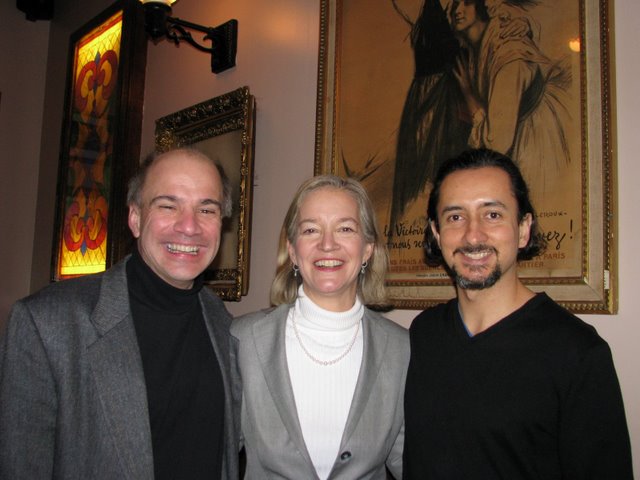
To get an invitation, check out the photos to see if you know someone in the group. Also attending were Rick Ober of Charis Pharmaceuticals, Doug Dixon (www.manifest-tech.com) who writes cover stories for U.S. 1 Newspaper, Lloyd George CPA of Financial Architecture, Stuart Malakoff of Merrill Lynch, Jeffrey Salton of UBS, Joanne Gere of Bioscience Collaborative, Kevin Howard of Oldwick Consulting, Bob Nicastro, Jeremy Kestler, an e-learning consultant, Dick Woodbridge (now of Fox Rothschild) and Nicholas Stevens of Siemens Communication. Or e-mail sgeorges3@comcast.net

Zweena: Finding the Sweet Spot for PHRs

Shake up the health care system, urges Janet Rae Dupre in her “Unboxed” February 1 New York Times column, “Disruptive Innovation, Applied to Health Care.” She hopes that the country will “innovate its way toward a new health care business model – one that reduces costs yet improves both quality and accessibility.” One way is to create what Princeton University’s Uwe Reinhardt calls a continuum of care that follows patients wherever they go and prevents needless tests and confusion about competing medications.

But even if President Obama follows through on his promise to use technology to improve healthcare and lower its cost, such change is a long way off, I fear. Until then, individual consumers need to figure out how to keep track of their own health records, and the best way I’ve found is to create a web-based Personal Health Record (PHR) through a Princeton-based start-up called Zweena Health (screen shot of home page shown).

PHRs are ideal for a scatterbrain like me, for whom digital everything is a godsend. I keep my calendar and address book on the web, so when I lose my paper copy for the umpteenth time, it’s still there. I get and pay my bills electronically, so when I forget what I paid to whom, it’s right there. Now that my personal health record is available through Zweena, I no longer have to worry about filing my mammogram, blood pressure, and colonoscopy records. When did I have that mammogram? It’s right there.

But I have a more important reason to value Zweena’s service: my husband’s two life-threatening conditions – heart disease (he had a triple bypass) and kidney cancer (he had a kidney removed plus chemotherapy). He’s fine now, but we make a regular circuit of six doctors’ offices and the occasional hospital visit, and he goes to three different hospitals. It’s crucial to his health that the nephrologist knows what the oncologist and cardiologist are doing, and the Zweena service will certainly help that. It could conceivably save his life.

Some object to the potential privacy invasion that PHRs might bring. The privacy of the health record is not that important to me because I don’t need to hide anything from an employer or anybody else. As someone commented on Matthew Holt’s Health Care Blog, “Is our energy truly best directed to worrying about 1) preventing a potential privacy violation or about 2) preventing getting killed or maimed in the health system due to lack of information technology and care providers having the right information at the right time?”

Some PHRs are being kept by insurance companies, some by employers. But I wouldn’t want to have to change services because my insurance changed, or because my job changed, and Zweena clients will own their own records and choose who gets access to them.

Zweena nurses do all the data entry, versus doing it yourself. Nancy Finn (who blogs on Healthcare Basics and was quoted on e-patients.net ) had success with entering her own information in Google’s answer to PHRs. I’m not sure I would be as successful. During the year of my husband’s cancer treatment I managed to keep track of his medical records, but now I’m back to being careless again. If typing in the data were left up to me, I’m might lose the records before I got around to entering them. I would be better off going back to my old system – stuffing everything in a briefcase. At least then I would know where they were. Zweena overcomes the laziness barrier.

I do not anticipate that my carelessness will improve as I age, nor will my health improve, and there may come a time when my children – in the so-called sandwich generation — will need to monitor my medical care. When I did this for my 96 year old mother, I traveled to Baltimore to accompany her to doctor’s appointments. But in the digital age, the doctor could put my daughter on a conference call in her office, and my daughter would have access to that day’s record of the office visit through Zweena.

Full disclosure: As a reporter for U.S. 1 Newspaper I had interviewed John Phelan, who founded Zweena to try to create a workable business and technical model for PHRs. Also a family member has a professional interest in e-health initiatives – but this background has alerted me to what other services are available. I’m eager to hear about alternatives, but so far I haven’t found another service where the service’s professional does the data entry, yet the patient owns the record.

There are oh-so-many other advantages to letting technology creep into the health care system, starting with improved doctor/patient communication, but digital personal health records will really come into their own when all the hospitals go digital. Case in point: my husband just had outpatient surgery at a fine hospital in Philadelphia. As he progressed through the system, seven nurses and doctors asked essentially the same questions seven times, each entered the answers on their own clipboards. In a hospital with digital records, entries could be made just once.