Monthly Archives: July 2009

Hurrah for Staying Put

If Fort Monmouth does pull up its drawbridge, as it’s slated to do, thousands of specialized tech workers would have to uproot their families and move to Maryland.

But maybe not. In the federal defense budget, two U.S. Representatives (Rush Holt and Frank Pallone), have inserted $3 million for a new New Jersey Technology Center, where the specialized techies could continue to provide intelligence and communications support to the U.S. military.

Don’t confuse the to-be-created New Jersey Technology Center with the Technology Centre of New Jersey, the tech park owned by the New Jersey Economic Development Authority. (When checking on TCNJ I found that Chubb Institute has changed its name, which slipped by me. Chubb’s education arm went deep into the red, was bought by private equity, separated from the insurance company, and is now called Anthem Institute. It’s across the street from what must be its arch rival, DeVry Institute.)

The bill passed the House on July 30 and still needed Senate approval, as of Friday, July 31.

“The men and women of Fort Monmouth — the scientists, engineers, and acquisition specialists who make the IED jammers and related devices — have acquired their skills over decades of service,” said Holt in a press release. “You can’t buy this kind of talent off the street and certainly not fresh out of grad school, which is why funding the Center and utilizing those workers who will stay in New Jersey is so important.”

Here’s an idle, obstreperous idea: Could those defense techies have found another home in Einstein’s Alley, for instance at the Sarnoff Center, which is busy with defense contracts as well? From the New Jersey shore to Maryland is too long a commute, but from the shore to Princeton is doable. And Sarnoff has extra space and like minds.
Arrivaderci, Esther


The subject of jet lag came up when Esther Dyson addressed the Princeton Chamber on July 9. Dyson had just returned from Russia, and she was working on almost no sleep, but gave a wow of a talk.

Directly after the lunch I left for the airport, with husband and granddaughter, for 10 days in Italy and have had plenty of time — a week — to recover, but am still not clicking on all cylinders. Perhaps if I had adopted Esther’s healthy lifestyle (to swim every morning) I would have done better.
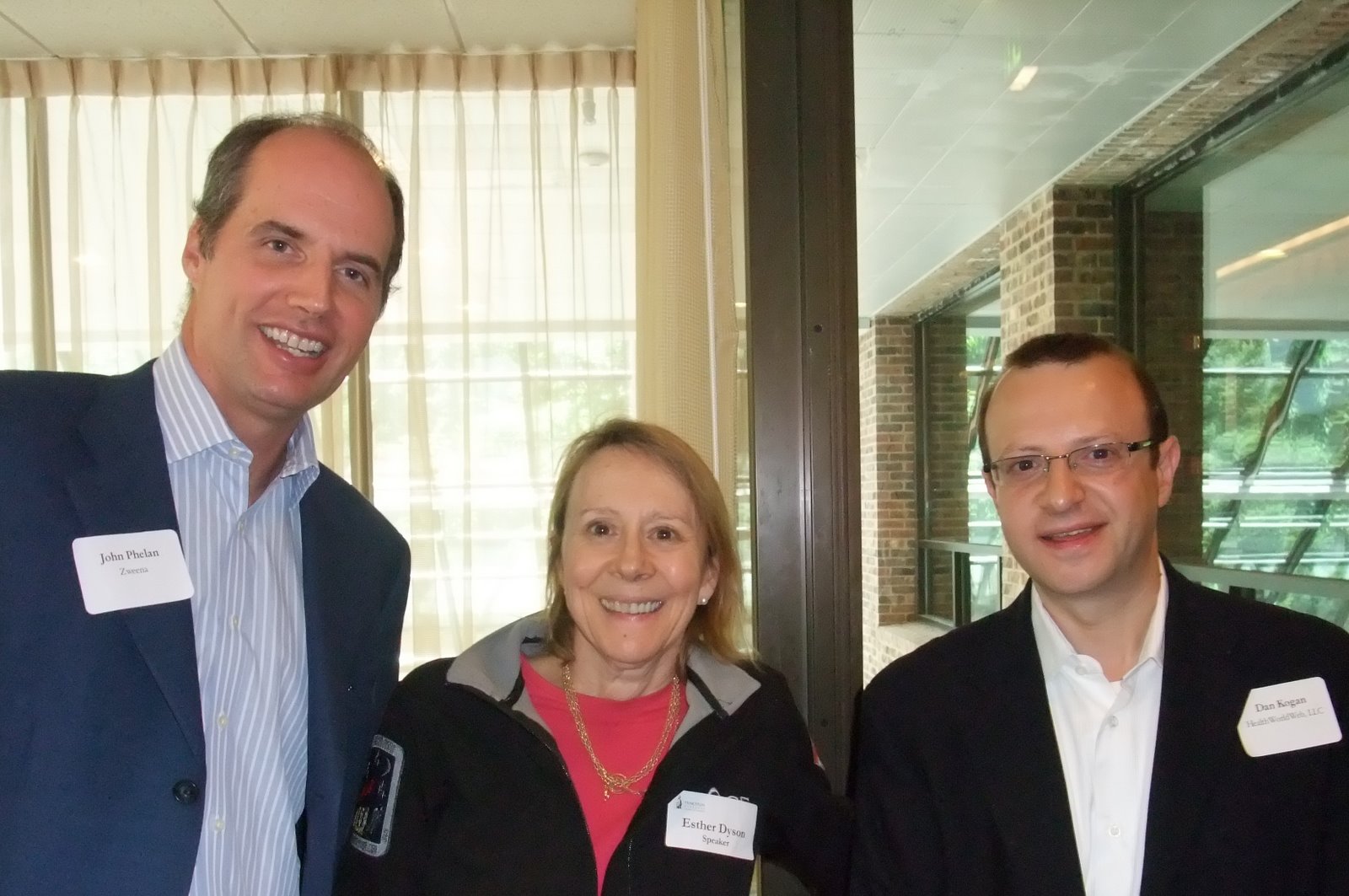
Since I left before I could comment on Esther’s talk, here is a link to her complete address, recorded for You Tube by Daniel Kogan of MyHealthExperience.com, which co-sponsored her chamber appearance. (In the photo, John Phelan of Zweena is on the left and Kogan on the right.) Also here is Dilshanie Perera’s excellent account in Town Topics.
And if you have your own memories of Italy, here’s an online album. Glad you asked.

Paying for Content?

In the ever perplexing discussion about whether readers will pay for news content, here is an apt summary from Editor & Publisher’s Steve Outing, quoting former Trenton publisher Dean Singleton. My previous entry featured commentary from Richard Bilotti, another former publisher at The Times of Trenton.

This is certainly a short entry, but I just wanted to call attention to Steve Outings wisdom, and it’s too long for Twitter…

The $2 Billion Mouse


I’ve always had a soft spot in my heart for Medarex (just bought by Bristol-Myers Squibb for nearly double the stock price) because Medarex has a transgenic mouse that can produce therapeutic antibodies that mirror a human’s antibodies. .

Mice are my favorite critters anyway, because I literally grew up in the Frank H.J. Figge mouse lab. The lab had 5,000 mice, who owed their existence to my father’s cancer research efforts, and my late mother, Rosalie Yerkes Figge, ran the breeding colony. My sister and I helped out in the family business with such age-appropriate tasks as filing records and filling glass bowls with cedar shavings (at five years old), transferring mice by their tails to clean bowls (age seven), and separating and marking the adolescent mice (age 10).

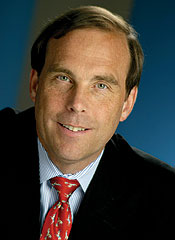
So when Donald Drakeman (left) started Medarex as a monoclonal antibody company in 1987 and 10 years later bought Genpharm with its transgenic HuMAb mouse, developed by Nils Lonberg, I was personally and professionally intrigued. Given the cost and time needed to administer clinical trials to humans, the Medarex mouse can help bring important drugs to market quickly and cheaply. I thought Drakeman was pretty smart to wend his way through some nasty patent disputes and emerge, owning the mouse.

Drakeman and his wife, Lisa Drakeman, have been on the cover of U.S. 1 at least three times, starting in 1987 when it was a pop-and-mom shop with offices at 20 Nassau Street. She came to Medarex as SVP of business development and moved on to be CEO of Genmab. He is no longer with Medarex but she is still at Genmab, based in Denmark but with an office here in Princeton.

Yesterday Bristol-Myers Squibb bought Medarex for what amounts to $2.1 billion, and this morning the stock of both companies shot up, with Medarex nearly doubling to $15 plus.

What does this do for GenMab? Nothing, GenMab claims. Medarex has sold most of its GenMab stock, earned in return for granting 16 prepaid licenses to use the special mouse for drug development. Medarex still owns 5 percent of GenMab, says GenMab’s PR person, Lucy McNiece. Of the 16 licenses, 13 have been used.

And now, of course, I kick myself for not having bought Medarex stock. Before I left my job at U.S. 1 in 2008, it would have been a conflict of interest for me to own it and also report on it. After that, naysaying from a stock broker (who shall remain nameless) deterred me.

But as my doc brother in law says, the Retro Spectroscope is never wrong. And congratulations to the prescient Medarex stockholders, the Drakeman family, and New Jersey’s biotech community. A rising tide raises all boats.

From Russia to Princeton


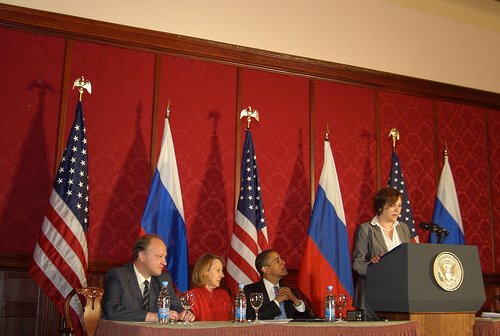
Esther Dyson’s Flickr account shows a July 7 photo of her sitting next to President Obama at the speaker’s table for a meeting in Russia. Her next appearance — a rare one, in her hometown — is Thursday, July 9, at the Princeton Chamber lunch, 11:30 a.m., at the Forrestal Marriott.

It’s hard to describe Esther Dyson, because she has so many interests, but here is a bio cadged from several sources:

Esther Dyson is a journalist and commentator on emerging digital technology, a founding member of the digerati, an entrepreneur, and a philanthropist. She has been highly influential for the past 20 years on the basis of her insights into online/information technology markets and their social impact worldwide, including the emerging markets of Central and Eastern Europe and Asia. In 1994 she wrote a seminal essay on intellectual property for Wired magazine and three years alter wrote Release 2.0: A Design for Living in the Digital Age.

Born in Switzerland in 1951, she grew up in Princeton, where her father, physicist Freeman Dyson, is at the Institute for Advanced Study. She majored in economics at Harvard, worked as a reporter at Forbes, then did investment research and bought a company, renaming it EDventure Holdings.

In 2004 she sold it to CNET Networks, the US-based interactive media companym and now operates as an independent investor and writer under the reclaimed name. An active investor as well as an analyst/observer, she participated in the sale of Flickr to Yahoo! and of Medstory to Microsoft, and her other investments included Del.icio.us, BrightMail, and Orbitz. Her primary activity is investing in startups and guiding many of them as a board member, including 23andMe (US), Airship Ventures (US), Evernote (US), Boxbe (US), Eventful.com (US), Meetup Inc. (US), NewspaperDirect (Canada), CVO Group (Hungary), Voxiva (US) and Yandex (Russia).

She is also active in public affairs and was founding chairman of ICANN, the domain name policy agency, from 1998 to 2000. She currently sits on the board of the Sunlight Foundation, which advocates transparency in government.. She is one of 10 initial volunteers in Harvard’s personal genome project. She has serves as a trustee of, and helped fund, such emerging organizations as Glasses for Humanity, Bridges.org, the National Endowment for Democracy, and the Eurasia Foundation (which co-hosted the 7-7-09 Civil Society Summit in Moscow). . She is also a board member of the Long Now Foundation, a trustee of the Santa Fe Institute, and hosts the Flight School in Aspen.

She is a close follower of the post-Soviet transition of Eastern Europe and is amember of the Bulgarian President’s IT Advisory Council. Last year she trained as the backup astronaut for Charles Simonyi’s Space Adventures trip aboard the Soyuz. In January she received the Aenna Burda award, for women in the media who successfully implement their extraordinary visions.

Here is the link to Michele Alperin’s article in U.S. 1 on July 8.


Those at the luncheon will have a chance to get Dyson’s take on their particular interests. She will speak briefly on “How can you weave together Silicon Valley, genomes, Russia, and space into a single talk” and then take questions.


Princeton’s Esther Dyson on July 9


Bogus privacy concerns keep us from having access to our own healthcare records, said Esther Dyson in the Huffington Post last month. As Quicken was to our money (it unlocked our financial records) we need the technology to get a look-see at our doctors’ records. That’s the message from a new advocacy group, www.healthdatarights.org.

Dyson, a Princeton native, speaks at the Princeton Chamber this Thursday, July 9, at an 11:30 lunch at the Princeton Forrestal Marriott on (take a breath) “How can you weave together Silicon Valley, genomes, Russia, and space into a single talk?” She’s in great demand among the digerati for her forecasting expertise, but she is also known for being able to explain puzzling technology to the non-techies of the world.
“Good health (not just healthcare) starts with individuals managing their own health and understand the impact of their own conditions and behavior,” writes Dyson. I can think of several Princeton-based companies that have staked their future on that proposition, among them, Princeton Living Well.
We need to be able to control our own data, and if the banks can figure out how to do it, the “privacy” excuse is a sham. If we can access our bank accounts online, why not our vaccination records?