Monthly Archives: April 2013

Speak . . . For Your President is Listening

Princeton University’s new president, Christopher Eisgruber, tells an Associated Press reporter , Geoff Mulvihill, that Princeton is a warmer place than it used to be (thanks in part to more ‘inclusiveness’ among students). He lauds the idea of a liberal arts education versus a job training period. (Andrew Delbanco’s book, just out in paperback, College: What Was, Is, and Should Be, takes the same tack.)Yet Eisgruber regrets that current students can’t share the experiences he had when arrived as a freshman in 1979, and here I’m quoting Mulvihill: 

‘Full faculty members sometimes served as discussion leaders for colleagues’ classes, it was more common for non-recruited athletes to walk on and join sports teams, and students weren’t so competitive from the moment they arrived on campus. But the last part, he said, is unlikely to change.’

In Not in Our Town discussions (NIOT holds discussions. ‘Continuing Conversations,’ on first Mondays at 7:30 p.m. at the Princeton Public Library),  that very subject — aggressive competitiveness — has come up several times. These discussions are open to the public but are “private,” not divulged afterwards. 

However, one of the discussion moderators, Roberto Schiraldi, published several documents on the NIOT blog. Schiraldi has retired from a job as a Princeton University counselor. He shared an open letter to the current university president, Shirley Tilghman, He also posted part of a paper, A White Man on the REZ: “Higher” Education In A Culture of Fear: A Journey Through Alienation and Privilege to Healing

The question: Have student values of competition — getting the best grades and the best job — superseded  humanistic values? 

The future president of Princeton University says he plans to “just listen” during his first year in office. If Eisgruber is listening, now is the time to speak.

Stand Against Racism — Today

What’s Left Out — Art or Accommodation? NYT on Mitchell Rales

I started out to comment on the joys of living next to Princeton University, but this is turning into a wry comment on big-time journalism.

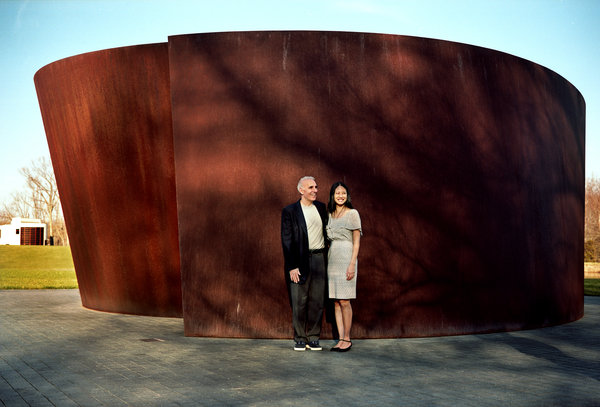
photo by Christopher Gregory/NYT

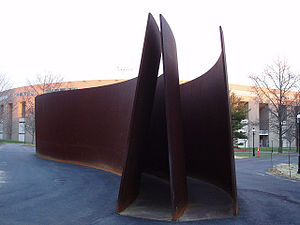
An article in tomorrow’s New York Times features a billionaire and his wife standing in front of an instantly recognizable sculpture, recognizable that is, if you wander on the Princeton University campus. Just east of Washington Road, behind Frank Gehry’s Lewis Library, is the humongous Richard Serra sculpture, The Hedgehog and the Fox, three giant rusty curving walls. In the NYT photo, Mr. and Mrs. Mitchell P. Rales stand in front of it something that looks just like it, a Serra sculpture entitled Sylvester.

Wikipedia photo
(I can’t find the U.S. 1 photo
from the August 2000 installation story)

My first reaction is an appreciation of the privilege of living in Princeton. If you have a habit of walking on the campus, you are getting an unwitting education in contemporary art. See one Serra, you’ll recognize the next. See one Lipchitz, you will spot another.

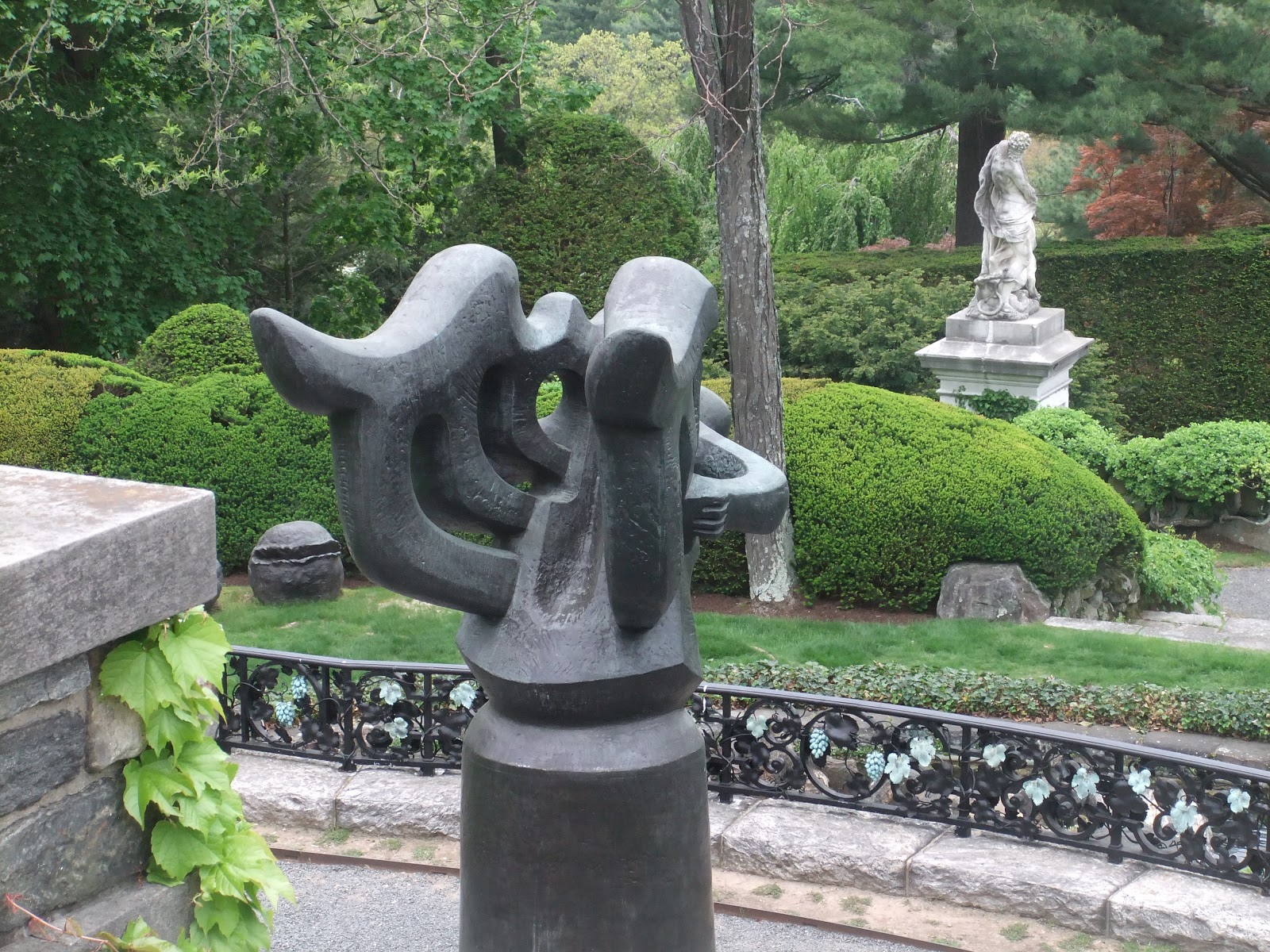
Song of the Vowels by Jacques Lipchitz
at Kykuit (my photo)

We discovered this when we toured Kykuit, the Rockefeller estate near West Point, New York. Almost every sculpture that the Rockefellers owned, the Princeton campus has one by the same sculptor. Both the Rockefellers and the Putnam collection own a copy of Song of the Vowels by the Cubist sculptor, Jacques Lipchitz. 

My second observation is what the Times left out. The article tells of a 56-year old man, married to an art curator who is 36 years old, and all it says about that — seven paragraphs from the bottom — is, “The couple, who married in 2008, work very much as a team.” It leaves out the public record of the First Wife (with whom he had two children) and the Second Wife (who was the first curator of the private/public museum).

The article also omits what is important to business reporters, like how Mitchell Rales’ father was raised in the Hebrew Orphan Asylum, and that he and his older brother Steven made their fortune in junk bonds. It’s all in the public record.

That sounds very much like a publicist saying “you get to write this story only if you omit x y and z.” I’ve had similar requests, some I honored, some I didn’t.

Rales was “weaned on the the family real estate business,” according to an article written on him in his younger days,  and rightfully averse to publicity. But like the Barnes Collection of yore, he has this mammoth collection of art and is trying to share it with the public. To do that well, he needed the “right” article in the “right” paper, i.e. the New York Times.

OK, I’ll admit that the bio has nothing to do with the focus of this article, entitled “Like Half a National Gallery in Your Backyard.” The curtailed bio includes the brothers founding Danaher corporation as a science and technology firm that grew into a publicly traded company valued at $40 Billion. It tells of his life changing experience in 1998 when he almost died. After that he began to found a museum that is open to the public by appointment (so as to give everyone plenty of room, does this sound like Barnes?) and pays for area schoolkids to visit on field trips (Barnes again).

So leaving important parts of the biography out of this story could have been the reporter’s independent decision.

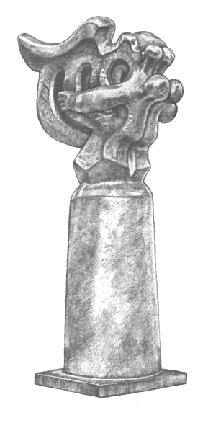
illustration by Heather Lovett
from P.U. Communications

But I would have wanted to include how Mitchell’s father — when one of his sons got a paper route — required the boy to give 10 percent of his earnings to the housekeeper. Maybe that didn’t fit the story, but how could I leave that out?

You can see the Song of the Vowels in the plaza between Firestone Library and Princeton University Chapel. As you view it, you can see that the skill of the artist is represented by — what’s left out.

Stressing Out over Boston

Usually on Saturday, Sharon Schlegel has a light-hearted column in the Times of Trenton that warms the heart, but not this week, not after Boston. She wrote…

It… led me to think back on something I only learned when my daughter started driving years ago: No matter how hard parents try, we must eventually face that we can’t fully protect our children. It’s an awful lesson….

But there are things even in this horrible story to be glad about, namely the folks watching who saw the explosion, saw victims fall to the ground bloodied and bent, and ran toward, not away, from the explosion sites. They responded immediately by trying to help. To me, they represent the best in us, inspiring me by their courage and selflessness. 

For the rest of the column, click here. 

Here is another response to the calamity, this one from Terri Walker, a yoga instructor at Rocky HIll Yoga at the first reformed Church in Rocky HIll and at a major pharmaceutical company. She is a mentor in the Yoga Shanti Teacher Training program for Colleen Saidman Yee and Rodney Yee in Sag Harbor, NY. 

 After the news of Boston, I had difficulty teaching yoga in my classes this week. It was hard to find the energy to speak out loud while my emotions were pulling me down. It was was hard to find the purpose of doing asana, while others not so far away were suffering publicly on so many levels.


Then I remembered backbends. I remember my first teacher saying how many full wheels (Urdhva Dhanurasana) she did after the death of her daughter. Every day she opened her chest, keeping spaciousness on a physical level around her heartcenter, so grief could come and go, without 
taking residence in her body; emotionally and physically she didn’t solidify at the
base of a downward spiral.

Backbends, from the most gentle of raising our arms overhead and lifting the breastbone, 
to the more difficult, are exhilarating. They help keep our upper body aligned and
functioning and enable us to be open to vulnerability. Rodney Yee wrote, in “Moving
toward Balance” that “the more vulnerable you allow yourself to be, the more connected
you are, which enables you to listen and respond to what is occurring in the present
moment.”

Our world is changing and has grown smaller. There are countless sad events occurring
globally all the time. We are all in this together. Backbends help us recover and expose
the part of ourselves where compassion and our helpful natures reign. Backbends help us
stay open and alert to the gracious good moments that also occur globally every day. We
just don’t hear about those as much. Let’s start that conversation.

Namaste, Terri


Dance Review: 4-19-2013

 This is a draft of a review of the concert I saw on Friday, April 19, 2013.
The choreographers were “mature” 10 years ago, but on the 10th anniversary of “I’ll Have What She’s Having,” this program has come of age. Each had something to say, and some dances were memorable.
Claire Porter has spent a lifetime wittily syncing words and ideas with movement. In Frame,  to a score by Guy Klucevsek, four dancers (Marie Alonso-Snyder, Christine Colosimo, Linda Mannheim, and – on Friday – Debra Keller) take picture frames to peer through, truck around, pile up, eventally making clear how valuable new and different perspectives can be. “So many ways to look at things.” It was subtle, deft, a winner on many levels.
The other new group dance, Pink Ribbons, by Fara Lindsay, to music by Flack, had blunt impact on an emotional level. Five women in a waiting room are summoned, one by one, behind a lit screen for the ritual. First the mammogram. One by one, the suction biopsy needle goes down the line. All this you see in shadow. One by one the cleaver goes down the line. The women emerge clutching their pink robes, their heads covered with scarves. They are broken. One falls, is helped up. Two reach out to help a third. Each gathers strength from the next. Part B is a poignant solo by Lindsay, followed by the re-entry of all the patients, recovered and swinging their way back into the world. The cast of 11 included Christine Colosimo, Louise Bolge, Erickson, Meiying Huang, Keller, Linda Mannheim, Eri Millrod, Nancy Musco, Shari Nyce, and Marie Alonso Snyder. It should be a fundraiser for the Y’s pink ribbon benefit. 
Mannheim spent most of Porter’s piece locomoting on the floor so it was a revelation to see her long-limbed Graham-and-Pilates trained body stretch out in joyfully beautiful ways – on a pole, no less. With her yearning extensions, in Axis Mundi (to the music of Ennio Morricone) she took pole dancing to a new level. I imagined it to be her love song to life.
In A Pas de Deux Linda Erickson simply walked and walked some more, never stopping, while her partner efficiently tricked her out in the frippery of cheap feminity – bosoms, butts, wig and all. All this to Bobby McFerrin singing Psalm 23, the version that makes God a she. 
In the trio Sylvie, with Milrod and Lindsay, Nyce revealed an enriched emotional palette, moving from serenity (“Bring me little water Sylvie” to a chain gang chant. Nyce repurposed her signature limber lifts to the stark impact of struggle. Nyce’s co-choreographers were Terri Best and Deborah Brokus. 
A duet by Dawn Berman and Susan Brady Pinto had similar intensity without the emotional focus.
I’ve seen Colosimo do some inventive pieces using props, but here she went for savvy showbiz with a deft tap dance. She’s a showman in the best sense of the word.
Also on the program: Flamenco artist Lisa Botalico (with Valerie Aguilar, Jan Bhaskar, Sharron Bollen, and Cathy Carr) presented the colorful El Café de la Union, Marie Alonzo danced to poems read by Tatyana Petrovicheva, and three dancers performed to live music (well, almost live, the bagpipes were recorded but the accordion and sax were live). On Saturday, Debra Orenstein will present two Isadora Duncan works.
The program repeats Saturday, April 20, at 7:30 p.m. The community room at the Princeton YWCA has effectively been turned into a black box theater for the occasion. 

Alonzo adds this explanatory note, which I’m glad to include:

Marie Alonzo’s work  “50 shades of fifty” part 2 was accompanied by poems written and read  by Tatyana Petrovicheva. “Because of time limitations for  solos ( 10 minutes) I could not perform the full solo of 42 minutes (part 1,2,3,4). The complete conceptual work of asking 50 dancers for 50 seconds of movement and stringing them in the order they were received, will be performed at an evening of my choreography and dance on June 22nd at the West Windsor Arts Council.”

On My Calendar: Paulette Sears and Daniel Rattner

A long-time choreographer friend,
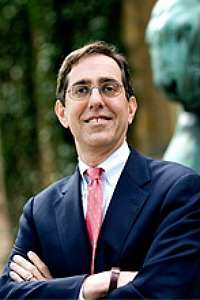
Paulette Sears (left), will present her work for the last time as a Rutgers Mason Gross faculty member in Dance Plus Spring, on Fridays, Saturdays, and Sundays from April 26 to May 5. Her work is sometimes challenging, always discerning, and I am eager to find out what she will say, in movement, at this point in her life.
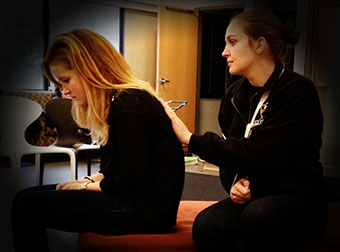
I also want to encourage the work of an artist at the beginning of his career. Daniel Rattner, who presents his Princeton University senior thesis production, Oh Where Are You Going, about two sisters (right), starting April 26. We happened to see Rattner’s wonderful riff on the Red Riding Hood legend for a summer children’s show at Theatre Intime. He has a big talent, and I’m eager to see where it goes.
Also coming up
I’ll Have What She’s Having, two more nights, April 19 and 20 at the Princeton YWCA, featuring the work of another choreographer I’ve watched for 30-plus years, Claire Porter, recent winner of a Guggenheim.
Janell Byrne‘s well of invention never dries up, and her Mercer Dance Ensemblperforms on May 18 and 19.
Are there any guest reviewers out there? After so many years of watching and writing, I may not have the stamina to write them myself. 

In Boston, They Knew How the Dance Moved

Atul Gawande, a emergency room doctor in Boston, posted this on his Twitter feed, his piece for the New Yorker on why Boston ERs were ready. Everyone rallied. Everyone did their job. They “knew how the dance moved”

Talking to people about that day, I was struck by how ready and almost rehearsed they were for this event. A decade earlier, nothing approaching their level of collaboration and efficiency would have occurred. We have, as one colleague put it to me, replaced our pre-9/11 naïveté with post-9/11 sobriety. 

I remember attending a crisis workshop at the American Red Cross, too many years ago to count. And then there was a followup meeting at a hotel. Could it have been before 9/11? Perhaps so, because no one in the hotel room seemed all that worried about, for instance, how to evacuate Central New Jersey. I wrote about it and threw away the notes.

Hopefully, somebody — the right somebodies, kept the notes. Can we be confident that area hospitals have had all kinds of emergency drills?. The best way to prevent the worst is to prepare for it. 


A Dance Weekend

 To celebrate the 10th Anniversary of the YWCA Princeton’s
 acclaimed dance performances of “Ill Have What She’s Having…” 
Dance Project,  performances are
 at the YWCA Princeton’s Black Box Theater
on Thursday, April 18 at 7:30 pm, 
Friday, April 19 at 7:30 pm and Saturday, 
April 20 at 7:30 pm.  All tickets are $25. 
Claire Porter will be a guest artist.