All posts by bfiggefox

Let Your Ears Do the Hearing: Are Yellow Pages Obsolete?


Should you advertise in the newspaper or the yellow pages? On the radio or TV? Or put all your marketing budget into social media and hire somebody to Twitter for your business?

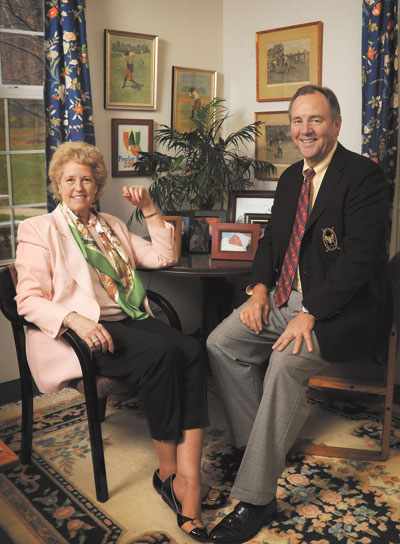
No better person to answer that question than John F. Kelsey III, who has been researching it for three decades. The founder of The Kelsey Group (TKG), will speak on “The Changing Marketing Mix: how can you attract business in the new decade?” for the Princeton Regional Chamber this week, Thursday, March 3, 11:30 a.m. at the Forrestal Marriott. This picture shows him with his wife Pam, in a November 26, 2008 cover story for U.S. 1 Newspaper.

“John Kelsey anticipated the rise of electronic media and its impact on the Yellow Pages and small-business marketing around the world,” according to a company spokesperson. “He worked tirelessly to help incorporate Yellow Pages into the world of contemporary online and mobile marketing. And he created a community that brought traditional media and new media together.”

“The Kelseys built a company that researched and analyzed data on print and electronic Yellow Pages, local search, small-business marketing, and local media,” wrote Scott Morgan in the U.S. 1 article. “They had weathered the days when they made no money, and scored big.”

When they sold the company in 2008, conferences made up 40 percent of its business. TKG focuses on Internet, mobile, and Yellow Pages, and the buyer, Virginia-based BAI, specialized in radio, television, and consulting — a good fit.

In his own blog Kelsey quoted an article in the NY Times (”Mom and Pop Operators Turn to Social Media“) that shows how even the smallest of companies can grow rapidly using Twitter as a promotional vehicle. “No, there’s no advertising money associated here … yet. The old saw “where there’s a will, there’s a way” comes to mind.” Kelsey promised that advertisers will find those using smartphones. “The money is not likely to be new advertiser dollars, but rather expenditures coming from other media that are looking for the most efficient way to drive conversions within geotargeted areas.”

Full disclosure: I’m on the chamber program committee and I’ve been wanting to hear John Kelsey’s wisdom for some 20 years. See you there!

Surreal: From HomeFront to Wealth Planning


In the space of three hours today, I have picked up provisions from a food pantry (on someone else’s behalf) and gone to a conference on how to donate wealth, whether to use a gift annuity or a charitable remainder trust.

Pictured above, top, are Celia Bernstein (CFO and operations director, left) and Connie Mercer (founding CEO) of HomeFront, the wonderful 30-year-old nonprofit that offers all kinds of services to the poor and homeless. I had offered to pick up food for one of their clients, a friend of mine who does not have a car.

I’d been to HomeFront’s offices on Princeton Avenue before, at the grand opening, as a matter of fact. I’d written about HomeFront on numerous occasions for U.S. 1 Newspaper, starting when Mercer started the organization in 1990. To quote from the website, “the average HomeFront client earns $8 per hour and works forty hours per week. The average rent for a two-bedroom apartment in Mercer County is $1,022.00. You do the math.”

Now that I know someone who needs HomeFront’s wonderful services, I’m getting to know this organization on an under-the-skin basis. Perhaps I’ll be able to write more later, right now it’s enough to know that it’s there.

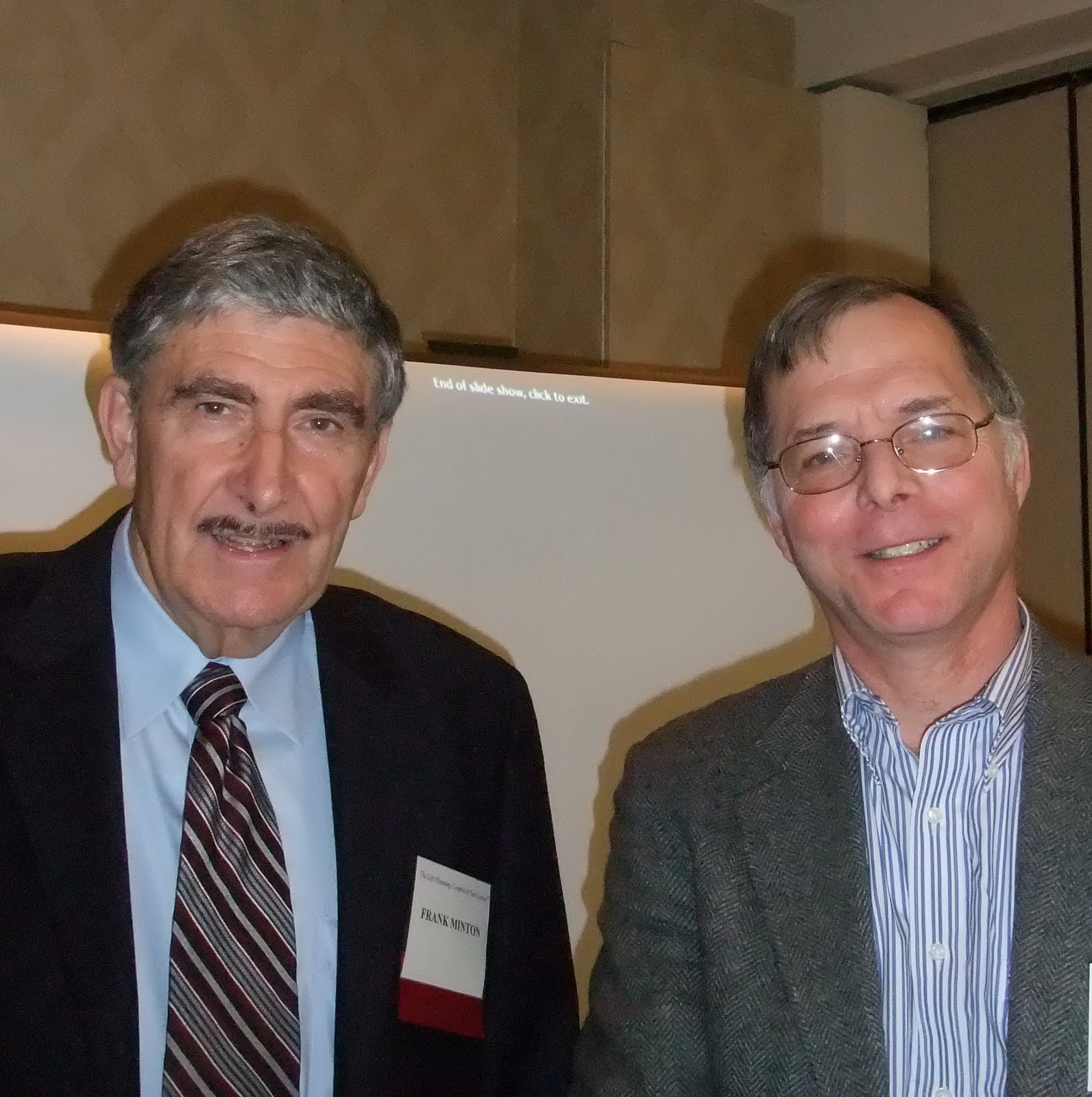
From there, it was up Route 1 to the Doubletree Hotel to sign in for the Gift Planning Council of New Jersey’s morning seminar, where Frank Minton (far left, shown with Joe Pistell of United Methodist Homes) spoke to a large group of folks who help rich people donate money, while retaining some income. The question for the morning: which is better, a gift annuity or a charitable remainder trust?

I’m not a financial planner or anything like that, and much of it was over my head. I just wanted to get an insight in how the financial planners think. Sure enough, which they recommend to their clients often depends on they work for. If they work for a charity, they are more likely to recommend a gift annuity, if the donor is their client, the charitable remainder trust is often favored.

It was a surreal juxtaposition.

Ed Zschau and Friends: Tech Transfer

 
Posted by Picasa

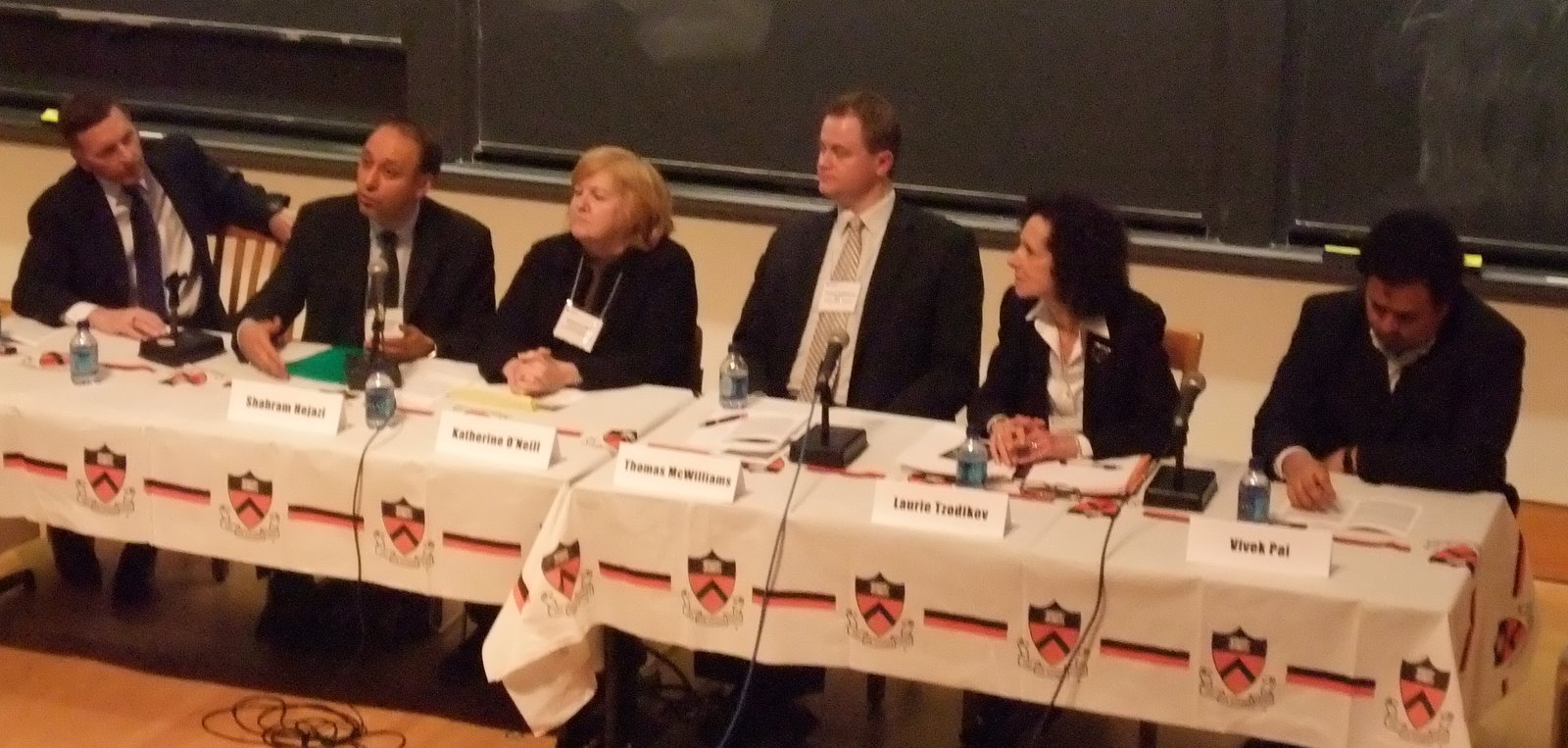
“There are great ideas and there are ideas that will sell and they are not always the same thing,” said Thomas McWilliams of Drinker, Biddle & Reath. He spoke at Princeton University’s Keller Center Technology Commercialization Panel, chaired by Ed Zschau, on Tuesday, February 16, at 5:30 p.m. (From left: Ed Zschau, Shahram Hejazi, Katherine O’Neill, Thomas McWilliams, Laurie Tzodikov.)

Shahram Hejazi, venture partner of BioAdvance and former CEO of Zargis Medical Corporation, had a similar warning: Is the business idea merely a solution that is looking for a problem? Even if you do what you say you can do, does anybody care?

The business idea must be able to make three times the required investment, said Hejazi. If you need $100 million to prepare for the company’s sale, can it sell for $300 million, and can you show any company in this space that will sell for that?

But angel investors have realistic expectations, said Katherine O’Neill, executive director, Jumpstart NJ Angel Network. When they put their money in pre-revenue companies, they expect revenue from just one out of 10 companies. Three may live, six will die.

What type of company attracts investors? They look for innovative patent technology, solutions to real problems, a low level of initial capital to bring the business to fruition, and an enthusiastic representative (which could be a graduate student) who can communicate the value of the technology.

Angels also look for a technology in which they have expertise. They don’t want to contribute just money; they want to add value to the firm.

All of this information applies to any young company but taking university inventions to market has its own problems, she said. Academic inventors get distracted by their other responsibilities. “An amazing number of academic scientists don’t return calls from potential investors,” said O’Neill. She pleaded with professorial entrepreneurs. “If you’re busy and don’t have time to meet, at least return the call and say so.”

Vivek Pai,
associate professor of computer science, experienced the conflict between his entrepreneurial and academic pursuits. He helped architect and develop iMimic Networking, the fastest Web proxy service in the world. It was bought out by a company that was bought out by Cisco, then he cofounded CoBlitz, a content distribution firm.

Pai said that if he hadn’t needed to concentrate on getting tenure, his company might have gained better market share. “Be prepared for your new company to consume all your free time. If you aren’t willing to spend that time, then license your technology. “

Laurie Tzodikov
told how the Princeton University office of Technology Licensing and Intellectual Property works closely with professors and graduate students to commercialize their ideas. Each year the office gets 80 to 100 invention disclosures, files 60 provisional patents, makes 15 to 20 agreements per year, and helps two to three startups per year.

Some examples: Alympta, the Eli Lilly cancer drug; protection equipment from TigerOptics; Universial Display Laboratory, mice models sold through Taconic Artemis.

“We need a partnership with the inventor. We need to be very persistent,” she said.

But by far the most surprising observation came from McWilliams. In the USA Inventors have just one year to file a patent after they first publish their research. Elsewhere in the world, it’s a much shorter fuse, and for China you need to get the patent almost before you publish.

Amazingly, what constitutes “publishing” can be just giving a slide presentation, or giving any kind of presentation where someone has the opportunity to take notes. That’s a strong warning to keep your mouth shut until you have hired a lawyer.

Future events: a Keller Center entrepreneurs’ panel on Friday, February 26, at 2 p.m.

And the New Jersey Entrepreneurial Forum hosts a seminar on intellectual property, effective low-cost protections and portfolio strategies, with Elliott Stein of Stevens + Lee and David Gange of Chemistry Patent Search, on Thursday, March 11, at 4 p.m. at the Technology Center of New Jersey.

Einstein Alley Entrepreneurs: What Next?

 
Posted by Picasa

Ed Zschau’s ears must have been burning this week. He chaired a Keller Center panel on technology transfer on Tuesday afternoon and was being talked about on Wednesday, both morning and evening. In his high tech entrepreneurship classes, and his mentoring of companies, Zschau has had a huge influence.

At the Princeton Chamber breakfast on Wednesday morning, Darren Hammel told how, when he and his buddies took Zschau’s high class, Zschau encouraged them to turn their term project into a business, which has grown to be Princeton Power Systems.

At Einstein Alley Entrepreneurs Collaborative on Wednesday evening, Steven Georges said that Zschau operates in an idea factory – to listen, coach, criticize. He quoted Zschau as saying, “Always be on a horse worth riding in a race worth winning.”

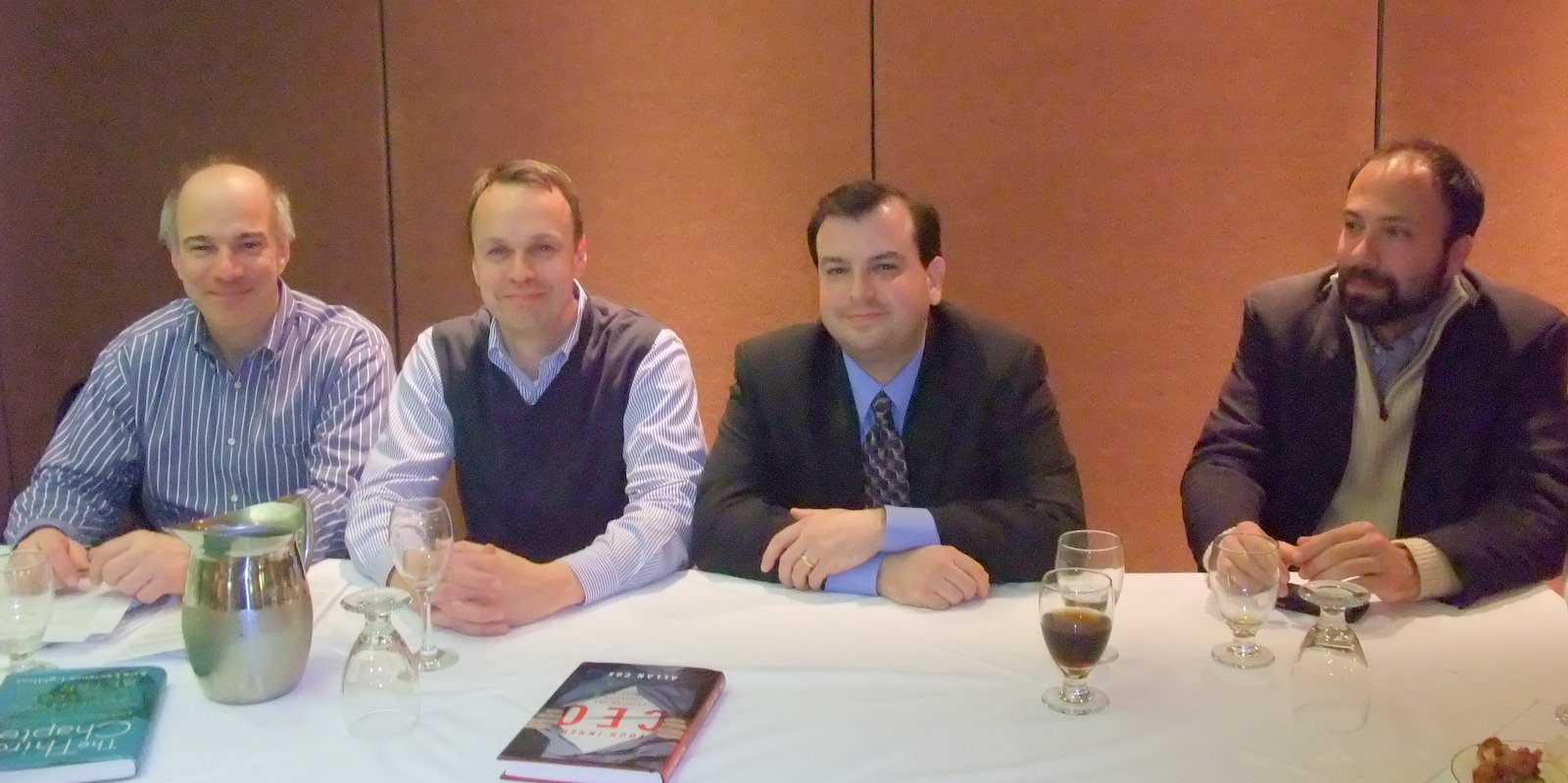
Georges (far left) was on a panel, along with (continuing left to right) John Romanowich, Jeremy Kestler, and moderator Eric Kutner. On the theme “What Next?” each brought books to recommend, and some of their remarks verged on the spiritual, perhaps appropriate for the day some celebrate as Ash Wednesday.

Summarize your life in 10 words, in order to contemplate your inner essence, as in Allan Cox’s “Your Inner CEO.” Don’t look at what you are saying. Look at what you are doing. If you are not getting the result you want, it is because of your actions. John Romanowich.

Mesh your worlds. If your job doesn’t relate to what you enjoy in life, you have a problem. Live an entrepreneur’s life if only by living your big company job in an entrepreneurial way. As in Christopher Gergen and Gregg Vanourek’s “Life Entrepreneurs.” Eric Kutner.

Have faith in your purpose in life. “Each of us has a mission and a plan. After a transition in which I lost my job, my father, and the lease on my house in one year – I now embrace transitions as opportunities. You need to know who you are. I know I’m not the idea guy, I’m the project manager.” Steven Georges.

Leave a footprint on the world. If someone helped you, pay it forward as in Marc Freedman’s “Encore: Finding Work that Matters in the Second Half of Life” and in Sara Lawrence-Lightfoot’s “The Third Chapter.” Steven Georges.

Have faith in your hunches. Make good or bad decisions quickly – you won’t know which is right until you do it. And if you listen to your feelings, your gut, you will know what is right. John Romanowich.

And then they had practical advice.

On Careers: Consistent job searching is the new reality, so do market research on yourself, as in the article Tom Peters wrote for Fast Company, “The Brand Called You.” Kestler.

On Selling Tech Products. Don’t go for the mass market. Find the early adaptor, the company with a problem that makes it worth the risk to try your product or service. As in Geoffrey Moore’s “Crossing the Chasm: Marketing and Selling High-Tech Products to Mainstream Customers.” Kutner.

On Market research reports. They are backward looking, in contrast to innovation, which is disruptive. If you can market research your idea in a report somewhat else wrote, you are probably 5-10 years too late. Don’t charge off into an industry when you don’t have deep technical expertise. Romanowich.

On Funding: If you have a deal that’s going to happen, you almost can’t kill it. If you have a deal that’s not going to happen, you almost can’t revive it. So don’t put so much energy into the difficult deals. Romanowich.

On Employees. In a downturn, you can get good people you wouldn’t otherwise get. What kind of employee you need depends on where you are in the product cycle. Some are risk averse; some don’t like the monotony of late in the product cycle. Romanowich.

On Business Ideas:: You want to solve a problem that somebody will pay you for. Kutner.

On operating in the new economy. Let people know what is going on. Have ambassadors and keep them up to date with what you are doing so they can help get your message out there. Kestler.

All liked bootstrapping as a practical way to stay on target. “What does not kill you makes you stronger,” said Romanowich. By having to work faster, better, cheaper – rather than spend someone else’s money – you create a better company.

Zschau is slated to speak at a Princeton Chamber breakfast on Wednesday, April 21, and there is another Keller Center lecture on Friday, February 26, at 2 p.m.

Power Creates Jobs


During his senior year at Princeton University, Darren Hammell and several buddies worked on an idea for a company in their dorm rooms, and they tested the idea in Ed Zschau’s high tech entrepreneurship class. The day after their graduation, serial entrepreneur Greg Olsen made an investment by writing a term sheet on a yellow post-it note at Starbucks on Nassau Street.

Nine years later Hammell has just turned 30, and his company, Princeton Power
Systems,
has raised more than $6 million. It is cash-flow positive, has 40 employees, and is hiring, aiming for 91 new jobs in two years.

I’m quoting my own article here; it ran as the cover story in U.S.1 on January 20, and the photo is by Craig Terry. I’m rerunning the lead in Princeton Comment because Hammell will address the Princeton Chamber at its breakfast on Wednesday, February 17, at 7:30 at the Nassau Club. (Full disclosure: I’m on the program committee that scheduled this.)

I heard Hammell’s very successful presentation to the Einstein Alley Entrepreneurs Collaborative, and he also spoke to the Association for Corporate Growth (ACG-NJ). Somebody asked me last week, Why should I come to hear him? Hmm, I said, and here is my answer:

* Just plain good story: Hammell is a good raconteur with a tale that combines hard work, derring-do, and luck — and the right connections.

* Connections: He has excellent ones and maybe they’ll show up.

* Information: Hammell can tell, not just about his company (which has software-enabled heavy-duty systems for power generation and conversion) but also about the big picture on energy.

* Investment ideas: Hearing how one academic spinout succeeded may give you some ideas about where to look for your next investment.

* Inspiration: Daydream about how your 20-something offspring — or you yourself — might take a good idea down a similar success road.

* Intergenerational HR tips: Hammell says he used to “not trust anyone over 30” but his company brought in a mature CEO. How’s that working?

Maybe none of these reasons work for you. That’s OK, different strokes for, well, you know.

Another option: Ed Zschau moderates a technology commercialization panel at the Keller Center in the Friend Center on Tuesday, February 16, 5:30 p.m. It is free.

Or: the Exploring Life Sciences Mercer County Breakfast, sponsored by the Greater Philadelphia Chamber, on Wednesday, February 24, at 8 a.m. at the Nassau Inn. If you belong to either the Mercer or Princeton chamber, it’s free if you register in advance. Otherwise it’s $35.

Moroccan Prince of Princeton


A Prince of Morocco lives in Princeton in political exile.

In Abu Dhabi the Prince has a green energy business. Here, at the university, he supports an institute that aims to build bridges to the Western world.

These details come from a Daily Princetonian article, via PrincetonTour

It will not surprise some members of the Princeton community, particularly those who follow the work of Not in Our Town (an interracial, interfaith social action group in Princeton committed to speak truth about ‘everyday racism’) that the following incident occurred: When the Prince was a student at the university (Class of ’85) he got picked up by local police, in connection with a Hoagie Haven robbery, and spent an hour in the hoosegow. He was released with apologies to the Moroccan embassy.

The next event at the Institute for the Transregional Study of the Contemporary Middle East, North Africa, and Central Asia (TRI)is Wednesday, February 24, 2 to 5:30 p.m. at 202 Jones Hall. “The Global Financial Crisis and the Persian Gulf: Dubai’s Debt and the Future of Islamic Banking” will have roundtable presentations and discussions by Rachel Ziemba, Eckart Woertz, Don Hanna, Mahmoud El Gamal, Ibrahim Warde, and Aron Zysow.

Kuenne: Doing the Math on Headache Pills

If you use Excedrin for your headaches, you are among 18 percent of the population and you are what Chris Kuenne terms “an aggressive medication believer” who wants to nuke your headaches. Excedrin does that because has two relievers in it, plus caffeine, and the caffeine makes the other drugs work faster.

At the Princeton meeting of the Association for Corporate Growth (ACG) on February 4 at the Westin, Kuenne told how his firm, Rosetta, gains market share with its trademark strategy, “personality-based segmentation,” which offers mathematical ways to connect behavioural and attitudinal data.

Rosetta told its Excedrin client (at the time, Bristol-Myers Squibb) to focus everything – ads, packaging, PR, whatever – on that niche market of aggressive medication believers, those who want meds, want to use them aggressively, and believe that they will work. “We told them to spend no dollars on the other 82 percent of the market.”

Personality-based segmentation has worked, for Rosetta, in five vertical markets: healthcare, finance, consumer/retail, B2B web-based technology, and travel. With $130 million in revenue in 2008, Rosetta is now among the top 10 digital ad agencies in the United States and the largest privately held one.

His advice to would-be entrepreneurs: if one or two things fascinate you, that could be your cues for business ideas. Some of his other success strategies:

Focus on one great idea.

Focus on the right industries and serve the right marquee clients.

Obsess over quality and client impact.

Hire the smartest people.

Run like a publicly held company from the beginning. Have a major law firm, major accounting firm “and grow into them.”

Those strategies helped, but so did timing. The dotcom bubble had come and gone when Rosetta was starting up. So it had time to reinvent itself and ride the next wave.

Kuenne made his first sale at J&J;, where he got his start. After graduating from Princeton University in 1985 and getting a Harvard MBA, he worked at J&J; for 10 years, then did a stint at Nelson Communications. He spun out his part of Nelson Communications into Rosetta in 1998, setting up at the Carnegie Center. In 2005 he “moved downstream” and captured more of the business by buying a same-sized company, Simstar, a digital ad agency with $10 million in revenue.

In 2007 he found a private equity partner, Lindsay Goldberg, to fund Rosetta’s buildout. Since then Rosetta has acquired Cleveland-based Brulant, a software company that partnered with IBM, and, just announced last month, Wishbone, a healthcare strategy and communications firm.

A caution for today’s economy: “We couldn’t have done the Simstar acquisition – borrowing $4 to $5 million on a $20 million company – today.”

Hurley: Aim High in B-ball and Business

“I want every practice to be a masterpiece,” said Bob Hurley Sr., who for 38 years has coached the Friar’s basketball team at a tiny coed high school, St. Anthony’s in Jersey City. With 10 classrooms and 250 students, the school doesn’t even have its own gym, but, as Hurley said, “What we lack in bricks and mortar we make up in a dedicated faculty. In 38 years, every kid but two has gone to college.”

At 62 his “old style values” and coaching methods are legendary. A Bergen Record reporter, Adrian Woinarowski, covered the 2003-2004 season in “The Miracle of St. Anthony: A Season with Coach Bob Hurley and Basketball’s Most Improbable Dynasty,” and it may soon be made into a movie.

Hurley spoke to the Princeton chamber on Thursday, February 4, a speech that was admirably covered by Anita Shaffer in the Times of Trenton. Also the St. Anthony Friars will play a Maryland team in the PrimeTime Shootout at Trenton’s Sun Center on Saturday, February 13, at 6 p.m.

You’d have thought this would be a sports speech, but as Herb Ames (who wrote an inspirational memoir “Aim High” about how sports can influence your work) pointed out afterward, there were multiple comparisons between basketball and business.

Work hard. “I teach them how honorable work is,” says Hurley, who sweeps the practice floor himself.

Stay current. “When you’re an older person in leadership, it is particularly important that those around you know you are cutting edge.” He attends 6 to 8 clinics a year. “And I take notes from every single person I come across.”

Don’t let any detail slip by. “I’ve written out my practice every day for 43 years, and I’ll go back and look at what we did five or 10 years ago.”

Make a strategic plan. “After 10 games we scout ourselves, to see where we are and where we want to go to.”

Focus on your dream no matter what. “I found something in life that never made me want to do something else.” The “no matter what” was that, to earn enough money, he spent long days on the streets of Jersey City as a probation officer and only recently retired.

At the end of the talk, prompted by a question from Kristen Appelget about coaching your own sons, Hurley made a poignant observation – he even seemed to surprise himself – as he told how he had turned down a chance to coach at Xavier. (Hurley’s good friend, Skip Prosser, took the job instead and went on to Wake Forest, where he died of a heart attack.)

The family was ready to move to Cincinnati, when his oldest son, Danny, pleaded with him not to go. “He and Bobby made impassioned pleas to stay,” said Hurley, noting that he had never really made the connection between not ever being a college coach and his sons’ desire to play at St. Anthony’s.

Of course it wasn’t easy on Danny to be the coach’s son. “If your son is really good or really bad, it’s not a problem. But if he’s in between — I had to take it up a notch, and I treated them worse than anyone else. The kids didn’t want to be him. But after 18 months we finally got it right. The first kid (Danny) could really pass, and that made everyone kinda happy. The second guy (Bobby) was more of a scorer. We won six consecutive state championships and both were New Jersey players of the year.”

After being a star at Duke, Bobby played for the NBA and is a horse breeder. Danny played at Seton Hall and now – like father, like son — is happily coaching high school basketball at St. Benedict’s. That’s another parallel to business. In sports, as in business, what your parents do can have a huge influence on your career.

PJCF Speed Dating: 17 Shots on Goal

Seventeen new companies, fourteen potential funders, one reporter, and a Congressman. It was a great start for Princeton Job Creation Forum’s first speed dating session, aiming to create companies to create jobs in New Jersey, on Tuesday, January 26. Princeton University hosted the three-hour marathon at the Friend Center, led by an all-volunteer team, led by David Sandahl of Decision Consulting, along with Drew Marshall of Primed Associates, Star Wilmuth, Len Newton, and Karen Jezierny.

“There’s so much energy in this room!” exclaimed Jezierny, director of public affairs at the university. And there was. Every five minutes the funders had to move to the next table. I hovered, and when there was a free presenter, plopped myself down and started interviewing. At risk of truncating info to inaccuracy, here’s some of what I found:

Caliper’s Herb Greenberg, with Rick Roman, pitched a re-do of Greenberg’s free service “Vet Career Connect” matching jobs with competencies needed, based of course on the applicants taking Caliper’s famous test. Greenberg is looking for a database partner. Companies will pay less to list their jobs than on major job boards, but they would get the added value of applicant test results. The unemployed would pay nothing.

Ray Ingram, a serial entrepreneur in the learning space, has a new firm, Dathil, that offers Adult Literacy Using Enhanced Recognition, a Software as a Service to make adult literacy training more economical. He’s looking for $250k seed money, and developers to finish the remaining 20 percent.

John Hartmann, an alumnus of Merck, looked to Hungary for polymer technology and his ElizaNor Polymer LLC, which uses Hyaluronic acid to make a skin care product that sounded to me as if it could be the next Neostrata. Also a product for cancer patients, and a revolutionary one for wound management that uses blue light to convert a liquid to a solid that disappears.

The GamerCast guys, Louis Eagan and Jeff Paytas, with their Fox Rothschild attorney Daniel Madrid, are looking for $100,000 to promote their live streaming user broadcasts of video games that involve celebrity athletes. I recognized only the name of Mia Hamm the women’s soccer champion on their roster but I’m an illiterate sports observer. This company is located mostly in Las Vegas.

Whereas Green Earth Power Systems is very very local, the brainchild of serial entrepreneur Roger Bessler. He sold one company to start this one. One of his ideas, to use his Sarnoff-honed expertise to make Household “E-Pods” powered by solar and natural gas, supplying electric for electric vehicle charging, house heating, and cooling from a thermal cell. It’s quite a story.

So is the Larry Richards story, explained in a previous article in U.S. 1 Newspaper. With him, Richards brought George Hannah, former finance director of the City of Trenton, and Herbert Bright, retired from Nabisco. Their Trenton Information Management Company (TIMCO, pictured above) has a good chance of bringing $2 million in revenue next year and at least 200 Trenton jobs.

Dimitry Paramanov retired from his job as director of global access at Bristol-Myers Squibb to start MED-IN-TOUCH, using Internet and wireless technologies to improve patient medication compliance in the clinical trials space. He outsources the R&D; to MPR Engineering.

A real change of pace: a movie producer, Joe Seldner, is looking for funds to produce Operation Pedro Pan, a Cuban immigration saga. Seldner is already working with Paramount on a Ripley documentary and one with the McCloskey ministries.

John Nash’s RadioSurgery Partners was a bit of a ringer because it’s based in Timonium, Maryland, but it partners with hospitals like St. Peter’s and Cooper Medical Center. It packages the latest technology (like Cyberknife) in an economical way.

Diena Seeger, vice president of operations at Viocare, tell of the companies personalized wellness technology ecosystem, too long to explain here but you may know it as Princeton Living Well. Viocare, founded by Rick Weiss, is looking for money for sales, marketing, and branding efforts.

Chris Tyrrell and Gerald O’Donnell, former Wall Streeters, want to do their part in changing the world by selling energy-efficient lighting technologies to warehouse owners at Exit 8A. Their firm, Carnegie Center-based Right Energies LLC, will partner with a mid-west manufacturer and offer no-up-front-cost financing.

Others represented: Joseph Calabro of Pathlink LLC in Red Bank; Mario Gonzalez of Princeton Pathology Services at 20 Nassau Street (he has a gynecological medical device); Raj Malhotra’s Precise Solutions Inc. (software for electronic medical records) in East Brunswick; Medford’s TCMG offering eco-friendly, LEED-certified American made cabinets and countertops.

The most unusual technology, and the most well-organized presentation, was Regeneco LLC, which aims to gather up all of New Jersey’s old tires and, with a gasifying process, convert them into electricity and saleable scrap steel. Jerome Block, Ulf Hansson, and Nicholas Hegedus seem to have all the answers: the process doesn’t pollute and makes money for everyone all around. They would build nine plants in the U.S., each employing 25 people. Only catch: the first plant will be expensive. But the stats they cite are compelling: for every person in the United States there is one discarded tire lying around somewhere.

That’s what might have sparked your interest if you were the one with $100k under your mattress and looking for a place to put it that would help both you and the nation’s economy.

Rep. Rush Holt declared that innovation – private sector job growth based on a well-trained workshop and new ideas — is the key to an economic rebound. He likened the day to taking shots on goal. Not every one gets in, but some will.

Here is the link to some snapshots. If you find yourself there, add your name. And if you don’t like your likeness, let me know and I’ll take it down.

A correction was made to this post on 6-18-2010.
Home Grown Jazz Talent


It’s always exciting when hometown kids make good in the music business. Many a Princeton kid has gone on to jazz or rock fame, often from the legendary Princeton High School Studio Band.

Wendy Zoffer, a musician whom I met through the Princeton chamber, wrote to tell that her son (Dylan Cohen, lead guitarist of Mad Cats and Beehives) just finished a gig at the Stone Pony and their next will be at Finnegans on February 20. He’s a senior at West Windsor-Plainsboro South. Also in the rock band are Keith Lalley, (trombone/vocals), Meggen Greenberg (bass), and Mike Cintron (drums).

Then I heard that Jesse Fischer is bringing his Brooklyn-based band, Soul Cycle, to Small World on Friday, January 29 to play what is billed as “an infectious blend of jazz, funk, and world music.” I know Jesse through his brother, Ezra, who worked at U.S. 1 for awhile. Both their parents (Ilene Levine and Richard Fischer) are teachers, he at Princeton Friends School, she at Roosevelt Public School.

Jesse Fischer has been performing at Small World, in various bands, for 15 years. While at Princeton High School, Fischer played with the Studio Band for all four years, 1994 to 1998, under the leadership of the late Tony Biancosino. “Dr. B was a huge influence on me,” says Fischer, “in terms of leadership style and musicality.” Fischer also studied jazz piano with Princeton-area teacher Laurie Altman and with Stanley Cowell at Mason Gross School of the Arts, but considers himself mostly self taught.

His current band includes sax player Brian Hogans, bassist Josh David, percussionist Shawn Banks, and drummer Corey Rawls. Rawls also teaches privately in the Princeton area. They just finished their third CD, Mosaic, described as capturing “the intimate energy of a live performance, resulting in honest music that ranges broadly from contemplative to joyous, from searching to playful. Overflowing with memorable compositions, dynamic group interplay, and raw soul, Mosaic is a bold statement in support of real music.”

I was interested in his account of a typical work weekend: a singer- songwriter showcase Friday evening, a late set with an R&B; cover band Friday night, a bar mitzvah Saturday morning, a jazz gig Saturday night, sit in with an African band after-hours, and then play in church Sunday morning.” He created his latest CD to reflect this mix.