Category Archives: Dance and the other arts

The Artist Next Door

On Cedar Lane, the Fox family lived next to the Kruse family. We were the age of their parents. They were “us” when we first came to Princeton, their girls in middle school and high school. We were lucky to have them — and the Zimmermans across the street — as neighbors. They helped us out and — with unfailingly gracious hospitality — included us in their circle of friends, often gathering around a table on their patio, overlooking both of our back yards.

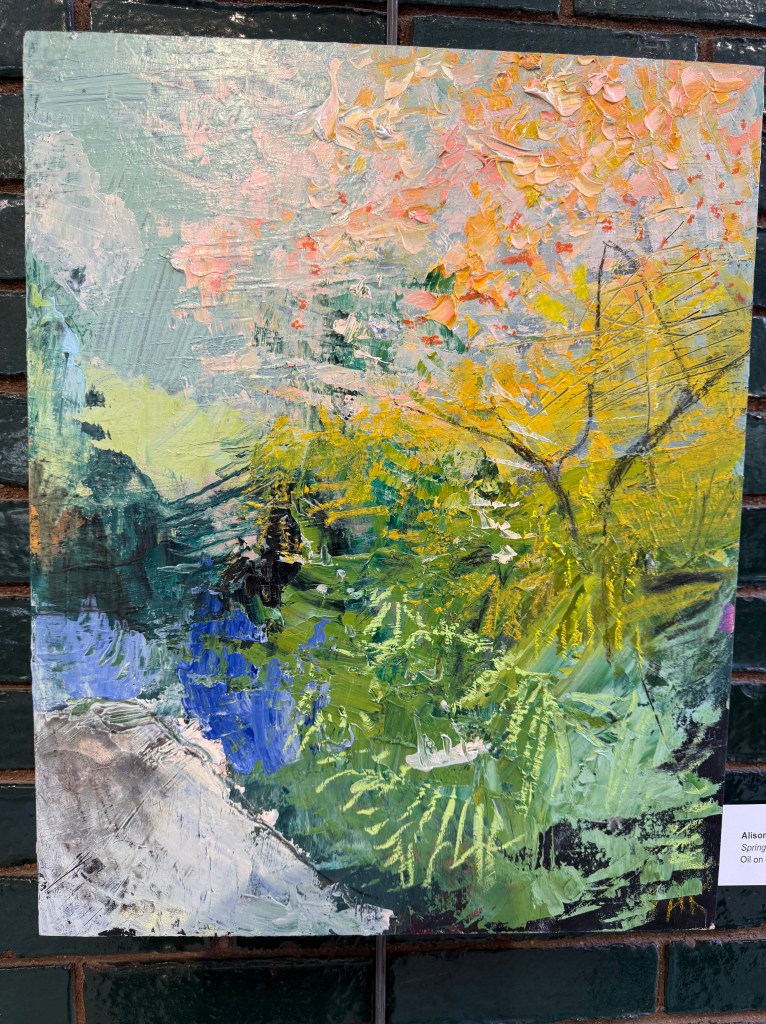
Alison Kruse, amazingly, grew up to be the artist she always wanted to be. Her exhibit “Painting Life” is on view in the Considine Gallery at Stuart Country Day School through Thursday, November 20. Alison says she hopes each piece is a “visual journal entry, rooted in truth and lived experience, exploring the interplay of memory, place, and emotion.” I believe the oil and charcoal work above, titled “NJ,” captures the spirit of gathering at that table in the twilight.

I’m delighted by Alison’s success. She went to Princeton High, studied in after school classes with Heather Barros, and majored in fine arts at Queen’s University in Kingston, Ontario. She has earned foundation grants and residencies and has stayed true to her vision. I’m also impressed by the support she had. Not every parent would have wholeheartedly supported a daughter’s painting vision.

Thanks also to Phyllis Wright (show below), the art teacher at Stuart who brought her class to network with the artist, and to Sara Hastings for drawing my attention to this exhibit by featuring it on the cover of the Princeton Echo. I’m proud to say that I own an early work by Alison Kruse.
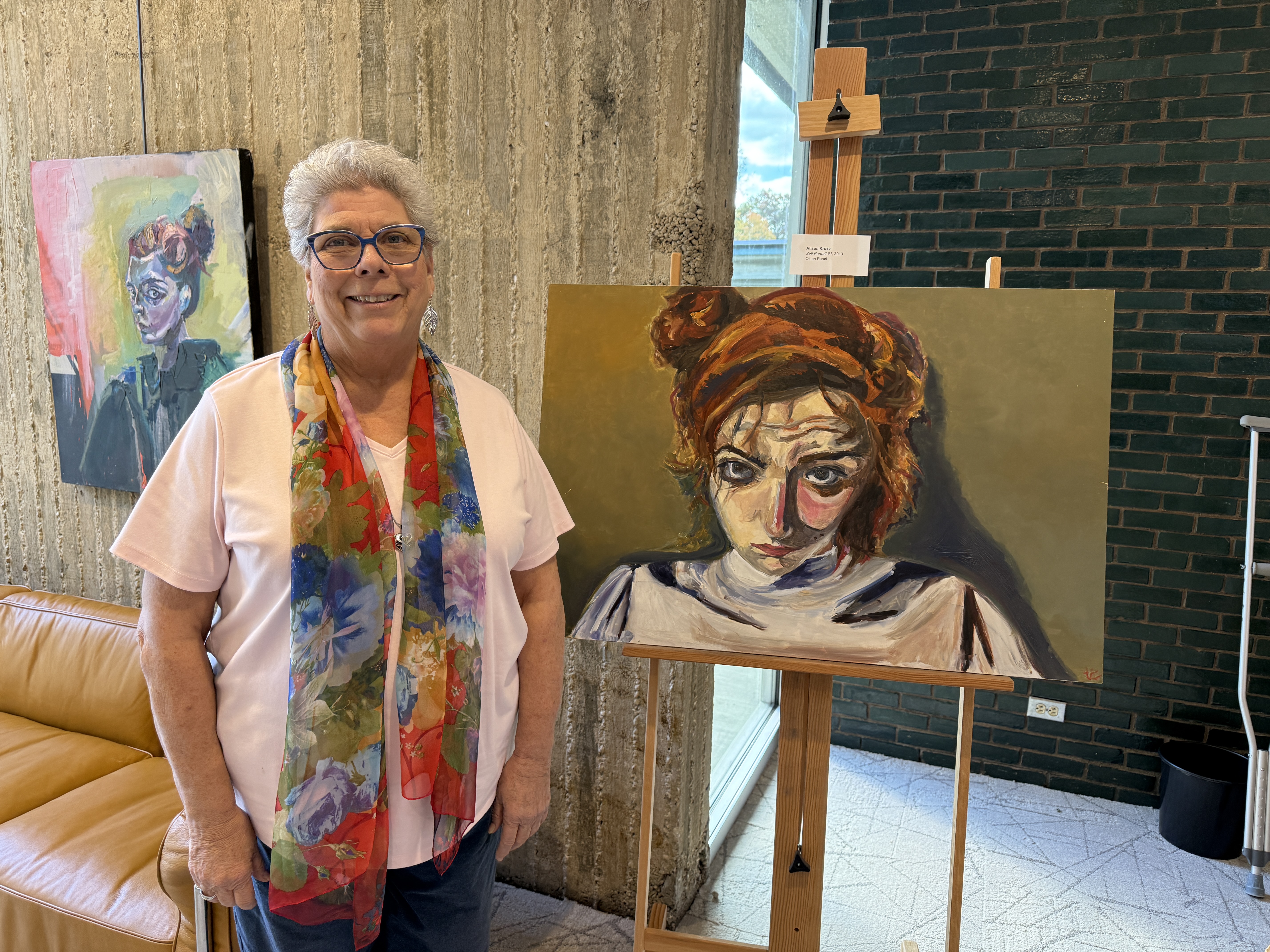
Alison’s mother, Kate Kruse with the Princeton Echo cover image.

‘Christmastide’

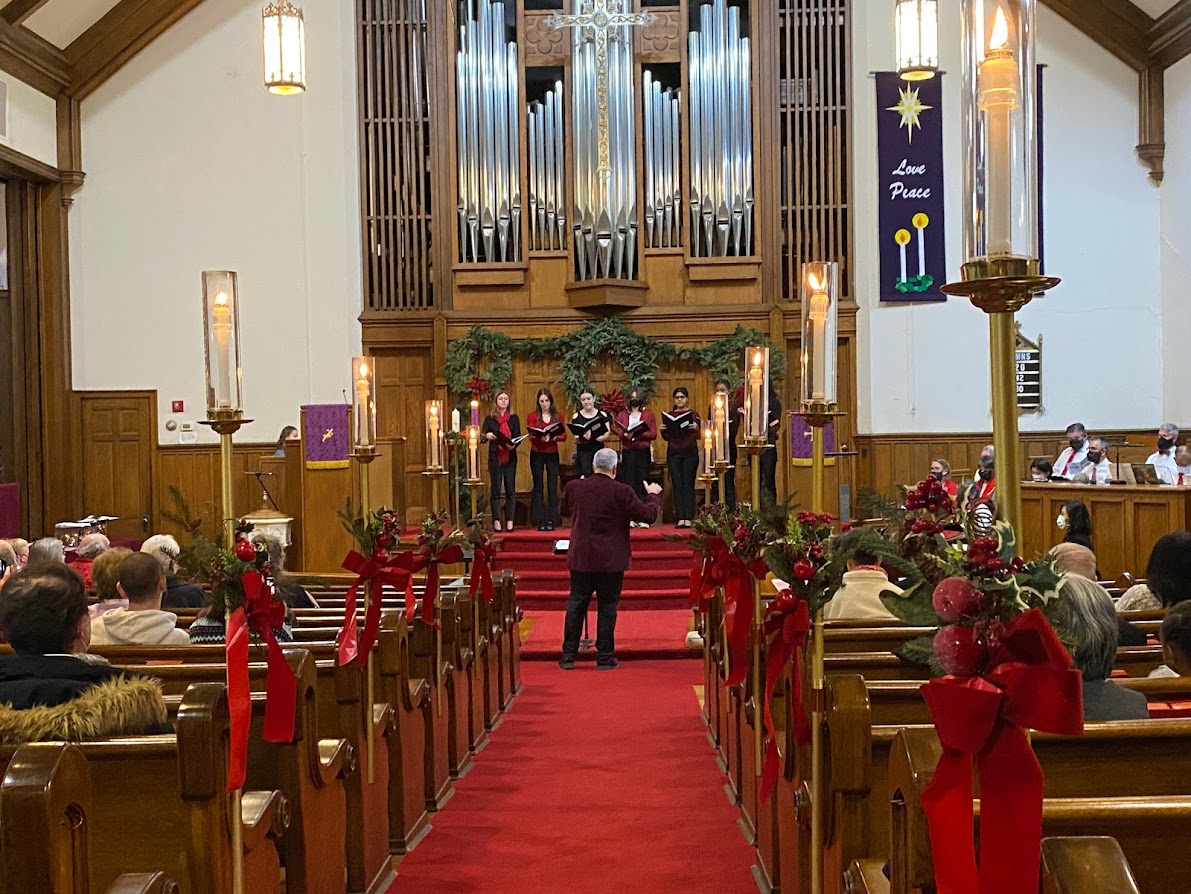
Christmastide, an anthem by Tom Shelton, sends chills down my spine whenever I hear it. Today I was fortunate to hear Shelton’s Youth Choir render it twice, in a day of beautiful music, first at morning worship, when the Chancel Choir also sang one of my favorites, Bach’s Jesu Joy of Man’s Desiring. They reprised it tonight, along with joyful music from the Chancel and Handbell Choirs, directed by Hyosang Park, in a concert entitled “Rejoice!”

Here is the link to hear Christmastide, from Sunday, December 17 at 10 a.m.

This post is a thank you to the musicians at Princeton United Methodist Church – and to musicians around the globe – who put their hearts and souls into bringing the hopeful strains of Advent and Christmas music into churches and concert halls everywhere. How can anyone not believe in the divinity of our Creator when listening to these harmonies?

So – thank you to these musicians, and as you read their names, you will see that several do double and triple duty. Many of them perform in professional ensembles. But there’s nothing like hearing your own friends make music in your own house of worship. Kudos to Park, who put the program together, as well as to Shelton.

In the Chancel Choir are Mandy Du, Yvonne Macdonald, Joan Nuse, Lori Pantaleo, Françoise Maitre, Karen Hoagland, LaVerna Albury, Jenni Collins, Lindsay Diehl, Stephen Offer, Curt Hillegas, Yannick Ibrahim, and Jim Frisbee. They gave us Handel’s Christ is Born (arranged by Jon Paige) and Shepherds Come Rejoicing by Joseph M. Martin, and Purcell’s Rejoice in the Lord Always.

 In the Youth Choir are Elli Collins, Juli Collins, Maggie Collins, Shermel Morgan, Julia Potts, and Aditi Rapaka. After joining the Chancel Choir for the Purcell, they sang two old world carols and then, with Jenni Collins as soloist, Shelton’s Christmastide.  

The Handbell Choir played News of Great Joy in an arrangement by Arnold Sherman and O How Joyfully, arranged by John Behnke. Ringing were Irene Yu, Diane Peterson, John Macdonald, Yvonne Macdonald,  Joan Nuse, Bob Nuse,  Amy Gardner,  Bill Gardner, Julia Ciccone, Mary Ciccone,  Sarah Betancourt, and  Heather Hansen.

The orchestra closed the program with Handel’s Rejoice Greatly, featuring Bill Gardner on trumpet, along with Elizabeth Rouget, Violin; Myles McKnight, Violin; Paul Manulik, Viola; Gabrielle Hooper, Cello; Scott Collins, Clarinet; Amy Gardner, Clarinet; Bill Gardner, Trumpet; Julia Hanna, Piano. Ian Macdonald and Eric Gillette managed the video stream, available here on this Facebook page. Or on the website.

As Rev. Jenny Smith Walls said, in using the words of Kate Bowler for the benediction, “We have quieted our souls to listen, for your word made flesh is life to us.”  

                       ———————- Barbara Fox

On Christmas Eve at 4 p.m. the Children’s Choir leads a family-friendly candlelight service — and at 8 p.m. a traditional service features the Chancel Choir, Youth Choir, and instrumentalists. All are welcome.

Joseph Pilates, Anthony Rabara — and Jacqueline Winspear

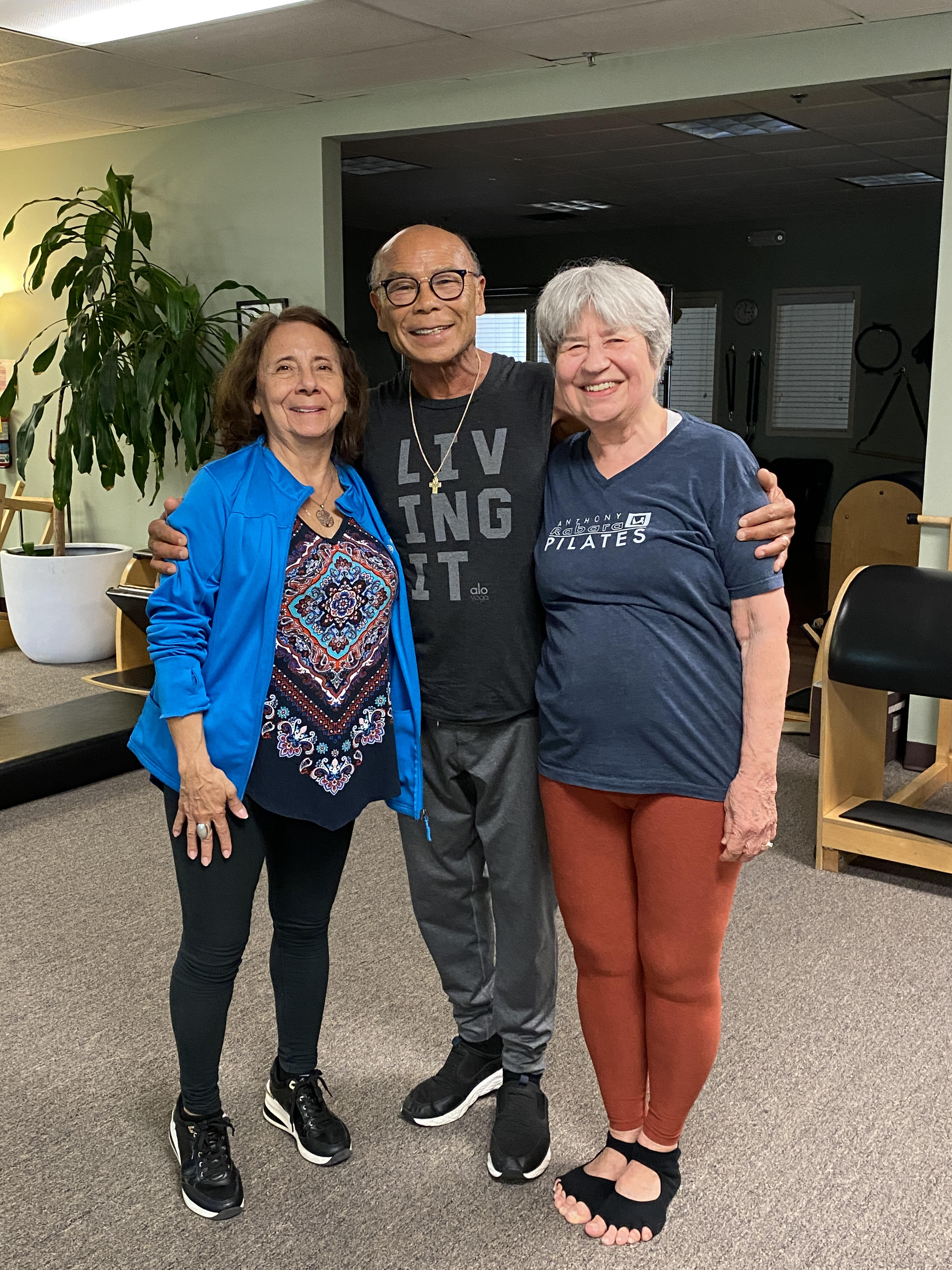
Sari Mejia Santo, Anthony Rabara, Me

I’ve been taking classes in the Pilates Method ever since Anthony Rabara brought it to Princeton in the ’90s. He teaches the purest form of the now famous body work devised by Joseph Pilates. Back then, this method was known mostly in the New York dance community. Rabara was one of the first eight trainers certified by Joseph Pilates’ protegee, the late Romana Kryzanowska.

Thanks to Rabara and his studio’s expert teachers – they go through more than 600 hours of training — my severe arthritis is held at bay. With discerning eyes they can spot the slightest misalignment and cue the corrections that prevent injury and strengthen muscles that you didn’t know you had.

This week I had the very exciting opportunity to study with Romana’s daughter, Sari Mejia Santo. She leads Romana’s Pilates International, which operates a global instructor network in 40 countries and 30 U.S. States. My lesson turned out to be a demo for a dozen instructors in the room. It was challenging, to say the least, but she made it fun.

In a delightful coincidence, I had just come across a passage in a Maisie Dobbs mystery by Jacqueline Winspear that mentions Joseph Pilates, who developed his technique on wounded soldiers during World War I. In “Birds of a Feather,” set in England between the wars, Maisie’s assistant, Billy, gets to “study exercises and movements to counteract the lingering effects of war time injuries.”

“What ‘e says, Miss, is that I’m increasing my core. . .

“Your core?” Maisie watched Billy brush out the mane of a mare with an enviable track record…

“There are all these different exercises, some to stretch me legs, some me arms, and me middle, and some are really small movements right ‘ere,” Billy pointed to his stomach with the curry comb, “which is me core.”

“Well, it seems to be doing you a lot of good. I saw you walk across the stable yard with barely a limp.”

“The main thing is that the pain ain’t what it was.”

So says Billy. The main thing, for me, is that going to the Rabara studio is fun – and the “really small movements,” as Billy puts it, keep me feeling young.

:

Ebenezer on the Couch

At McCarter, Lauren Keating’s rewrite of Charles Dickens “A Christmas Carol” relates Scrooge’s obsession with money to Dickens’ life story.  Of the two children in the play who have symbolic names, “Want” and “Ignorance,” Dickens was a child of want.

While previous productions delighted audiences with spectacle and magic deployed by the spirits who scare Ebenezer Scrooge into generosity, Keating’s version is much more generous with psychological insights. For instance, it opens with a peddler who introduces all the characters, including Ebenezer’s obnoxious father. Ebenezer, played by Dee Pellettier, skillfully reveals his gradual change. 

As a collector of antique buttons, and a member of the New Jersey State Button Society, I have been doing research on the history of button making and ran across what I believe to be a significant insight into Dickens’ childhood. In 1852, in his ”Household Words,” he described the Birmingham button factories: ‘range beyond range of machines—the punching, drilling, stamping machines, the polishing wheels, and all the bright and compact, and never-tiring apparatus which is so familiar a spectacle in Birmingham work-rooms. We see hundreds of women, scores of children, and a few men… Very young children gather up the cut circles. Little boys, ‘just out of the cradle,’ range the pasteboard circles, and pack them close, on edge, in boxes or trays; and girls, as young, arrange on a table the linen circles…”

Far from being outraged at this child labor, Dickens wholeheartedly approved. Compared to his own experience, the button making tots had it easy. After all, they were with their parents and worked only 10-12 hours a day.

In contrast, when Dickens was 12, his job (pictured above) was to paste labels on bootblack jars in vermin-infested smelly factory with long hours. Meanwhile his father was in debtors’ prison, accompanied by his mother, along with the younger children.

If naysayers object to Ebenezer being played by a woman, oh well. As Keating points out, gender differences were more accepted in Dickens time than in Victorian times. Dickens refers to “the cook and the cook’s special friend.”

If this version more openly preaches the moral of the story, so be it. That’s in the true spirit of Charles Dickens.

The ghost of Christmas Past begins to change Ebenezer in Lauren Keating’s version of “A Christmas Carol” at McCarter Theatre. Photo by Matt Pilsner.

Correction: earlier I listed the Dickens publication as “Household Matters.” Apparently it was “Household Words.”

Embodied Faith: experience spirituality in a new way

I’m excited about this. You knew I would be. Annalise Hume begins a four-session “Embodied Faith” workshop on Monday, September 26 at 7:30 p.m. I’m inviting all my friends and movement buddies to attend — by zoom or in person. Here’s how Annalise describes what we’ll do.

Our bodies hold memories and store our stories. By paying attention to how we feel or want to move, we can gain a deeper understanding of ourselves and God. Each week we will experience a passage of scripture or theological theme through a combination of prayer, movement, play, and journaling. If you yearn for a fresh way to experience God this year, come and play. No previous dance, yoga, or movement experience necessary.

ANYBODY can do this. “While the sessions are movement based, our brain-body connection is so strong that you are welcome to do the entire class in your imagination without moving at all. All abilities and disabilities are welcome.”
These four sessions are sponsored by Princeton United Methodist Church and any reader of Princeton Comment will be my guest. The sessions are every other Monday from 7:30-8:45pm by ZOOM or in person in the church’s Fellowship Hall at 7 Vandeventer in Princeton. Register here:

https://princetonumc.breezechms.com/form/1353a5

Buttons, buttons- did you ever see such buttons as these?

When a friend finds out I collect buttons, it’s hard for them to imagine what KINDS of buttons I collect. Here are two ways to be beDAZzled by buttons.

One. Page through the offerings of a button auction to benefit a nonprofit button group here . These enamel buttons and the glass buttons above (courtesy of Armchair Auctions) will give you a taste of the gorgeous buttons available.

Two. Drop by the New Jersey State Button Society‘s show on the Saturday after Labor Day, September 10, 10 to 3 p.m. If you get there a little before 1 p.m. you can hear the talk, “Buttons Go to Work” featuring uniform and work buttons, as below. The show is in Titusville, just south of Lambertville, so make a day of it!

Buttons About Horses!

Yes, vintage and antique buttons can have horse themes. On Saturday, before you pour those mint juleps, help me celebrate “Derby Day” at the New Jersey State Button Society show and competition. On May 7, from 9 to 3. door prizes and displays will have a horse-racing theme, and admission is free.

It’s at Union Fire Company, 3926 River Road (minutes south of Lambertville). More than a dozen dealers and artists will offer buttons made from enamel, china, metal, and ivory — plus modern and vintage buttons made from fruit pits, rubber, and glass. At 11 am we will distribute favor ornaments, made by button artist Nancy DuBois. Exhibits on how buttons can embellish quilts and how to use buttons with children will be presented by Mary Jane Pozarycki and Susan Infosino. Helene Plank’s display shows how buttons can paint pictures.

See you there!

Dance again — at home!

Gabriella (Profitt) Cunha

If you love to dance.

If you like dance class but don’t like people watching you.

If you wish you could dance but don’t have time to get to a studio.

If you worry about getting hurt.

If you can’t find ‘the right teacher.’

If you yearn to dance but – to put it kindly – are ‘past your prime.’

Then you are like me.

For decades, I’ve been an eager but not technically proficient amateur dancer. In 1960, for one fabulous summer, I studied the Limon technique at the American Dance Festival. Over the years I studied dance whenever I could, wherever I could.

Two years ago I discovered Gabriella Cunha’s virtual “in home” Dance Workout class, offered by Martin Center for Dance on Wednesdays and Saturdays at 12:30 p.m.

Of ALL the techniques I’ve studied, I like Gabriella’s the best. Though she does not know Limon’s movement, hers is uncannily like his — organic, swinging, satisfying.

You may know that I am a former dance critic. Critics, of course, aren’t supposed to be promoters. But hey! I am retired. And at my age I get to do and say what I please.

Using modern dance concepts that beginning dancers can follow, Gabriella suggests modifications so that elder dancers (like me) can safely move. Her studio is a small room, so anyone can take the class in a small room.

I could go on and on — but here are some clips so you can see what I mean:

Here is a sample of the upper body warmup.

The shoulder warmup.

The foot warmup.

After the 45-minute class, Gabriella offers 15 minutes of stretching. I’m always intrigued by her insights on how the human body is put together. In addition to her expertise in music, ballet, modern dance, Reiki, and yoga, she is working towards a degree in naturopathic medicine. In her class, I feel safe.

Without the eyes of anyone on us, in our own spaces — I and the other students can feel like a dancer again. If you are a young beginner or an older person who used to “take class,” I invite you to join us. The classes are “a la carte,” come when you can.

For information, DouglasMartinArts@gmail.com or 609-937-8878.

Smart Connection

I had never heard of Christopher Smart, though as an English major I should have. My passion was Renaissance and 20th century poetry, and I kissed off the 18th century with one semester.

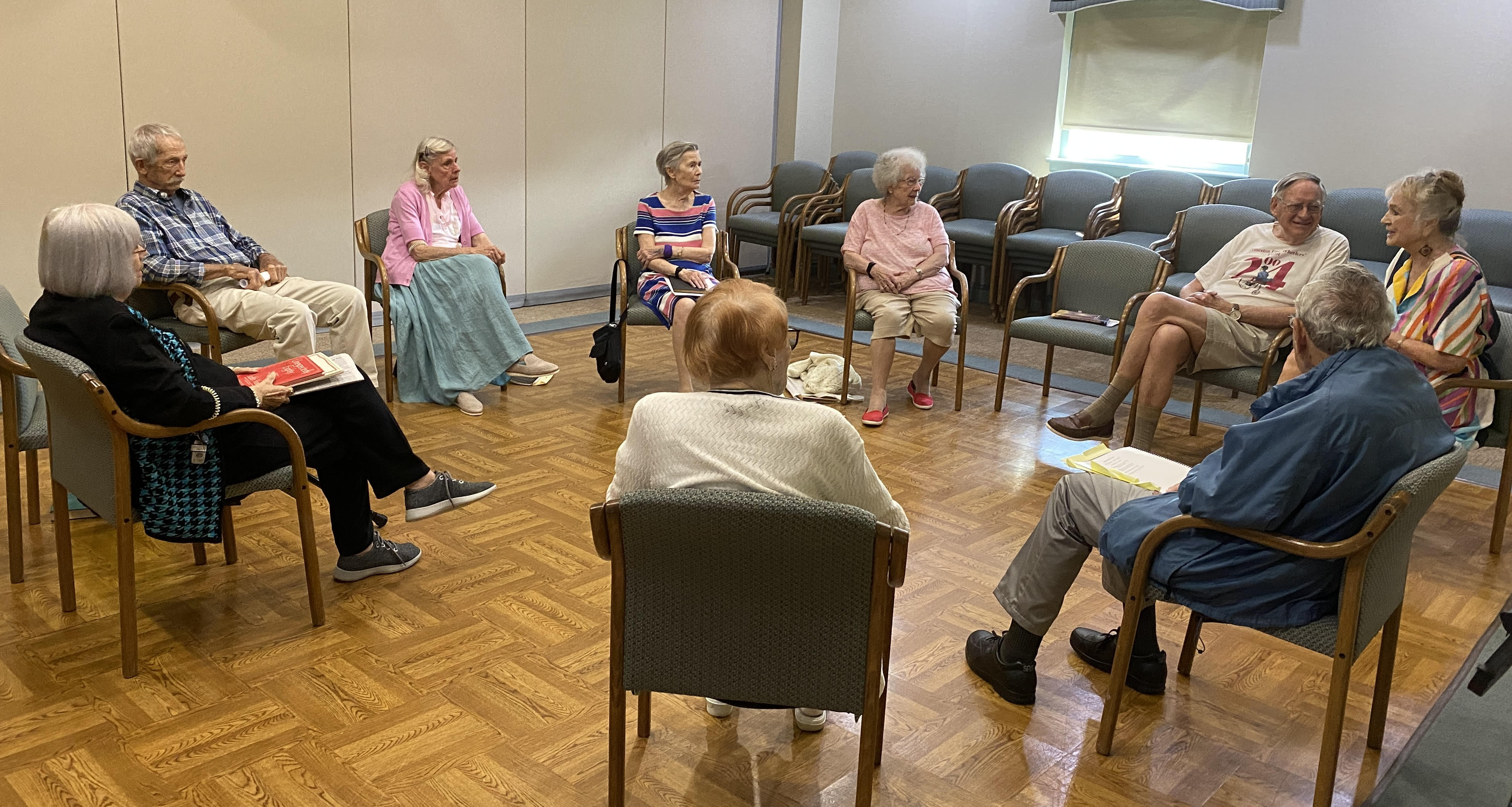
At the Poetry Circle at my elder residence, Stonebridge at Montgomery, curated by my new friend Hope, some read selections and some listen. Yesterday the coincidental links were giving me, as a wanna-be English teacher, delight. Perhaps “time present and time past” lurks in lots of poems, but every poem read that day — by Joyce, by Len, by Lois and by me — seemed to connect to that subject. Len’s contribution, a poem that he wrote to go with one of his collages, was even called ‘Connections.’

My contribution was potentially daunting: ‘Burnt Norton,’ the first of T.S. Eliot’s Four Quartets. I had lived into these lines in college and choreographed a dance about them:

….Only a flicker
Over the strained time-ridden faces
Distracted from distraction by distraction
….

Time past and time future
What might have been and what has been
Point to one end, which is always presen
t.

but since I’d handed out copies and distributed the reading, everyone happily dived in to share Eliot memories and favorite lines. So satisfying.

Then Nancy came up with a long but wryly amusing selection written by 18th century poet Christopher Smart. Drat, I thought, that’s the only poem read today that doesn’t have something to do with time. It doesn’t have a connection to the others.

I like connections. Sometimes I allow myself the belief that they are arranged by a higher power.

This morning I reached for my daily devotional guide, couldn’t find it, and absentmindedly opened a book that I hadn’t allowed myself the time to read, Lawrence Block’s’ The Burglar Who Counted the Spoons, given me by button friend Ann Wilson, who promises that ‘buttons’ are featured in the plot. Fast skimming to page 19 and, lo, there is Christopher Smart, explained as a contemporary of Samuel Johnson and Oliver Goldsmith. Says the first person narrator: He was unquestionably talented, but he was also mad as a hatter, and given to fits of religious mania that led him to implore his fellows to join him in public prayer. “I’d as soon pray in the street with Kit Smart as anyone else in London,” Johnson allowed, but others were less tolerant, and Smart spent the better part of his mature years clapped in a cell in Bedlam, where he wrote a line of poetry every day.

I choose to believe that it was not a coincidence that I picked up that book, read to page 19, and found the connection to what Nancy read the previous day.

You may believe what you will. And I won’t ask you to pray in the street.

M

Use stillness – or movement- to meditate?

I choose “move.”

Told by a shrink that I really really need to find a meditation class, I dabbled in various mindfulness techniques but never found one I could stick with. First, because I am Christian, and when they start talking about chakras, I get an uncomfortable feeling about polytheistic religions. I am fine with however anybody else wants to worship their God or gods, but I need to keep my own wandering and curious spirit reined in.

I choose “move.”

Second, I don’t do “Same.” Routines are supposed to be calming, I’ve been told, because you don’t have to make those minute by minute decisions. (Decision making is another of my weaknesses.)

Third, most meditation techniques emphasize quiet stillness. Since for all my 80 years I have probably had undiagnosed ADD, I have trouble sitting still.

Nevertheless, while I yearned to hear the still small voice of God, to experience the “still point of the turning world,” I remained mired in a “place of disaffection…distracted from distraction by distraction” [Burnt Norton, T.S. Eliot.]

Seven weeks ago, I found my answer. On weekdays at 7 AM and on Saturdays at 8 AM I zoomed for Wake-Up Meditations led by — amazingly — a member of my United Methodist church, who had been tapped to be the lay leader of the Adult Education Ministry Team. Claudio Lamsa Da Silva has studied a wide variety of meditation techniques.

 “In my twenties,” he says, “I explored different ways of practicing monasticism through the lens of various religions…. I explored Hinduism in ashrams in India, Buddhism in Nepal, Zen temples in Japan, and Sikhism through my wife.” In 2005, he served as a monk in Zen monasteries in Japan and after that walked the 900-mile Ohenro pilgrimage alone in complete silence. ” DaSilva employs all these concepts, and his ecumenical vocabulary accommodates all religions, but I can be personally comfortable praying to God the Parent, God the Son, and God the Holy Spirit.

As for the formerly despised Routine, I am a changed woman. No longer a night owl with disrupted sleep patterns, I conk early, awakening at 6:15 (or 6:30) to stumble into the kitchen for the prescribed lemon water and lukewarm tea. After tuning in from 7 to 7:30, I am able to be, as we say, “present in my life” and have set my intention to govern the day. This IS what I need to do to age well.

Most valuable to me, the fidgety dancer, is the chance to emphasize a particular thought with movement and touch. Some is the same and some is different every day, Monday to Friday, because each day has a different focus. The movement is easier to do than describe. Anyone interested, I encourage you to take advantage of the free trial for Daily Wakeup Meditation, currently May 31 to Jun3 4 at 7 AM Eastern Standard Time. The daily classes are ordinarily $10 but half that price if you go by the month. Email Claudio@reconcilewithlife.com for information and the link.

If you do, you will join me and people from around the world without having to leave your house. In Da Silva’s words:  We explore together the dimensions of our being (physical, emotional, mental and spiritual) and of our living (relationships with others and with life) through breathing exercises, contemplative meditation and adjusting movements. 

Photos from Reconcile With Life web page and Facebook page.

.