Category Archives: Faith and Social Justice

items from Not in Our Town Princeton (http://niotprinceton.org) and Princeton United Methodist Church (http://princetonumc.org)

Faith and Ethics for Tyson Foods

11-7 faith and work

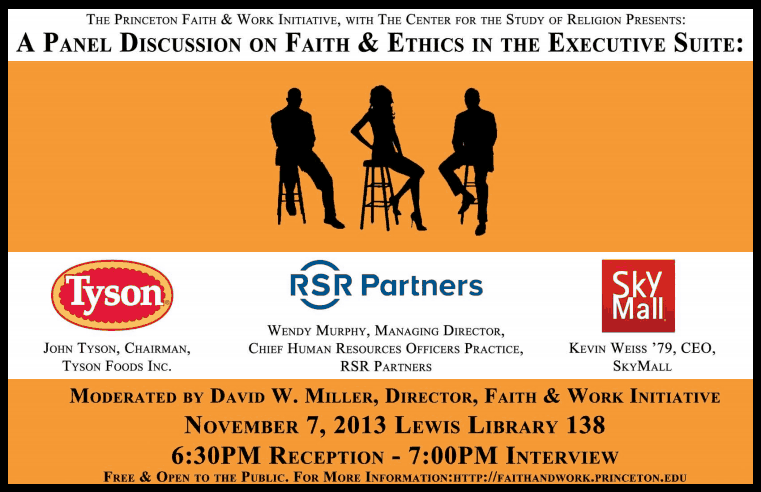
Faith & Ethics in the Executive Suite: A Panel Discussion

Press release: The Princeton University Faith & Work Initiative (FWI) will host a panel discussion with Wendy Murphy, Managing Director, Chief Human Resources Officers Practice, RSR Partners; John Tyson, Chairman, Tyson Foods Inc.; and Kevin Weiss ’79, CEO, SkyMall, on November 7, 2013 at 7:00 pm, on the Princeton University campus in Lewis Library 138 (the modern building, near the intersection of Ivy Ln. and Washington Rd. in Princeton). The event will be preceded by a reception from 6:30 – 7:00 pm.

John Tyson, the grandson of the company’s founder, has been part of the company since he was a teenager, has worked in almost every department, and eventually became the company’s chief executive officer. Among other accomplishments, Tyson is known for his development of Tyson Foods’ unique set of “Core Values” and their chaplaincy program.

The panel is free and open to the public and is sponsored by the Princeton University Faith & Work Initiative (http://faithandwork.princeton.edu/), with the Center for the Study of Religion (http://www.princeton.edu/csr/). For questions, please contact Anita Kline askline@princeton.edu or (609) 258-5545.

If you are concerned about excess (the excessive proliferation of goods in Western society)

If you like to discuss and participate actively in the creation of a piece of art —

come to the Princeton University School of Architecture between November 20 and 24 for a contemporary salon, “This Situation,” staged by art/dance/aesthetics rebel Tino Sehgal.

What constitutes a work of art? the art experience? For Sehgal, quoting the press release, it entails a direct engagement, in the here and now, between visitors and players in carefully choreographed situations. The visitor is conceived as a fundamental part of the work and may, if he/ she chooses to participate, dramatically alter its unfolding.


“We need to work on fighting poverty instead of changing the
curriculum,” said Diane Ravitch, an opponent of charter schools and emphasizing testing. “Stop blaming the schools and the education  system for social problems they did not cause.” She spoke last night at Princeton High School.

Good Fun, Good Causes

wash-well-4-300x272

Andrew and Jie Hayes, shown here, hosted their second annual harvest picnic at Washington Well Vineyard, raising funds for UFAR to combat riverblindness and for SAVE, the animal shelter. More than 200 people enjoyed the music, food, and fun — even grape stomping!

van dagens

At left, Laura Brinkerhoff, president of Brinkerhoff Environmental, the largest woman-owned environmental service company in New Jersey and Margaret Van Dagens, owner of J&M Marketing Communications, at the Jasna Polana for a lunch sponsored by the United Way to raise money to supply books to needy pre-schoolers along the Route 1 corridor. The September 26 lunch was the first event in a series of fund raisers to encourage reading readiness in pre-schoolers, organized by the Women’s Leadership Council of the United Way.

Faith and Ethics in the Executive Suite: Mark Hutchinson

Mark Hutchinson, president and CEO of GE China, opens the public seminar series at Princeton University’s Center for the Study of Religion on Thursday, September 19, noon to 1 p.m. David W. Miller, director of the Princeton University Faith and Work Initiative, will moderate. Location has yet to be announced.
 
This is actually the second seminar for the CSR but the first is open only to the university community, perhaps because it is a controversial topic, or because it will attract so many eager listeners. The topic? You might guess that it has sex in the title and you would be correct.  Frank Schaeffer is to talk about The Politics of Religion and Sexuality. I saw him speak several years ago at CSR. He is the son of evangelical theologians Francis and Edith Schaeffer, founders of L’Abri, but does not necessarily toe his parents party line.
 
The next topic is perplexing as well: Good and Evil. Yale University’s Paul Bloom will discuss Just Babies: The Origin of Good and Evil on Thursday, September 26, 4:30 to 6 p.m., in Friend Center, Bowl 006 (that’s on Olden Avenue, part of the EQuad.) It is co-sponsored with the Center for Theological Inquiry. Bloom’s most recent book deals with How Pleasure Works. As here:

Here, he will talk about whether babies are born selfish.

From John Locke to Sigmund Freud, philosophers and psychologists have long believed that we begin life as blank moral slates. Many of us take for granted that babies are born selfish and that it is the role of society—and especially parents—to transform them from little sociopaths into civilized beings. Paul Bloom argues that humans are in fact hardwired with a sense of morality. Drawing on groundbreaking research at Yale, Bloom demonstrates that, even before they can speak or walk, babies judge the goodness and badness of others’ actions; feel empathy and compassion; act to soothe those in distress; and have a rudimentary sense of justice.

Mr. Bloom, I am glad you proved this with your research, but any parent knew that all along.

Connie Campbell, Pillar of Witherspoon Community

Len Newton called to tell me about the funeral for Connie Campbell, an active member of Witherspoon Presbyterian Church who died at age 84 on August 23. She typified the leaders of the black community, says Newton, lauding her career. He cites her obituary in Town Topics. She was a buyer at Claytons, a department store on Palmer Square, at a time when it was difficult for African Americans to get anything but a government job. 

Newton, who is white, has long been a champion of interacial communities. He was among those who founded the group of homes on Dempsey Avenue, built to be an interracial and affordable community, and he joined Witherspoon Presbyterian Church which, in 1952, was mostly black. “When I came from Philadelphia to work at Opinion Research, I went at least once to every church in town. The choir director at Witherspoon recruited me because they needed a tenor.”

Fewer and fewer people remember how it was in Princeton in the ’50s, Newton says. In the late 1930s, AFrican Americans were pushed out of what is now Palmer Square to make room for the town center. Schools were segregated until 1948.

“The African-American community was invisible to the white community at that time. But people knew each other. If went to a party on the West Side, I would find Connie and her husband, Floyd, serving the food.”

Newton celebrates all she did, including being an ordained deacon and elder of Witherspoon Street Presbyterian Church; member of the original Verse Speaking Choir; board member at Princeton Nursery School, Princeton Arts Council, and Princeton Senior Resource Center, and serving as a volunteer at Princeton Hospital.

The funeral service will be held at 2 p.m. on Saturday, August 31, 2013 at Witherspoon Street Presbyterian Church, 124 Witherspoon Street, Princeton. Calling hours will be from 1 p.m. until time of service at the church. Interment will be held at the Princeton Cemetery.

Calling hours will be from 6-8 p.m., Friday, August 30, 2013, at Witherspoon Street Presbyterian Church. Organizational service will be conducted at 7:30 p.m. at the church.

Beginning a Beautiful Friendship

This post, by Jeanette Timmons, is on the blog at http://www.princetonumc.org. She wrote it for the newsletter of the Jewish Center of Princeton, honoring the cooperation and support between the congregations:
The Jewish Center has offered support to the Cornerstone Community Kitchen, an outreach program that feeds Princeton area residents a hot dinner every Wednesday evening at the Princeton United Methodist Church. PUMC congregant Larry Apperson conceived and implemented the program in June 2012, which serves 60 meals each week. Currently, TASK delivers the main course and CCK volunteers prepare side dishes and serve the meal in a restaurant-style environment.

TJC congregants Jeanette and Forrest Timmons began volunteering at CCK in August 2012 as part of Forrest’s Hesed project. Jeanette enjoyed the experience so much, she has volunteered weekly ever since. Other TJC families, including the Glassers and Zinders, have since volunteered too.

In August 2013, PUMC began a renovation of its kitchen so that the CCK can prepare its entire weekly meal on-site. TJC offered the use of its dairy kitchen so that CCK could continue its food preparation uninterrupted during the nine-month-long project. While forging this relationship, PUMC donated its 10-burner Vulcan stove with double oven to TJC. This timely act of generosity came just as the oven in TJC’s meat kitchen broke down.

Both guests and volunteers come to CCK’s Wednesday dinners for a variety of reasons, be it need-based, for companionship, or the feeling of camaraderie that pervades the environment. Friendships have formed as many volunteers and guests are regulars. “The greatest unexpected pleasure that’s come from our service has been the coming together of people from throughout the community to serve,” says Apperson. Guests sit at tables decorated with centerpieces, are served by volunteers, and are entertained by a pianist. The relaxed atmosphere invites lively conversation. Besides the dinner meal, bagels, sandwiches, children’s breakfast bags and gently used clothing are available for guests to take home.

The CCK is truly an interfaith, community-wide effort. Besides congregants from TJC and PUMC, CCK has welcomed volunteers and support from Beth Chaim, St. Paul’s, and Queenship of Mary Roman Catholic churches, Quaker Friends, Princeton University, local Girl Scout troops, and the Princeton Historical Society. Local businesses such as Panera and the Bagel Hole regularly donate baked goods, and Zorba’s Brother and the Rocky Hill Tavern have provided an entire meal. For more information about CCK or to get involved, please email cck@princetonumc.org.

Jeanette Timmons

Cub Reporter Interview: Julie Harris

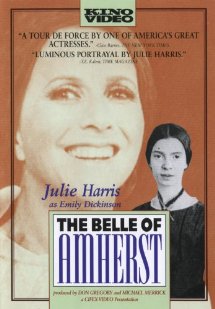
julie harris

Julie Harris died. What an actress. My interview with her, when she portrayed Emily Dickinson in Belle of Amherst, was an early lesson in the freelance journalism business. Besotted with Emily Dickinson, I saw her in that one-woman play in Philadelphia and went backstage with my daughter, age 13. Harris agreed to speak to me by telephone at her next stop, St. Louis.

Harris had just made a movie, The Hiding Place, based on the true story about Corrie Ten Boom, the Dutch Christian who survived a Nazi concentration camp and managed to forgive her captors.
corrie ten boom
That book made a deep impression on me (it fueled my desire to memorize Bible verses in case I was ever trapped without a book, either incarcerated or lost in the woods or whatever).

So I assumed Harris was a Christian. I sold a story on her to a national Christian magazine, and then set about to track her down — because somehow she had failed to tell me how to reach her. Publicity agents were not helpful to a newbie writer, but I knew she was in St. Louis, so I methodically called all the hotels in St. Louis until, bingo, I found her and we talked for about 15 minutes.

Then the story fell apart. Julie Harris was a very spiritual person, but she avowed that the deities that she valued most highly were, in this order, Gandhi, Mother Theresa, and Christ. Maybe the first two were reversed.

That wasn’t sufficient for the Christian magazine. I don’t think I ever managed to sell the story to any publication, but I did get to talk to the actress I adored. The Hiding Place seems to have passed into oblivion; it was not even mentioned in the New York Times article. RIP, Corrie Ten Boom and Julie Harris.

Statistics Don’t Count . . . But

Somebody has supposedly measured the intelligence of every city in the United States and has proven that Princeton is in the top three smartest cities in the nation.

We could have figured that out without the test. And we doubt the efficacy of the test in the first place. But we’ll smile and acknowledge the honor.

Now the question is — what are we doing with these massive brains to help our community, our world?

White Southern Lady: Civil Rights Advocate

How would Princeton be different if Barbara Boggs Sigmund had lived? Her mother, Lindy Boggs, just died: 

The New Orleans Times Picayune obit writer describes Bogg’s “disarming personal charm, a gift for communicating warmth and a sense of civility that drew others as her allies, almost to their surprise

Friends said she elevated manners to an art form, and made personal charm a powerful political tool. . . But a hard substantive edge always glinted just below the surface. . . Mrs. Boggs also became famous for her tenacity — a warm and ever-gracious refusal to take no for an answer. . . 

Boggs supported civil rights, as did her daughter, who began to follow her father’s and mother’s political trajectory as mayor of Princeton Borough. Boggs quit her job in Congress in 1990 to care for Barbara who, after years of sporting an eye patch, would die of cancer that year.

Had Barbara Boggs Sigmund lived, I believe she would have — in her New Orleans drawl — done something about issues of inequality with which Princeton is still struggling. She was her mother’s daughter.