Category Archives: Faith and Social Justice

items from Not in Our Town Princeton (http://niotprinceton.org) and Princeton United Methodist Church (http://princetonumc.org)

Why Not “Oriental?”

Someone who attends Not in Our Town events wrote me to ask why the use of the term Oriental is considered a racial slur.
   I was reading in the Trenton Times recently that it is no longer accepted to say that someone is Oriental or call someone Oriental.  I don’t understand. If they appear to be from eastern Asia, what’s the problem?


 Who has an opinion? 


Persusing what is known as The Racial Slur Database does not help, as the term Oriental is not listed there. 
An online encyclopedia, About.com, compares the use of Oriental to the term Negro and says it is outdated. 


A listserv dealing with Asian concerns provides no conclusive evidence, other than to say that other Asians use the term for anyone who looks Chinese. Could it be that the term is too inclusive — used by whites who don’t know how to discern nationalities by their appearances? 


Yes, says May  M. Ngai, author of Impossible Subjects: Illegal Aliens and the Making of Modern America, who suggests that it’s not a slur but it implies ‘outsider.” “It’s a Eurocentric name for us, which is why it’s wrong. You should call people by what (they) call themselves, not how they are situated in relation to yourself.”

Bottom line: don’t say “Oriental.” If you know the ethnic background (Chinese American, Korean, etc.) say that, otherwise say “Asian” or “Asian American.” People are not carpets. 
 

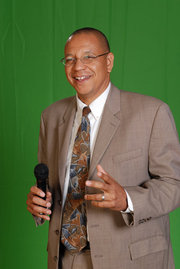
Caldwell: Evangelist for Success

He comes from three generations of Methodist preachers, and his father was an international leader in the areas of civil rights and social justice, but Dale Caldwell has turned his considerable talents of persuasion to improving the world in ostensibly secular ways. A graduate of Princeton, Wharton, and a Harvard executive program,  Dale Caldwell has been a senior manager at Deloitte, executive director of the Newark Alliance, deputy commissioner of the NJ Department of Community Affairs, a Certified Financial Planner, and CEO of 10 organizations, mostly recently Strategic Influence LLC. 


At the Princeton Regional Chamber breakfast on Wednesday, October 19,  at 7:30 a.m. at the Nassau Club, Caldwell will reveal his “Intelligent Influence” secrets on recognizing how people make decisions and what influences their decisions. “Influence is not purchased or assumed, it is bestowed,” says Caldwell. “Understanding how one is influenced, how to influence others, how to influence an organization, and how to influence outcomes is to understand how to create success.” 
In the career education arena, Caldwell wrote “School to Work Success” (now in paperback and Kindle), and founded the Residential After-School Program, Take-Your-Community-To-Work-Day, and School-to-Work Day. In the volunteer world, he was president of the New Brunswick Board of Education, Crossroads Theatre Company, and the eastern section of the United States Tennis Association. His love of tennis resulted in his latest book, Tennis in New York City: the Most Important Sport in the Most Important City in the World.  

If you missed the chance to see Dale Caldwell weave his speech magic at the Princeton Public Library’s TED X event, come to the chamber’s breakfast on Wednesday. It’s the chamber event where everyone gets to introduce themselves, and walk-ins are welcome. 


Next up: Chris Kuenne of Rosetta on Thursday, November 3. 

Sister Citizen: Harris-Perry

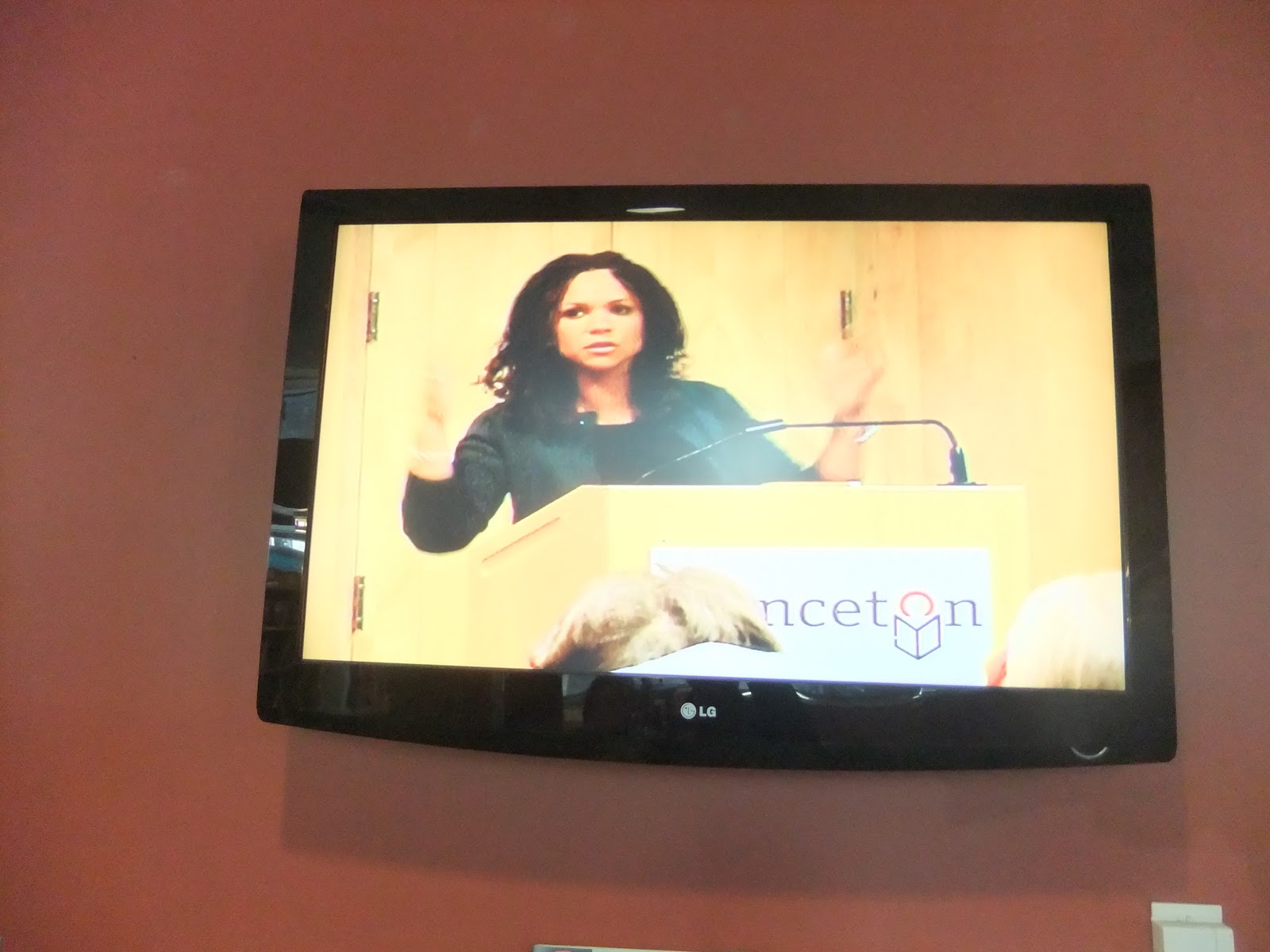
Melissa Harris-Perrydoesn’t like the book or movie “The Help,” and that’s an understatement. It wasn’t the topic of her talk at the Princeton Public Library today, but somebody asked that question and set her off on one of her always provocative, often funny, riffs on racial politics.
She returned to Princeton today (October16, as shown on the screen in the lobby) to talk about and sign her book, “SisterCitizen: For Colored Girls Who’ve Considered Politics When Being Strong Isn’t Enough.”
She listed three familiar stereotypes. The first is The Mammy as in HattieMcDaniel (and, there’s that “The Help” book again.) The second is The Jezebel. The third is the Angry Black Woman, as in Sapphire.
A current stereotype is “Strong Black Woman,” but Harris-Perry questions whether that should be today’s acknowledged goal. 
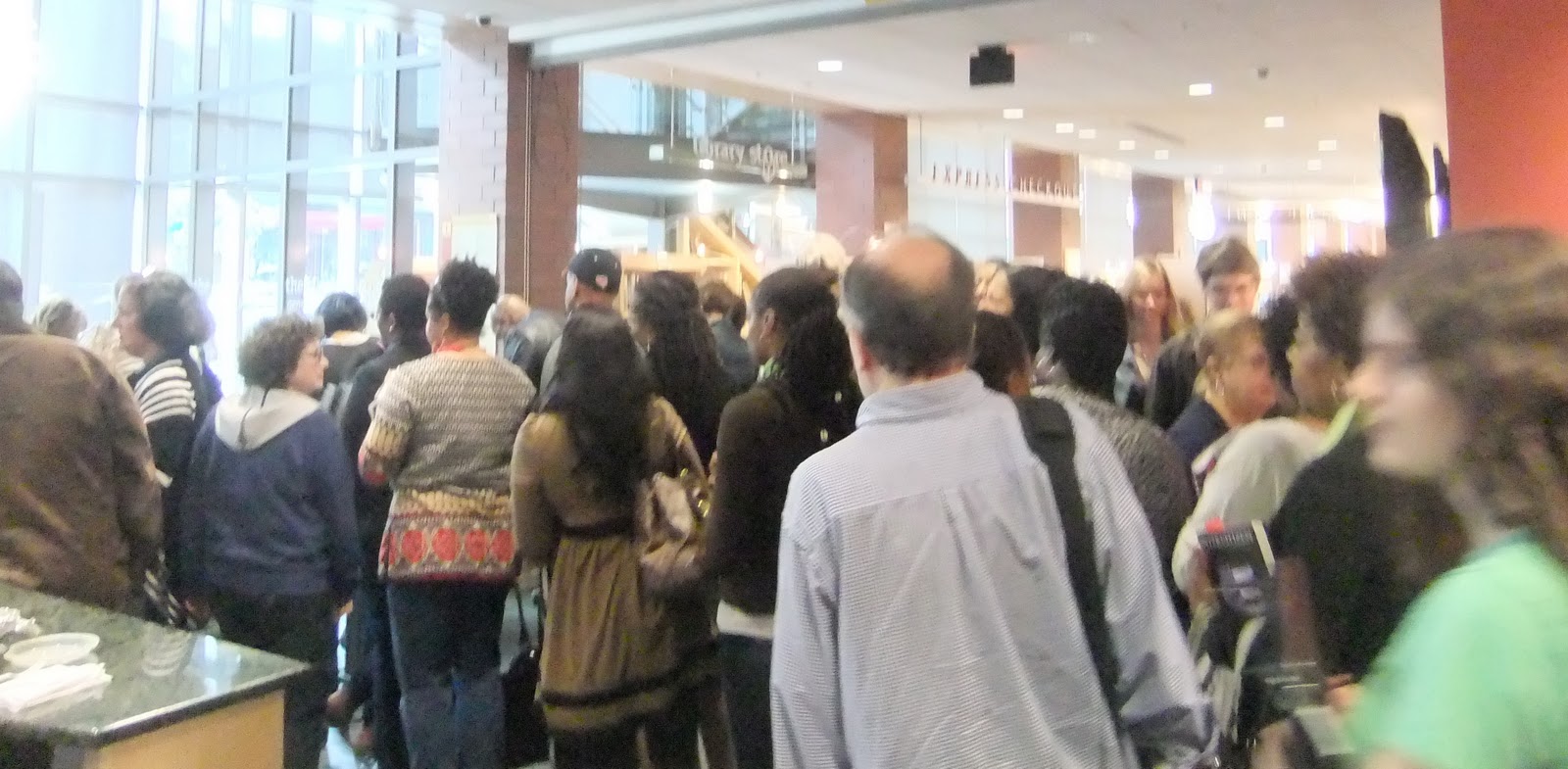
She got an uncomfortable laugh from the packed room at the library when she noted that, if “strong” is the compliment for a black woman, the highest compliment for a white woman is “thin.” In the book she says that the goal of strength contributes to “pervasive experiences of shame for black women… a shame management strategy that has both emotional and political implications for black women.” It leads to “political anorexia.”
Skimming the book (a long, long line to get it signed) brings me to comments about Michelle Obama, a graduate of Princeton and Harvard Law, who decided not to take an active role in her husband’s administration in order to focus on being Mom in Chief. “She subverts a deep, powerful, and old public discourse on black women as bad mothers….Black single motherhood is blamed for social ills ranging from crime to drugs to urban disorder…”
“Michele Obama’s insistence on focusing on her children is also a sound repudiation of the Mammy role. Mammy…ensures order in the white world by ignoring her own family and community. Calling on Michelle Obama to take a more active policy role while her children are still young is in a way requesting that she use her role as First Lady to serve as the national Mammy. Michelle refused.”
The Mammy stereotype in “The Help” enrages Harris-Perry. From the viewpoint of the white author, at no time in any black servant’s life, does the servant not utterly adore the white children she cared for. Nor does the author acknowledge the difficulties and consequent feelings that the black servant might have regarding her ability to care for her own children and husband.

Worst: by making up a disempowering history (the white author gets the money and the job and leaves her co-authors behind in Jim Crow Mississippi), the real history fades.
 The real history is that, when Medgar Evers was killed, those same black domestics in Jackson– had actually organized on their own behalf. ”By telling the story this way, it either suggests that there weren’t real women who did real things or it allows us to ignore how much more dangerous, complex, and personal those stories were than this fictional one we’re getting.

The line for “Sister Citizen” booksigning stretched from the library’s front door to the library’s back door.  The initial chapter is available at Amazon.

Against Racial Divisions: Three Tries This Week


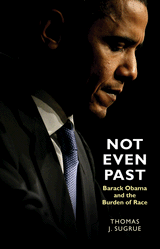
Even in what is being hailed as the post civil rights era, racial divisions – particularly between blacks and whites – remain entrenched in American life. So says Thomas Sugrue, author of “Not Even Past,” an examination of the paradox of race in Barack Obama’s America.

Sugrue is the first of two who will discuss the topic this week. He will speak on Wednesday, June 9, at 7:30 p.m., at the Princeton Public Library. The event is free.

Racism in the 21st century is also the topic for Stephanie Jacobs who will speak at a Princeton United Methodist Church program on Sunday, June 13. Breakfast is served at 8 a.m. and the talk begins at 8:30 a.m. RSVP at 609-924-2613; a $5 donation for breakfast is requested. The church is located at Nassau & Vandeventer streets in downtown Princeton.

Sugrue is a leading historian of civil rights, race, and urban America, who teaches at the University of Pennsylvania. His books include “Sweet Land of Liberty: The Forgotten Struggle for Civil Rights in the North” and “The Origins of the Urban Crisis: Race and Inequality in Postwar Detroit.” His talk is part of the “Thinking Allowed” series at the library.

Jacobs is a relationship coach and consultant with more than 15 years experience as an educator, counselor and trainer. She is doctoral student in Drexel University’s Program in Couple and Family Therapy and also serves as an adjunct faculty at The College of New Jersey. Rooted as she is in the Christian faith, Jacobs is particularly interested in the issues relating to navigating diversity and racism in today’s world

A practical way to confront racial and economic forces that segregate communities is to attend the closing worship and prayer walk for the Justice Revival on Sunday, June 13, at 3 p.m. It begins and ends at Trinity Cathedral, 801 West State Street.

“We will leave the closing worship service and walk together through the neighborhood, meeting neighbors and joining with them in prayer and reflection at key locations,” say the organizers. “Our goal is to show that Suburban Mercer County cares about Urban Trenton and that we are committed to being neighbors to one another.” (www.revivejustice.org)

Full disclosure: I made a similar post on the blog for Not in Our Town, where I serve on the steering committee. I am a member of Princeton United Methodist Church.

Not in Our Town


When we moved to Princeton in 1981, I was lucky enough to have cousins already living here. One was my first cousin on my father’s side. On my mother’s side is Ann Harris Yasuhara, and if you go by the rules, she is my first cousin once removed. We feel lucky to be so geographically close, and so as soon as I was able (when I no longer worked full time at U.S. 1) I began to meet with one of the organizations she supports, a faith congregation-based group called Not in Our Town. Click on the links to see the mission statement, and here is the list of what individuals and groups can do to fight racism.

Not in Our Town, along with Princeton Public Library, will present a workshop “Engaging in an Exploration of White Privilege” on Monday nights, starting April 13 at 7:30 p.m. Among the presenters is Ann Yasuhara, pictured, and she hopes to make this “an inviting, friendly, and engaging experience.” Perhaps you’ll join us . . .

David Abalos: Against Assimilation

If Hispanic immigrants don’t do the menial jobs, who will? That’s the un PC question I didn’t dare ask in public, when David Abalos, a visiting professor at Princeton University, addressed the Princeton chamber breakfast. He is an expert on multicultural gender scholarship and on Latinas and Latinos in the U.S from the perspective of a politics of transformation, and he spoke about Hispanic immigration and its effect in Princeton.
Each wave of newcomers to this country – from Africa, Ireland, Italy, Eastern Europe – has worked their way up the chain to get educated, accepted, and assimilated, explained Abalos today, at the Nassau Club.

He told his own story. His parents emigrated from Mexico to Detroit in the 1920s. During the Depression, the Mexicans were pressured to go home but his father cut hair and sold apples to survive. His mother opened a boarding house. He began working at age 8, and at age 12 had a daily job.

Each “tribe” who immigrates, he said – Mexicans, Irish, Jews, Italians – has been made invisible and used for cheap labor. Then the children try to “assimilate,” because children want security above all else, and they try to be like everybody else. Those who are “exceptional” are seen as more like the elite (like “us”), and they get the college scholarships. After World War II, the GI Bill was the immigrants’ entrance into the white society, which is the power society.

But Abalos opposes the concept of “assimilation.” A graduate of the University of Toronto, Abalos was a professor at Seton Hall. In the 1970s, when it was not popular, he advocated for Latino representation in students, faculty, and administration. Now he is active in the immigrant community in his home town, Hightstown, and he urges his Princeton students not to forget where they came from. “When we make it, we close the door. Assimilation is a deadly issue. Be in Princeton, but not of Princeton. If you become elitist you will abandon your own community. Don’t forget what your parents went through.”

Some snippets, some statistics:

Economic: Undocumented Hispanics in Princeton currently come from Guatemala, Mexico, and Ecuador. The Ecuadorians have paid as much as $14,000 to a “coyote,” a smuggler, borrowed against their homes, to cross the border. They earn about $10 an hour, so most work two jobs, don’t have driver’s licenses, and live in overcrowded situations. “They will work any kind of job in order to support their families back home.”

Race and class: Even within an ethnic group, prejudice is rampant. “If you are dark and have an Indian name, you are in trouble throughout Latin America.” Abalos said that, as a light-skinned person, he initially had trouble being accepted by darker-skinned immigrants.

Official policies: School principals in the U.S.A. are no longer allowed to ask about immigration status of students and families. In Princeton and surrounding areas police officers write traffic tickets without asking about immigration status. The University Medical Center of Princeton is doing a “superb job” in treating the immigrant population, and this is in the interests of community-wide health. “If immigrants go underground, they will not report communicable diseases.”

Taxes: According to Princeton University’s Doug Massey, 86 percent of immigrants pay taxes, though they will never see Social Security payments (though these payments are being held in escrow). According to Rick Ober, the AARP tax center on Clay Street brings in lots of undocumented immigrants who are paying taxes. “They are paying taxes, they support the businesses on Main Street, the owners of their apartments are paying taxes – they are contributing to this country with their cheap labor,” said Abalos.

Education vs Demographics: As the U.S. workforce changes, by 2020 we will not have the college educated people needed for the workforce. Why? “For years we were not allowed to go to school, because they wanted us to do the cheap labor,” says Abalos. “Now we start to pay the piper.”

The birth to death ratio for whites is one to one. One person dies, one baby is born. For African Americans it is 1 to 3. For Asians, 1 to 2, for Latinos, 1 to 8. Yet only 12 percent of Latinos have a BA, 1 percent have master’s degrees, 0.2 percent PhDs. It is projected that, by 2043, there will be 100 million Latinos in the United States.

A good example of how compassion and democracy did work is when, in 2006, Princeton University’s valedictorian was an undocumented immigrant.

On NAFTA. This came up in the question period. Abalos believes that Mexico got a worse deal than Canada. Corn is a sacred and basic food in the Mexican culture. When the U.S. “dumped” subsidized cheap corn into Mexico, a good number of the 30 million Mexicans involved in corn production lost their jobs. They moved north, and couldn’t get manufacturing jobs, so more of them came across the border, compounding the undocumented immigration problem.

Afterwards I consorted with Denise Vargas of Excel Graphics to ask my un-PC question, who will be the next cheap labor force? “It could be teenagers,” she said. “Kids need to learn what work is. I raked leaves and shoveled walks. They could be out there raking leaves and shoveling walks on our street, rather than everyone hiring lawn services.”

And as I was walking out of the Nassau Club, talking with Abalos, I asked him that burning question, “So if democracy and compassion work to educate the current immigrants, who will do the cheap jobs? What population will fill in?”

Just as I said “cheap jobs” we passed a Nassau Club employee polishing the window next to the door. Maybe he didn’t hear, but to me it was an awkward moment. We didn’t stop. And anyway, the employee was “invisible,” right? But he wasn’t quite invisible. He spoke to us, a minor comment, on the order of Have a Good Day. To his credit, Abalos said something in reply. I’m embarrassed to admit I was so intent on my question that I did not reply.

My own answer to that question involves a concept that I am told looks like socialism and would stymie the desire to improve one’s self. But I will say it anyway: Pay unpopular blue collar jobs more at the risk of paying white collar jobs less. Pay in inverse proportion to the nastiness of the job.