Category Archives: Uncategorized

Princeton Scientist: Joseph Nichols

In the early days of U.S. 1, in the 1980s when it was a monthly, everyone on the staff delivered the paper. One of my favorite routes was Princeton Service Center, because I would get to stop at the Prodex lab and chat with Joe Nichols. He reminded me so much of my father — an ever curious scientist, never stopping work, always eager to see what discoveries lay ahead. He would have been in his ’70s then.

In the 1990s I pitched in on delivery from time to time, and again I would find Joe — now in his ’80s — in his lab. Alas I never got to attend a piano concert by his beloved wife Sylvia, but when she died in 1995 he sent me a tape of her work. Occasionally I’d call him for background information on a story about Integra Life Sciences. In its earliest days Integra (and its predecessor companies) were based on collagen technology, in which Nichols was a pioneer. Integra’s first product, based on collagen, was artificially-grown skin that saved the lives of those with terrible burns.

Richard Caruso, founder of Integra, credits Joseph Nichols, co-founder of Helitrex, with playing an important role in the use of collagen materials. “Not very much of what we are doing today would be possible if it were not for Joe Nichols’ brilliance 20 years ago,” said Caruso in a 1997 U.S. 1 article. “He was an incredible mentor and always interested in being helpful to us.”

When I talked with Stuart Essig (the CEO of Integra Life Sciences) after his speech at Princeton University’s Friend Center a couple of months ago, Essig and I were chatting about the early history of the company and Joe Nichols. Essig said he had been keeping in touch with Joe — but that he hadn’t heard from him lately.

Now we know why. He had had a stroke and had been confined to a nursing home. Joseph Nichols, 92, died on November 27 at the King James Care Center in Chatham, New Jersey. The memorial service is Tuesday, December 1, at 1 p.m.

In Princeton, scientists like Joe Nichols can flourish. In semi-retirement he could maintain a lab at Princeton Service Center, next to companies like Greg Olsen’s Sensors Unlimited. With intelligence and perseverance, Joe Nichols pursued his scientific dreams.

Job Creation Forum: Speed Dating For Money


In a “speed dating” session, funders will sit across tables from fund-seekers on Tuesday, January 26 at Princeton University. It is co-sponsored by the university, the Princeton Chamber, and the Princeton Job Creation Forum (PJCF). PJCF is a community-based effort to jumpstart new business formation and much needed job creation.

For financiers, the speed dating session offers a look at two dozen early stage businesses and a possible stake in a growing enterprise.

For entrepreneurs, particularly in the “opportunity landscape” areas of green tech, new medical therapies and healthcare productivity, and smart infrastructure, the opportunity is to find needed financing to get the new business job creation engine going.

PJCF held its first public meeting on Wednesday, November 4 (which happened to be the day after the election that will change NJ government). More than 30 people attended from diverse fields.

Len Newton, former principal with Opinion Research & Response Analysis, convened the November 4 meeting. A graduate of MIT, his “special sauce” idea is to tap alumni networks to help grow jobs in the state. Click here for the notes but here’s the short version of what happened:

David Sandahl – organizer of PJCF and principal, Decision Consulting
“Until companies get going, we’re stuck. We want to accelerate the business creation and job creation process. The growth rate required to add jobs means we need to be growing the economy at more than 3.5% per year, and the only way to add jobs is though small business, innovation, and financing at the local level.”

Jed Seltzer: Executive Director of the Health Information Technology Commission: (which has its next meeting on Thursday, December 3.) The electronic health record (EHR) business is a potential growth area. Health IT gets $2 billion annually from Health & Human Services. Other agencies investing in EHRs are NIH, Department of Agriculture, and National Science Foundation.

The blockbuster model for drug development is being replaced by the “small ball” version of drug development and marketing success, with opportunities for the $250-400M drug.

Also, equipment sharing, for healthcare R&D;, can reduce costs (example, the NJ Tech Centre in North Brunswick).

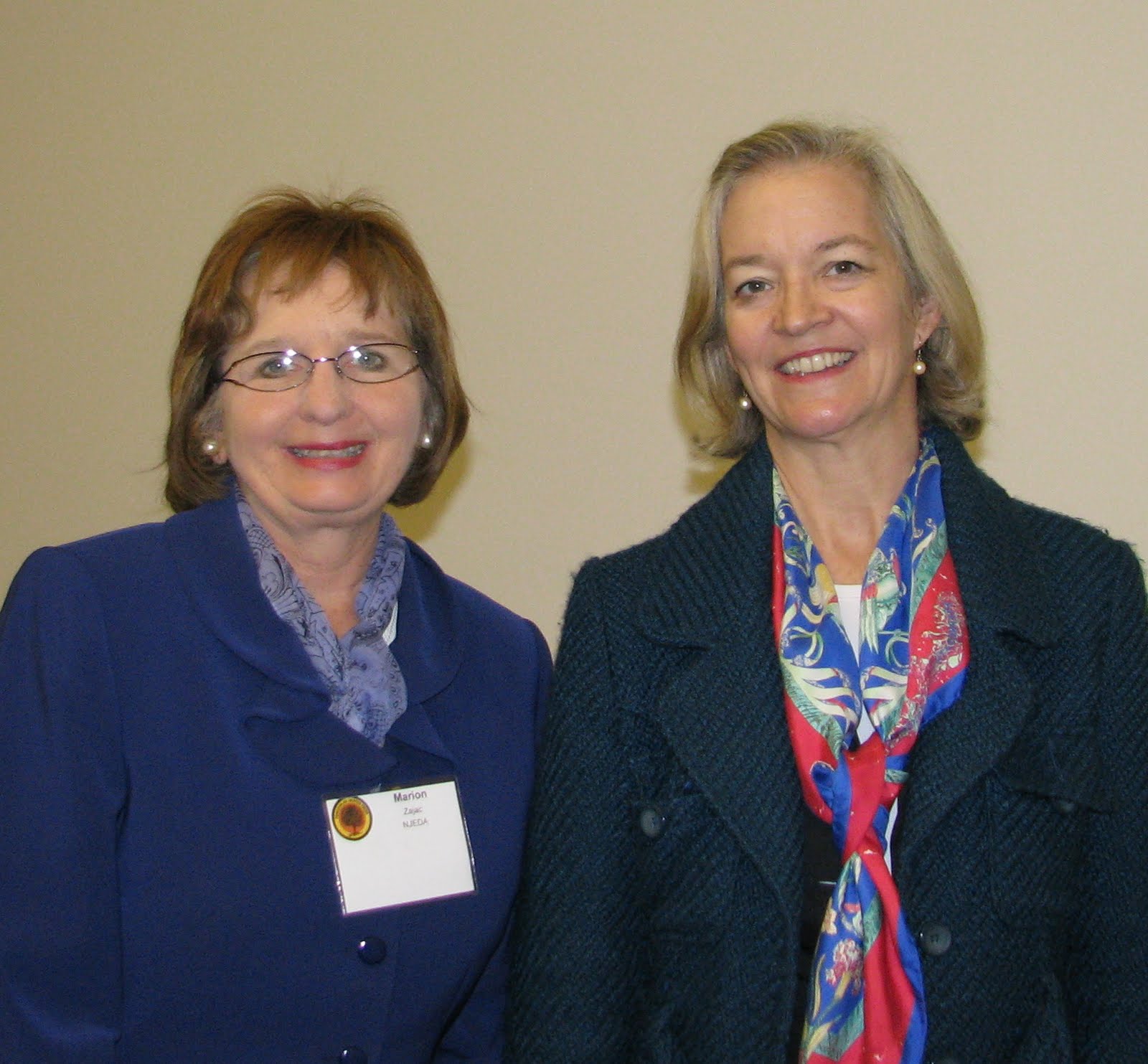
Marion Zajac of the New Jersey Economic Development Authority (pictured on left with Nell Haughton of Congressman Rush Holt’s office): The nonprofit NJEDA offers financing through loans that don’t tap the state budget. It administers projects funded by the state. “The only thing we don’t provide to entrepreneurs are the ideas!” http://www.njeda.com/web/default.aspx

Two breakout groups, led by Drew Marshall and Wade Speir, focused on how to accelerate the business formation and job creation process, how to identify resources, and what should be the next steps for the Princeton Job Creation Forum.

The three most likely growth areas are Green Tech, Healthcare, and Smart Infrastructure. For the complete list of suggestions, click here. My faves below:

• Access university alumni as a channel to innovators
• Available funds and resources are not readily seen or known about – make them more visible and noticeable. Have central source of information and funds.
• Facilitate partnership formation – recognize opportunities to match jobs to appropriate job-seekers
• Develop, encourage and support the permission and belief that NJ is a business-friendly environment (provide case studies, compelling stories and messages, etc.)
• Support existing businesses, in that a “rising tide” will lift all boats perhaps by providing tax incentives for existing businesses to create jobs
• Redirect incentive that might usually be targeted to attract large employers to small businesses where there is a higher return
• Be Matchmakers / Mentors to match large and small business Foster local business collaboration to increase the mutual market share of collaborators
• Address the regional tax perception (one that appears to favor Bucks County, PA) by funding an independent study on the relative merits of starting a business locally
• Capitalize on Einstein’s Alley and on available publicity through our Congressman, Rush Holt
• Work with Realtors on creating small business opportunities through favorable terms or offsets, etc.
• Recognize de facto incubators and fund them. Work with Realtors on creating small business opportunities through favorable terms, offsets, etc.

My take-home idea: After many years of unsuccessful attempts to put together a good commerce web page, NJ finally has a good business-readiness road map. a tool for the business owner to respond to both enter the market and respond to it over time. The NJ Business Portal – http://www.state.nj.us/njbusiness/index.shtml Past efforts to digitally coordinate this information were not successful. I think this website works, and it is a legacy from the Corzine administration that the Christie administration would do well to keep. Don’t throw the baby out with the bath water.

Avon’s Andrea Jung: Not Your Grandmother’s CEO


Posted by Picasa

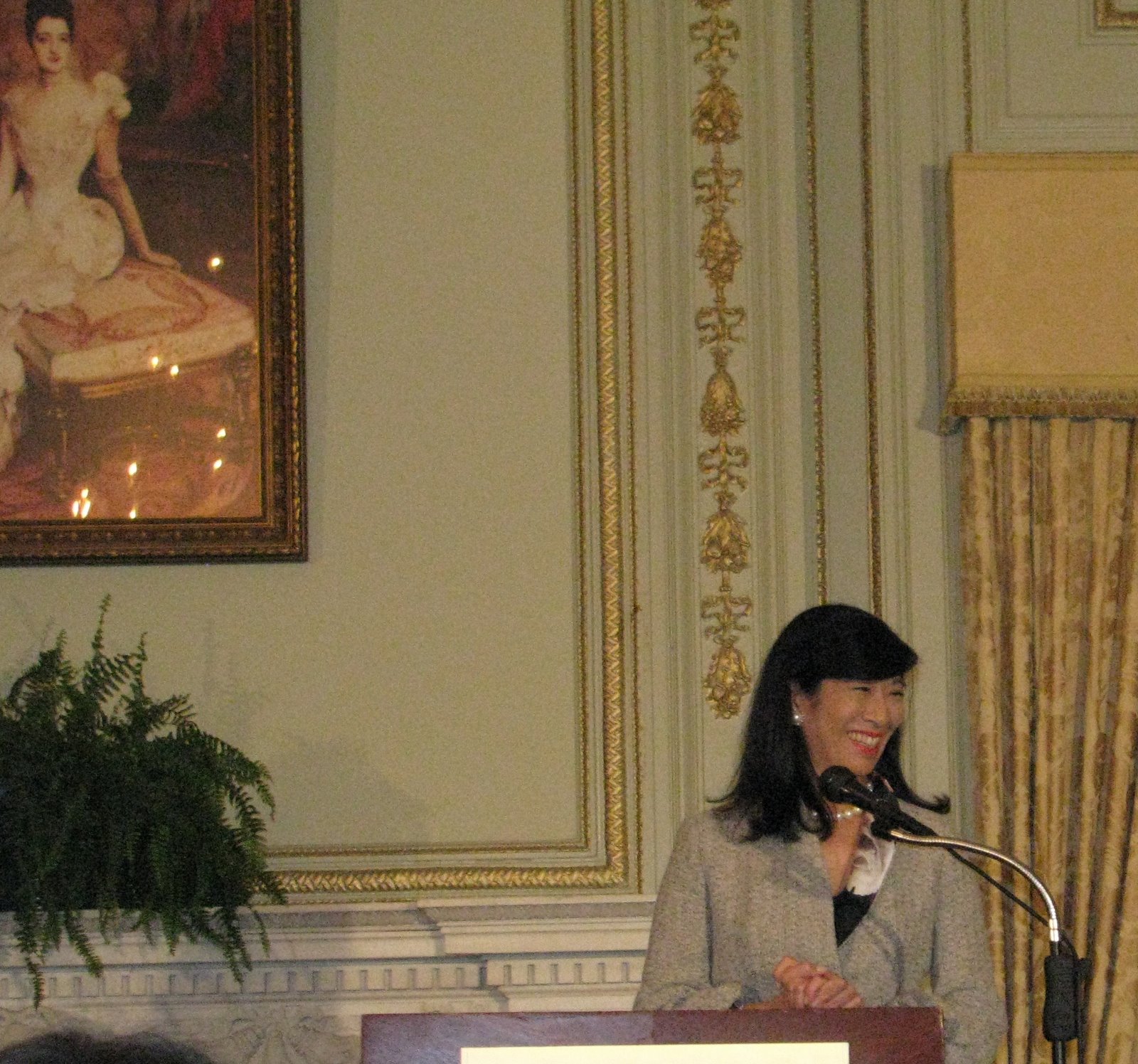
Flanked by portraits of the Vanderbilt Twomleys, in Fairleigh Dickinson University’s Georgian Revival “Mansion” (a Hampton Court-look alike), Andrea Jung, chairman and CEO of Avon Products Inc. recounted her 10 year journey to rescue the 125-year-old firm from being “your grandmother’s cosmetics company.” Jung, a 1979 Princeton graduate who majored in English, is widely recognized as one of the most powerful women in business. She spoke at the Rothman Institute of Entrepreneurship CEO Innovation series today, November 19. The take-home: To succeed in a down economy, innovate, but look to your roots to figure out how

Jung measured her success by two crossword puzzles in the New York Times. “In 1990, hip chic women did not want to buy Avon. The clue for _V_ _ was “Ding Dong.” This year, the clue was “the company for women.” Among the top 100 companies, it is the only direct selling company, and one of two beauty companies (Chanel being the competitor).

R&D; investment: She built a $100 million R&D; facility in Suffern, New York and honchoed a “robust but disciplined” regime of breakthrough technologies.

Innovative media:
She slashed budget for traditional media and started buying celebrity endorsements, like Reese Witherspoon. (The corporate looking Avon rep sitting next to me was wearing Witherspoon’s fragrance, In Bloom.)She bought ad words on Google, not only for cosmetics and beauty but for “part-time job.”

Then she bought an ad for the male-dominated Super Bowl lineup, a 30-second recruiting ad before the kickoff, when the women are watching, and got a 24 percent bump in recruitment.

Every Avon associate has the tools to put up a website. When Avon distributed the Super Bowl spot to the associates’ websites, it got a viral marketing bonanza.

Innovative distribution: Avon took the lead, in the mid 1990s, in the now hot emerging markets. It is # 1 in Latin America and Central & Eastern Europe and strong in Asia. Russia is its second best market, grossing $800 million. “We will get an oversized share of growth in those markets.”

Restructure: “I was hired for growth (she had been at Neiman Marcus and Bloomingdales) and we hit the wall in six years. I was not a cost queen or turnaround expert. My executive coach told me to walk out the door on Friday ‘as if you fired yourself’ and come back new. From ’05 to 08 we took away responsibilities and divided the duties between consumer and commercial. We flattened the structure, took out one-third of 15 layers (to be closer to the consumer and more innovative) and freed up $1.1 billion for advertising and celebrities.”

Grow in a recession
: “In a recession, there are more casualties, but there are more heroes, who gain market share. In a time when the world is full of questions, we can show that we have the answers.”

The answer: microloans. A starter kit for an Avon saleswoman used to equal the weekly food budget. Now it costs just $10, and the recruitment ads emphasize “I can’t get fired, I can’t be laid off.” Since the recession started, six million women joined Avon. Comparing job loss numbers and new Avon reps, country by country “became a metric with a lot of pride.”

Communicate in a recession
: Go out into the field and repeat the message. “Be consistent and clear. You can’t do that enough.”

Keep prices low:
She cited Booz, that a recovery “will not substantially reverse frugal spending plans. Says Jung, “If you can find innovation and quality, why pay more? Lipsticks are $6 and $8, not $15 and $20. Anti aging creams are $36, not $100.

Keep focused on your mission: Avon was founded, and FDU’s mansion was built, in the same time frame, when it was heresy for women to be independent. Avon empowers women, said Jung. More than 85 percent of Avon reps in Russia do Internet marketing – and their families benefit from their being online. “We feel we are part of the solution, and also that we have a social purpose,” says Jung. Avon gave $725 million for women’s health (breast cancer) and funnels money to prevent domestic violence. “Our associates know we continue to do good things. The world needs us to do good things.”

Auto Exec: Slash Print, Do Cause Marketing

At Fairleigh Dickinson’s innovation lecture, featuring Avon CEO Andrea Jung, I sat next to an Avon rep on one side, and a retail automobile executive on the other. Roy Bavaro, director of corporate marketing and brand development of DCH Auto Group, wanted to hear how the advice of a CEO of one historic company (Avon is 125 years old) might apply to his company.


Posted by Picasa

Founded 60 years ago by Shau-wai Lam, whose first auto dealership was Paramus Honda, it has more than two dozen dealerships in New Jersey, New York, Connecticut, and California. It sells nearly a dozen kinds of new and used cars, with sales of more than $1.83 billion. And like Avon, the company has a female CEO, Susan Scarola.

So before the lecture I pumped Bavaro on what was his firm’s secret sauce. “Grass roots marketing,” he said. “We slashed our traditional media budget.”

Coming from the newspaper world, I don’t like to hear that. But then I heard, “We took the funds and gave back to the community.” In other words, cause marketing.

Each dealership, including DCH Brunswick Toyota on Route 1 in North Brunswick, pairs with a high school and partners with “S.A.D.D.” or “Students against Destructive Decisions.” (Yes it used to be against Drunk Driving but the new term is more inclusive.) The DCH program is called “Keep It Out of Cars,” as in “mindless” driving, don’t do it.

“Cause marketing is good.” Bavaro said, “when it’s an important cause, when you believe in it, and when you have transparency.” You can’t be seen as profiting from it. DCH is very transparent. It’s hard to find the S.A.D.D. program on the website. “When we are at the high schools,” he said, “we are talking about the program. We are not selling cars.”

iPhone Apps: Cottage Industry

Motivation breeds success. Four of the five presenters in the iPhone App panel embarked on their quest for personal reasons. The panel, at Princeton University’s Friend Center on Thursday, November 12, was entitled “iPhone Apps – the New High Tech Gold Rush?”and moderated by Ed Zschau.

Princeton junior Matt Connor showed an I-phone app, Islet, for family members with Type 1 diabetes.

A graduate student, Harry Schmidt, has figured out how to put the Latin and Greek dictionaries on the I-Phone.

Then comes serial entrepreneur Ken Kay, whom I’ve been covering for U.S. 1 for 15 years. Kay tapped the expertise of his college student son to program an app that would help his friend, connected with a Philadelphia arts organization, icihere.

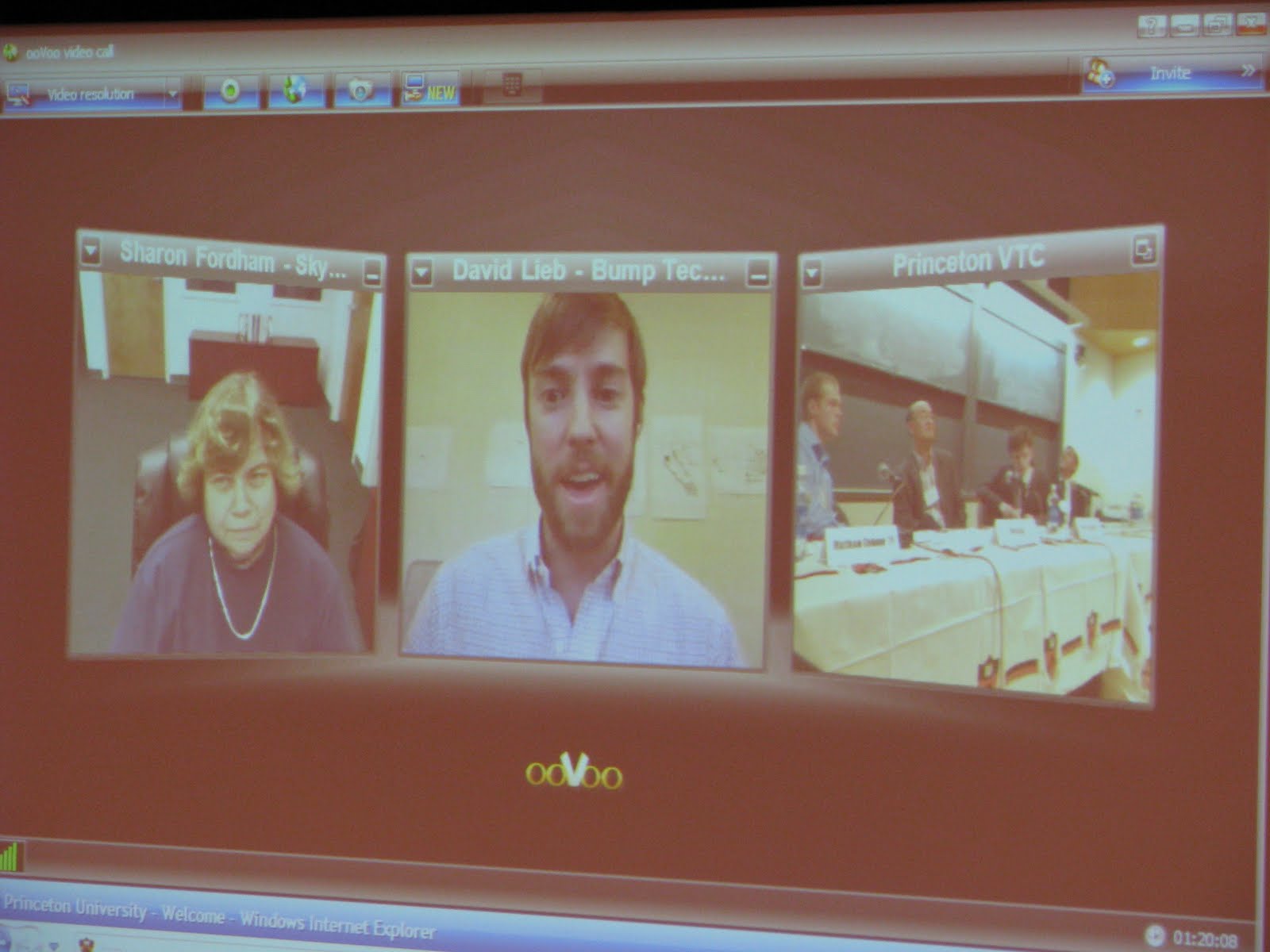
A 2003 alumnus, David Lieb (shown on Skype, middle), has attracted $3 million to develop “Bump,” an app that uses algorhithms in the sky to transfer info from one “bumped” phone to another. His fellow MBA students were using pencil and paper to exchange information.

And then in the crowd was a schoolboy, intent on his I-phone game and likely a future game developer. That was the territory of Sharon Fordham (shown on Skype, left). The board chairman of Skyworks and a Douglass graduate (let’s hear it for women’s colleges), she has been remarkably successful marketing Skyworks, which has 15 of the top 100 games. Unlike the other four presenters, she did not do the programming herself; her company translated existing properties to the iPhone platform.

The take-away for this session might be that iPhone programming skill is a terrific resume item and not all that hard to learn. When Kay couldn’t find a good programmer, he turned to his son for help. Schmidt is not a programmer by trade. Buy the $99 kit and you’re set to go. It’s such a hot area that Princeton University is sponsoring a contest for the best i-Phone app, and the Wall Street Journal has declared it a hot new cottage industry. Developers get 70 percent of the profit from downloads.

The schoolboy? His dad happens to be Gordon Bloom, the visiting professor from Harvard who teaches social entrepreneurship. Bloom will be on deck next week. He hosts “Social Entrepreneurship: A Rising Generation Changing the World” on Thursday, November 19, at 4:30 p.m. at the Carl Fields Center, the new building just down the street from the Friend Center

The student i-Phone app contest winners will be announced on Friday, December 18, 3 to 6 p.m. I can’t wait to see what they’ll come up with.

Age No Barrier to Creating Jobs


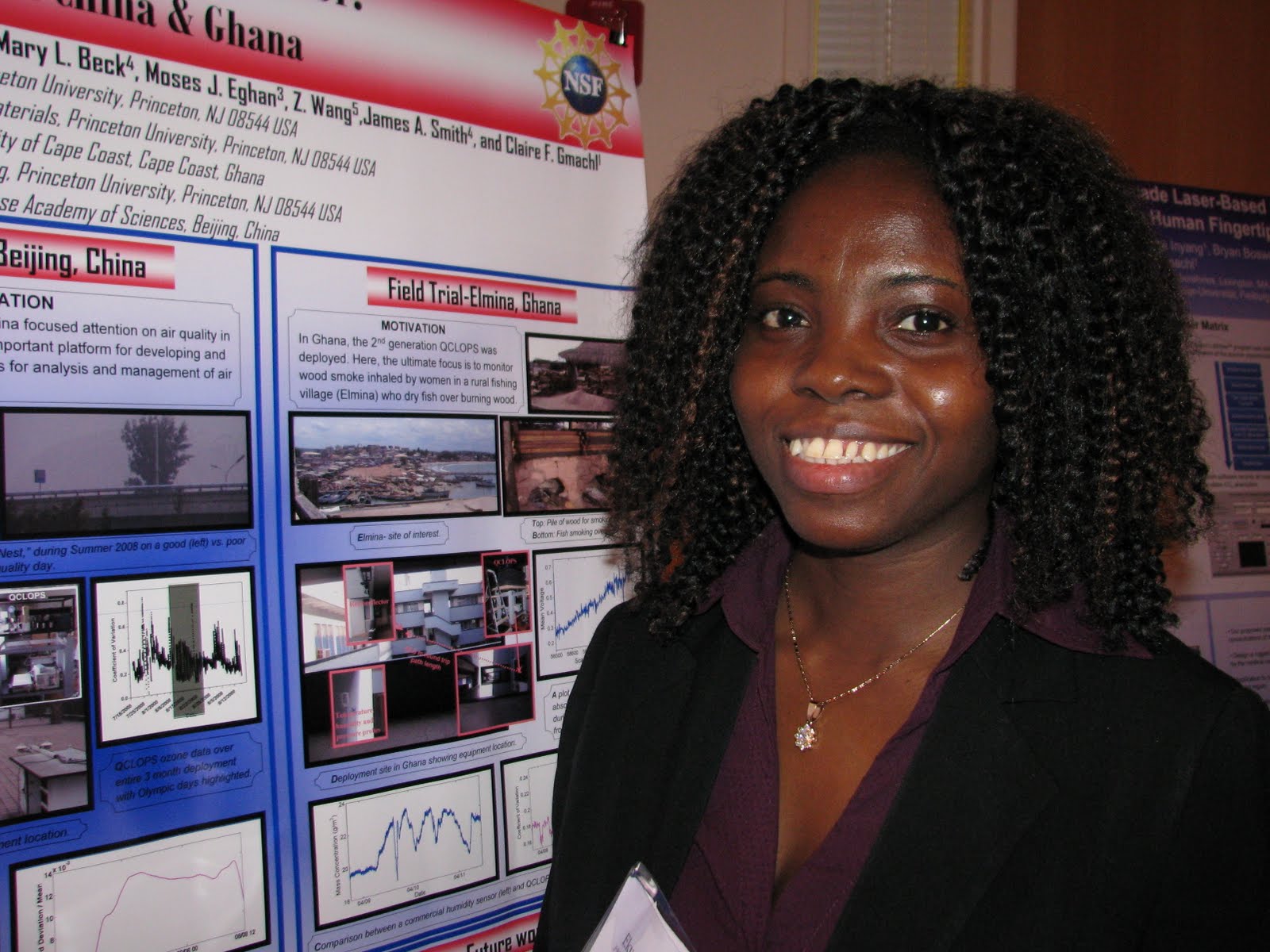
Age is no barrier to invention. At the 11/12 NJEN poster session at Princeton University’s Friend Center, I had a lively discussion with a student from Ghana, Ekua Bentil (shown above), who took sensor equipment (mid-infrared open-path gas sensors) to Ghana to measure wood smoke inhaled by women who dry fish over burning wood.

At the other end of the age spectrum, Nat Cooperman (shown talking to Valery Herrington) has one of those ideas that are so smart you don’t know why someone didn’t think of it: inexpensive freezing and overheat indicators. Cooperman brings out his little pellet disks, and you think he’s offering you a mint, but no, they show how crystals have changed with the temperature – an inexpensive way to prove whether a vaccine shipment got too hot or too cold. Look for him and his poster at Biotech 2009’s expo in Philadelphia on Tuesday, November 17.

Other favorites: Sanford Roth’s point of care ultrasound device for bone fractures (www.medsonics.com), Carl Mattocks’ CheckMi, using algorithms to link personal health records (PHRs) to billing, and Gregory Emsellem, a Parisian who is here at the university to test Elwing Company’s propulsion technology for the satellite industry. Each is relevant to companies that are already here: Medsonics for Abbott Point of Care (i-Stat), CheckMi to ZweenaHealth, and Elwing to Propulsion Science and Technology, among others.

Also here, Rick Weiss of Viocare, whom I have written about frequently for U.S. 1 Newspaper. He is known for his success in leveraging grants and his generosity in sharing that knowledge. He has teamed with Ajay Divakaran of Sarnoff for a tool for epidemiologists and clinicians, a cell phone app that automatically estimates food volume. Weiss has several products on the market for clinical nutritionists, and locally he is famous for Princeton Living Well, the multifaceted healthy lifestyle project that taps the power of the Internet and social media to promote diabetes prevention, weight control, and general wellness.

Most of these enterprises lack the needed ingredient, funding. On Wednesday, I went into evangelist mode, plumping for Princeton Job Creation Forum, a very young grassroots volunteer effort to stimulate the economy of the state through commercial innovation. PJCF will have a website in a couple of weeks, and in late January, perhaps January 26, PJCF will have a “speed dating session” with lenders and potential investors on one side of the table and entrepreneurs on the other. To be informed of that, email David Sandhal at info@pjcf.org. Whether through NJEN, NJEDA, SBDC, or PJCF, in this economy, we need all ages, all hands on deck.

25 Year Survivors: NJCST and U.S. 1

At the NJEN poster session last night in the Friend Center, Princeton University’s Joe Montemarano congratulated Peter Reczek, current head of the New Jersey Commission on Science and Technology for the commission’s longevity, nearly 25 years. He believes it’s the longest continually operating tech commission in the nation.

I had just come from the staff party at U.S. 1, where we toasted the boss on his cover story, featuring his survival tips, entitled “Still Standing after 25 Years.”

Determination seems to be the common denominator between the two organizations, and after 25 years, determination is still called for. Montemarano warned that, with every change of governors, the NJCST has been in jeopardy. Having survived two such changes (he worked in state government during the Kean-Florio change, and the Florio-Whitman change), he revealed that new administrations try to do their homework before doling out funds to state agencies. Because homework on the tech agency is daunting “they tend to save them for last, but that’s when all the money is gone.”

What kind of homework? It’s when they call up entrepreneurs and innovators and administrators in the business community to ask them their opinion.

Says Montemarano: “Take any opportunity you have to give input on the NJCST’s enormously important role, and how valuable it is for the future.” For example, Reczek announced $5.6 million in grants-in-aid given out this week to 26 companies, plus $40 million in clean energy grants, co-sponsored by the EDA and BPU. Many a young, struggling company has managed to stay standing because of the NJCST’s leadership.

Other Montemarano advice: Show up at tech gatherings whenever you can. Your future angel or VC may be there. If they keep seeing you – even though you are not ready to ask for money – they will be “getting comfortable” with you.

Nearly 100 people knew that and showed up yesterday to network and peruse the 27 posters (shown above, Lou Wagman at the podium). And today, four entrepreneurs will discuss I-Phone apps as part of the Jumpstart Lecture Series, and important people are sure to be there. Sponsored by Princeton’s Keller Center, it’s in the same building, Friend Center, at 5:30, it’s free, and a reception will follow. This will be fun to hear about, even though you’re not in the tech business yourself.

For other meetings, check the Business Meetings section of U.S. 1 Newspaper or its online database at http://www.princetoninfo.com. Keeping a great database of events, online, that the community can depend on — that’s one of Rein’s secrets for “Still Standing.”

Dreams in Progress: NJEN’s Tech Poster Show

Today’s news was a heavy blow: Pfizer is closing the Wyeth research plant on Ridge Road, and 400 jobs will disappear or go north to Connecticut.

But let’s focus on the good news. New Jersey’s Einstein’s Alley is rich with great technology ideas, and you can preview some of them at the New Jersey Entrepreneurial Network’s annual poster show at Princeton University’s Friend Center. The state’s technology czar, Peter Reczek, executive director of the New Jersey Commission on Science and Technology, will keynote.

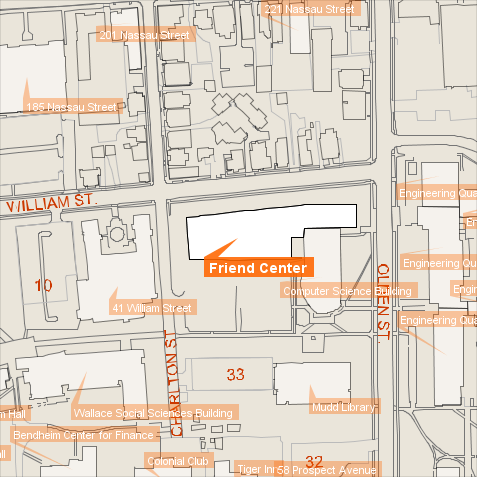
Details: It’s Wednesday, November 11, 4:30 to 6:30 p.m. at Princeton University’s Friend Center, (William and Olden Streets). Cost: $45.00 at the door. Appetizers, desserts and beverages will be provided (www.njen.com).

To titillate technological imaginations, here are some of the technology entrepreneurs you will get a chance to speak with.

Five Princeton engineers who have a sensor used in China for the Olympic Games to monitor gas concentration and in Ghana to monitor smoke inhaled by women who dry fish over burning wood.

Sanford A. Roth of Medsonics, with a portable ultrasound diagnostic point of care device to detect, monitor, and status of bone fractures.

Carl Mattocks of CheckMi, with Medicin Arhivo, using algorithms to update Personal Health Records (PHRs).

N. Soundararajan of Nourishing Inc. in East Brunswick, with Reachout, an e-commerce application enabling retailers to make offers to consumers who need to buy “now,” facilitating sales through a duplex negotiation process.

Terry Miglani of Tachus Technologies, a women-owned firm with proprietary software for managing obsolescence in the electronic and medical industries.

Also technology that harnesses energy of ocean waves, regulates temperature of vaccines being shipped, uses nanotech for a biofuel cell that converts the body’s own glucose to power implantable devices, and devises an online gaming and social networking site for advertisers.

Plus, you’ll hear the technology czar, Reczek, of the NJCST. “NJCST has been a key and continuous player, supporter and leader in NJ technology-based economic development since 1985,” says Joe Montemarano, of Princeton University. Governor Tom Kean created this commission, and every newly elected Governor, upon inauguration, has tried to do away with it. Fortunately the state’s technology community rallied in support each time

Just out today: the NJSCST awarded more than $5.6 million through its grants-in-aid program.

Future dates for NJEN: February 3, 2010, a venture fund panel at the Princeton Marriott, at noon. Wednesday, April 7, a lunch at Rider University on corporate and non-profit funding sources. Wednesday, June 2, an angel network roundtable lunch at the Princeton Marriott.

Gallup’s Frank Newport: Size Doesn’t Matter

Pollster Frank Newport believes that two heads – actually, 200 or 1,000 heads – are better than one. “The collective wisdom of people looked at together is very valuable,” said the editor in chief of the Gallup Poll, in a deftly engaging talk at the Princeton Regional Chamber lunch today. “The business leader who relies on his own judgment has a fool for a consultant.”
(Above, he is in the center with chamber CEO Peter Crowley, left, and Grant Somerville of Merrill Lynch, right.)
Newport records daily from a recording studio at his Carnegie Center office; the Gallup headquarters moved out of town but used to be on Chamber Street in the building now owned by Henderson Sotheby’s.

How the Gallup Poll began: Founder George Gallup had polled for ad agencies and Hollywood directors until he famously opposed a “mail-in” survey and predicted the outcome of the FDR/Alf Landon presidential race. Still, he had to persuade the general public that, with scientific random sampling, the size of the sample doesn’t matter. A chef doesn’t have to eat all the soup to taste for salt, he used to say. A doctor doesn’t need to take all your blood to test it.

What the public hears about is a small percentage of the Gallup business, which does 95 percent of its work for corporations. It polls 1,000 people daily, including the cellphone population. The four research areas: to understand a marketplace (business specific), to understand an industry (industry specific), to track the economic environment (measuring consumer confidence), and to understand the political environment. Re the economy, as of yesterday, 21 percent of the nation are satisfied with how things are going, yet 80 percent are satisfied with their personal situation.

(I’m stopping here for an urgent aside, sounding the horn for a potential help for the job debacle. Newport said the polls show a slight uptick in people saying that their companies are hiring, but very slight. Meanwhile I’m rooting for a grassroots job creating initiative, Princeton Job Creation Forum, which invites anybody — you ?– to pitch in to help to replace jobs. The group met the day after the election and has some firm plans to jumpstart new and growing businesses. Contact info@pjcf.org — ok back to Gallup, thanks for listening.)
Last year, 2 percent said they had the flu, this year, 2.7 percent have had it.

Those numbers don’t necessarily reflect New Jersey. Nationally, Ronald Reagan is the # 1 favorite among American presidents with JFK # 2 and George Washington ranks near the bottom with only the six percent of the votes. That’s not the New Jersey opinion, which is the third most Catholic state and one of the top 10 Democratic states. New Jersey also ranks above average in ethical optimism, whether a lost wallet would be returned.

As for the Corzine defeat, Newport wasn’t surprised. After all the polls predicted it. He carefully guards his own political opinions. “Not even my wife knows how I vote.” In fact, believing as he does in collective wisdom, “the more I look at the data, the more I question my own opinion.”

Twitter’s Jack Dorsey: Who You Know Still Counts

Posted by PicasaThe digital divide was wide tonight, at a 3 to 5 p.m. NJSBDC networking event at the College of New Jersey, followed by a talk by Jack Dorsey, creator, co-founder, and chairman of Twitter and considered an influential Internet pioneer (pictured, top).

Most folks at the networking either don’t Tweet or are just trying to figure it out. My card stack includes one lender, two executive coaches, two web developers, an attorney, three automotive guys, a logistics company, an interior decorator, and an education franchiser. Of that crowd only event planner Michael D. Young professed to be comfortable with Twitter, and the college students who sat behind me professed to be totally uninterested in Tweeting.

But Kendall Hall was packed, and Dorsey told a compelling story about being given two weeks and one other programmer to build the first model of an update system that works on cell phones. It debuted at the SXSW music festival in Austin in March, 2007. “It was the right place at the right time. And it was the first year at SXSW for the Wall Street Journal and the New York Times. But we failed, technically. “

System failures continued, sometimes for hours, even a whole day. They finally figured out that — though a communications firm — they weren’t communicating well. “We were not talking to each other and our investors, not practicing transparency.” The fixes included:

Lots more communication (blogging, twittering) without worrying about overload (“you filter out what you don’t need.”)

Building instruments to find out how people are using Twitter

Admitting mistakes.

Working in public and sharing the work with anyone interested. For instance, Twitter users invented the use of the @symbol, replies, retweets, hashtags, and even the word ‘tweet’ to stand for ‘updates.” “If we had not said we don’t know what it is good for, we would not be a success today. Tweet by tweet they defined what it meant to them.”

Dorsey says he is still tinkering with the business model, and no, he hasn’t made any money yet. (I asked why teens text rather than Twitter and he didn’t really have a good answer, except that it’s up to each individual and group to decide what is useful.)

When he watched President Obama address Congress he noticed the legislators were looking at their cell phones. Then his own phone buzzed. It was his Congresswoman, twittering her take on the speech. “I’ve never felt closer to my government,” he said.

The hardest part of starting a business? Starting. “It’s important to start as quickly as possible, to get it out on paper and allow others to play with it. If it is a ridiculous idea, it can be closed, and you move on.”

Dorsey had lots of good insights on “real-time communication” but the back story of how TCNJ snagged such a hot speaker has nothing whatsoever to do with social media. How did Dorsey get to TCNJ? He had grown up with the son of TCNJ’s new business dean, William W. Keep (pictured on left with SBDC’s Lorraine Allen).

It always is and ever will be, “Who You Know Counts Most,” world without end amen.