Category Archives: Uncategorized

Thanksgiving Juxtaposition


It’s Thanksgiving morning, and as I wake up, from dreams about what spices to put in the stuffing, I hear the consecutive headlines from my NPR station in Philadelphia: Door to door shootings targeting wealthy Americans in Mumbai and balloons and bands in the Thanksgiving Day parade, a surreal juxtaposition, the top two stories of the day, delivered in the same matter-of-fact newsman voice.

Thunk. Back to the scary world, with its echoes of 9/11.

Wince, my previously okay back goes into stress-mode pain.

Resentment – how can that station make those two topics almost equal, one right after the other? They wouldn’t do that if the terror were in Philadelphia.

Reason kicks in. Of course not, because the parade would have been canceled. The terror is overseas, remember? What makes it different from all the other attacks and suicide bombings is the scale, and what makes it different from other large scale attacks, like the trains in Madrid, is the focus on Americans and British civilians. Yesterday my husband and I personalized the news, thinking about his colleague who will travel to that city next month, and about the family of Gupta, the student from Bombay (yes, it was that long ago, when it was still called Bombay) whom we added to our family Christmas celebration in Pittsburgh.

Bad things happening far away bring one degree of pain, but the pain ratchets up when you have a friend there. (Are we, in Princeton, taking full advantage of the opportunities we have to achieve world peace by befriending the thousands of overseas visitors that spend time here every year?)

Still, I resent the “both things are equal, both things are OK” tone of the Philadelphia announcer. Then Steve Inskeep, the national newsguy in DC (pictured above) comes on, with the same news. My news nose kicks in. I met this guy once. How will he handle this?

Inskeep starts off with an advantage over the local announcer. Because the headline summary is over, he can put all his focus on Mumbai, and he matches his voice to the story, his voice filled with concern. Then he unpacks the story, adding details. Horrible details to be sure, but knowledge is power, as they say, and the details are somehow reassuring. He drills down one layer, to the reporter on the scene, 700 foot from the Taj Mahal hotel. More details. Again, knowing more helps. Then another layer, to an Indian restaurant owner who saw the shootings, and an unidentified man, apparently American, who was in the hotel lobby when the shooting began.

How can these details possibly be soothing? Maybe because, as bad as they are, they are not as bad as my worst fears.

Maybe because Inskeep tells them with the utmost empathy, giving me the assurance that he is distraught as I am about this.

Maybe because – now that I know exactly what happened, I can fashion my own scenarios. What would I do if gunmen stormed my room? Would I be brave, scared, or full of faith and ready to meet my Maker? I hope I would be all three. I guess I’d better start working on that last one.

Three Nights at McCarter


Twyla Tharp always seemed so New York – frantically quick, unexpected turns of phrase, “distracted from distraction by distraction,” to quote T.S. Eliot. Or so Hollywood, languorously glamorous. So when I heard her 12-year-old Quaker/Shaker work, “Sweet Fields” would come to McCarter, danced by the Aspen/Santa Fe ballet, nothing could keep me away. She had gone back to some Quaker ancestors for her inspiration and used Shaker-like hymns and William Billings for music. I craved the simple lines of a simpler time, the message that faith-filled movement might bring. Had she done it? Had this impatient, wise-cracking choreographer managed, with a straight face, to summon purity, faith, devotion, and simplicity.

Yes. I’m not going to try to describe it on the Sunday morning I’m writing this, as I listen to the Anonymous Four sing similar music on NPR and get ready for church, but the answer is yes.

Aspen Santa Fe came to McCarter on Tuesday, November 18, bookended by the Soweto Gospel Choir on Monday and followed by Emmanuel Ax and Yefim Bronfman playing two pianos on Wednesday. What a lineup.

Re the Soweto – since we moved to Princeton some 25 years ago McCarter has had “diverse” programming. It was here that I first encountered Sweet Honey and the Rock, for instance. Apparently it was not always so. At the memorial service for Fannie Floyd earlier this year, her husband Jim, a former borough mayor, said that Fannie had been instrumental in pointing out to McCarter that Princeton’s African American community were not seeing themselves on stage. Thank you, Fannie.

We bought tickets to Ax/Bronfman early in the season because they were playing my very favorite, Brahms Variations on a Theme by Haydn. My request to use the Haydn theme for my wedding march was rejected by the organist, so I hear it every chance I get.

It’s been way too long since we’ve seen a recital. When I worked a five day week, if I went out at all, it was to see dance, or maybe a symphony. It boggled my mind, to use a cliché, to watch two old masters put their hearts and souls into the old masters. In addition to the Brahms they played a Mozart Sonata in D (K.448) and Rachmaninoff’s Symphonic Dances (Opus 45) plus a Latin-styled confection, “Recuerdos’ by a living composer, William Bolcomb.

To make it even more special, I encountered a third “old master,” Moshe Budmor. (Sorry Moshe, even though we both take Pilates with Anthony to keep us young, we both get senior citizen rates). Moshe is a child at heart; his musical work is play and he loves toys. Together we perused the array of puppets at the McCarter shop, and I was ready to buy the fabulous Snowy Owl, with a head that can turn 360 degrees, but Moshe, an even more experienced grandparent than I, advised against it, because the turning mechanism is too difficult for that age. Perhaps I’ll buy it for myself, to remember the moment.

(A note to the sponsors of the Bronfman/Ax evening, printed as the Robert J. Ciattos and Mary and Ted Cross and the Aspen Santa Fe evening – Katherine Benesch, Adam Burrows, and Mr. & Mrs. Edward B Matthews. Thank you.).

Now Dance plus Then Dance: Morris, Rainier, Cohen

Baryshnikov can etch the smallest movement in your memory, and so can Tina Fehlandt, as she showed last night, Friday, November 21, when she danced ‘Peccadillos,’ a Mark Morris solo that has been danced by the famous Russian and by no woman, until now. It opened a program called “Now Dance,” choreography and/or performances by faculty and guests at the Hagan Dance Studio on the Princeton University campus and repeats tonight. The performance is sold out, but first-comers can usually snag an uncollected ticket.

Fehlandt, who danced with Morris’ company for 20 years, was accompanied on the requisite toy piano by music of Erik Satie, played sensitively by a scrunched-up David Tenney. From toy soldier-sharp angles, to sweeping-open circles, to breathfilled swings, to angst-filled clutches, she and Tenney made little jewels out of each variation.

Rebecca Lazier, the acting department chair, brought a four-person company for two works, this year’s ‘Terminal,’ with Ravel’s Bolero-based music by Gregory Spears, and excerpts from an in progress work, “Coming Together,” with a voice and sound score by Frederick Rzewski, referring to the massacre at Attica state prison. I found the prison one more compelling. Though in its current version it lacks a discernable climax, the coupling of the four dancers had a compelling ebb and flow. Jennifer Lafferty, Rommel, Salveron, and Storme Sundberg are all beautiful dancers, but Emily Stone – very tall, she towers over the three – was especially wonderful to watch.

Todd Allen and Ying-ying Shiau’s excerpt from Zvi Gotheiner’s ‘Interiors’ was a tour de force of elasticity. Confined to a chair, they moved back and forth, in and out, over and under, coming apart and returning together in an endless number of ways, just gorgeous dancing.

Jason Herbert was impressive as a young boxer in a work by Dyane Harvey-Salaam, against a background of Cassius Clay/Mohammed Ali photos and words, a collage of interviews, and music from a film. It was witty, poignant, and inventive, and it is perfect for touring to schools and youth programs.

Patricia Hoffbauer took a 1962 Yvonne Rainer piece, ‘Three Seascapes,’ out of mothballs. I tried to call up that Judson Church period, when this dance was a protest, and I could imagine just how revolutionary it was. First she jogged around with her hands stuffed in her raincoat pockets, exuding determined energy in complicated floor patterns. Then a too-strong chorus of coughers gathered at a mike while she danced repeated phrases of exhaustion and sickness. In Rainier’s version of Fokine’s ‘Dying Swan,’ she used tulle to have a tantrum. Audience members without any historical context laughed out loud. It did look funny, out of context. Just a little program note, just a little verbal introduction, would have clued them in and helped them to appreciate it.

Ze’eva Cohen’s ‘Cloud Song’ was a more effective throwback to the past. Nicely danced by Elizabeth Schwall, a Princeton senior and the only student dancer on the program, it ended with a film of the young Ze’eva. Beautiful.

I’m going to post this right now, without much proofing, without adding all that I might like to include, on the odd chance that someone may see it and try to get to the program tonight. It’s been years since I wrote dance reviews on a regular basis, and it’s really hard to make myself do it again. If I labor over them, I’ll never get around to them. So – what you see is what you get. Though I may add some second thoughts later.

I started this Friday night and finished it Saturday morning. Now I’m off to the electronic recycling day, which comes only six times a year, with my car full of old technology – used hard drives, discarded phones, yards of wire. Dance may be evanescent. Old dances may be hard to reproduce. But it’s certainly more useful and important to the world than old technology.

PS. Anybody who sees errors, please tell me. Anybody with a different or similar opinion, please comment.

Eulogizing Tap and Rock: Howard Sims Jr. and Joe Boyd


A movie on hoofers in Harlem in the ’30s and 40s, and a book on rock in the ’60s — they’re featured back-to-back this weekend.

Joe Boyd, a native son, now a producer and music historian, reads from his book, “White Bicycles: Making Music in the 1960s” tonight (Friday, November 21, at 7 p.m. at the Arts Council). As Kevin L. Carter reports in this week’s U.S. 1, Boyd discovered and/or produced artists ranging from Pink Floyd and Nick Drake to Eric Clapton, the Incredible String Band, Fairport Convention, Richard and Linda Thompson, R.E.M., Kate and Anna McGarrigle, and 10,000 Maniacs. Jim Floyd, son of Princeton’s former mayor, will introduce the show. Floyd, Princeton Class of 1969, took the photo of Boyd at the Newport Festival that was used on the front cover of “White Bicycles.”

Howard Sims Jr., the son of “Sandman” Sims (1917-2003), will comment on the film “No Maps on My Taps,” which features his father. Sims Jr., now 39, lives in Princeton with his wife and four children. He appears in the film as a boy dancing with his father. It will be shown on Sunday, November 23, at 3 p.m. at the Princeton Public Library.

Both Boyd and Sims Jr. are eulogizing lost arts. Carter quotes Boyd saying he doesn’t think popular music is as important, or as musical, as it was during his ’60s heyday. “It is nowhere near as important as it was in the ’60s,” Boyd says. “Every art form has its golden age, and I fear pop’s has passed.

Sims believes that Savion Glover, who he says owns the tap legacy, focuses on performing, not evangelizing. “I think he is a beautiful person,” says Sims. “but he is the last of this era. When he’s gone, this craft is gone.”

Whether in race relations or in the arts, says Sims, “We need to do things for each other. No matter what you may think of me, I need to speak to you, and I need to show you that I am not the person you think I am. If we have a craft or a skill, it shouldn’t be about money all the time. We should share that knowledge with each other. That was the beautiful thing about my dad.”

Redux: From Starter Home to Mini McMansion

My October 22 U.S. 1 Newspaper article on the Harrison Street teardown (a modest ranch was turned into an imposing duplex) provoked a healthy number of responses. Then a real estate reporter for the November 9 New York Times, Antoinette Martin, claimed that teardowns are slowing down in New Jersey. No longer are we the Number One Teardown State.

Then I had a note from a neighbor, who also happens to be a land planner, as below:

As someone who lives in a larger home and gladly pays for the privilege with increased real estate taxes — I have no problem with the housing style. For that matter, I have no problem with smaller cape cods either.

As a lapsed planner I think that one of the attributes that make a neighborhood interesting is an eclectic mix of different styles especially as a neighborhood matures. It seems a little like government over-kill to me to unreasonably limit house size or to dictate style or taste. We are not about to order the demolition of the large graceful older homes on Princeton Avenue or Nassau Street to accommodate the “small is better” preference, are we?

And it seems that government has enough to do without attempting to set artificial limits on house size in service to a mistaken notion of affordability. Six hundred thousand dollar “tear downs” have nothing to do with affordibility.

The problem, if there is a problem, with the new duplex on Harrison Street is not with its discordant size and roadway proximity. The problem is that a single-family home where empty nesters lived was replaced with two units which will accommodate younger families each likely to have school-aged children. If you quickly do the math, the increased local property tax yield is buried by the increased educational expense which then has to be spread across the tax base. I am certainly not complaining — that’s just the way it is.

There is an old Pete Seeger song about the downside of a neighborhood where all the homes look alike — whether they are capes, ranches or oversized homes on small lots. Slavish consistency is the hobgoblin of stunted planning — diversity rules.

On the other side of the fence, so to speak, is another neighbor, also a land planner, who vehemently objects to supersizing houses on her block. I repeated the question that the zoning officer asks, when people object to what is legal, “Where were you when the zoning hearings were held?”

11th day, 11th hour


Veteran’s Day, 2008

When we were growing up, my husband recalls, schoolwork stopped at 11 a.m. on November 11, Veteran’s Day. Last month we did a lot of remembering at the Pearl Harbor memorial , and today — invited by Class of ’81 West Point alumnus Matt McCarville — we plan to attend a morning service at Princeton University Chapel, where the speaker will be Uwe Reinhardt, the healthcare economist and father of a Marine. I’ll be surprised if he doesn’t have some harsh words regarding healthcare for veterans.


Several days later

Reinhardt did indeed have strong words about the nation’s failure to provide what veterans need: “We bicker over a GI Bill — we more than twice as rich as the World War II generation. . . I was shocked this year (when testifying in Congress) at one senator who sincerely believed (support) for veterans would be unsustainable. If I was rude, I was rude for a cause. There should never be a healthcare facility for veterans that wasn’t the best. …”

What sets military people apart: “their code of honor, the bonds that they form — so that they die for one another, and their determination to complete their mission even if they do not agree with that mission…”

Don’t thank the soldiers with casual words at airports, he said, “but by our resolve to make our country genuinely patriotic by caring for one another.”


A Million Dollar Thank You

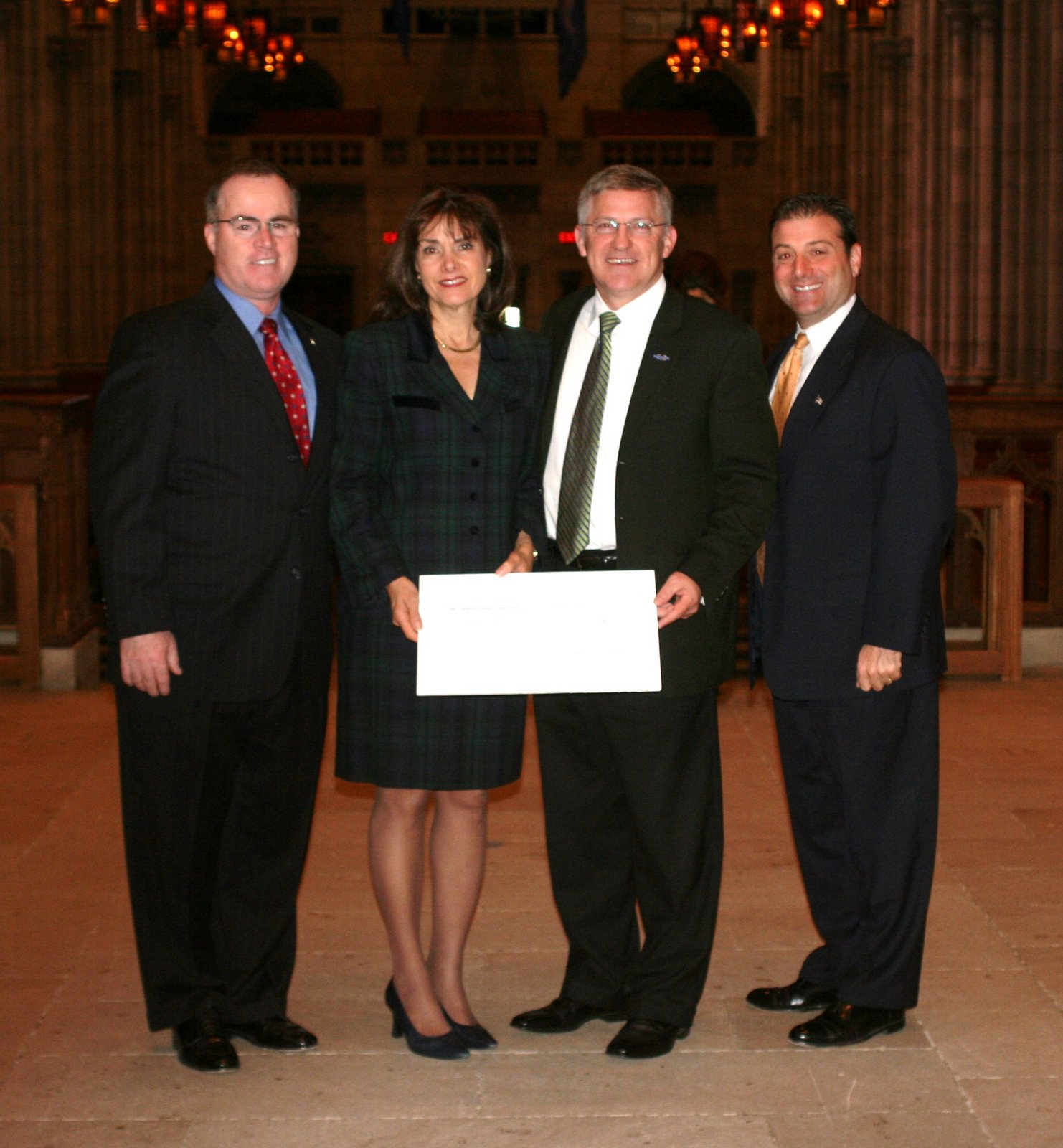
What happened next was really amazing. At the end of his speech, someone stepped forward and presented a $1 million check, yes that’s right, $1 million for the Wounded Warrior Project to help severely injured soldiers make a transition to civilian life. It was astonishing. It was heartening.

It seems that the president of the Charles Evans Foundation (honoring the founder of the fashion house Evan-Picone) is Linda J. Munson, and Munson is a client of the MSM Group at Merrill Lynch. She was looking for a way to honor veterans. “As a trustee and president of the foundation, she asked us to find an organization that would benefit from a major gift,” says McCarville. He had served in the Special Operations Command in Desert Shield and Desert Storm and his last assignment, before retirement, was to command the ROTC unit at Princeton. Now he works with the fellow West Pointers in the MSM Group at Merrill Lynch.

McCarville found the Wounded Warrior Project, which honors and empowers wounded soldiers, doing everything from sending backpacks to hospitalized soldiers overseas to getting legislation passed that pays traumatically injured soldiers $100,000 up front, rather than after months of red tape. The Evans Foundation gift will provide scholarships for a 12-month training and rehabilitation program in Jacksonville, Florida. Wounded soldiers can get physical rehabilitation in a state-of-the-art facility plus earn 12 credit hours at Florida Community College, and work in paid internships.

Just 60 people attended this service, and had there been publicity about it, I think there would have been at least 100 more.

Bishop Hans Vaxby, Justice, and Social Capital


“You do not need to be president to open doors,” said Bishop Hans Vaxby, preaching at Princeton United Methodist Church yesterday, the first Sunday after the presidential election and also the International Day of Prayer for the Persecuted Church. Born in Finland and based in Moscow, the bishop governs the Eurasia Area, the largest geographical area in the Methodist church, covering 11 countries. Re Christian persecution in formerly Soviet states, he told an anecdote about tourists in China who couldn’t take a scheduled boat trip on a river because it was too dry. Then some VIPs arrived. For them, a dam was opened so their boat could pass, and then all the other tourist boats could sail as well.

Referring to Buchenwald and Stalingrad, and invoking Amos 5:24 (“Let justice roll down like a river, and righteousness as an ever-flowing stream,” which echoes the inscription on the civil rights memorial in Montgomery, Alabama) he challenged us to fight the subtle forms of persecution found in this country. We are silent when we should speak out about bullying and injustice. “To let justice roll down for you and me mostly means – not to open a dam, but to open our mouths, to say ‘what do you mean by that,’ or ‘I’m afraid I can’t agree with you.’

Bishop Vaxby’s words echoed the advice of Melissa Harris-Lacewell in post-election commentary two days ago (November 7 post). Asked what ‘ordinary people’ could do, she advised, “If you belong to a group, don’t wait for marching orders from the top. If you don’t, look for one.” In her most recent post, she challenges academics of all stripes, from PhD candidates to high schoolers looking for term paper topics, to investigate an aspect of the Obama campaign.

Here are some other opportunities I know about and I’m asking for everybody else to chime in with their suggestions and experiences …

Support Not in Our Town, a congregation-based organization dedicated to stamping out bias and eliminating racism. Also keep in touch with the YWCA’s Racial Injustice Institute.

Hear David Abalos, a professor in the Princeton University politics department, speak on “The Impact of Hispanic Immigration on the Economy of the Princeton Region,” at the Princeton chamber on Wednesday, November 19, at 7:30 a.m. at the Nassau Club.

Help increase “social capital,” which has a surprisingly low score around here, according to a survey by the Princeton Area Community Foundation and the chamber foundation (www.bettertogethercnj.org) “Social capital” refers to the friendships, acquaintances, and working relationships that tie people together and, as Yogi Berra famously said, “If you don’t go to somebody’s funeral, they won’t come to yours.” Communities that can increase their social capital are likely to have higher educational achievement, less crime, well-performing governments, better community relations, and faster economic growth, said Lewis Feldstein, speaking at the Better Together conference last month.

Donate to the Crisis Ministry of Princeton and Trenton, which works to prevent hunger and homelessness. It hosts the Soweto Gospel Choir in a benefit at McCarter Theatre on Monday, November 17 (www.crisisministry.org).

Fighting persecution need not be relegated to Eurasian Christians who are walking through the darkest valleys referred to in Psalm 23. It might mean obeying the advice in the parable in Matthew 24:35, “I was hungry, and you gave me food… I was a stranger and you welcomed me.” Or resisting a bully with words.

Vivian Stringer: Standing Tall

On Thursday, November 6, two days after the election, Rutgers basketball coach Vivian Stringer addressed a sell-out crowd at the Princeton Chamber lunch. As a board member of the chamber, I don’t write U.S. 1 Newspaper articles about chamber events, but I had interviewed Stringer for a book signing (U.S. 1, May 7 )http://www.princetoninfo.com/index.php?option=com_us1more&Itemid;=6&key;=Stringer

Having read her wonderful biography, “Standing Tall,” I recognized her “tough talk.” As in previous years she has some new players with big egos and reputations who are trying to resist her grueling conditioning requirements, “and they continue to read their reputation.” No matter how talented the player, she keeps them on the bench until they pass her fitness test.

Also in the book, she is frank about the prejudice she encountered as a child, a student, a coach, and a mother. So I was eager to hear her response to the inevitable question, “How did you feel about the election.” Taken aback, choked up, she could hardly speak at first, and then admitted that her reaction — tears — was a total surprise. “I cried a lot. I have seen so much. I cried with Colin Powell. I cried with Jesse Jackson. I thank God I was able to see it. He reconnected every living body. He exemplified the Christian principle — when they got rough, he turned his head and offered nothing but love.”

Her sons, she said, can look at the president elect and know that they, too, could someday be president. Then she confronted her mostly white audience. “Most of you in this room might not think about that. I’m proud of America. Proud of all people. It is good to see someone judged by the content of their character, not the color of their skin.”

The motivation behind Stringer’s luncheon appearance was to announce that, for the women’s tournament, Sovereign Bank Arena would host the Sweet Sixteen and the Elite Eight. Stringer also tried to make a case for how New Jersey could profit from the Big East being moved to New Jersey. Two at my table, Joe Demetor and Anthony Eagleton from Nelligan Sports Marketing — they market the Rutgers teams, had some insights on that. Though the Meadowlands might seem a perfect venue for the Big East, it would be difficult to match the ticket sales in Connecticut, which happens to be the epicenter of enthusiasm for women’s basketball.

Also at my table were three Susans — Susan Bowen from Mercer County Community College (with her from MCCC were Walter Brooks and Jacob Eapen), Susan “Fabulous” of Fabulous Fare (dessert and fancy food caterers), and Susan Gargano of Dominion Ventures, a private equity firm that invests in “non traditional stable assets,” i.e. trailer parks.

For an hour after the luncheon was over Stringer signed her book. With me in line were Melissa Tenzer of Careers USA and Richard Ober, who knows Stringer’s pastor, Rev. “Buster” Soaries of the First Baptist Church of Lincoln Gardens. Ober tells how he was the corporate counsel at United Jersey Bank when UJB loaned the money to build that church. After the papers were signed, Soaries asked an unusual question, “Now what can I do for you?” Hmm. Well, the bank was having trouble recruiting for a back office in an out-of-the-way spot with no transportation. On the spot Soaries promised to set up van services and find employees, and he followed through on the promise, providing dozens of hard-to-get, valuable workers for that location.

Among the others I met: Lorraine Allen of the New Jersey Small Business Development Center, William Rhoads of CrossRoads Counseling & Communications, Ann Cannon and Wendy Sturgeon of Allies Inc. (Ann is also a Mercer County freeholder), Arlene Goldberg of Churchill Corporate Services, Bill Belmont of FastSigns, Alexis Nelson of Wyndham Princeton, Lisa Snyder of NJAWBO (NJAWBO has now joined the chamber), John Smith of Capable Communications, Bob Bruschi and his daughter (Bob used to be Princeton Borough’s administrator before he moved across the pond), and Ilonka Seamon of Real Possibilities.

Everyone at the lunch came home with Stringer’s book, courtesy of generous sponsors. (It’s a great read, and would be an inspirational gift.) Nearly everyone stood in line to get her autograph. An hour after the dishes were cleared, she was still signing.

On Friday, November 7, at noon, Melissa Harris-Lacewell, who worked in the Obama campaign, will give an election wrapup at Princeton University’s Carl Fields Center on Olden Avenue…

Einstein: On Science and Faith

Nancy K. Frankenberry suggests that Albert Einstein had “the unconventional spirit of a great genius meshing with the intellectual creativity of the Jewish tradition to produce an ardent faith.” She edited “The Faith of Scientists in their own words,” just out from Princeton University Press and just added to the collection at Princeton Public Library.

She puts Einstein in the chapter with historical titans: Galileo, Kepler, Bacon, Pascal, Newton, Darwin, and Whitehead. She also includes excerpts from Rachel Carson and Jane Goodall, from Stephen Jay Gould and Freeman Dyson — 21 scientists in all.

Einstein is a perennially fascinating subject, and as the United States goes to the polls today I find it comforting to reflect on his concept of “an infinitely superior spirit.”

An excerpt from Frankenberry’s introduction:

“Einstein’s pantheism, like that of Spinoza, whom he admired, was based on a belief in an underlying mathematical intelligence pervading a deterministic universe, a belief he could not relinquish even in the face of the indeterminism of the science of quantum mechanics he helped to establish. Einstein could not conceive of a personal God who would directly intervene in the world or influence the actions of individuals or sit in judgment on creatures of His own creation. His faith consisted in a profound admiration of the infinitely superior spirit that reveals itself in the little that we humans, with our weak and transitory understanding, can comprehend of reality. He said that morality is of the highest importance, but for us, not for God.

“Einstein described the emotional state that accompanies and inspires great scientific achievements as similar to that of the religious person or a person in love. He recognized the importance to science of the kind of very broad faith shared by the scientists in this book. ‘Science can only be created,’ Einstein said, ‘by those who are thoroughly imbued with the aspiration toward truth and understanding. This source of feeling, however, springs from the sphere of religion. To this there also belongs the faith in the possibility that the regulations valid for the world of existence are rational, that is comprehensible to reason. I cannot conceive of a genuine scientist without that profound faith.’”

Deals versus the Aloha Spirit


Still groggy from 12 hours in the air, after two weeks in Hawaii, I wade through my E-mail to find a message from a news organization, Dow Jones Interactive, with the pitch that I will get the most “Return on Vacation” (which I suppose refers to the Return on Investment of accountants’ balance sheets) with a trip to Hawaii.

Hawaii, proclaims this advertorial, offers the “all-too-rare opportunity to truly relax; to replenish your spirit, reunite with family and friends, renew your sense of adventure, and explore the natural wonders of our planet.”

I couldn’t have said it better myself, even if I’d been paid the big bucks to write it. “Hawai`i’s six major islands,” it goes on, “are green-capped mountains lifted from the bottom of the sea, decorated with rainbows, surrounded by blissfully clear waters, and rimmed by sun-swept, sugary sand beaches.”

Good stuff. I was going to try to write about our trip, but now I’m a mite intimidated. Maybe I should just stop there and link to http://www.gohawaii.com/deals

Naah. I’ll take a chance that I can say something that doesn’t gush but that is sufficiently interesting to divert attention from the worrisome national scene.

In so many ways our patch of earth is like Hawaii, and so many ways different. Mainlanders may snicker about the “Spirit of Aloha,” but it is not a joke. In places where westerners have not prevailed, we found the people to be really much nicer. Nice may not be quite the right word, but add friendly and helpful, and it’ll do. It’s similar to the friendliness vibes you get when you leave the notoriously unfriendly northeast to travel south or to the Midwest, but there is also a “spirit” part to it, a resonance with the earth and sky, and sometimes this is underlined by organized religion. Those natives who turned over their souls to the Christian missionaries loved their new deity with a devotion derived from total dependence on the land. Some are now Buddhists, some Shinto, but they do seem to possess a certain warmth of spirit.

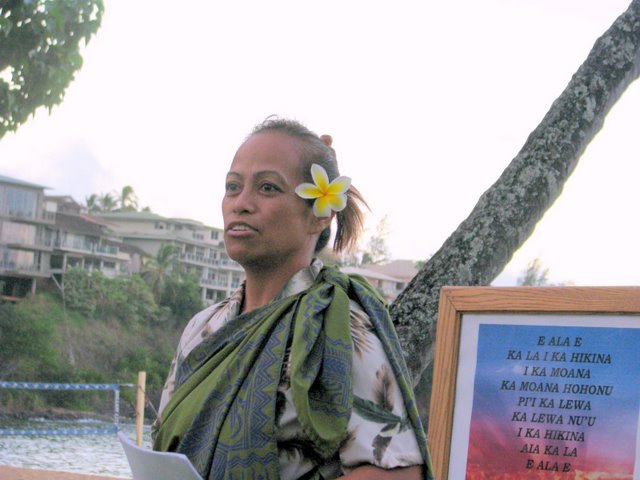
And surely the weather and geography contribute to the Aloha spirit. How can you feel sad or angry or bitter when your skin is being softly touched by a warm breeze (the difference between winter and summer is about 4 degrees), and you are surrounded by beautiful flowers. A lei costs $8 and a $70 bouquet here costs $10 there. A native Hawaiian woman who grew up on Niihau (the island where native culture is preserved) taught us the chant to help the sun rise, and that we should pick any flowers that we see, and put them in our hair to make ourselves beautiful. Pluck them alive, she said, and leave flowers that have fallen on the ground. Her audience, tourists at the Kauai Marriott, protested that would be considered stealing on the mainland. Blossoms belong to everyone, she insisted.

It’s beyond gender. One of the men checking us in at the airport sported a flower in his uniform lapel.

Yet I kept thinking about this unusual E-mail from Dow Jones. It was all over the newspapers that tourism, the state’s major industry, was down by more than 17 percent in August, and our Honolulu hotel, which was about to go into Chapter 11 bankruptcy, voluntarily dropped its price by $20 a night.

The Hawaiian Convention & Visitor’s Bureau spends $20 million on marketing, according to a PR rep, often adding $1 million for an off-season campaign. (An intriguing comparison to Princeton’s CVB, http://www.visitprinceton.org, but that’s for another time.) Generally that can be leveraged, with partnerships from airlines and tour agencies, to about $3 million. This year, with everyone so worried about fuel prices and the looming recession, the HVCB was able to bump the $1 million up to about $12 million. I guess that helped pay for the E-mail that directs me to the “two for one” offers. But side by side with the “deals” are the videos on hula dancing and swimming with manta rays. That’s deliberate, because discounts alone won’t get anybody on a plane for 12 hours. “People want to go to someplace that they want to go to” says the PR rep, Jay Talwar, “and they want to get a deal while they are there.”

The campaign targets eight markets, and New York is the only one on the East Coast. I guess everybody further south will just go to Florida or the Caribbean and be done with it. But I bet you won’t find much “Aloha Spirit” in Florida.

http://picasaweb.google.com/bfiggefox/HawaiiTheAlohaSpirit#