Deals versus the Aloha Spirit


Still groggy from 12 hours in the air, after two weeks in Hawaii, I wade through my E-mail to find a message from a news organization, Dow Jones Interactive, with the pitch that I will get the most “Return on Vacation” (which I suppose refers to the Return on Investment of accountants’ balance sheets) with a trip to Hawaii.

Hawaii, proclaims this advertorial, offers the “all-too-rare opportunity to truly relax; to replenish your spirit, reunite with family and friends, renew your sense of adventure, and explore the natural wonders of our planet.”

I couldn’t have said it better myself, even if I’d been paid the big bucks to write it. “Hawai`i’s six major islands,” it goes on, “are green-capped mountains lifted from the bottom of the sea, decorated with rainbows, surrounded by blissfully clear waters, and rimmed by sun-swept, sugary sand beaches.”

Good stuff. I was going to try to write about our trip, but now I’m a mite intimidated. Maybe I should just stop there and link to http://www.gohawaii.com/deals

Naah. I’ll take a chance that I can say something that doesn’t gush but that is sufficiently interesting to divert attention from the worrisome national scene.

In so many ways our patch of earth is like Hawaii, and so many ways different. Mainlanders may snicker about the “Spirit of Aloha,” but it is not a joke. In places where westerners have not prevailed, we found the people to be really much nicer. Nice may not be quite the right word, but add friendly and helpful, and it’ll do. It’s similar to the friendliness vibes you get when you leave the notoriously unfriendly northeast to travel south or to the Midwest, but there is also a “spirit” part to it, a resonance with the earth and sky, and sometimes this is underlined by organized religion. Those natives who turned over their souls to the Christian missionaries loved their new deity with a devotion derived from total dependence on the land. Some are now Buddhists, some Shinto, but they do seem to possess a certain warmth of spirit.

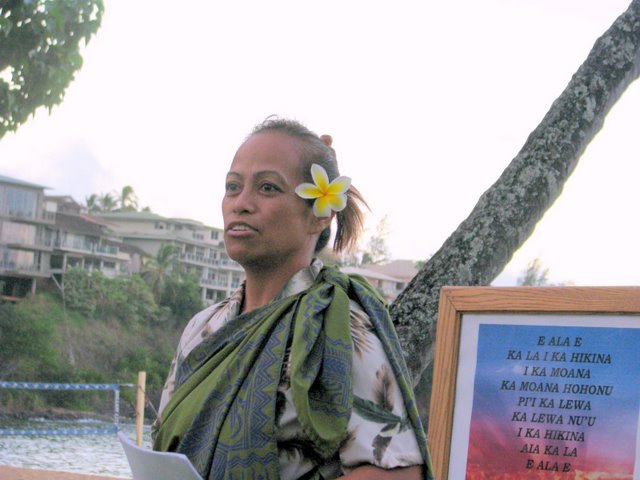
And surely the weather and geography contribute to the Aloha spirit. How can you feel sad or angry or bitter when your skin is being softly touched by a warm breeze (the difference between winter and summer is about 4 degrees), and you are surrounded by beautiful flowers. A lei costs $8 and a $70 bouquet here costs $10 there. A native Hawaiian woman who grew up on Niihau (the island where native culture is preserved) taught us the chant to help the sun rise, and that we should pick any flowers that we see, and put them in our hair to make ourselves beautiful. Pluck them alive, she said, and leave flowers that have fallen on the ground. Her audience, tourists at the Kauai Marriott, protested that would be considered stealing on the mainland. Blossoms belong to everyone, she insisted.

It’s beyond gender. One of the men checking us in at the airport sported a flower in his uniform lapel.

Yet I kept thinking about this unusual E-mail from Dow Jones. It was all over the newspapers that tourism, the state’s major industry, was down by more than 17 percent in August, and our Honolulu hotel, which was about to go into Chapter 11 bankruptcy, voluntarily dropped its price by $20 a night.

The Hawaiian Convention & Visitor’s Bureau spends $20 million on marketing, according to a PR rep, often adding $1 million for an off-season campaign. (An intriguing comparison to Princeton’s CVB, http://www.visitprinceton.org, but that’s for another time.) Generally that can be leveraged, with partnerships from airlines and tour agencies, to about $3 million. This year, with everyone so worried about fuel prices and the looming recession, the HVCB was able to bump the $1 million up to about $12 million. I guess that helped pay for the E-mail that directs me to the “two for one” offers. But side by side with the “deals” are the videos on hula dancing and swimming with manta rays. That’s deliberate, because discounts alone won’t get anybody on a plane for 12 hours. “People want to go to someplace that they want to go to” says the PR rep, Jay Talwar, “and they want to get a deal while they are there.”

The campaign targets eight markets, and New York is the only one on the East Coast. I guess everybody further south will just go to Florida or the Caribbean and be done with it. But I bet you won’t find much “Aloha Spirit” in Florida.

http://picasaweb.google.com/bfiggefox/HawaiiTheAlohaSpirit#

e-health package in NYT

Anyone involved in an e-health business — and in Princeton, that includes Viocare Technologies (www.viocare.com), Zweena (www.zweenahealth.com), HealthAtoZ.com (www.healthatoz.com), e-Healthcare Solutions (www.e-healthcaresolutions.com), Intellisphere (www.mdnetguide.com), and Princeton Living Well (www.princetonlivingwell.com) — will glom on to today’s science section of the New York Times.

The Times’ array of savvy reporters — Gina Kolata, John Schwartz, Tara Parker-Pope, Jane Brody, Gardiner Harris, William J. Brod, Roni Caryn Rubin, plus some doctor contributors — have contributed to a quite wonderful seven-page no-ad section, complete with useful sidebars. Having it all assembled in the paper version may be superior to reading the online version in some ways, so I’m blogging this while it’s on the newstand. But if you missed it, the articles in the online version, an example below, provide useful hot links.

I’ll save my explanation for my intense interest in e-health matters for another post.

http://www.nytimes.com/2008/09/30/health/30online.html?oref=login

BD Wong’s “Herringbone”

I saw “Herringbone” at McCarter on opening night, and it was one of those times when you’re glad you went before you read the reviews. Yes, part of it was very dark and horrifying, and in movies I’m such a wuss that I leave the theater for the scary parts, but with live theater I was indeed ready to suspend disbelief. If I had read the reviews, I might not have gone.

And as I reread LucyAnn Dunlap’s interview with Wong (U.S. 1, September 10) I realize that I never saw “M Butterfly,” the David Henry Hwang play and film in which Wong played a female Peking Opera singer.

My first encounter with men playing women on an Oriental stage was in the late 1970s, when the Grand Kabuki troupe played the Beacon Theater in New York. I was freelancing and living Philadelphia, and I managed to snag an interview with an eminent actor. I was starstruck.

I went back and brought two of my young children — they couldn’t have been older than six and nine — to a matinee. They were mesmerized.

I was amazed at how, even within the rigid form of Kabuki, the actor could embody the spirit of an elderly woman with pathos and humor at the same time. It’s this emotion-filled sleight of hand that drew me in, past the dark parts, to “Herringbone.” I can’t get back to McCarter (though the play continues through Oct 12) but maybe I can rent the movie.

BD Wong Makes His Entrance — 11 Times (U.S. !, September 10)

U.S. 1 ran the Simon Saltzman review on September 17.

Family Values


My father, Frank H. J. Figge, was a cancer research scientist, and he used to tell me that “Nothing is ever completely true or completely false.” A useful mantra for a reporter. When he died, I was a 34-year-old stay-at-home mom with three children and an intense desire to tap his creative legacy. I learned by doing, as a stringer for a daily paper, and then specialized in dance.

After 10 years of freelancing as a dance writer, I got my dream job, working for Rich Rein at U.S. 1 Newspaper, Princeton’s business and entertainment journal, then a monthly, now weekly (www.princetoninfo.com). Covering business or technology, I discovered, was like covering dance. You present a personality, and you translate the technical terms into words that a layperson can understand. Whether writing about a choreographer, an entrepreneur, or a scientist — they are all “people” stories.

Two decades later I’m freelancing for U.S. 1, on a less stringent schedule. Freed from editing responsiblities, I am “out and about,” meeting business people and attending concerts. Virtually every day, someone I meet or something in the news reminds me of a person I’ve interviewed or an article I wrote, two or 20 years ago. I resisted blogging (what? put stuff up on the web that no one else has edited? do wordsmithing for free? make my reporter’s life public?) Why not just keep a journal?

Because journaling is private, and I’ve been putting words out for public consumption for so many years that it feels right to keep doing it. Perhaps my perspective will be useful — and provoke you to add yours. The comments page is open, and you don’t have to “join” or “sign up” though any identification you might provide would be most welcome. What did your father or mother tell you that affects how you do your work today?