Epigenesis: when something goes wrong

glatt book

Epigenesis is all over the news. On Monday I heard about it on NPR’s Morning Edition. that scientists are excited about epigenesis with a small letter e. It describes a way to turn off a gene that might trigger a disease. Susan Kay Murphy, of Duke University, is studying how a mother’s environmental exposures and nutrition during pregnancy may be causing epigenetic changes in babies.

If you were around Princeton 10 years ago, the word “Epigenesis,” with a big letter describing the company, will trigger different memories. It was a the name of a company founded by Jonathan Nyce to cure asthma.

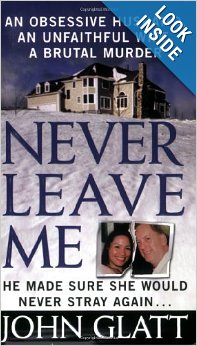
And then you may remember Jonathan Nyce. Despite the best efforts of arguably the best criminal attorney in town, Robin Lord, he was convicted of murdering his Filipino wife who was having an affair. Judge Bill Matheisus sentenced him to”passion provocation murder,” eight years, eligible for parole in five. I covered the trial. The New York Times wrote about it. A tabloid writer published a book about it (shown above).

Meanwhile Epigenesis, the company, attracted the venture capital support of Jan Leschly of Care Capital. The company downsized to half its space and 10 employees, let go of its core technology and started working on a drug that could be brought to market faster. I lost track of the company. The firm is no longer in Care Capital’s portfolio and the website (www.epigene) is defunct.

In 2010, after five years, Nyce came out of prison and proceeded to publish his own book about the trial, to explain his claim to innocence. A person is innocent until proven guilty, and one doesn’t criticize a book unless one has read it. But let’s just say the reviews aren’t good.

The word epigenesis comes from the Greek epi (over, above, outer) and genetics. Epigenetics can be described as the study of changes in gene expression or cellular phenotype, caused by mechanisms other than changes in the underlying DNA sequence. Growth disrupted, derailed.

That also describes Jonathan Nyce. Talent gone wrong.

Dancing the Gamut

RoS Chosen One Small

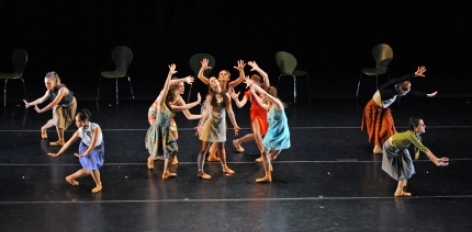
This post is to recommend seeing American Repertory Ballet at Rider’s Bart Luedeke theater on Saturday, September 21st (tonight, as you receive this). Tickets are $20 ($10 for seniors). We went on Friday. The company is in great shape and the program runs the gamut of emotions from romantic love to joyful camaraderie to tender affection, to despicable, ugly hate. Rarely do ballet dancers get to ‘do nasty’ as here.

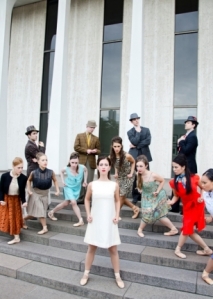
The piece was, you might guess, Stravinsky’s Rite of Spring, choreographed by company director Douglas Martin, who has danced quite a few Rites in his time. In the original Nijinsky version, recreated when Martin was with the Joffrey Ballet, staccato thrusts and poundings build up to the sexual sacrifice of a virgin. Martin’s serious satire was equally full of lust for sex and lust for power, but it was set in an office. Half the women were typists, half were “personal secretaries” verging on geishas, all undulating and preening. Cast as ‘ad men,’ the males mimed every macho cliche, including riding a horse, all pumped up and competing for power. I was tempted to giggle but I graduated from college in 1961 when women were expected to be secretaries not salesmen and it aggravated rather than amused. At the end of that section, in comes the boss from hell, Joshua Kurtzberg. The males kowtow and the female objects are flung around and tossed down.

angst_Credit-George_Jones_0

The Stravinsky score, you may remember, is pound/pound/pound/pound loud/loud/loud/loud, all sharp edges and staccato. Seated typists percuss with their toe shoes. Men jump with two feet. It’s similar to the angst in Nijinsky’s tribal version but — wait — now it’s not them, it’s US. WE are the ones in the competitive workplace, elbowing our way to the top or wishing we had the nerve to do that. We are the ones who say “It’s not enough to succeed, your cohorts have to fail.”

One ad man, Stephen Campanella, gets tossed to the side, and the staccato jubilation of deals made goes on. During the lengthy pianissimo, the choreographer takes up time and adds comic relief having the maintenance guy, Jacopo Jannelli, rearrange the chairs. Then it’s a restart of angst, this time with the “Chosen One,” Shaye Firer, on stage.
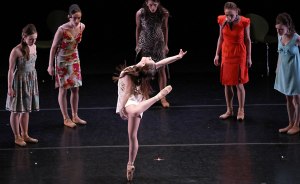
rite chosenone_Credit-Leighton_Chen

In the original, she would be a virgin headed for sacrifice. Here she is a rebellious woman turning against type to snatch male power, represented by a man’s jacket. Decide for yourself what the end means. Here are video excerpts.

It was strange to watch Samantha Gullace lead the nasty crew of vamping women, when just 20 minutes ago she had played a luminous Juliet to Edward Urwin’s tender Romeo. Only the pas de deux is on this mixed bill, and I look forward to the full length version on October 11 in New Brunswick, with orchestra.

In between the “hate” and the “love” was a bravura piece of baroque fluff, choreographed to Vivaldi by Martin’s wife and former dance partner, Mary Barton, titled “Five Men and a Concerto.” She challenged them with some very fast classical footwork. Campanella, Cameron Auble-Branigan, Alexander Dutko, Joshua Kurtzberg, and Marc St.Pierre met the challenge with brio. Barton tapped Campanella’s Gene Kelly-like ability to look like an average Joe while doing hard things with his feet, Dutko’s exceptional talent for legato phrasing and St. Pierre’s penchant for teasing humor. A delight.

After the opener, Patrick Corbin’s “Caress,” I found out at intermission why it seemed so “all of a piece.” Set to Schubertian piano music by Kate Jewel, it uses three basic movements from a postmodern technique called Contact Improvisation, in which body contact is the cue for making up movement as you go along.

Without knowing that, this is a charming work, because one senses the spirit of Contact Improv — dancers pay close attention to each other instead of looking in the mirror or playing to the audience. Monica Giragosian and Urwin led Transformation Song, Samantha Gullace did the sharp-edged Storm; Alice Cao and Auble-Branigan were in Meditation, and Karen Leslie Moscato and Mattia Pallozzi ignited each other in Fire. Kurtzberg sinuously caressed the air in Amabile and had an interesting duo with Gullace with their four arms as one bird’s wings. Most memorable was the pair of same-sex duos, Dance with Me. Campanella and Dutko danced downstage left, Firer and Claire van Bever downstage right. first one couple moved, then the other. It answered the question, what does a love duet look like when there are two of each kind. The men were tender but not feminine. The women were female but strong. The piece ended with everyone on stage, in silence, with a last caress.

Please note: This is the new theatre at Rider, NOT the Yvonne Theatre. Above: photos of The Chosen One, in white, staged (credit Kyle Froman), and in performance, middle photo: George Jones. Third photo: Leighton Chen.
The Pluses of Google Plus: @LynetteRadio

lynette
Lynette Young screens her home page, Purple Stripe Productions.

 Just after graduating from high school, Lynette Young ran a project with 40 network engineers, all many years her senior. “I’m a geek by heart, a marketer by necessity,” admitted Young. She demonstrated both at the September 19 joint meeting of the IEEE and NJ CAMA when she taught about about Google Plus. After 2 1/2 years, she said, it is tipping into the mainstream, is bigger than Twitter, and is the second business social networking site.

Facebook is good to connect with people you already know, but  Google Plus takes you to the rest, she said. Then she gave chapter and verse on how to do it. Own your page,” admonished Young. If you are a bricks and mortar business, capitalize on Google’s attention to “local.” For instance, if  you have a restaurant  be aware that Google now owns Zagat, so your reviews are live on Google Plus

The “hangout” and the “HOA” are new and exciting tools. You gather up to 10 friends or clients, tape your conversation live (hangout) then post it on YouTube (hangouts on air). That’s convenient because Google owns YouTube. It sounds like a marketing bonanza.

If you have a restaurant, Google now owns Zagat, so your reviews are live on Google Plus. “Own your page,” admonished Young. Bricks and mortar businesses should capitalize on Google’s attention to “local.”

I must admit I am still slightly paranoid about Google knowing everything about me. Somehow I had a “slip and fall,” and I fell onto the Google Plus platform. Now I’m in a lot of “circles” though I don’t have any “circles” of my own.  I’ll look into this. If you get notified that you are in one of my circles, you might start receiving Princeton Comment in a different way. (As always, you may unsubscribe and I won’t hold it against you 🙂

A second chance to hear Young is at the PC Users Group at the Lawrence Library on Tuesday, September 24, at 7 p.m.  She will tell more about how to put together hangouts and HOAs. “Set up the webcam, invite nine people, record it, port it, done.”

But the real problem with talking heads  is — are they interesting? Present company excluded,  I think talkers are more likely to be boring than writers.

Wishing It Were August Again?

October-2nd-Save-the-Date-Website-644x1024

Wednesday morning I’m looking forward to hearing from James Steward, the Gee-Whiz-How-Does-He-Do-It director of the Princeton University Art Museum. In his short tenure he has partnered with all kinds of organizations to bring new audiences to one of the best kept secrets on campus. He’s at the Princeton Chamber breakfast ($25 for members at the door).

Thursday I’m going to learn how to wrestle with Google Plus, when NJ CAMA (stands for advertising and marketing etc.) hosts Lynette Young on the university campus. If you have added me to your Google Plus circle, I have not added you. I don’t embrace what I can’t understand.

Friday it’s off to Rider University to see the opening concert of American Repertory Ballet and its gorgeous young dancers (it repeats Saturday). Also on Friday, Philadanco comes to TCNJ. And the next day, Saturday, September 21, dancers dance for world peace at the Princeton YWCA.

What drives all this activity? Volunteers, of course. Volunteers in general, and some specifically, will be honored in a gala, staged by Volunteer Connect, on Wednesday, October 2, at Grounds for Sculpture, as you see at the top of the post. Volunteer Connect helps non-profits get skilled help, and helps professionals develop their skills.

Somewhere in between I’m talking to Folks That Know about technical innovations in Mercer County. I’m writing a preview for the October 4 “Mercer Makes” seminar. That’s only three Fridays away — perhaps pencil it in.

Septembers are always busy, but does this one seem more so?

Faith and Ethics in the Executive Suite: Mark Hutchinson

Mark Hutchinson, president and CEO of GE China, opens the public seminar series at Princeton University’s Center for the Study of Religion on Thursday, September 19, noon to 1 p.m. David W. Miller, director of the Princeton University Faith and Work Initiative, will moderate. Location has yet to be announced.
 
This is actually the second seminar for the CSR but the first is open only to the university community, perhaps because it is a controversial topic, or because it will attract so many eager listeners. The topic? You might guess that it has sex in the title and you would be correct.  Frank Schaeffer is to talk about The Politics of Religion and Sexuality. I saw him speak several years ago at CSR. He is the son of evangelical theologians Francis and Edith Schaeffer, founders of L’Abri, but does not necessarily toe his parents party line.
 
The next topic is perplexing as well: Good and Evil. Yale University’s Paul Bloom will discuss Just Babies: The Origin of Good and Evil on Thursday, September 26, 4:30 to 6 p.m., in Friend Center, Bowl 006 (that’s on Olden Avenue, part of the EQuad.) It is co-sponsored with the Center for Theological Inquiry. Bloom’s most recent book deals with How Pleasure Works. As here:

Here, he will talk about whether babies are born selfish.

From John Locke to Sigmund Freud, philosophers and psychologists have long believed that we begin life as blank moral slates. Many of us take for granted that babies are born selfish and that it is the role of society—and especially parents—to transform them from little sociopaths into civilized beings. Paul Bloom argues that humans are in fact hardwired with a sense of morality. Drawing on groundbreaking research at Yale, Bloom demonstrates that, even before they can speak or walk, babies judge the goodness and badness of others’ actions; feel empathy and compassion; act to soothe those in distress; and have a rudimentary sense of justice.

Mr. Bloom, I am glad you proved this with your research, but any parent knew that all along.

It’s Button Show Time!

enamel fop

Today, if you read this on Saturday, is the New Jersey State Button Show and Competition, where you will see some very gorgeous enamel buttons, like the 19th century French fop on the left. One of the competitions is for enamels.

Uniform buttons will be prominent too — there’s a talk on them at 1:30 p.m. Admission $2.

The show runs 9 to 4 p.m. on Saturday, September 7, at the Union Fire Company fire hall, 1396 River Road (Route 29), Titusville, NJ 08560. buttonlady@optonline.net or http://newjerseystatebuttonsociety.org

You don’t have to buy any of the pretty buttons, but you will be tempted to!

Ears See It in a New Way: William Klenz

In 1959, Dr. William Klenz required his undergraduate music history students at Duke University to unlock the secrets of baroque music by studying original texts for what led up to it — social dances of the Renaissance, as taught by dance master Thoinot Arbeau  in his Orchesographie.

Tapping dance sources is now a small but recognized niche (NYT, 9-4-13).

I believe Klenz — who never wore a watch because he didn’t want to be the slave of time, and insisted that all of his students sing “A” upon arising in the morning so that they would be in tune with the world — was an unrecognized genius.


Yellow journalism for a “Yankee Drummer?”

19th century journalists could be as nasty as today’s radio talk show hosts.

I was curious to learn more about a lovely room at my church (Princeton United Methodist). We are renovating the ground floor of our century-old building, and the Sanford Davis room — which opens onto Nassau Street and onto the sanctuary — is getting lots of use.

I found a fascinating and laudatory account of Charles H. Sanford in a book on PUMC’s history by the late Ruth Woodward. And because a tribute book to Sanford was auctioned last June, additional material has surfaced. A unsigned New Zealand newspaper article castigated his business practices in Brazil and excoriated him as a “Yankee drummer” (salesperson) “for the sale of pills and toilet preprations.” Here is my post with links to the New Zealand article. Fair and balanced? You decide.

Connie Campbell, Pillar of Witherspoon Community

Len Newton called to tell me about the funeral for Connie Campbell, an active member of Witherspoon Presbyterian Church who died at age 84 on August 23. She typified the leaders of the black community, says Newton, lauding her career. He cites her obituary in Town Topics. She was a buyer at Claytons, a department store on Palmer Square, at a time when it was difficult for African Americans to get anything but a government job. 

Newton, who is white, has long been a champion of interacial communities. He was among those who founded the group of homes on Dempsey Avenue, built to be an interracial and affordable community, and he joined Witherspoon Presbyterian Church which, in 1952, was mostly black. “When I came from Philadelphia to work at Opinion Research, I went at least once to every church in town. The choir director at Witherspoon recruited me because they needed a tenor.”

Fewer and fewer people remember how it was in Princeton in the ’50s, Newton says. In the late 1930s, AFrican Americans were pushed out of what is now Palmer Square to make room for the town center. Schools were segregated until 1948.

“The African-American community was invisible to the white community at that time. But people knew each other. If went to a party on the West Side, I would find Connie and her husband, Floyd, serving the food.”

Newton celebrates all she did, including being an ordained deacon and elder of Witherspoon Street Presbyterian Church; member of the original Verse Speaking Choir; board member at Princeton Nursery School, Princeton Arts Council, and Princeton Senior Resource Center, and serving as a volunteer at Princeton Hospital.

The funeral service will be held at 2 p.m. on Saturday, August 31, 2013 at Witherspoon Street Presbyterian Church, 124 Witherspoon Street, Princeton. Calling hours will be from 1 p.m. until time of service at the church. Interment will be held at the Princeton Cemetery.

Calling hours will be from 6-8 p.m., Friday, August 30, 2013, at Witherspoon Street Presbyterian Church. Organizational service will be conducted at 7:30 p.m. at the church.