This job of keeping our children safe, and teaching them well, is something we can only do together, with the help of friends and neighbors, the help of a community, and the help of a nation. And in that way, we come to realize that we bear a responsibility for every child because we’re counting on everybody else to help look after ours; that we’re all parents; that they’re all our children.
This is our first task — caring for our children. It’s our first job.
You will recognize these words, spoken by President Obama, comforting the nation after the Newtown massacre. I came across them this morning, on the website of Obit magazine, one of Bob Hillier’s several publications.
Reread the speech here.
Being a parent, he said, is “like having your heart outside of your body all the time, walking around.” He praised the teachers who gave their lives, the teachers who saved lives with encouragement “wait for the good guys, they’re coming”; “show me your smile,“ the first responders, the courage of the children.
Where am I in this endeavor, where are you? What are you doing, what are we doing, to keep children safe and teach them well? How are we helping create a world where our children can grow up to be “self-reliant and capable and resilient, ready to face the world without fear?”
We each must come up with our own answer, our first resolution for 2013. I’m still pondering mine, trying to discern God’s plan. And you?
Helping Hands 2012: Crawford House and TASK

Every Christmas, U.S. 1 Newspaper devotes the issue to good deeds done in the community. This year, the Helping Hands issue highlighted the proprietors of Smith’sAce Hardware and Shop Rite who reach out to Crawford House, a halfway home for recovering women, to offer employment. These businesses, along with ten others, were recently honored for offering employment to the women. They include Bon Appetit, McCaffrey’s Markets, Jordan’s Stationery and Gifts, Chez Alice, Chartwell’s Dining Services, the Red Oak Diner, Nelson’s Corner Pizza, and Wendy’s.Read the U.S. 1 story here.
You may not realize that any corporate donation to a Princeton-area charity can be featured in the columns of U.S. 1 Newspaper under the heading of Corporate Angels. If you run a charity – or if your company has made a donation – send that item to info@princetoninfo.com.
For instance, Wegman’s has made a very generous donation to a fundraiser for the Trenton Area Soup Kitchen. Set for January 26 in Levittown, Pa, and put together by Tehmina Jovindah, this is a $50 plate dinner, complete with live music by David Brahinsky and others, and all of the ticket price will go to TASK. The corporate donors for this event, including Wegman’s and the Ramada in Levittown, will see their names in U.S. 1 Newspapers Corporate Angels column.

For instance, Wegman’s has made a very generous donation to a fundraiser for the Trenton Area Soup Kitchen. Set for January 26 in Levittown, Pa, and put together by Tehmina Jovindah, this is a $50 plate dinner, complete with live music by David Brahinsky and others, and all of the ticket price will go to TASK. The corporate donors for this event, including Wegman’s and the Ramada in Levittown, will see their names in U.S. 1 Newspapers Corporate Angels column.
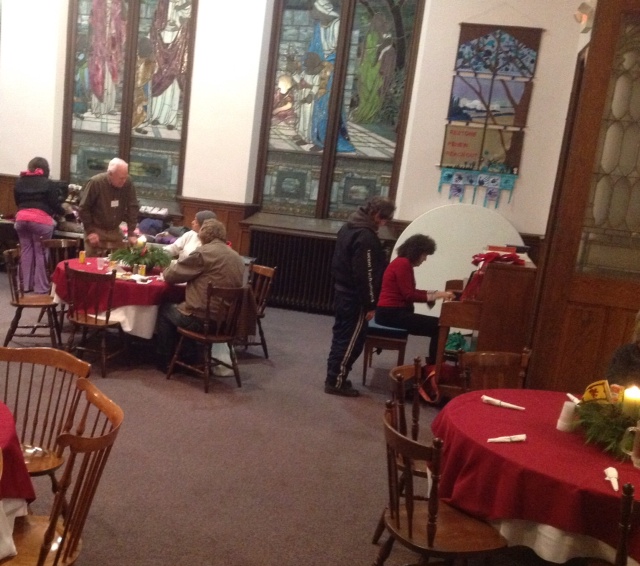
Everyone knows TASK feeds the hungry in Trenton, but there are people in need of food in Princeton as well. To help meet this need, the Cornerstone Community Kitchen at Princeton United Methodist Church opens its doors from 5 to 6:30 p.m. every Wednesday. Some come for the food, some for the fellowship, all are graciously served a hot meal complete with a decorated table and a piano player in the background.
“All who come to our Cornerstone Community Kitchen will be guaranteed a warm greeting, someone to talk with if they like, and a satisfying meal,” says Jana Purkis-Brash, pastor at PUMC. The church, located at Nassau and Vandeventer, prepares the meal in partnership with the Trenton Area Soup Kitchen. The meal includes a hot entrée, fresh vegetables, dessert, and a breakfast bag for the children.
It doesn’t stop over the holidays. Cornerstone Community Kitchen will operate on December 26 and January 2. Readers of this blog are most welcome to attend. Says Purkis-Brash: “Please join us in fostering community in our wonderful town.”
Gatherings to Remember and Hope
 Interfaith Gathering for Remembrance, Unity, and Hope
In response to the Newtown, CT shooting, the Princeton Clergy Association along with Princeton University’s Office of Religious Life, Fellowship In Prayer, Palmer Square and the Nassau Inn is sponsoring an Interfaith Gathering for Remembrance, Unity, and Hope from 5:30-6:15 PM on Thursday, December 20 on the Green in front of the Nassau Inn at the rear of Palmer Square in Princeton. Leaders from different faith traditions will share their reflections. Please bring a candle.
Winter Solstice: Longest Night Service 
In the wake of the Newtown tragedy, Princeton United Methodist Church will hold its annual Longest Night Service on Friday, December 21, at 7:30 p.m. This elegantly designed service of worship and remembrance was planned for those who find themselves in the shadows of painful holiday memories at the time of the Winter Solstice.
Catherine Williams, assistant pastor, says that this year’s service will be particularly meaningful for those struggling with the nation’s loss of so many children. “The prayers and candle-lighting will give those present at the service an opportunity to join those who mourn in solidarity and in faith with the people of Newtown,” she says. “We believe that God is with us, even on the darkest of nights.”
PUMC is a diverse congregation whose members come from many surrounding communities, backgrounds and faiths. For parking information go to www.princetonumc.org or call 609-924-2613.
Look for the Helpers
In a couple of hours, Sunday School will begin, and I am wondering what these children will say about the tragedy in Connecticut. And what we teachers and parents can say. I turn to the Mister Rogers website for the answer. “Thy rod and thy staff, they comfort me….”
“When I was a boy and I would see scary things in the news, my mother would say to me, “Look for the helpers. You will always find people who are helping.” To this day, especially in times of “disaster,” I remember my mother’s words and I am always comforted by realizing that there are still so many helpers – so many caring people in this world.“

| Helpful Hints | |
|
|
Princeton’s Polyakov: Finalist for Milner Money
 Alexander Polyakov, left, a 67-year old physicist at Princeton University, is in the running for the $3 million Fundamental Physics Prize, donated by Russian entrepreneur Yuri Milner. Polyakov, who works with quantum field theory and string theory, used to live in Moscow and work at the Landau Institute. He is now the Joseph Henry Professor of Physics.
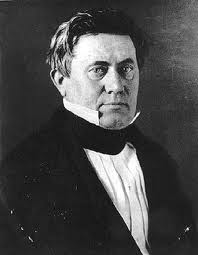 (You remember Joseph Henry. His yellow house sits on the front lawn of the university, and he contributed to the invention of the telegraph, the telephone, and the electric motor. He was also the first director of the Smithsonian Institution.)
 |
| Yuri Milner (photo from Crunch base) |
Milner, 51, who by the way is a Wharton school graduate, made his $1 billion on such internet investments as Groupon and Facebook. Just announced: his investment in 23andme, the consumer genetics startup that Esther Dyson talked about three years ago at a chamber lunch,. Milner calls himself a failed physicist, according to today’s New York Times article, and this is the second year he has given out lots of prizes.
The winners will be announced on March 20, and since the previous winners select the next winners — if you are a physicist, it wouldn’t hurt to be extra nice to Professor Polyakov. Milner’s prize is more than double the Nobel Prize, and you don’t have to travel to Stockholm.
January 26: Locked Up, Locked Out, Locked Away
“Locked Up, Locked Out, Locked Away” will be the theme for the NJ Council of Churches annual Issues & Action event, set for Saturday, January 26, at Shiloh BaptistChurch in Trenton, NJfrom 8:30 a.m. – 1:00 p.m. For a more detailed press release, click here.
 To address incarceration in New Jersey and the United States, the speakers will include Professor Mark Taylor of Princeton Theological Seminary, author of The Executed God; Professor George Hunsinger, also of Princeton Theological Seminary and founder of the National Religious Campaign Against Torture; Ms. Bonnie Kerness, Esq., coordinator of American Friends Service Committee’s Healing and Transformative Justice Project; and The Reverend Samuel K. Atchison, president of Trenton Ecumenical Area Ministry, a leader in addressing the issue of re-entry of prisoners into society.
 The program will provide opportunities for participants to engage in dialogue and to discuss how they might be engaged in prison ministries. REGISTER: office@njcouncilofchurches.orgor
call 609-396-9546.
Architects: Think Ahead
 Architects are eminently practical. Most of them, anyway. Theirs is among the most useful of occupations. Writes Robert Geddes: “Architecture should embrace fitness — order and organization, growth and form. The ‘oath of architecture’ should be loud and clear: make it fit.”
Geddes, former dean of the Princeton University School of Architecture, has a new book Fit: an Architect’s Manifesto, published by Princeton University Press. In Rich Rein’s column in the current issue of U.S. 1 Newspaper, Rein lists some of Geddes’ eminent projects and also notes that he is a leader of Princeton Future, “the farsighted group that calls attention to planning issues that otherwise only come into view when they reach the planning board for a yes or no vote.”
Geddes will speak and sign his book at Labyrinth Books, 122 Nassau Street, on Monday, December 10, at 6 p.m. 609-497-1600. That’s the same night that the Princeton Township Planning Board will continue its hearings on the controversial AvalonBay development of the former medical center building.
Geddes wrote that buildings should be “our shared, functional, and expressive places.” I can guess what he thinks of the AvalonBay plan.
Also in the news is how another prominent architect, J. Robert Hillier, is recycling giant boulders to help shore up the New Jersey shore. While excavating for his age-restricted development on Bunn Drive, Bob Hillier’s contractors unearthed 400 tons of glacial rock. It is being put to great use to build jetties in Deal, Bay Head, and Mantoloking.
Finding the rock was a surprise. There isn’t a good way to predict whether you are digging into it. I discovered that when the well digger came to dig 300 feet down for my geothermal heating and cooling system.
But urban planning — town planning in a community of Princeton’s size — need not involve surprises. We need to take a leaf from the architects’ books and, not just “THINK” but “THINK AHEAD.”
Peter Brown: Fundraisers Learn from Ancient Rome
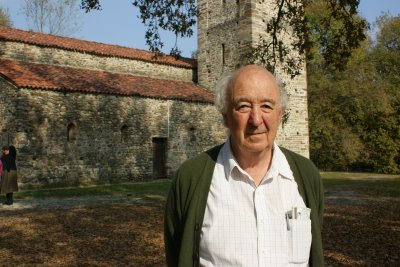
When it comes to fundraising, Christians in the 4th century may have something to teach the churches and charities of today. At least that’s one thing I got out of the conversation between Peter Brown and Elaine Pagels at Labyrinth Bookstore on Wednesday night. Brown and Pagels talked about his new very thick book Through the Eye of a Needle: Wealth, the Fall of Rome, and the Making of Christianity in the West, published by Princeton University Press. The room was packed with Brown’s many avid admirers, a group to which I now eagerly belong.
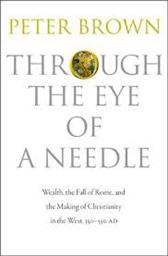 Brown is the acknowledged expert on late antiquity, the period from the 2nd to the 8th centuries, when the Christian church was on the rise and the aristocracy of Rome was in decline.
Telling of how the church acquired its wealth, Brown said that — in contrast to secular Rome’s rich upper class, which felt an obligation to give gifts for the public good — the big givers of the Christian church were not necessarily the wealthy. “To hold together such a socially differentiated group of givers was one of the great achievements of the Christian churches of the time.,” writes Brown. “It was based on creative synergy between new wealth and a low profile religious group that had already been schooled to engage in collective ventures.”
The “low profile religious group” was, of course, the Hebrew people, who had been indoctrinated for centuries on how they should take care of widows and the poor.
“The unspoken heroes are the average Joes,” said Brown. Their names weren’t on monuments, like the rich Romans. They were on tombstones and in graffiti. They had a willingness to give big.”
Apparently some things in the church never change. If you know anything about big money fundraising, you have heard of the 80-20 rule, that 80 percent of the funds raised will be donated by 20 percent of the people involved. That’s why, when you start to raise big money, you go to the likely big donors first, to get a head start.
Guess what — this has been true for 17 centuries, says Brown.
Thanks to Francisco Marshall’s blog for the terrific photograph of Peter Brown.
|
. P. 87.
“Members of the rich often came to the church so as to find there a social urban lung. They valued in the churches a certain lowering of the sense of hierarchy and a slowing down of the pace of competition.”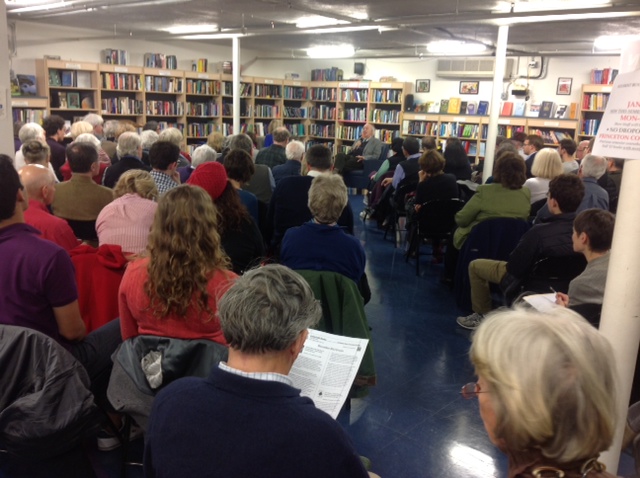 The sense that the glory of heaven stood behind their every gift enabled the Christian rich to contribute regularly and with that much less strain. By giving in the Christian churches they took part in a communal religious venture tinged with expectation of limitless rewards.
Peter Brown: The Church as “Social Urban Lung”
 |
| Peter Brown spoke at Labyrinth Bookstore |
Diversity is much prized by some Christian congregations, but in recent history it hasn’t always been this way. Churches have been historically the most segregated, divisive groups in America. But in Rome in the period of late antiquity, in the period from the 2nd to the 8th centuries, says Peter Brown, the church promoted the value of diversity.
In a conversation between Brown and Elaine Pagels at Labyrinth Bookstore on Wednesday night. Brown and Pagels discussed Brown’s new Through the Eye of a Needle: Wealth, the Fall of Rome, and the Making of Christianity in the West, published by Princeton University Press. Brown cautioned against “pauperizing” the poor, thinking of poor people as … simply … poor.
Quickly scanning his book, I found Brown’s observation that, in the Hebrew tradition, the poor were not merely beggars: They came to the rich and religious leaders to seek justice and protection. Brown writes (page 77) that the early Christian church viewed the poor, not as ‘the others” but as “our brothers.” (Ironically that is even more true today now that folks who thought they could live in comfort now find themselves in foreclosures. In Princeton there are hidden pockets of need in the most affluent-seeming homes.)
Brown writes (page 87) that wealthy people “valued in the churches a certain lowering of the sense of hierarchy and a slowing down of the pace of competition.” (Just two days before, this is what Roberto Schiraldi seemed to be calling for, when he led a Not in Our Town discussion on the values of “white privilege” at the Princeton Public Library.)
Continues Brown, “Members of the rich often came to the church so as to find there a social urban lung.” That term, social urban lung, describes a place like the Princeton Public Library, which harbored refugees from the power outtage, some poor, some wealthy, all equal as they needed warmth and plug-ins. It also describes the house of worship where people can drop their pretensions or inadequacies and “love their neighbor as themselves.’
It has resonance to see what I see happening in my own church, where at the very hour Peter Brown was speaking, the Cornerstone Community Kitchen was serving dinner to a wide variety of people — some who needed the food, some who just wanted to mingle, some who just wanted to “give back” by helping. The good part is, you don’t need to know — and it isn’t obvious — to which group a person belongs.
P.S. Come out some Wednesday for the free meal, served in partnership with the Trenton Area Soup Kitchen but definitely not in a soup kitchen atmosphere. You are served by volunteers at an elegantly dressed table (at right), and the meal includes fresh vegetables, salad, and dessert, and there’s even a piano player. It’s every Wednesday, 5 to 6:30, at the Methodist church at the corner of Nassau and Vandeventer, all welcome.
I love Brown’s term, “a social urban lung.”
Questioning the Values of the Establishment
Achieve Achieve Achieve? Maybe competing for good grades is not a good enough value, said New York Times columnist David Brooks, speaking to a Princeton University audience last week. He said he was disappointed that university students — whom he famously criticized a decade ago for being overly competitive — still place too much emphasis on achievement. “The language of achievement has overshadowed the language of virtue,” he said.
Many of the same views are held by Roberto Schiraldi, a counselor and therapist who formerly worked at Princeton University. He contrasts the values of elitism, power, wealth and control with the values of cooperation, sharing, support, and service. He questions what Princeton students and residents hold as core values and how these values relate to white privilege and race.
Schiraldi and Barbara Fox will facilitate a discussion at the monthly session, co-sponsored by Not in Our Town, of Continuing Conversations on Race and White Privilege, on Monday, December 3, at 7:30 p.m. at the Princeton Public Library. All are welcome.
 Princeton Comment