Monthly Archives: April 2009

White Privilege: ‘The Hidden Wound’


Sarah Halley made the distinction between safety and comfort. As the facilitator for the first of four Not in Our Town workshops on White Privilege at Princeton Public Library, she wanted everyone to feel safe but not necessarily comfortable. “If you start to feel uncomfortable, get a little curious,” she suggested. “Use it as a way into the work as opposed to the way out of the work.”

Full disclosure: I represent Princeton United Methodist Church on the steering committee for Not in Our Town (NIOT), a faith congregation-based social action group that works to combat racism and bias in Princeton. The workshops are NIOT’s response to the often-heard comment, voiced in inter-race discussion groups, “We really wish white people would teach white people about racism.”

The result: this series, “Engaging Together to Explore White Privilege.” White privilege has been defined as a right, advantage, or immunity granted to or enjoyed by whites beyond the common advantage of all others. It differs from racism in that the people benefiting from white privilege may not necessarily hold racist beliefs and can be unaware of the privilege.

About 60 people came to the first workshop, and the next Monday, 7:30 p.m. sessions are on April 20, 27, and May 11. Co-sponsored by the library, the sessions are free. For information, email niot.nj@gmail.com or me at bfiggefox@gmail.com

Halley explained the “Paradox of Diversity.”

All people, no matter what race, share the same values and hopes.
Some people are like each other in terms of race, gender, or group level identities.
Each person is also an individual, like no other person, in terms of DNA, life experience, and upbringing.

White people are more likely to be seen as individuals, Halley noted, then members of minority groups. “Why would you have part of you erased?,” she asked. “I don’t want my identity erased, but I don’t want to be seen as a group.”

Participants journaled for 7 minutes on what and where they had learned about race, and then shared some of their observations.

This is what Wendell Berry had to say on the subject, on page 62 of his 1989 slim volume, “The Hidden Wound,” available at the Princeton library.

“I am a good deal more grieved by what I am afraid will be the racism of the future than I am about that of the past. . . I have the strongest doubts about the usefulness of a guilty conscience as a motivation; a man, I think, can be much more dependably motivated by a sense of what would be desirable than by a sense of what has been deplorable.”

About a dozen people who could not come to the first session have made plans to attend the second session – everyone is welcome.

Looking at What They’re Having


It’s difficult to make a dance fraught with emotion, and it can be even more difficult to choreograph light entertainment and do it well. Most difficult of all is to keep it simple yet give it an original twist. That’s the message I took from “I’ll Have What She’s Having,” the Princeton YWCA-sponsored concert for women choreographers over 40, at Rider’s Yvonne Theater on Saturday, March 28.

Most of the work I’ve seen by Susan Tenney, for instance, is fraught with political or philosophical meaning, but in “Thank you, thank you so much (Suite Ella):” her dancers performed to Ella Fitzgerald’s moods (shown at left). It’s as if she said, “enough gloom and doom.” The format was nightclub, as the dancers played the showbiz aspect to the hilt, lip synching. But the “construction values”(a fillip of a movement that takes it out of cliché, a hand on face penche’ arabesque turn, a change of pace that contrasts with the music) punched it up to the level of concert dance.

It’s rare when a choreographer can get inside a dancer’s skin to reveal his or her internal style, and Tenney – helped by Doug Smith’s costume designs – gave her three dancers this gift. She tapped three themes – the brassy “I’ve got-it-and-I’m going-to-show-it-to you” confidence of Kathleen Smith, the sensual elegance of Rachel Grisi, and the hidden angst of Jeffrey Rubio. Rubio can sell a song with the best of them, but in his solo, he made his way across the stage apron to “You’ve Changed.” with an intense internal focus.

Tenney had paid tribute to her late mother in last year’s concert, and this year it was Joy Vrooman Sayen who offered “Danse Pour Ma Mare,” to a song from Chants d’Auvergne by Joseph Canteloube. Though I remember seeing her choreography in the ‘80s she has been mostly teaching, not performing, since then. I was glad to see her evocative elegy, sad for the death that inspired it. Rooted to the ground, wearing layers of clothing over loose pants, she made inward, ever larger circles with her arms, cradling, then releasing out and up in suspended joy. It was more of a thoughtful aubade than a stricken lament.

Marie Alonzo Snyder premiered the heartfelt “Songs of Nilad,” using projections of archival photographs and music by Cantor Joseph Cysner. Snyder and her excellent partner, Henri Velandia, commemorated the European Jews who found sanctuary in Manila before World War II. With its three different moods, it “reads” like a mini-novel and will be especially welcomed at school and community Holocaust observances.

Loretta Di Bianca Fois’s subtle treatment of a dark topic, domestic violence, was part dialogue, part movement. As her character dithered, against a rendition of “Ave Maria,” she talked to a bunch of roses, stroking then plucking their petals and throwing them down on the floor. You realize that the flowers are a metaphor for her relationship.

Alison Maxwell performed Ilana Suprun’s solo, shedding grey workclothes to reveal the eponymous “The Black Dress.

Each of the “just for fun” pieces had an element that distinguished it as a concert dance versus pure showbiz.

Maxwell’s “Too Smooth,” a ballroom duet with Leland Schwantes, evoked “Dancing with the Stars,” except that Schwantes, an Ailey-trained dancer who makes his living as a hand model, retains considerable élan.

In a writhing, smoky torch solo, “Visitor,” the lithe Shari Nyce (who danced with Princeton Ballet in its early days), surprised with her edgy choices, with sensual references more familiar in less selective venues.

Christine Colosimo, the YWCA dance director, invested “July,” a three-piece suite, with the premise of someone sitting at a café in various cities.

Fara Lindsey also presented a triptych, “Learning to Wait.” In “God I Hope I Get It,” nine dancers comically mimed a Filene’s style bargain counter, did an angst filled “Please,” and finished with a top-hat chorus line, “If You Could See Me Now.” That’s the annual joy of this concert – an opportunity for dancers (and former dancers) to strut their stuff.

Next year’s program needs dancer bios. If they are indeed paid, surely they aren’t paid enough to perform without credits. Their friends and family are, after all, ticket buyers.

PHRs: You Get What You Pay For

Concerns about the privacy — and accuracy — of electronic health records (EHRs) hit the fan when Lisa Wangsness of the Boston Globe picked up an e-patients.net blog posting on how a patient tried to transfer his records to Google Health to form his own personal health record (PHR).

From the Boston Globe, April 13, 2009

“WASHINGTON – When Dave deBronkart, a tech-savvy kidney cancer survivor, tried to transfer his medical records from Beth Israel Deaconess Medical Center to Google Health, a new free service that lets patients keep all their health records in one place and easily share them with new doctors, he was stunned at what he found.”

Patient deBronkart found gross inaccuracies in his records, attributable to many reasons. Some:

* information was extracted from diagnostic codes rather than the actual records
* diagnoses were sometimes undated, so a condition from five years ago appeared to be present today
* multiple personnel had access to the electronic record and could have made changes without attribution

My conclusions:

1. Capital Health’s new hospital will, I believe, depend on EHRs. The physician’s practice on Terhune Street is, after a year’s preparation, now paperless. Should we be leery of this new system?

2. Perhaps not, if we consistently ask for copies of our own records (PHRs). This may not be important for someone in good health, but for the chronically ill or the cancer survivor, it can be a matter of life or death to “catch” any inaccuracy.

3. Zweena Health, a Princeton-based firm (I am an unabashed fan and a beta tester but am not paid by Zweena), is a small company that appears to have solved this dilemma. It helps you maintain your online Personal Health Record, to which you and your doctors have access. Every time you visit a doctor, Zweena elicits the record and posts it online, so you can compare it with what you think the doctor told you, and so you can share it with other doctors.

Zweena appears to have solved the privacy and accuracy issues. Now it needs to solve its financing issues and get employers to enroll their employees. Unlike Google, it levies a charge. (What was that old saw, ‘you get what you pay for’?

4. EHRs are going to get a bad rap from this dust-up. Is it deserved? Will it help to throw money at the accuracy problem? I don’t know either answer.

5. Blogs can be powerful (the Boston Globe picked up this story from a well-established blog) but it takes a newspaper to bring an issue to national attention. All the online shrieks and murmurs about the hazards of EHRs and PHRs do not have the power of an investigative piece in print media.

Of course, I’m biased, but then that’s why I’m writing a blog.

Odetta: Don’t Look Away


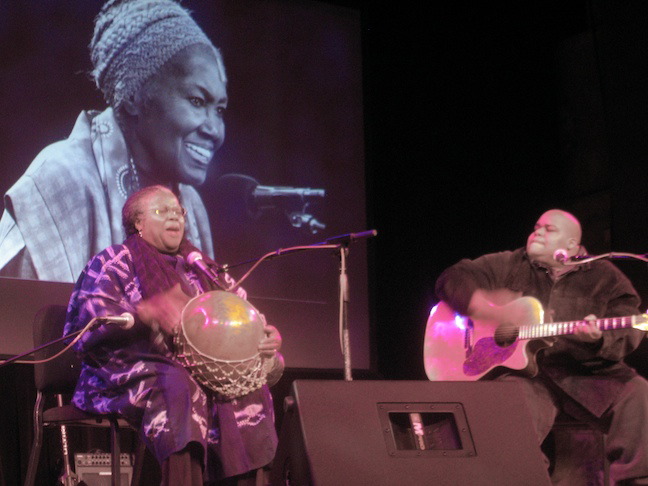
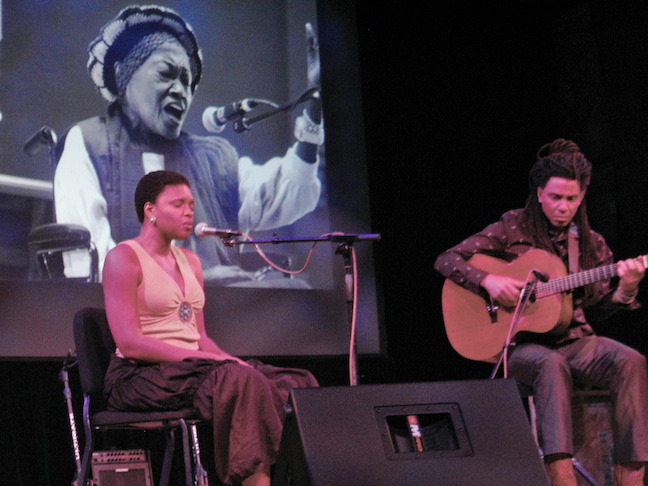
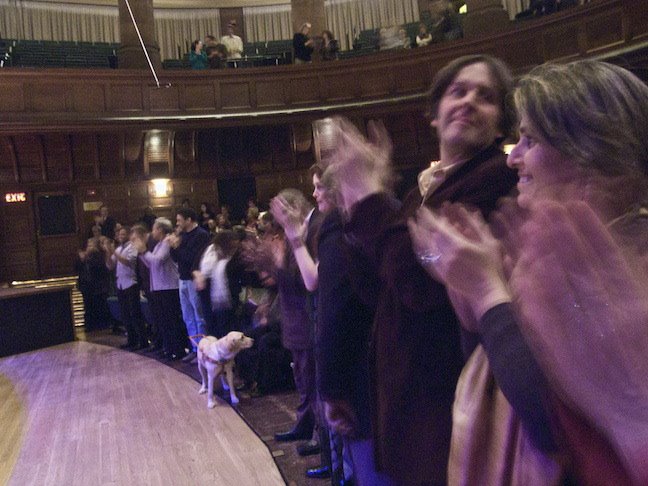
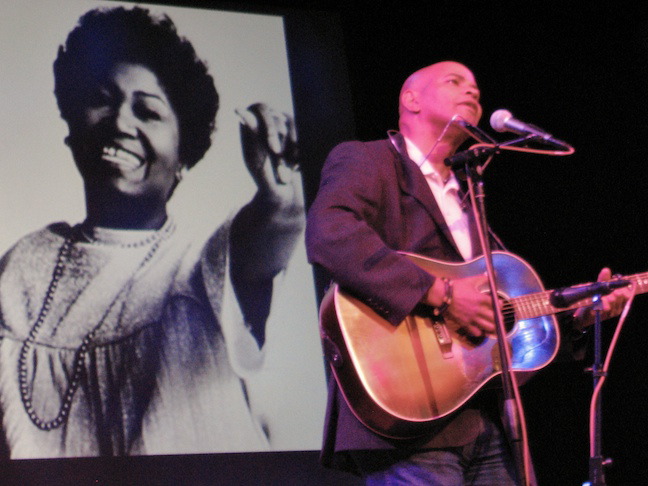
“She told us who we had been, and challenged us not to look away,” said Matthew Frye Jacobson of Odetta. Jacobson spoke at the wonderful tribute concert for “Odetta, the Queen of Folk,” at Princeton University on April 9. Jacobson, who is white, is a Yale professor working on a book, “Odetta’s Voice and Other Weapons: The Civil Rights Era as Cultural History.”

Thanks to Stephanie F. Black for these beautiful photos.

“White guilt is not what I’m talking about,” said Jacobson. “I’m talking about awareness.” With songs full of pain, telling about chapters of both white history and black history, Odetta “told us something important about who we might be.”

This rang true for me, as a group I belong to, Not in Our Town, prepares for a workshop entitled “Engaging Together to Explore White Privilege.” Perhaps this workshop can help us all to explore “who we might be.”

The first session will focus on notions of identity and privilege. The next two sessions will consider ways that white privilege hurts not only people of color, but also white people. Building on the consciousness raised and the understanding acquired, the final session will engage participants in considering how they can open their hearts to incorporate into their life’s work an active confrontation of racism.

Sources will include Unpacking the Backpack of White Privilege by Peggy McIntosh, Learning to be White by Thandeka, White Like Me by Tim Wise and the video Mirrors of Privilege.

The workshop continues Monday, April 20, and Monday, May 10 at 7:30 p.m. at Princeton Public Library. It is free, and though pre-registration at niot.princeton@gmail.com
is available, it is not required.

From Ivory (Gothic) Tower to Marketplace


It took two hours to give away $40,000 — 25 minutes of introductions, less than an hour for a dozen contestants to speak for three minutes each, and about 40 minutes for the judges (Shahram Hejzi, Ralph Taylor-Smith, Joyce Tsang, and Tom Uhlman) to make their decision. At Princeton University’s Innovation Forum held last night, a cancer therapy was deemed the most valuable tech transfer opportunity.

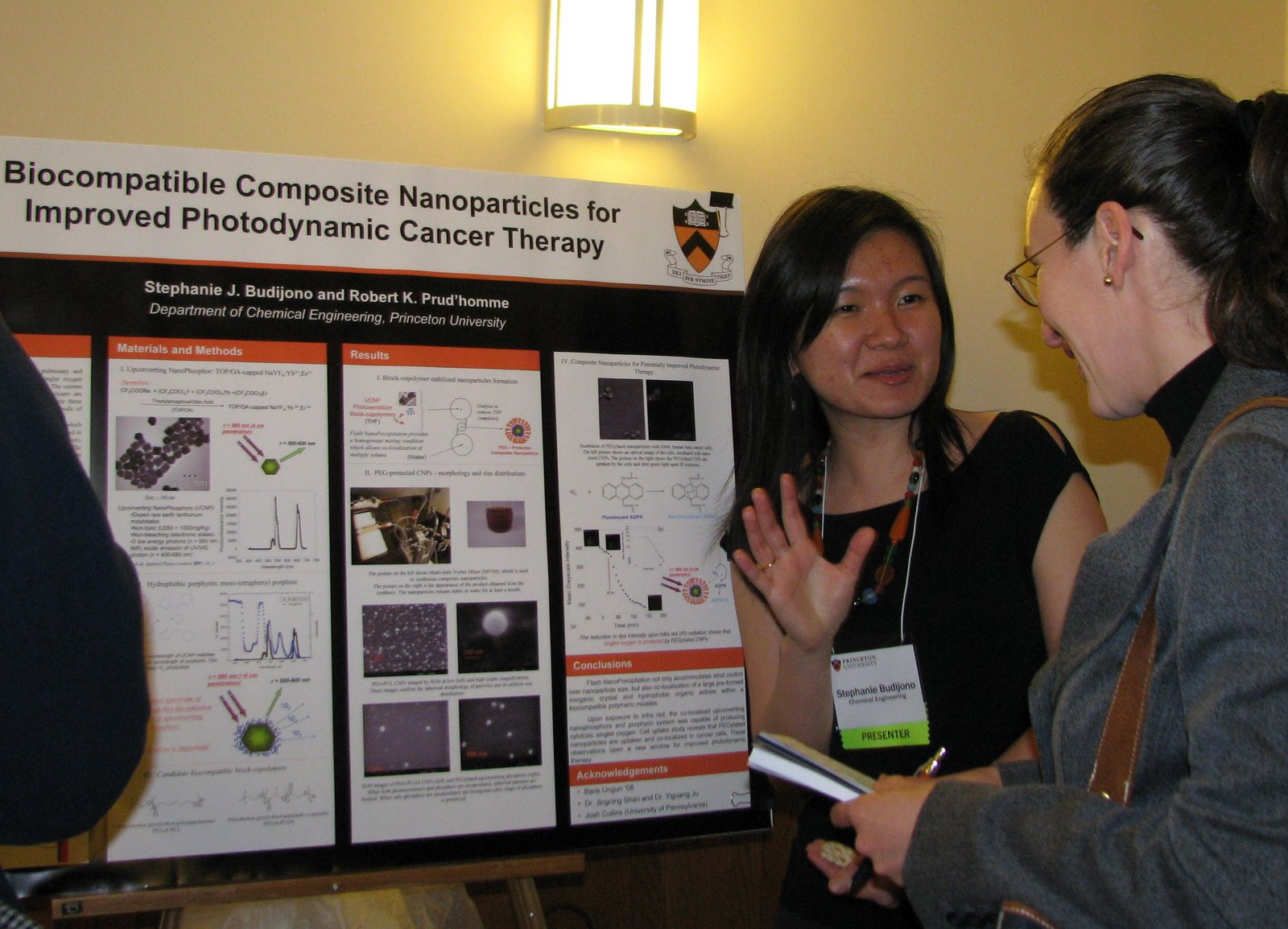
Stephanie Budijono, a chemical engineer in Robert Prud’homme’s group (pictured, with Dora Mitchell of Battelle Ventures), won the $25,000 grand prize from the Jumpstart New Jersey Angel Network for “Deep-penetrating Upconverting Nanoparticles for Photodynamic Cancer Therapy.” By using stealth pegylated particles and infrared activation, her therapy can improve light penetration and reach cancer cells that lie deep within the lungs.

Second prize for $10,000 went to Stephen So, working with Gerard Wysocki, for laser spectroscopy to detect trace gases in the air. The device, the size of a plastic bottle, works unattended and uses AA batteries. Bomb sniffing dogs can’t work 24/7, but this device can. It also has health applications (monitoring patients at home) and environmental monitoring potential.

Vivek Pai’s edge acceleration box for slow networks, called EdgeXL, won the $5k third prize.

Peter Reczek, who has been executive director of the New Jersey Commission on Science & Technology since last May, encouraged Oliver Graudejus, an electrical engineer who is working with Sigurd Wagner on a medical device, a tissue-like electronic interface. Medical devices represent the future of healthcare innovation, says Reczek, in terms of collaborations across many disciplines – biology, engineering, math, and physics — that can achieve commercial success.

The other nine entrants may not have won any prize money, but they got some good exposure — the denizens of Einstein’s Alley turned out in force, pretty much filling the large hall, Computer Science 104. And now their poster and three-minute pitch are ready for the next opportunity.

Bob Monsour, of the Keller Center, emceed the event, and said the judges had an easy time of it. I thought that might be a bit unfair, because there were some other great ideas, but perhaps they weren’t commercially viable.

Least likely to succeed in my opinion and in the opinion of an observer I can’t name, was a double MRI machine that could hold two people, useful for studying interpersonal communication. The inventors claimed that it would save money to do two MRIs at the same time.

Now who is going to sign up to snuggle up with a stranger to get their insides photographed? Nobody.

Where there’s smoke, there’s hope — for journalism

Richard Bilotti, former publisher of the Times of Trenton, spoke to the Princeton chamber at the Princeton Marriott yesterday, and remembered speaking to the same group at the same hotel two decades ago, when it was still called Scanticon. He had pulled a Palm Pilot out of his pocket and predicted we would all be reading our news on Palm Pilots. Yesterday he brandished his iPhone. He reads all his news on either an iPhone or a Kindle, electronic book.

Optimistic about the transition from print-based news to new media, he compared it to how the printing press wrested control of information from the Catholic church. Now online media and social media are grabbing control from print editors. ”After watching the news for 50 years and spending a lot of time surfing the net, reading, and thinking, I have come to believe that new ways of passing news will be more democratic, will give us more viewpoints, will provide more information and make our democracy more robust and more responsive to the people.”

He answered the credibility and bias questions.

“The information will be no more or less credible than what we have received from the usual media. Of necessity, newspapers have had to skew the news, based on space and reporters and resources available. Reporters cannot help but bring the biases of their race, upbringing, and education. I constantly received complaints about bias, from the straightforward accident story to the most complex investigations, but I probably received more complaints about stories we didn’t publish or that we overlooked.”

Journalists need to get proficient with online reporting opportunities, he warned, noting that the New York Times pays $750 a year to deliver a paper to one driveway.” Reporters will go to work on online sites. Some started by newspapers, before they stop printing, others new. Some will provide news on a host of topics. Some on geography, such as in Plainsboro. On interest, local soccer. Or on advertising, that offer money for clicking on an ad. Or from a nonprofit, like Kaiser.org, which provides health related news and information. Reporters will set up offices in Wegman’s, talk to people and spread the news. Other journalists will comb for news, then blog about it.

The current daily paper business model “grew almost by happenstance. As markets changed and developed, newspapers monopolized advertising in their communities.” This “marriage of convenience” began to break down more than a decade ago, when Internet sites began to siphon off classified ads. “Advertisers began cheating on newspapers in wild sexy ways. Having lived on the wild side they are not going back to boring homes. Newspapers can no longer count on the advertising dollars to pay reporters and photographers. The readers changed too. They are not satisfied with news that is 12 hours older than what they have seen on the screen.”

To illustrate the current state of confusion Bilotti told about a photographer, assigned to cover a forest fire, who called the city desk because he couldn’t shoot from the ground because of the smoke. He was told to go to the airport and a plane would be waiting. At the airport, a plane was gunning up on the tarmac. He hopped in, said “Let’s go,” and the plane took off. He directed the pilot to fly low over the fire. “Why?” said the pilot. “Because I want to take pictures.” “You mean, you’re not the instructor?”

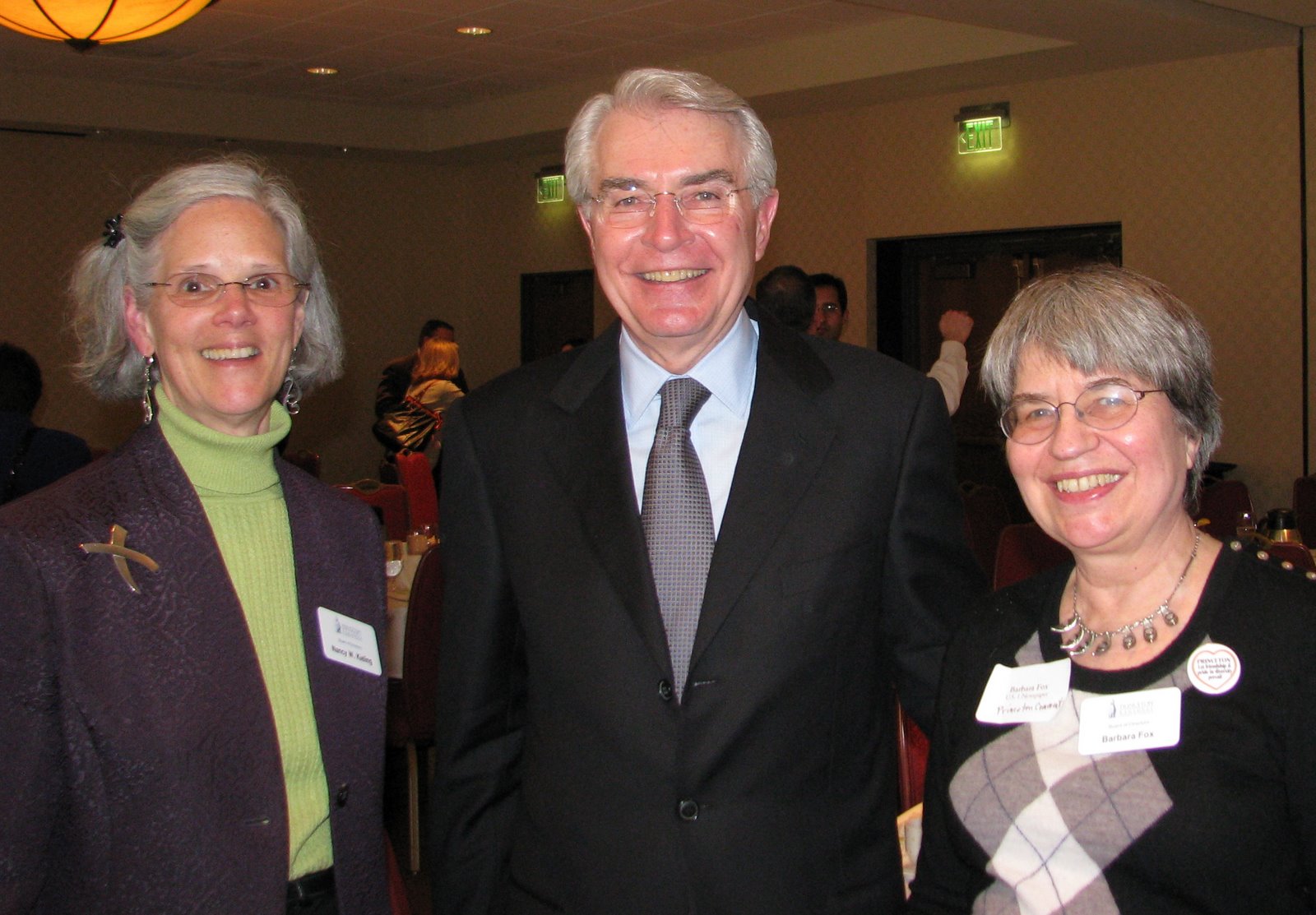
Full disclosure: I used to work for Richard Bilotti (shown above with me on the right and Nancy Kieling of the Princeton Area Community Foundation, left). Before I joined the staff of U.S. 1 Newspaper, I was a freelance dance writer for the Trenton Times from 1981 to 1986, and I remember when he changed the business model for nonprofit ads, offering free display ads on an as available basis. Part of his wonderful support for the arts was his championing of the Trenton Education Dance Institute,, a fabulous project that brings dance to public school children. I support his daily newspaper accomplishments.

But I had hoped to hear an answer for how to get the public to pay for what they are used to getting for free. U.S. 1 Newspaper changed the print paradigm when it offered a serious newspaper at no charge to readers. With one exception, Dow Jones, print newspapers are still offering their work online for free, and they are still figuring out how to monetize it.

“When people ask me about the future of newspapers, I tell them that the thick smoke is creating confusion, turmoil, and nervousness,” he said. Nor did he predict who would put food on the reporters’ tables while they are trying to monetize their blogs and websites.

“After all,” he said, “I am still looking through the big clouds of smoke without my instructor. After the printing press, there was confusion and chaos as the printing press owners change society. Confusion and chaos will reign in the information marketplace until we figure out what works. But something will work and money will be made. No one ever knows what will work until it works.”

Two for Entrepreneurs

Two Princeton University events on Thursday, April 2, are potentially useful to area entrepreneurs in Einstein’s Alley. One is on executive ethics, and the other is more like a game show, where the winning ideas walk away with $40,000.

David F. Eisner, CEO of The Markets.com, speaks on “A Jewish Perspective on Ethics in the Executive Suite” at 4:30 p.m. in the Lewis Library, Room 138, on Washington Road. David W. Miller, director of the Princeton University Faith & Work Initiative, moderates the free talk sponsored by the Center for the Study of Religion and the Center for Jewish Life.

Billed as a “single-source destination site for comprehensive and real-time equity capital markets information and research from leading global investment banks,” it has a portal that allows institutional clients to access the web-sites of member banks. A graduate of American University with a law degree from Boston University, Eisner has been CEO of The Markets LLC since it was founded in 2000 by 11 leading banks.

Over at the E-Quad, the Keller Center for Innovation in Engineering Education is holding it Winners Take All Evening, the 4th annual Innovation Forum. The Jumpstart NJ Angel Network offers a total of $40,000 in prize money to three companies at 6 p.m. on Thursday, Computer Science 104. After the three-minute presentation from each of 12 companies you can place your bets for which the judges will choose. Among the entrants (all from the university) are a multiple-people MRI scanner that can simultaneously scan more than one person for studying brain responses of inter-person communication and physical contact, a monetary system for online content trading, and an ultra efficient energy laser spectroscopic trace gas sensor for sensor networks and portable chemical analysis.

It is free, and so is the reception afterward