All posts by bfiggefox

Paradise as a Default Setting

If you, like me, have come to dread the anniversary of 9/11, with all its attendant angst, Rebecca Solnit’s new book, “A Paradise Built in Hell: The Extraordinary Communities That Arise in Disaster” could provide some solace and/or diversion. I’ve not read it, only read Dwight Garner’s review in the New York Times and Steven Winn’s in the San Francisco Chronicle, but I wholeheartedly agree with Solnit’s premise, that most people respond heroically in emergencies large and small and, in fact, derive satisfaction from their generous actions.

From Publisher’s Weekly: “Surveying disasters from the 1906 San Francisco earthquake to 9/11 and Hurricane Katrina, she shows that the typical response to calamity is spontaneous altruism, self-organization and mutual aid, with neighbors and strangers calmly rescuing, feeding and housing each other. Indeed, the main problem in such emergencies, she contends, is the elite panic of officials who clamp down with National Guardsmen and stifling regulations.”

According to the reviewers, Solnit documents racist policies that made the Katrina situation worse and notes that more people should have been able to escape. She quotes a minister: “Can you imagine during 9/11, the thousands who fled on foot to the Brooklyn Bridge…? What if they had been met by six or eight police cars blocking the bridge, and cops firing warning shots to turn them back?”

Says Solit: “The joy in disaster comes, when it comes from that purposefulness, the immersion in service and survival, and from an affection that is not private and personal but civic: the love of strangers for each other, of a citizen for his or her city, of belonging to a greater whole, of doing the work that matters.”

In workplace situations that don’t count as disasters, such as when a valued colleague leaves and everyone pitches in to get the work done, I have seen this kind of “social capital” at work, people immersing themselves in service, pitching in to get the work done, and feeling good about their efforts.

Solit calls it “paradise” when a community pulls together to pursue a survival goal and achieves a sort of euphoria. And I’d like to think that I, as an individual, could achieve the same high if I could manage to pull myself together – and somehow, once and for all, organize my time — to reach a goal.

As quoted by Garner, Solnit shows the way: “Her overarching thesis can probably be boiled down to this sentence: ‘The recovery of this purpose and closeness without crisis or pressure’ — without disaster, that is — ‘is the great contemporary task of being human.’ “

In September the Jewish calendar starts over, a new school year begins, and — no matter what our religion — we get to start over. I’m going to try not to look backwards at September 11, but forward from that date. Quoting Solit: “Just as many machines reset themselves to their original settings after a power outage, so human beings reset themselves to something altruistic, communitarian, resourceful, and imaginative after a disaster, that we revert to something we already know how to do. The possibility of paradise is already within us as a default setting.”

For specific suggestions on how to “reset” your life , consider listening to the motivational speaker Bill Boggs, scheduled for the Princeton Chamber lunch on Thursday, September 10, at 11:30 a.m. at the Forrestal Marriott. The four-time Emmy winner will share success strategies from his recent book, “Got What It Takes? Successful People Reveal How They Made it to the Top.” Call 609-924-1776 or www.princetonchamber.org.


The Body Never Lies

Descartes is the villain, said Amy Castoro of the Irimi Group, if you are having trouble getting your mind to stay in touch with your body. Castoro, in a fabulous workshop for the Association for Woman in Science yesterday at the Miele headquarters, told the fascinating history of somatic psychology, how the body affects the brain and vice versa. “The price of learning to think objectively is the separation of mind and body,” she said.

I had to leave the meeting early, but not before she had everyone up on their feet in a “centering” exercise. Emotion can happen from the outside in, she suggests. If you hold a facial expression long enough, your body and your thoughts mirror it. “All of us have a shape. The shape we hold reflects our history.”

So if we consciously change our shape (our posture, our stance, the way we hold ourselves) we not only change the way we look to others (as in a job interview), but we can also change our mood.

One of her mentors is California-based Richard Strozzi-Heckler and another is right here in Princeton, Les Fehmi, author of “The Open Focus Brain: Harnessing the Power of Attention to Heal Mind and Body.” (I’m also a believer in the Open Focus methods of dealing with everything from hypertension and ADD to insomnia and pain.)

Though Castoro quoted Alice Miller as saying “the body never lies,” the woman who more famously said that was Martha Graham. The body might not lie, but you can negotiate with it. If you stand up straight and tall and look like a winner – you will feel like a winner. And you’ll likely be one.

(Writing is one of the few occupations where you can hide your body language. If you are reading this on Thursday, August 13, stop by to meet a bunch of writers, at the U.S. 1 Newspaper reception for writers (and readers), 5 to 7:30 p.m. at Tre Piani in Forrestal Village. This cash bar event celebrates the U.S. 1 fiction and poetry issue but welcomes everyone. So what do poets look like, anyway?)

Sorcerer’s Apprentice on LinkedIn: Get the Mop


Do you remember the scene in the Disney movie, Fantasia, when Mickey finds the Sorcerer’s Book of Magic? Mickey got in trouble for reading only half of the directions in the Book of Magic. That was my mistake, twice — once when pressing the first button on Linked In, again when trying to clean up the mistake.

So what happened? I’ve been trying to slow down my acquisition of Linked In contacts partly because I was getting overwhelmed but mostly because I thought I would have to pay for extra space. (Wrong, as I found out.)

That’s the background.

About 9 a.m. Sunday night I was noodling around and spotted a siren call. “Check to see who, on your email list, could be invited to Linked In.” I did this once before and accidentally invited everybody on my email list to, swooping up lots of people like my husband’s retired first cousin who apologized profusely about not wanting to join.

This time I was sure I knew what I was doing. Just select four of the 364 people in my gmail list. Press button. I sent out 360 invitations.

Some went to people I know, others to people I don’t know that well but who are perfectly logical to link to, but many to travel agencies and PR people who have emailed me once.

Think back to where Mickey gets the bucket and mop, times two, times 200, times 2,000.

I reached for the mop. According to the Help section on Linked In, I could withdraw each invitation and “no message will be sent.” That sounded like the unintentionally invited folks would never know. No message would be sent, right? Blissfully ignoring my lurking suspicion that a first message had already been sent, I carefully deleted most of the 360 invitations. How long does that take? About 90 minutes, at five keystrokes each.

Whew. I went to bed, figuring I could at last sleep well. I didn’t sleep well. And I woke up to some puzzled email messages, like this one.

“Just wanted to ask, was it something I said :)”

It turns out that “No message will be sent” means “No second message will be sent.” So when the eager Linker goes to click “yes” the cupboard is bare.

How insulting! How obnoxious! What a slap in the face! What to do?

Since Emily Post lacked advice on this 21st century problem, I asked communications trainer and coach Ken Jacobs, who had good advice, including blogging about it in a “humorous, appealing tone.” Said Jacobs: “I believe that people are understanding when you own up, apologize, and show a little humor.”


Okay, so here it is. If you are getting this, and you were puzzled, discombobulated, or otherwise thrown off balance by getting my LinkedIn invite — only to find it didn’t work — I humbly apologize. Bit by bit, I’ll go back through that list and give us both another chance. If you want to say yes, I’m sure we’ll make beautiful networking music together. Or, to speed it up, get proactive, just invite me, and I’ll say yes!

Cue Stokowski and Paul Dukas… . “Gee thanks, so long, I’ll be seein ya.”

Refreshing the Fresh Air Runners


If you admire those who open their homes to Fresh Air kids from New York City — but have never figured out how to put that into your schedule — it”s not too late to sponsor a runner in the Fresh Air Fund half-marathon, in New York City on Sunday, August 16, says Sara Wilson.

Last summer, she says, the race raised more than $125,000.
And it’s probably not too late to join the race! Check it out at http://freshair.org/racers

Blocking and Tackling for Capital Health

Frankly, I was worried about Capital Health System’s building a new hospital on Scotch Road in Hopewell, while at the same time University Medical Center of Princeton is building its own new hospital in Plainsboro.

How will both have enough patients to be viable, I doubted.

Capital Health’s CEO Al Maghazehe (pronounced “MAG a see”) cleared that up today, speaking at a Princeton chamber lunch on how CHS contributes to the area’s economy. CHS will draw some patients from Princeton’s catchment area, yes. But as the southern-most high tech hospital, it can tap patients from all the smaller hospitals to the south, a rich source of revenue indeed.

Okay, now I get it.

Maghazehe also revealed some intriguing business strategies.

Yes, he promotes teamwork. Yes, he advocates employee empowerment.

But how did he walk away with the largest loan that the U.S. Department of Housing & Urban Development ever made?

He credits his “down year” of 1998 when, after the merger of two century-old hospitals (Helene Fuld and Mercer), he had trouble meeting payroll. “The auditor sat in my office. I had terminated just about everyone on the management team – the CFO, the two medical directors, the CIO, and many midlevel directors,” he said. “It was just me.”

With a new team he reversed the trend and doubled business. And this is what he says HUD based its nearly $800 million loan on — not on a balance sheet that shows 700,000 patients and a half million dollars in revenue — but on its confidence in CHS being able to cover its debt service.

Other strategies:

Incentives to primary care practices. “The primary care network should be large enough to fuel growth. Some hospitals have 200. We are up to 35, and adding.”

Designating Fuld as a trauma center and bringing in top-level doctors for it.

Buying technology (the cyberknife and robotic surgery) and bringing in people to run it.

Competing with Philly by hiring away entire teams (including the stroke and cerebro-vascular team from Thomas Jefferson, though he didn’t name that hospital in his talk). And setting up cutting edge (sorry for that one) equipment.

Opening satellite offices like the Hamilton walk-in surgery center, which went from 7,000 to 35,000 procedures annually.

Designating the Philadelphia Eagles as CHS’s official team (no, that’s the inside joke of the lunch today, but Maghazehe is a notorious Eagles fan).

Perhaps the most interesting revelation, that Maghazehe is a one-job man. He came to CHS as an intern and never left. That may explain why he is so famously and outspokenly loyal. On this occasion he introduced a table-full of his own doctors, but he also gave gracious nods to Skip Cimino (just named CEO of RWJ at Hamilton) and metaphorically doffed his hat to Princeton: “This region is extremely fortunate to have two brand new hospitals built at the same time.”

Persuading One-on-One

There are networking groups, and then there are workshops. Lately, combos of those two are proving successful.

Communications coach Eileen Sinett (www.speakingthatconnects.com) has begun to hold breakfast meetings on “last Fridays,” and I fetched up at her door, on Plainsboro Road, on July 31. So did nearly two dozen other people, eager to network but also ready to sponge up wisdom from Eileen on how to present themselves better. Scott Melzer, an Ameriprise financial advisor, was the co-host and Biz4NJ the co-sponsor of this Speaking For Biz program.

After chatting with an unusually diverse group of people, ranging from my colleague, Bart Jackson, and Warren Pick, a TV producer – to Cindy Urken, a realtor, and Sherry Waryasz, a certified laughter leader – we settled down to introduce ourselves. Eileen suggested an intriguing departure from the typical “elevator” speech. Instead of “my name is and here is what I do,” we were to begin with “Clients say…” or “People tell me….” or even just “When….”

If you think of the typical introduction as like a news story, with the Who, What, When and Where at the top, this kind of “alternative introduction” is like a mini-feature story, a nifty little narrative. We learned a lot about each other in a very short time.

Then we puzzled over the difference between providing information and persuading. Having just returned from Italy, and my first visit to Pisa, I was intrigued by the answer from Prakash Rao, a time management coach. It seems that Galileo proved the theory of gravity by dropping things from the Tower of Pisa, but for 100 years the faculty at the University of Pisa did not teach his theory. Galileo had failed to persuade.

Here is a snippet from Eileen’s mini-lesson on persuasion, memorable with the rubric Smart Individuals Head Big Companies. Setup or frame your context with three irrefutable statements, that no one can contest. Then and only then present your Idea, followed by How it would work, and then by telling the Benefits. Or just tell the benefits and wait for your target to ask how he can get it.

Sinett runs some other low-cost opportunities to pick up speaking tips, but the next Biz4NJ breakfast is Friday, August 28, at 8:30 a.m. at 610 Plainsboro Road, on the topic “Tweaking Pitches for a Different Audience.” Cost: $10. Please RSVP at 609-799-1400 because space is limited. Photo: From left, Nicolette Datri, an intern, and Eileen.

Too Many Baskets

George Amick, long-time editorial writer for the Times of Trenton and now a political columnist, always makes a lot of sense. Monday’s column on “perp walks” and political corruption in New Jersey not only made sense, it made me feel better about the Garden State. Of the several reasons he offered on why New Jersey has a reputation for corruption, the one that makes thevery most sense “is that New Jersey has more dishonest public officeholders because we have more public office holders, period.”

Where I grew up, Baltimore County, is no stranger to corruption. The county’s most famous bribery villain, Spiro Agnew, resigned as Nixon’s vice president because of bribery charges dating back when he was Baltimore County Executive. He was the only U.S. vice president to resign because of a criminal charge.
But even Baltimore County can’t match New Jersey, because it has no sub-fiefdoms. Its school systems has 22 high schools.
Mercer County, in contrast, has 13 municipalities, each with just one or two high schools. Amick points out are that these municipalities are “governed by part-time officials…whose only guide is a woefully inadequate and erratically administered state ethics code.”
I can’t link this blog to Amick’s column until tomorrow, so support newspapers and go buy today’s edition. But I must quote his quote of Mark Twain.
“It was Pudd’nhead Wilson who recommended, contrary to the old proverb, that you put all your eggs in one basket — ‘and then watch that basket.’ New Jersey has far too many baskets. “

Hurrah for Staying Put

If Fort Monmouth does pull up its drawbridge, as it’s slated to do, thousands of specialized tech workers would have to uproot their families and move to Maryland.

But maybe not. In the federal defense budget, two U.S. Representatives (Rush Holt and Frank Pallone), have inserted $3 million for a new New Jersey Technology Center, where the specialized techies could continue to provide intelligence and communications support to the U.S. military.

Don’t confuse the to-be-created New Jersey Technology Center with the Technology Centre of New Jersey, the tech park owned by the New Jersey Economic Development Authority. (When checking on TCNJ I found that Chubb Institute has changed its name, which slipped by me. Chubb’s education arm went deep into the red, was bought by private equity, separated from the insurance company, and is now called Anthem Institute. It’s across the street from what must be its arch rival, DeVry Institute.)

The bill passed the House on July 30 and still needed Senate approval, as of Friday, July 31.

“The men and women of Fort Monmouth — the scientists, engineers, and acquisition specialists who make the IED jammers and related devices — have acquired their skills over decades of service,” said Holt in a press release. “You can’t buy this kind of talent off the street and certainly not fresh out of grad school, which is why funding the Center and utilizing those workers who will stay in New Jersey is so important.”

Here’s an idle, obstreperous idea: Could those defense techies have found another home in Einstein’s Alley, for instance at the Sarnoff Center, which is busy with defense contracts as well? From the New Jersey shore to Maryland is too long a commute, but from the shore to Princeton is doable. And Sarnoff has extra space and like minds.

Arrivaderci, Esther


The subject of jet lag came up when Esther Dyson addressed the Princeton Chamber on July 9. Dyson had just returned from Russia, and she was working on almost no sleep, but gave a wow of a talk.

Directly after the lunch I left for the airport, with husband and granddaughter, for 10 days in Italy and have had plenty of time — a week — to recover, but am still not clicking on all cylinders. Perhaps if I had adopted Esther’s healthy lifestyle (to swim every morning) I would have done better.
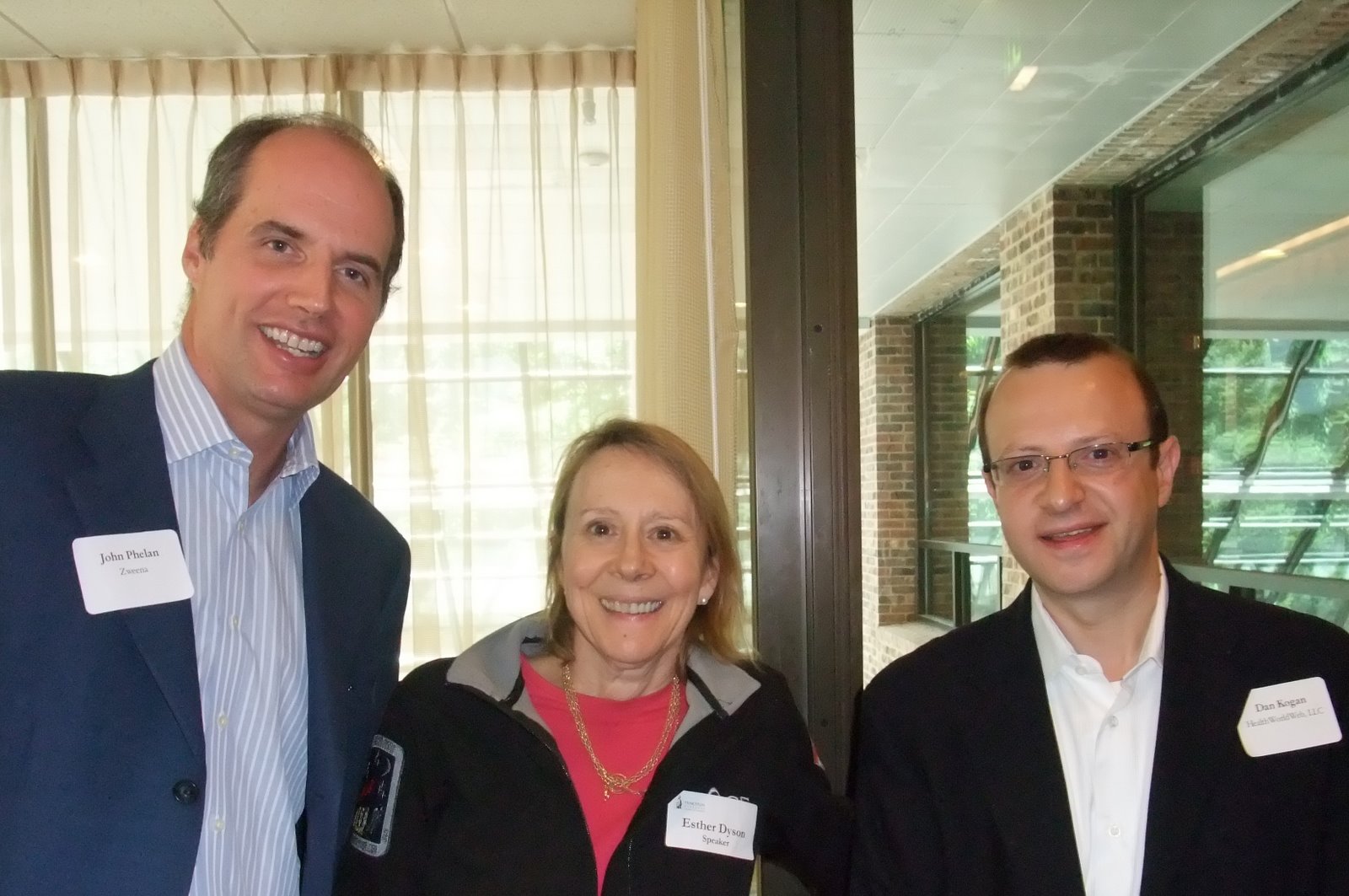
Since I left before I could comment on Esther’s talk, here is a link to her complete address, recorded for You Tube by Daniel Kogan of MyHealthExperience.com, which co-sponsored her chamber appearance. (In the photo, John Phelan of Zweena is on the left and Kogan on the right.) Also here is Dilshanie Perera’s excellent account in Town Topics.
And if you have your own memories of Italy, here’s an online album. Glad you asked.

Paying for Content?

In the ever perplexing discussion about whether readers will pay for news content, here is an apt summary from Editor & Publisher’s Steve Outing, quoting former Trenton publisher Dean Singleton. My previous entry featured commentary from Richard Bilotti, another former publisher at The Times of Trenton.

This is certainly a short entry, but I just wanted to call attention to Steve Outings wisdom, and it’s too long for Twitter…