All posts by bfiggefox

The Best Communiversity Yet

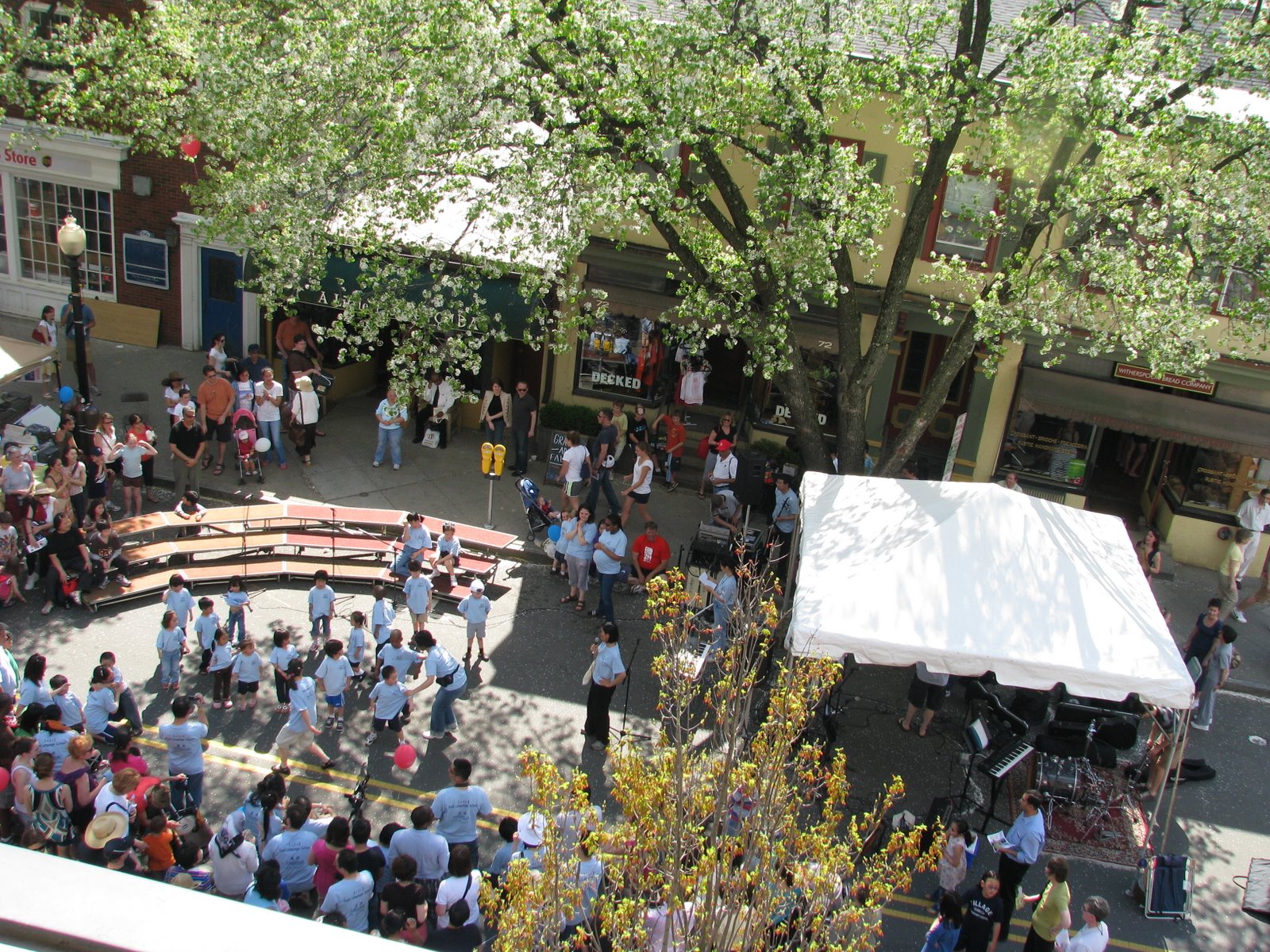
The same folks who partied at Pinot 2 Picasso last night had to get up today and put on the annual town gown celebration, Communiversity. I walked into town from our home on Cedar Lane to find the Chinese School that meets just up the street was performing on Witherspoon Street.

Everybody was having a good time in the hot sun. I met, and snapped photos of, Anne Reeves (the founder of the feast), and a bunch of other people who help people make Princeton what it is: Nancy Kieling (of Princeton Area Community Foundation and the Princeton chamber), Madolyn Greve (of Gloria Nilson and the chamber), Nancy Robin (the founder of Hands on Helpers) and the organization’s current executive director, Adrienne Rubin, and Steve Kruse, who is an activist for the bicycling cause. The Methodists were out in force — Judy and Dick Miller, Susan and David Gange (at the Stonybrook Orchid table), and the youth from Princeton United Methodist Church, who were selling baked goods for their Appalachian Service Project.

Even the Obamas were there! Well almost. See them here.

The Left Bank: Arts Council at University Square

How long has University Square remained empty? No matter, it was transformed into the Left Bank tonight for Pinot 2 Picasso, the Arts Council of Princeton’s pre-Communiversity Gala.

Here are some
photos, no more than snapshots really, of the evening.

New this year was SureTech.com‘s fabulous custom-designed wall-sized video display. Before the auction it randomly showed the various art work. During the auction it showed the matrix. When someone made their choice, that picture popped up large on the screen and then was covered by their number on the matrix. It must have been a challenge.

Very creative, very high energy party. And great weather predicted for tomorrow. Anne Reeves must surely be pleased.

Einstein Lecture: Harness the Sun


Alan Heeger (on left) charmed the eager audience at the Princeton Chamber’s Albert Einstein Memorial Lecture yesterday at Princeton University’s Robertson Hall. The 2000 winner of the Nobel Prize in chemistry, whose lab is in Santa Barbara, told how to turn the dream of low cost plastic solar cells into reality: “We receive on earth in one hour enough energy to take care of the needs of the planet for a year. The question is how to use it. We need to decrease the cost by at least a factor of five.”

I’m not going to try to explain “self assembly of bulk heterojunction nano materials by spontaneous phase separation” even though Heeger was so clear that I almost understood it at the time. Afterward, Aaron Wadell offered to go over it with me. As COO of Global Photonic Energy Corporation, a spinoff of Universal Display, he works in this space. Thanks, but no thanks, Aaron. There is a limit to what I will write for free.

As an aside, Heeger noted that the very word “photon” was coined by Einstein. And the first time Heeger referred to images taken by the electron microscope, I got a sudden twinge and looked over to Bob Hillier, sitting in the fourth row on the center aisle. Hillier’s father invented the electron microscope, and I thought again about how, here in Princeton, great accomplishments are commonplace. Just five days ago I was sitting in this room listening to the CEO of Google, interviewed by Princeton’s cyberspace guru, Ed Felten.

The “money” question came from Michael Hierl. Heeger said that throwing money at the problem might not speed up the process of commercializing plastic solar cell technology. Konarka Technologies (the former Polaroid facility, now converted to making the thin film) “has been able to raise the necessary funds.” (Since a family member is an expert in film manufacturing technology, I was intrigued when Heeger said that the soon to be defunct Kodak film plants can be converted into thin film production.)

Re money, “in my lab I’m not too worried,” said Heeger, adding, “my real concern is the public’s attitude toward fuel consumption. We should not be burning oil. Instead, “we should use it to make high value products.”

The sponsor roster for the lecture, in addition to the Princeton Regional Chamber Foundation, reveals who still has money to contribute to something like this: a construction firm (Bovis Lend Lease) an energy company (NRG), a chemical firm (Firmenich), and two pharmas, Bristol-Myers Squibb and Ortho-McNeil-Janssen. (Though Heebink’s topic was energy, he also co-founded Cynvenio, which does micro fluidics for cell sorting, and Cytomx Therapeutics, a drug delivery firm.) Plus Greg Olsen’s investment firm. GHO, and his former imaging company, Goodrich ISR Systems.

Guys who do high tech business development were out in force and Paula Durand, technology & life sciences venture officer of the ubiqitous New Jersey Economic Development Authority, was on the front row. (See photos).

Saying he is confident of early prospects for success, Heeger cited another Nobel winner, Richard Feynman, (roughly quoted): “All the molecules in my brain are different from six months ago when I saw you last, but I still know who you are.” It’s the structure of the brain that counts. “It’s the network structure that is stable. That gives me confidence that (in our life time) we can (do this).”

Googling Social Discourse: the CEO of Google

“Technology can increase the quantity of discourse, but can it increase the quality?” asked Ed Felten, “Think carefully about the way you design social software to get conversations that are more likely to be fruitful. There is a tremendous amount of science to be done to make any progress on this issue. If we make any progress at all it can have tremendous benefit.”

Felten (above, right), a professor at Princeton University, moderated a discussion on how technology will transform the global landscape, part of the April 17, 2009 Princeton Colloquium on Public and International Affairs. His guest, the CEO of Google, Eric Schmidt (Princeton, Class of ’76, above left),  responded to a wide-ranging discussion, including comments on the latest products, Street View and Latitude. For my more complete notes, click here. Some highlights of Schmidt’s comments: 

On international differences: “The key insight is that people are the same everywhere. They want to talk to each other. And people really do care about Britney Spears. It is really very disheartening. The only difference is language.”

Cell phone revolution: “People are carrying phenomenal computing resources. I like history so when I walk down the street, my cell phone could tell me the history of each of the buildings as I walk by. Why not? Google has the information, and the phone has GPS. Now you can have the Encyclopedia Britannica streaming to you. History is the mildest example I can think of.” (They discussed less benign examples.) 

“Now feature phones for $50 to $70 can be subsidized in developing countries for the poor, just living in their huts. If you are a farmer, your wealth is determined by the temperature, weather, agriculture prices, the need to know whether you have to sell the cow to get through a bad month. We think it is fundamental to get that kind of information.” 

International affairs: “I worry that we are locked in the old zeitgeist. The citizens of Cuba would benefit from fax and communication. If you were a dictator, the first thing you would do is shut off all communication and make sure that no one could see what you were doing. The internet works against that. The way you invade these countries is with information.” 

Media: “We use newspaper content with their permission. They have chosen to give that info in return for sending traffic to their sites, which they can monetize. But it does not make up for loss in print revenue, and that’s not a problem we know how to solve.” 

Healthcare: “Why is there not a wikipedia for doctors. Imagine in medicine the collective wisdom on outcomes.” 

Blogs: “There are 100,000 blogs created per day, and the average number of readers is one.”

Personal note about attending a celebrity event at Princeton University: I watched the morning events “live,” managing to get a seat by arriving well in advance of the Google talk. For the 3 p.m. Paul Krugman talk (see below), I was not so lucky. I could have watched from a different room, but since it was to be streamed live from the princeton.edu website, I went home and it worked pretty well. It was hard to read the small print on the PowerPoint slides. And before Krugman had finished (how long before I don’t know, he was answering questions), the website went down and on came some really bad music and a series of announcements about events that had already taken place. There must have been an automatic cut-off at 4 p.m.  So it’s worth it to get there early. 


Krugman: Don’t Worry About National Debt

Don’t worry about the national debt, said Paul Krugman, speaking at an April 18 Princeton Colloquium on Public and International Affairs. “Wealthy countries have been able to run up to 100 percent debt vs GDP without going into crisis. We did run at 100 percent after WWII. We come into this with debt at 60 percent of GDP and 100 percent is $6 trillion. It’s not a blank check but does give you running room.”

For my transcript of Krugman’s notes, click here.

Krugman didn’t have much else cheerful to say. He talked about “astonishing times” that he never expected to see in his lifetime, and that whether or not we spiral into a Great Depression, we are in depression economics. “The extent to which it is happening, is not supposed to happen. It is like some disease we thought was controlled has emerged in an antibiotic resistant form.”

“So far we are on track to having a slump as bad as the Great Depression, plunging just as fast. In world trade, we are plunging faster.”

“Where we are now is the fall of 1930, which by no means was the worst it got. What followed was the worst — the bank failures in the US, a corresponding wave in Europe. Destructive policies like raising interest rates to attract gold in 1931. Our best hope is that we have learned from our grandfathers.”

“Believe it or not, the disruption in our financial markets is worse than it was then.”

“The forecast is based on the federal budget returning in five years, but it is not at all clear where recovery comes from.”

“The striking thing is how hard it turns out to be to do anything forceful about the banks.
This morning, banks are being subjected to a stress test. But they don’t know what to do with the results.”

“Another of the shocks is Europe’s inability to act as a unit in this crisis, one of the major disappointments of this whole story.”

Still, Krugman tried to put a good spin on the current state of affairs.

“There was about 4 months when every single piece of news came in, it was worse than you expected. Yet for the last six weeks or so, things are not getting worse quite as fast as they were the previous six weeks. Even that is positive news.”

“But there was kind of a pause in the late 1930 before ‘It’ broke loose. We are hoping that doesn’t happen.”

“Even if it does stabilize, this will be very prolonged and very nasty.”
Past recoveries have been fueled by exports. “But this is a global slump. We can’t all export our way out of it unless we can find a planet to sell to.”

“At a fundamental level, this is a malfunction. It is not a case where the planet has run out of resources, or that we don’t have the ability to recover. It is a snafu. We ought to be able to fix it and get it moving again.”

“But we don’t know as much about it as we thought we did. And we need the political will to do things that are controversial but are essential. The policy response in the U.S. was much better than nothing, but is not enough. We needed $1.3 trillion not $8 billion, and more revenue to state and local governments. “

“Meanwhile, all I can say, is, Oh boy. This time is intellectually interesting, and personally terrifying. The scariest thing I ever thought I would witness in my years as an economist.”.

White Privilege: ‘The Hidden Wound’


Sarah Halley made the distinction between safety and comfort. As the facilitator for the first of four Not in Our Town workshops on White Privilege at Princeton Public Library, she wanted everyone to feel safe but not necessarily comfortable. “If you start to feel uncomfortable, get a little curious,” she suggested. “Use it as a way into the work as opposed to the way out of the work.”

Full disclosure: I represent Princeton United Methodist Church on the steering committee for Not in Our Town (NIOT), a faith congregation-based social action group that works to combat racism and bias in Princeton. The workshops are NIOT’s response to the often-heard comment, voiced in inter-race discussion groups, “We really wish white people would teach white people about racism.”

The result: this series, “Engaging Together to Explore White Privilege.” White privilege has been defined as a right, advantage, or immunity granted to or enjoyed by whites beyond the common advantage of all others. It differs from racism in that the people benefiting from white privilege may not necessarily hold racist beliefs and can be unaware of the privilege.

About 60 people came to the first workshop, and the next Monday, 7:30 p.m. sessions are on April 20, 27, and May 11. Co-sponsored by the library, the sessions are free. For information, email niot.nj@gmail.com or me at bfiggefox@gmail.com

Halley explained the “Paradox of Diversity.”

All people, no matter what race, share the same values and hopes.
Some people are like each other in terms of race, gender, or group level identities.
Each person is also an individual, like no other person, in terms of DNA, life experience, and upbringing.

White people are more likely to be seen as individuals, Halley noted, then members of minority groups. “Why would you have part of you erased?,” she asked. “I don’t want my identity erased, but I don’t want to be seen as a group.”

Participants journaled for 7 minutes on what and where they had learned about race, and then shared some of their observations.

This is what Wendell Berry had to say on the subject, on page 62 of his 1989 slim volume, “The Hidden Wound,” available at the Princeton library.

“I am a good deal more grieved by what I am afraid will be the racism of the future than I am about that of the past. . . I have the strongest doubts about the usefulness of a guilty conscience as a motivation; a man, I think, can be much more dependably motivated by a sense of what would be desirable than by a sense of what has been deplorable.”

About a dozen people who could not come to the first session have made plans to attend the second session – everyone is welcome.

Looking at What They’re Having


It’s difficult to make a dance fraught with emotion, and it can be even more difficult to choreograph light entertainment and do it well. Most difficult of all is to keep it simple yet give it an original twist. That’s the message I took from “I’ll Have What She’s Having,” the Princeton YWCA-sponsored concert for women choreographers over 40, at Rider’s Yvonne Theater on Saturday, March 28.

Most of the work I’ve seen by Susan Tenney, for instance, is fraught with political or philosophical meaning, but in “Thank you, thank you so much (Suite Ella):” her dancers performed to Ella Fitzgerald’s moods (shown at left). It’s as if she said, “enough gloom and doom.” The format was nightclub, as the dancers played the showbiz aspect to the hilt, lip synching. But the “construction values”(a fillip of a movement that takes it out of cliché, a hand on face penche’ arabesque turn, a change of pace that contrasts with the music) punched it up to the level of concert dance.

It’s rare when a choreographer can get inside a dancer’s skin to reveal his or her internal style, and Tenney – helped by Doug Smith’s costume designs – gave her three dancers this gift. She tapped three themes – the brassy “I’ve got-it-and-I’m going-to-show-it-to you” confidence of Kathleen Smith, the sensual elegance of Rachel Grisi, and the hidden angst of Jeffrey Rubio. Rubio can sell a song with the best of them, but in his solo, he made his way across the stage apron to “You’ve Changed.” with an intense internal focus.

Tenney had paid tribute to her late mother in last year’s concert, and this year it was Joy Vrooman Sayen who offered “Danse Pour Ma Mare,” to a song from Chants d’Auvergne by Joseph Canteloube. Though I remember seeing her choreography in the ‘80s she has been mostly teaching, not performing, since then. I was glad to see her evocative elegy, sad for the death that inspired it. Rooted to the ground, wearing layers of clothing over loose pants, she made inward, ever larger circles with her arms, cradling, then releasing out and up in suspended joy. It was more of a thoughtful aubade than a stricken lament.

Marie Alonzo Snyder premiered the heartfelt “Songs of Nilad,” using projections of archival photographs and music by Cantor Joseph Cysner. Snyder and her excellent partner, Henri Velandia, commemorated the European Jews who found sanctuary in Manila before World War II. With its three different moods, it “reads” like a mini-novel and will be especially welcomed at school and community Holocaust observances.

Loretta Di Bianca Fois’s subtle treatment of a dark topic, domestic violence, was part dialogue, part movement. As her character dithered, against a rendition of “Ave Maria,” she talked to a bunch of roses, stroking then plucking their petals and throwing them down on the floor. You realize that the flowers are a metaphor for her relationship.

Alison Maxwell performed Ilana Suprun’s solo, shedding grey workclothes to reveal the eponymous “The Black Dress.

Each of the “just for fun” pieces had an element that distinguished it as a concert dance versus pure showbiz.

Maxwell’s “Too Smooth,” a ballroom duet with Leland Schwantes, evoked “Dancing with the Stars,” except that Schwantes, an Ailey-trained dancer who makes his living as a hand model, retains considerable élan.

In a writhing, smoky torch solo, “Visitor,” the lithe Shari Nyce (who danced with Princeton Ballet in its early days), surprised with her edgy choices, with sensual references more familiar in less selective venues.

Christine Colosimo, the YWCA dance director, invested “July,” a three-piece suite, with the premise of someone sitting at a café in various cities.

Fara Lindsey also presented a triptych, “Learning to Wait.” In “God I Hope I Get It,” nine dancers comically mimed a Filene’s style bargain counter, did an angst filled “Please,” and finished with a top-hat chorus line, “If You Could See Me Now.” That’s the annual joy of this concert – an opportunity for dancers (and former dancers) to strut their stuff.

Next year’s program needs dancer bios. If they are indeed paid, surely they aren’t paid enough to perform without credits. Their friends and family are, after all, ticket buyers.
PHRs: You Get What You Pay For

Concerns about the privacy — and accuracy — of electronic health records (EHRs) hit the fan when Lisa Wangsness of the Boston Globe picked up an e-patients.net blog posting on how a patient tried to transfer his records to Google Health to form his own personal health record (PHR).

From the Boston Globe, April 13, 2009

“WASHINGTON – When Dave deBronkart, a tech-savvy kidney cancer survivor, tried to transfer his medical records from Beth Israel Deaconess Medical Center to Google Health, a new free service that lets patients keep all their health records in one place and easily share them with new doctors, he was stunned at what he found.”

Patient deBronkart found gross inaccuracies in his records, attributable to many reasons. Some:

* information was extracted from diagnostic codes rather than the actual records
* diagnoses were sometimes undated, so a condition from five years ago appeared to be present today
* multiple personnel had access to the electronic record and could have made changes without attribution

My conclusions:

1. Capital Health’s new hospital will, I believe, depend on EHRs. The physician’s practice on Terhune Street is, after a year’s preparation, now paperless. Should we be leery of this new system?

2. Perhaps not, if we consistently ask for copies of our own records (PHRs). This may not be important for someone in good health, but for the chronically ill or the cancer survivor, it can be a matter of life or death to “catch” any inaccuracy.

3. Zweena Health, a Princeton-based firm (I am an unabashed fan and a beta tester but am not paid by Zweena), is a small company that appears to have solved this dilemma. It helps you maintain your online Personal Health Record, to which you and your doctors have access. Every time you visit a doctor, Zweena elicits the record and posts it online, so you can compare it with what you think the doctor told you, and so you can share it with other doctors.

Zweena appears to have solved the privacy and accuracy issues. Now it needs to solve its financing issues and get employers to enroll their employees. Unlike Google, it levies a charge. (What was that old saw, ‘you get what you pay for’?

4. EHRs are going to get a bad rap from this dust-up. Is it deserved? Will it help to throw money at the accuracy problem? I don’t know either answer.

5. Blogs can be powerful (the Boston Globe picked up this story from a well-established blog) but it takes a newspaper to bring an issue to national attention. All the online shrieks and murmurs about the hazards of EHRs and PHRs do not have the power of an investigative piece in print media.

Of course, I’m biased, but then that’s why I’m writing a blog.

Odetta: Don’t Look Away


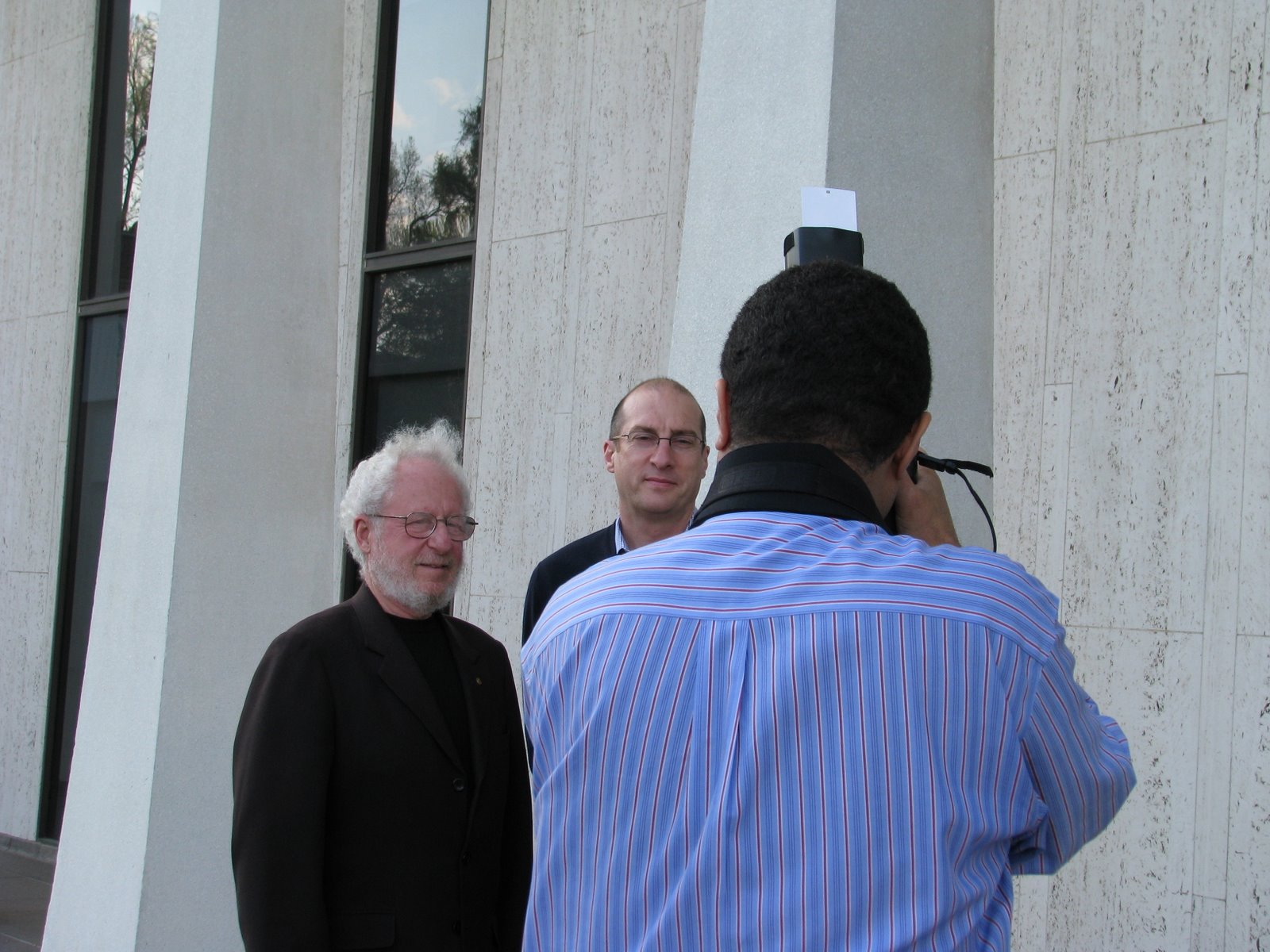
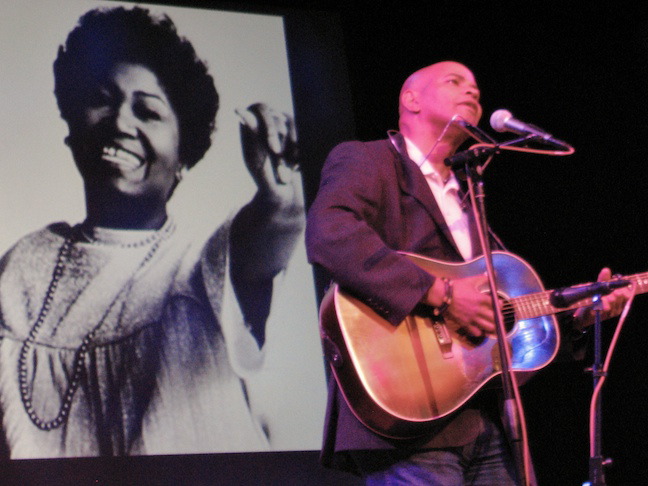
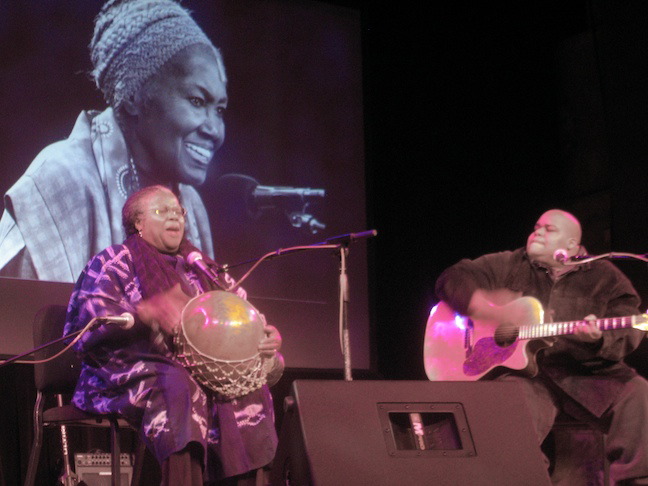
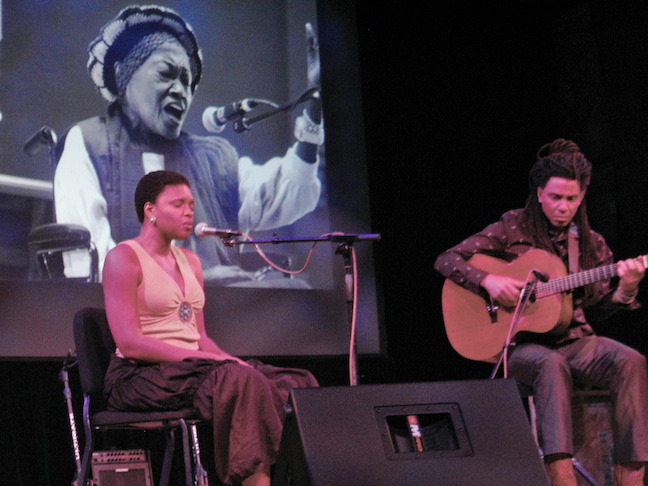
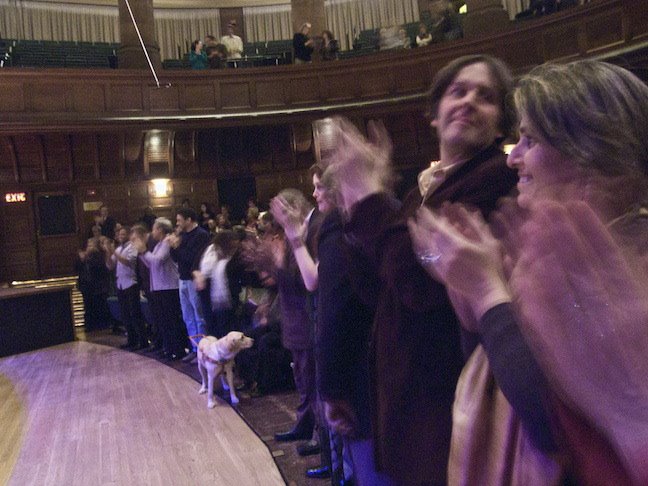
“She told us who we had been, and challenged us not to look away,” said Matthew Frye Jacobson of Odetta. Jacobson spoke at the wonderful tribute concert for “Odetta, the Queen of Folk,” at Princeton University on April 9. Jacobson, who is white, is a Yale professor working on a book, “Odetta’s Voice and Other Weapons: The Civil Rights Era as Cultural History.”

Thanks to Stephanie F. Black for these beautiful photos.

“White guilt is not what I’m talking about,” said Jacobson. “I’m talking about awareness.” With songs full of pain, telling about chapters of both white history and black history, Odetta “told us something important about who we might be.”

This rang true for me, as a group I belong to, Not in Our Town, prepares for a workshop entitled “Engaging Together to Explore White Privilege.” Perhaps this workshop can help us all to explore “who we might be.”

The first session will focus on notions of identity and privilege. The next two sessions will consider ways that white privilege hurts not only people of color, but also white people. Building on the consciousness raised and the understanding acquired, the final session will engage participants in considering how they can open their hearts to incorporate into their life’s work an active confrontation of racism.

Sources will include Unpacking the Backpack of White Privilege by Peggy McIntosh, Learning to be White by Thandeka, White Like Me by Tim Wise and the video Mirrors of Privilege.

The workshop continues Monday, April 20, and Monday, May 10 at 7:30 p.m. at Princeton Public Library. It is free, and though pre-registration at niot.princeton@gmail.com
is available, it is not required.

From Ivory (Gothic) Tower to Marketplace


It took two hours to give away $40,000 — 25 minutes of introductions, less than an hour for a dozen contestants to speak for three minutes each, and about 40 minutes for the judges (Shahram Hejzi, Ralph Taylor-Smith, Joyce Tsang, and Tom Uhlman) to make their decision. At Princeton University’s Innovation Forum held last night, a cancer therapy was deemed the most valuable tech transfer opportunity.

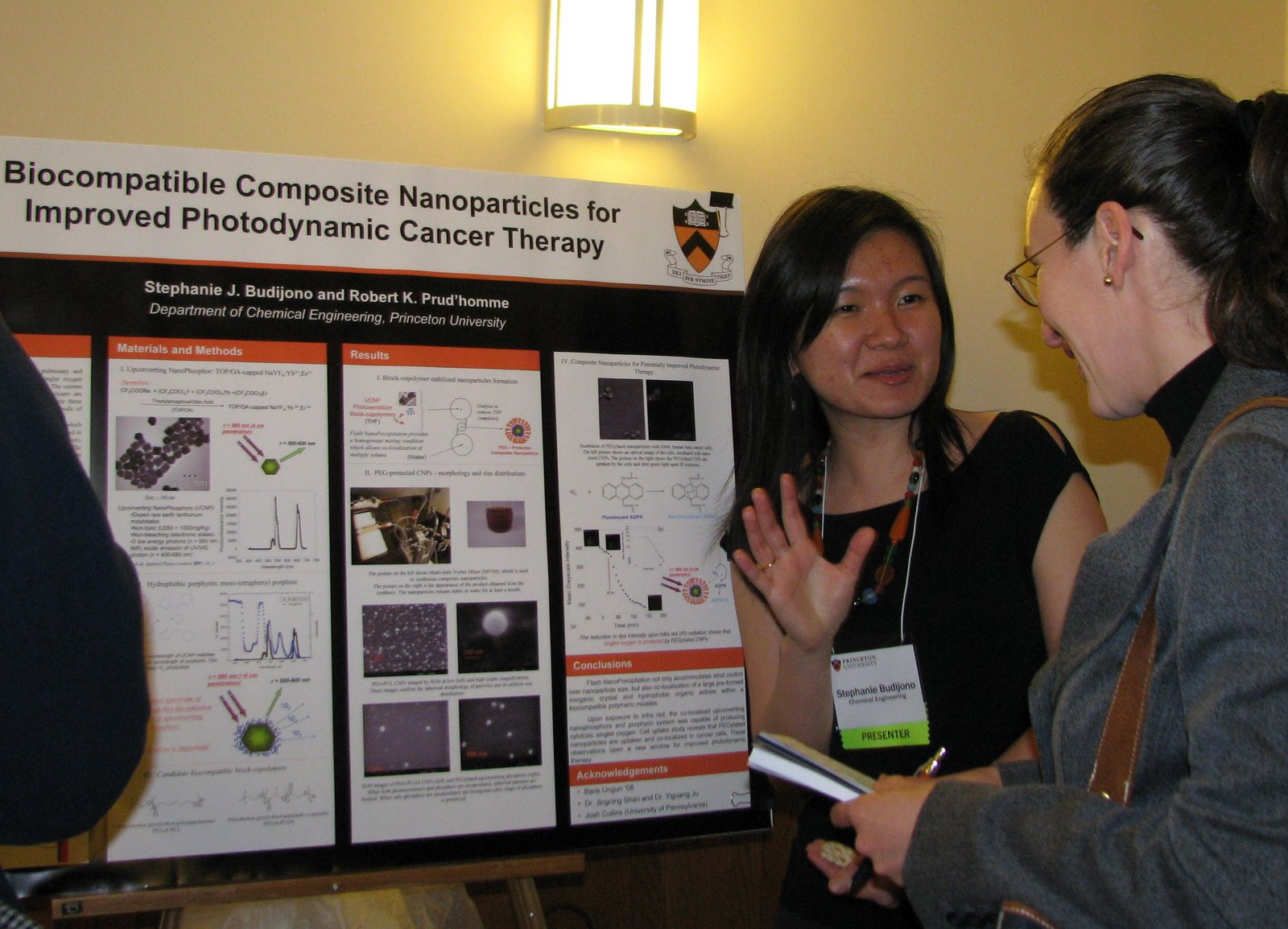
Stephanie Budijono, a chemical engineer in Robert Prud’homme’s group (pictured, with Dora Mitchell of Battelle Ventures), won the $25,000 grand prize from the Jumpstart New Jersey Angel Network for “Deep-penetrating Upconverting Nanoparticles for Photodynamic Cancer Therapy.” By using stealth pegylated particles and infrared activation, her therapy can improve light penetration and reach cancer cells that lie deep within the lungs.

Second prize for $10,000 went to Stephen So, working with Gerard Wysocki, for laser spectroscopy to detect trace gases in the air. The device, the size of a plastic bottle, works unattended and uses AA batteries. Bomb sniffing dogs can’t work 24/7, but this device can. It also has health applications (monitoring patients at home) and environmental monitoring potential.

Vivek Pai’s edge acceleration box for slow networks, called EdgeXL, won the $5k third prize.

Peter Reczek, who has been executive director of the New Jersey Commission on Science & Technology since last May, encouraged Oliver Graudejus, an electrical engineer who is working with Sigurd Wagner on a medical device, a tissue-like electronic interface. Medical devices represent the future of healthcare innovation, says Reczek, in terms of collaborations across many disciplines – biology, engineering, math, and physics — that can achieve commercial success.

The other nine entrants may not have won any prize money, but they got some good exposure — the denizens of Einstein’s Alley turned out in force, pretty much filling the large hall, Computer Science 104. And now their poster and three-minute pitch are ready for the next opportunity.

Bob Monsour, of the Keller Center, emceed the event, and said the judges had an easy time of it. I thought that might be a bit unfair, because there were some other great ideas, but perhaps they weren’t commercially viable.

Least likely to succeed in my opinion and in the opinion of an observer I can’t name, was a double MRI machine that could hold two people, useful for studying interpersonal communication. The inventors claimed that it would save money to do two MRIs at the same time.

Now who is going to sign up to snuggle up with a stranger to get their insides photographed? Nobody.