Hear success journeys at the Princeton Chamber’s Independent Business Summit on Thursday, with a panel that includes Peter Dawson (Leigh Imaging), Scott Needham (Princeton Air), and Jessica Durrie (Small World Coffee). Pictures to view, clean air to breathe, and caffeine to drink — they are three ‘gotta have’ products! It will be interesting to follow their proprietors’ journeys.
All posts by bfiggefox
Pride and Prejudice review, illustrated
Here is my review of Douglas Martin’s ‘Pride and Prejudice’ as published in U.S. 1 Newspaper on April 26, but with the addition of the excellent photos by Leighton Chen.

Jane Austen’s novel “Pride and Prejudice” is set in 1813 Regency England, where passions smolder under the veneer of a determinedly genteel society. As choreographer/librettist Douglas Martin and his team translate that novel, they hit ballet’s sweet spot. Gentility is, after all, basic to classical ballet.
This ground-breaking American Repertory Ballet production, premiered to a packed McCarter Theater on April 21, is a Douglas Martin triumph. No longer do I want to see the movie. Each character portrayed by the dancers is etched in my mind.
Every element of dance theater — character-based movement, mime, juxtapositions, props, exquisitely beautiful designs by A. Christina Gianinni, music played by the Princeton Symphony Orchestra, even a surround-sound score of horses’ hooves and birds singing — helps to tell the story.
With no program synopsis, it helps to know the novel that chronicles the unfolding romance involving the witty and judgmental Elizabeth Bennet and the rich and aloof Fitzwilliam Darcy, though some characters are easy to pick out on stage.
Ballet mistress Mary Barton, wonderful as Elizabeth’s mother, Mrs. Bennet, points to the ring finger of any single man in sight and inserts her dithery head-shaking everywhere she shouldn’t.
Kathleen Moore Tovar, formerly a principal with American Ballet Theater, also shows the young’uns how. As Darcy’s aunt, Lady Catherine, she cuts a skirt-swishing officious swathe, punctuating her snobbish opinions by up-jerking her knee.

Aldeir Montero, new to the company, is obviously Bingley, Darcy’s genial friend. With his every lunge and leap, opening himself to the audience, he exudes friendliness, in contrast to Mattia Pallozzi, who plays Darcy.
At the ball, contemptuously looking over his shoulder, Darcy clings to himself, with one Napoleonic arm in front, the other in back.

Austap Kymko, as the black-clad unctuous clergyman Collins, oozes himself from one hilarious misstep to another
 but smooths out some of the clumsiness after he marries Elizabeth’s dear friend Charlotte (Shaye Firer).

Gentility does not always prevail. When giddy youngest sister Lydia Bennet (Nanako Yamamoto) runs off with handsome seducer Wickham (Jacopo Jannelli) their bawdy sex scene rips off the veil of decorum and suddenly we seem to be looking at contemporary dance.
When Elizabeth (evocatively danced by Monica Giragosian) refuses Collins, the pragmatic Charlotte literally jumps on his back to claim him.
Mime? Throughout, and often extended into dance. When Elizabeth questions Charlotte about marrying Collins, the friends circle and touch their hands to the brows, then extend their arms out straight, question, answer, question, answer.
Juxtapositions enable insights.

Charlotte, in a not-so-good marriage, parallels the movement of the eldest Bennet sister, Jane (Lily Saito), who has been moping in a house on the other side of the stage, waiting for a suitor who does not arrive.
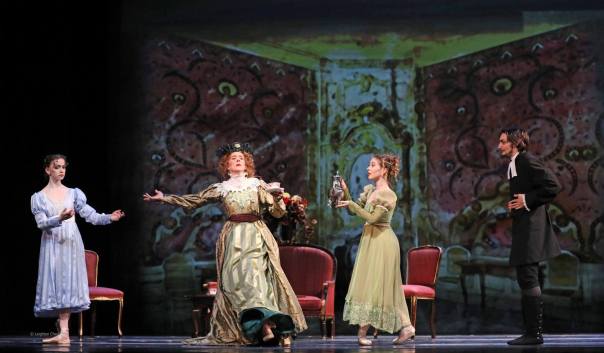
And an incident with a prop, a teapot, shrinks a storyline when Elizabeth outwits Lady Catherine, who has determined that Elizabeth will not be the one to pour her tea.
Scenic projections and costumes were beyond splendid. One that helped the story line was the headpiece of Caroline Bingley, which made a tall dancer (newcomer Erikka Reenstierna-Cates) an even taller and more formidable opponent to the success of the Bennet women.
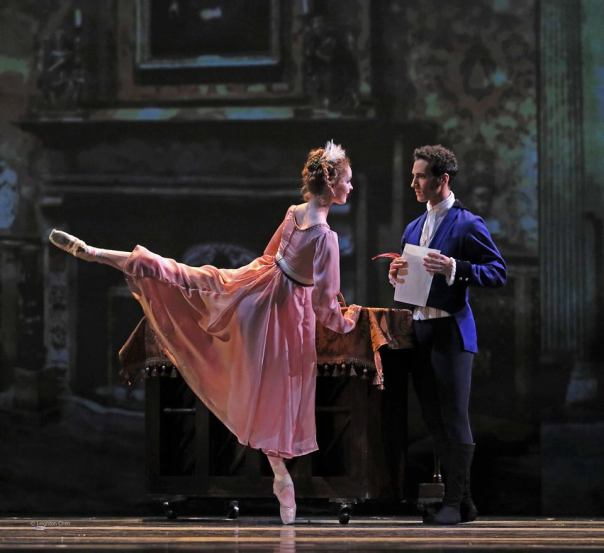
There is much excellent dancing in this 140-minute ballet — lots of women on stage at one time, and many chances for men to do double turns and land on one knee.
Music was by composers that were Austen’s favorites (U.S. 1, April 19). Each worked well for that particular dance and was vibrantly played by the PSO, directed by John Devlin. They did not build to the kind of climax that comes with Tchaikovsky ballets, but at moments of high emotion Martin inserted duets by Schubert or Mendelssohn, played by pianist Jonathan Benjamin with either cellist Michael Katz or violinist Grace Park.
The dramatic climax comes, of course, when Jane and Elizabeth get their men. Jane’s longed-for pas de deux with Bingley is simple joy — quick quivering beats with gentle lifts and expansive arabesques.
Elizabeth, in contrast, has spent most of the evening rejecting Darcy. Conflicted, he rarely offers open gestures and his first proposal is, literally, backhanded. With his back to the audience he twists himself into saying, in tightly gripped movement, that he loves her in spite of himself. She flounces off. Then, when she is devastated by the Wickham scandal, Darcy signals his desire to help with an expressive leg movement — an open rond de jambe — and sets out to fix the situation.
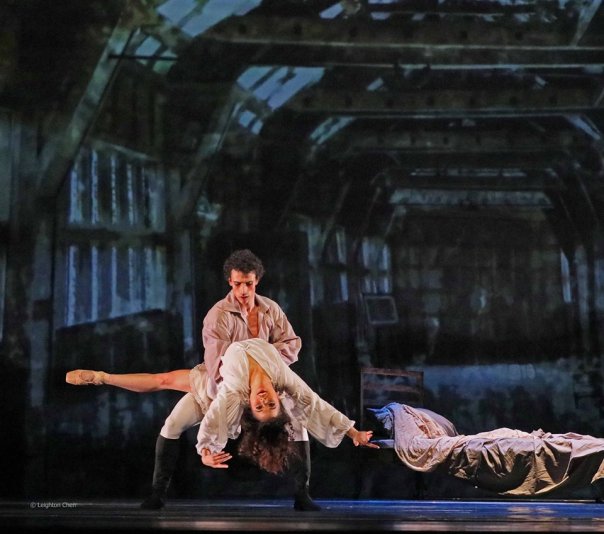
 Upon his return, as she stretches arms-wide in longing, he catches her in mid air, and she curls her head on his shoulder in delight. Again, she stretches to the nth, and curls around him.
The once haughty Darcy lies down behind her, his head by her knee, in an act of obeisance, and the audience erupts in applause.
(Addendum: In this video of a rehearsal, the first bit is Elizabeth dancing with the dastardly but charming Wickham. In the second, she dances with Darcy after she loves him. In the fourth scene Caroline obnoxiously separates Elizabeth from Darcy.)
Douglas Martin’s Triumph
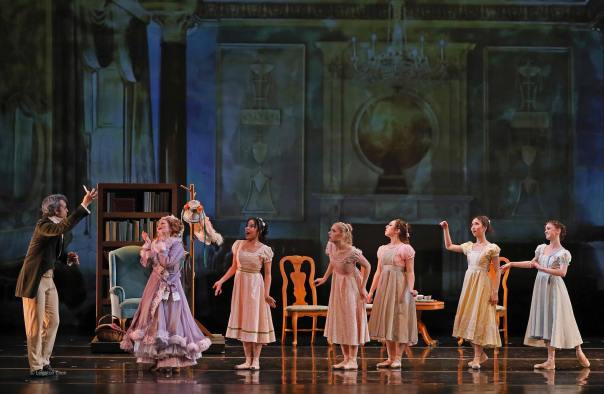
Rarely do I venture out of retirement to write a dance review, but a gaping hole needed to be filled. American Repertory Ballet premiered a full-length ballet about the classic novel “Pride and Prejudice,” and the arts editor of U.S. 1 Newspaper, Dan Aubrey, said “We need to review this” so here it is.
If given more space, I would more strongly emphasize that if you like to know what is going on, you need to study the book carefully. So much happens between so many people that it’s hard to follow. I am not a student of Austen, had not paid attention to any of the pre-event publicity, and barely had time to scan SparkNotes and it wasn’t enough. I’d have done better looking at the pictures, on ARB’s Facebook page, of the characters in costume — as pictured above, the Bennett family in the second scene, Mr. Bennet brandishing the invitation to the ball. In the first scene he visited Bingley and Darcy to obtain it. You’d have been quite puzzled by that scene if you didn’t know the story.
Also hard to fit in the assigned space — the real joy of watching these dancers liberated from tape by the Princeton Symphony Orchestra. The production values were fabulous.
For a similar opinion, here is Robert Johnson’s review.
Youth Talk about Race: Saturday morning

Two important discussions, among youth, take place Saturday morning. The local one welcomes all but requires reservations. Anyone can just show up to the national event.
On April 29, the Minority Student Achievement Network (MSAN) and PULSE youth organizations of Princeton High School will bring together students, parents, teachers, school staff, community partners and organizations for a day of discussions on current topics impacting our schools and community. In addition to hearing from guest motivational speaker Jonice Arthur, participants will have opportunities to dialogue in small groups, hear from a student-led panel, and enjoy lunch while engaging and encouraging our future leaders.
The event will take place from 9 am to 1 pm at Princeton High School 151 Moore Street Princeton, NJ 08541. RSVP required.

Also on Saturday morning, April 29, 7:45 a.m. to 12:30 p.m., the Princeton Prize in Race Relations invitest the community to its symposium. Held in Dodds Auditorium, Robertson Hall, it begins with a continental breakfast and the program starts at 8:30 a.m. The Princeton Prize in Race Relations (PPRR) recognizes and rewards high school students who have had a significant positive impact through volunteerism on race relations in their schools or communities.
The prize winners participate in four panels, followed by an 11 a.m. keynote address, “A Woke Democracy,” by Cornell William Brooks, president of the NAACP. Members of the community are warmly invited to attend. No registration is needed.
Boehm birds still fly

Einstein’s Seder
An account of Albert Einstein celebrating the Passover in Princeton, in New Jersey Monthly

Listening to the Liturgical Year

In a NYT article, Choral Music is Slow Food for the Soul, composer Nico Muhly has wise observations about how “the choral tradition operated in a series of interlocking cycles based on the liturgical year, with the music and the musicians playing a role in a larger drama.” Rather than expecting applause, church choir singing is “meant for worship…to be heard in a state of quiet meditation.. to guide the mind out of the building into unseen heights and depths.”
Muhly’s essay is meant to be a paean to Andrew Gant’s book O Sing Unto the Lord: A History of English Church Music. For me, it’s an affirmation of how — week after week, sitting in a church pew, listening to the Princeton United Methodist Church’s Chancel Choir — opens up my spiritual horizons. I am also inspired by the special music offered during Holy Week. This year Hyosang Park directs Anton Bruckner’s Requiem on Good Friday, April 14, at 7:30 p.m.,
As Muhly points out, live concerts of liturgical music follow the calendar. He finds himself “looking forward to a work’s annual visits as I would the arrival of a long-distant friend.”
Other notable choral concerts of the season — the Brahms Requiem by the Voices chorale on April 8, the Princeton Theological Seminary Choir on April 22, the Bulgarian State Women’s Choir on April 17.
Choristers — and attentive listeners — will agree with Muhly, that the liturgical tradition of choral music brings “sharp pangs of nostalgia, followed by a sense of gratitude that this tradition has been such an important part of my musical world.”
FYI: At Princeton United Methodist Church, the Chancel Choir, directed by Hyosang Park, sings at the 11 a.m. worship service. Tom Shelton directs the Youth Choir (at 9:30 a.m. on first Sundays) and the Children’s Choir (at 9:30 a.m. on second Sundays). The Handbell Choir, directed by Park, plays at both services on third Sundays, and a contemporary ensemble plays at both times on fourth Sundays. Everyone’s welcome to — just listen.
Sexism on the Hill
Subtle sexism is so precarious because it is thought-provoking — for the targets. Management and psychology researchers Dr. Eden King and Dr. Kristen Jones have found that implicit biases can actually be more harmful than outright discrimination for several reasons, including: the higher frequency with which they occur, the lack of clear legal recourse, and the amount of time women spend analyzing these perceived slights.
A former Congressional staffer writes about sexism in the Athena Talks blog on Medium.
This quote has interesting parallels to racism.
To be clear, this concern over sexism in the workplace was not part of my experience.
Bridgegate: Now Bordergate?
A Canadian mission team, ages 15 to 60, aiming to help rebuild homes from Superstorm Sandy was turned away at the border, according to this report.
They were to be hosted by a church whose minister, Rev. Seth Kaper-Dale of the Reformed Church of Highland Park, has been labeled “a vocal critic of Trump’s immigration orders.” (He is also the Green Party candidate for governor.)
According to the Customs and Border Patrol, they lacked the government letter needed to prove the project is needed. But mission teams have, for years, entered the United States from Canada without such documentation.
This group of teenagers and parents was told, by the immigration officials, that there was a danger that they might take away American jobs — and that there was no more need for home rebuilding resulting from Superstorm Sandy. No more need? Four years after the storm, more than 4,000 people have not recovered. Churches in New Jersey — including my own, the United Methodist Church of Greater New Jersey — are still working and collecting donations to get people back in their homes.
Does this seem like payback to you?
At the minimum, the United States loses tourist dollars. And trust. According to this report in The Guardian the Girl Guides of Canada have canceled all trips to the United States.
Why do the salamanders cross the road?

I can’t say that I like salamanders but I have an affection for them. My summer job at age 13 was feeding strips of beef liver to their cousins, Mexican axolotls, in the Figge lab.
This is the season when the salamanders cross the Beekman Road in East Brunswick. (No chicken jokes, please) And they need protection. Locals have organized to keep them being run over in the middle of the night, as described in this Packet story by Vashti Harris.
I went once, armed with a flashlight, and I did see one spotted salamander cross the road. It was exciting. What I mostly remember is the choral din of the spring peepers.
When to go? When the salamanders decide it’s time, on a warm night. Here’s how to plan your trip. Take the family but give each child a flashlight so they DON’T step on one.
Here’s what they look like — nothing like their Mexican cousins, which reach adulthood without undergoing metamorphosis. They never develop lungs, never walk on land — they keep their gills.
Axolotl photo from Wikipedia. Spotted Salamander photo from Friends of the East Burnswick Environmental Commission.
 Princeton Comment