All posts by bfiggefox

No longer overwhelmed spectators: NIOT

P1080025
Marietta Taylor, long-time NIOT Princeton activist, with me, at the Unity Awards 6-5-15

For those of us who can’t watch sad or scary things (Simona, this is for you!) here is a New York Times article, The Benefits of Despair, suggesting that’s the reason why we are activists. “A feeling of general badness calls for no specific actions, you feel lousy and trapped by your circumstances.” But with what Lisa Feldman Barrett calls “higher emotional granularity,” you might react with a “more specific emotion, such as righteous indignation, which entails the possibility of specific action…You are no longer an overwhelmed spectator but an active participant.”

Yesterday’s Not in Our Town Princeton’s Unity Awards Ceremony, where we heard the inspiring stories of eight activist young people, ratcheted up my “emotional granularity.” Hurray, hurray, and hurray! Read about it here.

P1080029 lineup
some past and present board members of NIOT Princeton at the Unity Awards 6-5-15

Transforming mental health: Janssen’s Kramer

Craig Kramer works for healthcare firm Janssen, but he and his wife had their own personal health challenge: Their daughter suffered from an eating disorder. Kramer speaks at the Princeton Regional Chamber luncheon on Thursday, June 2, 11:30 a.m. at the Forrestal Marriott. His topic: The business case for transforming mental health.

‘Art flows out of my studio’

Heather Barros, talented artist/teacher, has an exhibit at the D&R Greenway through June 17. Janet Purcell wrote about it here 

Reunions: Faith & Work Initiative

A dual career couple will be at the podium on Friday, May 27, 3 p.m.in the Faith and Work Initiative , part of Princeton University Reunions Weekend. On the panel: Marian Ott ’76 S75 P06, Chairman of the Nashville Metropolitan Transit Authority, President of the Tennessee League of Women Voters, Civic Leader, Volunteer and Activist; and Craig Philip ’75 S76 P06, retired CEO of Ingram Barge; now research professor, Vanderbilt University. It’s free at McCosh Hall Room 4.

‘She can make you a dancer…

. . . even if you never danced before. ‘

That’s a quote from the “Rate my professor’ page for Janell Byrne, who quietly retires as director of Mercer Dance Ensemble after, by my count, 36 years at Mer2016 5 toxiccer County Community College. (Her 30th anniversary concert was in 2010).

I’ve attended almost all of these concerts and this stands top of the list. Perhaps I’ll have time to explain why later, but I’m sending this out now because the final performance is today, Sunday, May 22 at 2 p.m. at Kelsey Theatre.

Here is the list of MCCC dancers: Amy Annucci of Ewing, Kayla Johnson of Wrightstown, Caitlin Kazanski of Robbinsville, Diego Montealegre of Lawrence, Terrell Moody of East Windsor, Sabrina Rahman of Lawrenceville, Brianna Rapp of East Windsor, Victoria Smalls of Hamilton Township, and Kourtney Tremaine of Trenton. Alumni and community dancers include Rebecca Brodowski, Nicole Colossi, Maleek Colvin, Jennifer Gladney, Delany Hoffman, Maria Laurenti, Stephanie Maher, Danielle Marchant, Ashley Miller and Taylor Miler.

Few choreographers have had Byrne’s opportunity — and burden — to produce, every year, handfuls of imaginative works on dancers of various body types and abilities. I love to see how she does it, how she makes dancers out of people who never danced before.


Review: Puerto Rican Soundscapes

Princeton Comment is delighted to welcome Oscar J. Montero, professor emeritus at Lehman College. He reviewed the improvisations staged by Alicia Diaz (a Princeton native) and Hector Coco Barez on May 14 at Hunter College.  

alicia 2

Princeton Comment is delighted to welcome Oscar J. Montero, professor emeritus at Lehman College. He reviewed the improvisations staged by Alicia Diaz (a Princeton native) and Hector Coco Barez on May 14 at Hunter College.

During Puerto Rican Soundscapes, a music colloquium at the Center for Puerto Rican Studies, Alfonso Fuentes tapped a key on the piano to launch into a compelling improvisational riff. Improvisation, he said, is at the core of his musical work.  Iranian scales led to melodic asides echoing the traditional Puerto Rican plena in recurring counterpoints.  In his performance Fuentes underscored the tensions in his work between improvisation and tradition, that is, between the individual’s creative quest and collective forms that belong to no one but are shared and reshaped from one generation to the next.  The work of dancer Alicia Díaz and musician Héctor Coco Barez brought to the “soundscape”of the colloquium its own improvisations.  The dancer and the musician centered their performance on suggestive counterpoints between body and sound, between movement and music, between the visual and the aural.  

In her comments throughout the performance, Alicia Diaz suggests identities that take shape precisely, and perhaps only, through improvisation and dialogue.   Notions about identity as a fortress to be defended have been contrasted to identities as series of ongoing personal and political negotiations. Especially for dwellers in one form or another of exile, national identity as a place of origin is at best a nostalgic narrative; at worst, the troubling memory of violence and loss.   The vibrant collaboration between Barez and Díaz maps out other places in the complex field of our identities, inviting the audience to see in them not the finality of theplace we can name as our origin but the ongoing creation of shared spaces where our own pleasures and anxieties about who we are and where we come from may be performed.

diaz 2016Díaz’s agile, remarkably precise movements are flowing at times, cut sharp at others.  During the question/answer period, a person in the audience mentioned the pioneering work of José Limón, implicit in Díaz’s highly personal choreography.  Yet while fluent in the vocabulary of modern choreography, Díaz dances bomba, steeped in the traditions of Puerto Rico, and riffs on the resonance of such a loaded quotation in her work.  Bomba’s relationship to a Puerto Rican identity may be said to be seamless.  Its roots are found not just in specific locales and well-known historical circumstances but in Puerto Rican families.  Díaz mentioned the teaching of Tata Cepeda, a member of one such family and one of the contemporary heirs of the legacy of bomba.  Yet a folk dance, performed today in various settings, may approach stereotypes that can flatten identity for easy consumption, a process evident to me, a Cuban, as I see dancers in Havana dressed in Brazilian costumes entertaining a new wave of tourists with our famous rumbas.  The physical replies danced by Díaz to Barez’s music demonstrate the possibilities and the limits of an improvisation informed both by the individual’s quest and by powerful traditions.  Their work suggest to me that when words fail us, and their destiny is to do so, the body and its music can help us reconsider other options, help us perhaps to come back around to words and new narratives that might see us through.  In a moment of political uncertainty and economic turmoil, not only for Puerto Rico but for the world we live in, the value of our traditions and their inflection through our own experiences, indeed our own bodies, informs the urgent quest of these Puerto Rican dancers, musicians and writers, a quest valid in its own right and for what it might offer to others now and down the road.

Oscar J. Montero

Professor emeritus, Lehman College, City University of New York

NY NY May 15, 2016

Chuck’s Cafe in the Limelight Again

According to the New York Times today, the Menendez brothers will be featured in a true crime series next season.

NBC is developing a “Law and Order” true crime series (the first season is based on the Menendez brothers).

Those of us who were here at the time remember that the brothers owned the Buffalo wing eater on Spring Street. Will attention increase business? Somebody’s going to make money on this story. Again.

Isadora – uncinctured

isadora
1900-1901 Getty Images: Photographer Ullstein Bild 

I can’t resist calling attention to this 1927 New Yorker article on Isadora Duncan written while she was still alive. It came to me in a David Remnick newsletter with the theme “Bohemians.” If only I had asked my mother, who would have been 28 years old, what she and her mother thought of Isadora then. Janet Flanner wrote:

A Paris couturier recently said woman’s modern freedom in dress is largely due to Isadora. She was the first artist to appear uncinctured, barefooted and free. She arrived like a glorious bounding Minerva in the midst of a cautious corseted decade. The clergy, hearing of (though supposedly without ever seeing) her bare calf, denounced it as violently as if it had been golden…

She has had friends. What she needed was an entire government. She had checkbooks. Her scope called for a national treasury. It is not for nothing that she is hailed by her first name only as queens have been, were they great Catherines or Marie Antoinettes.  

As you read it, listen to Chopin and Strauss, then watch one of the videos. Or look at ‘The Revolutionary,” (to Scriabin, 1923) where she used gravity (movement with weight) to foment both a political and an aesthetic revolution.

Imagine watching Isadora dance in chiffon gauze while you, like my grandmother, are laced in a corset.

Engulfing Experience: Fox or Hedgehog?

serra sfHave you forgotten about, or have your ever even seen, the giant sculpture jewel of Princeton’s campus, the Richard Serra sculpture? Two New York Times articles in the past two days made me want to go back and ‘walk’ the tunnel again. On May 12 Ken Johnson dubbed  Serra the “greatest living sculptor of Minimalist abstraction” and suggested that to view Serra’s work currently at the Gagosian Gallery was “an engulfing experience…Moving through the construction, you become acutely attuned to sight, touch and sound and to your own being in time and space. Consciousness itself becomes an object of consciousness.”  Today’s article on San Francisco’s MoMA features a Jason Henry photo (above) of the Serra sculpture at the museum’s entrance.

hedgehog fox

Serra’s 2010 sculpture, behind the Lewis Library (my photo above), is known as “The Fox and the Hedgehog.” As described on the campus web page, Industrial yet sensual, this massive sculpture invites visitors to walk through its steel curves in order to experience art, space, and environment in a physical way. The title, taken from an Isaiah Berlin essay on Tolstoy, quotes the Greek poet Archilochus: “The fox knows many things, but the hedgehog knows one great thing.” Serra extends this proposition as a question to students—will you be a fox or a hedgehog?

I am not a minimalist. Anyone who has been in my house knows that. But I like to feast my eyes on uncluttered space and put my body between the comforting metal walls of the Serra sculpture. If you haven’t tried it — do, and you can decide if you want to be the Fox or the Hedgehog. For me, that decision has already been made.


‘Grit is downstream from longing’

1973 BFF_at_SRV“The G.P.A. ethos takes spirited children and pushes them to be hard working but complaisant.” So said David Brooks in the New York Times in a column I want to keep, hence I’m writing about it now. Read it here and we can compare notes. Brooks says striving for the highest grades is “one of the more destructive elements in American education.”

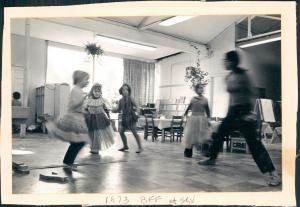
I’ve been thinking about this since the ’70s when I watched children enrolled at a private progressive school, School in Rose Valley, which encouraged individual enthusiasm. I taught there for a year, as at left. When students transferred to public school. I saw lust for creativity at least temporarily squashed. At least those children didn’t succumb to “high GPA fever” as evidenced by OK but not outstanding grade averages.

Then we moved to  Princeton where some fight tooth and nail for GPA honors. Grade mongering is also rampant in neighboring districts, dare I finger West Windsor-Plainsboro? (As an aside, parents choose this value when they buy a house  according to a column in the Washington Post:  “Forty to fifty years of social-science research tells us what an important context neighborhoods are, so buying a neighborhood is probably one of the most important things you can do for your kid,” says Ann Owens, a sociologist at the University of Southern California.)

But arduous pursuit of grades is not all bad, according to Angela Duckworth, a MacArthur fellow and author of the new book “Grit: the power of passion and perseverance” as quoted by Brooks. People with grit also have a high moral purpose, she says, and “they know in a very very deep way what it is that they want. Everybody’s life is organized around some longing.”

fhjf grading papers with E
Frank H. J. Figge at the dining room table, with a granddaughter working alongside.

That helps explain my own motivation. I grew up with parents who took their work home, who worked all hours of the day and night to Get Things Done. My father taught medical school, did cancer research, and edited anatomy volumes. My mother helped him. They exemplified grit, a passion to succeed that was organized, not around grades, but around what you could accomplish. Drawn in also, to help, my sister and I absorbed the self discipline that, as Brooks points out, can lead to career success.

How do you teach this, or can it be taught? Can it be only absorbed? Brooks says that people with grit have a strong inner desire. “Grit is thus downstream from desire. People need a powerful why if they are going to be able to endure any how.”

Duckworth says that schools could be designed — not to encourage scrabbling for grades but to “elevate and intensify longings.” In a school like that,  Brooks suggests, “you might even deemphasize the G.P.A. mentality, which puts a tether on passionate interests and substitutes other people’s longings for the student’s own.”

When I talk to high school seniors, as an alumna interviewer of a selective college, it’s hard to differentiate between an overprogrammed student who has been coached to be enthusiastic about a cause and one who has a true deep passion for a cause. Then I wonder — isn’t it OK to find your passion later in life? Yes, I decided, if you established your “grit” when you were young.– Barbara Fox