Category Archives: Faith and Social Justice

items from Not in Our Town Princeton (http://niotprinceton.org) and Princeton United Methodist Church (http://princetonumc.org)

Scripture Tour: Princeton University Chapel

earlymorning_MG_5524_575

When the Pedaling Parsonsministers riding bikes to raise money for missions — toured Princeton, their favorite spot was  the beautiful Princeton University Chapel. Here is the virtual tour with details on the choir loft carved from wood found in Sherwood Forest, and pews made from gun carriages. 

What is the scripture for this? My pick is Isaiah 2:4 and what’s yours?

It was built in 1928 for $2 million after the Marquand Chapel was destroyed in a fire.  The intent was, according to the University history, “to permit the University to maintain its religious heritage, but in a manner that recognized its public mission in an increasingly multicultural society.” I told them about the community -wide services at Thanksgiving and we commiserated on the sad fact that the University Chapel services are held, invariably, at the same time as the PUMC services. Tour it online here.


Photo by Steve McDonald.

The Peddling Parsons’ mission target this year is “Stopping Random Violence Before it Happens: investing in children and youth programming at local community centers.” office@northcantongrace.org

Spin the Wheel — Preserve the Sourlands

Two “do-good” events come up in the next 18 hours. Will you be stopping by the Plaza Palooza this afternoon, 4:30 to 7:30 p.m.? I’ll be at the table sponsored by Princeton United Methodist Church and United Front Against Riverblindness. We’ll have a “Help Us Help Others” Wheel — for $1 you get to spin the wheel and either win a prize — or your dollar goes to the charity that the wheel chooses. It’s fun. At the other tables you’ll meet area business folks, get free tastings and lots of giveaways. BAI water will be there, sure to be a hit in the heat! It’s free and a great place to network.

Bryson
Tomorrow morning, Wednesday, Jennifer Bryson will speak at the Princeton Chamber breakfast on one of her recent exciting endeavors.  For two years she had worked for the Department of Defense at Guantanomo Bay. Now her day job involves partnering with Muslim advocates for religious freedom, but she also campaigns to defend the Sourland Mountains from encroachment. Bryson (Stanford, Yale) is currently teaching at the Army War College.

I’m not always in agreement with preservationists (I’m siding with the Institute of Advanced Study re building on its property). Hear what Bryson has to say and make up your own mind about the 90 square miles of the Sourland Mountains, New Jersey’s “last great wilderness.” Everybody can come to this breakfast for the reduced member price, $25, and it’s great networking.

Align the Body as Well as the Soul

Make straight paths for your feet, so that what is lame may not be put out of joint, but rather be healed. Hebrews 12:13

I came across this verse in today’s Moravian Daily Texts, an ecumenical devotional guide read by 1.5 million in 50 languages. Though the writer of Hebrews surely meant spiritual healing, the same principle — align yourself correctly to be healthy — applies to the physical body as well.

With my Pilates instructor, Katrine, I am currently trying to heal tendinitis in a shoulder joint — partly by trying to learn to use my arm in a better way. And with a physical therapist, Jeff, I am retraining my jaw to open in a normal way. (Loquacious as I am, my mandible is abnormally tight.)

So it occurs to me that Hebrews 12:13 could be the mantra for Pilates and physical therapy. If your body is not aligned correctly, it develops bad habits until eventually you are “out of joint.” Pilates trainers and physical therapists discern alignment problems; they heal.

For your interest, here is the entire selection. The long passages (Psalms, Hebrew Bible, New Testament) at the top are from the “lectionary,” the verses read and preached upon by most Christian churches for this week. The Hebrew Bible verse (Ezekiel for today)  is chosen by lot during the previous year. A minister chooses the New Testament verse to go with it — and composes the prayer.

Moravian Daily Texts

Friday, July 12 – Psalm 83:13-18 Isaiah 32:1-33:16; Ephesians 5:21-33

They shall live in safety, and no one shall make them afraid. Ezekiel 34:28
Make straight paths for your feet, so that what is lame may not be put out of joint, but rather be healed. Hebrews 12:13
Like a comforting mother, hold me this day, Lord, with the tender touch that kisses our wounds and rubs our shoulder and keeps us safe when we fall or even fail. Thank you Lord. Amen.

‘She’s So Smart.’ Duh. Why Diversity Matters

Angela Amar, an African American nurse and Robert Wood Johnson Foundation Nurse Faculty Scholar, tells of an incident when a patient’s wife referred to her as “a lil’ colored girl here to see you.”
That was one issue to for her to work through, but Amar reveals the bigger issue is when her students say she is “smart.” Faculty members are supposed to be intelligent, Amar points out. Her white colleagues do not hear the same compliment.
“So, is it something that is remarkable because I am a woman of color? Am I an exception? Does my mere presence challenge students’ perceptions of African Americans?” Yes, her presence does challenge perceptions. She is effective as a mentor for minorities, but even more as a challenge to stereotypes that the majority holds.
Amar currently works in Georgia, and I don’t know where the “lil colored girl” incident took place, but let me make it plain to my Southern friends that I realize Northerners can be equally steeped in harmful stereotypes.
Here is the link, again, to Amar’s essay, and I’ll let her have the last word:
Diversity is not a one-way glass that only directs light in one direction. Diversity is a window—it lets light in and out. The benefits and opportunities of diversity are not just for the individuals who bring the diversity to the environment; diversity benefits everyone.

War Stories at WIBA

“Coveting Not the Corner Office, but Time at Home,” a July 7 article in the New York times, resonated with me, as I am sure it did with thousands of women. It begins:

Sara Uttech has not spent much of her career so far worrying about “leaning in.” Instead, she has mostly been hanging on, trying to find ways to get her career to accommodate her family life, rather than the other way around.

I’d been pondering the balance between career and family as I prepared my speech for the WIBA “Women of Achievement” breakfast last month.

Along with three other women (Denise Taylor, Danielle Gletow, and Barbara Hillier) I was “honored to be honored” at this event. Richard K. Rein, my ex-boss at U.S. 1, wrote an “outsider” column about it, outsider because he was a man at a predominently female gathering. Rich comments that Hillier was the one who put the career balance thing in context. She used the familiar Ginger Rogers metaphor (does everything that Fred Astaire does, but backwards and in high heels) but it is oh so true.

In the ’60s, ’70s, and even ’80s, women did not have so many choices as we do now. But living with limited horizons can be easier. Each of us must find her own way.

Marion Reinson — whom I know from the chamber program committee and the former Einstein Alley Entrepreneur’s Group — wrote a sweetly complimentary account of the WIBA awards breakfast. I posted it on my personal blog for my grandchildren to read someday.

It’s more difficult than you’d think to be praised in public, but it was a truly wonderful event, planned to be specially nice from the table decorations to the engraved Simon Pearce glass bowl that the honorees received.

So here is the ultimate thank you to everyone on the committee, printing all the names: Elizabeth Hampton (chairperson), Brenda Ross-Dulan (emcee), Lorraine Holcombe (chamber liasion), plus Mary Betz, Dale Blair, Donna Bouchard, Jodi Brigman, Carol Einhorn, Michelle Everman, Robin Fogel, Danielle Gletow, Meg Helms, Judy Hutton, Heather Kumor, Nicole Lyons, Jane Mahon, Eileen Martinson, Susan Mullin, Helen Okajima, and Lucia Stegaru. You did a great job!

And while I’m at it, the sponsors were Wells Fargo, jasna Polana, WithumSmith+Brown, PNC, MacLean Agency, Fox rothschild, Lindt Chocolates, and Monday Morning Flower & Balloon Co. Thank you all again.

Shirley Satterfield’s Princeton

Shirley Satterfield guides tours of the Witherspoon-Jackson neighhborhood, the historic African-American district, on behalf of the Princeton Historical Society. Her most recent tour was on “Juneteenth,” the oldest nationally celebrated commemoration of the Emancipation, observed as a holiday in many states.
Satterfield, who grew up in Princeton, was both informative and interesting — a hard combo to achieve on a tour like this. The tour is named after Albert E. Hinds, who worked on the crew that paved Nassau Street. Satterfield offers her tours to public and private groups, and the self-guided pamphlet can be purchased for $1 at Bainbridge House.

This picture is taken from the steps of the house where Paul Robeson lived as a boy, and it is across the street from the gate to the “colored” section of Princeton cemetery. Paul Robeson’s father and mother are the only African Americans buried in the main section of the cemetery, designated for whites.

Yes, though it was north of the Mason Dixon line, Princeton was a Jim Crow town.

Support ‘Ban the Box’ on June 13

ban box color

If a man serves time in prison, will he ever have the opportunity to compete for a job? Not likely, unless proposed legislation passes the State Senate. The  NJ Opportunity to Compete Act (S2586), otherwise known as Ban the Box, will be discussed Thursday, June 13.  It would let someone with a prior criminal record — who posed no threat to society — to apply for employment without having to disclose the record on the very first application. Time enough to reveal that in the interview. For more on how to support this legislation, click here. 


Not Just Old White Men

Image

That someone in the Medici family had African heritage may come as a surprise, but that’s what we learn in Revealing Presence in Renaissance Europe, on view through Sunday at the Princeton University Art Museum. When Alessandro de Medici, the out-of-wedlock son of Pope Clement VII and an African maid in the Medici household., became the Duke of Florence, there were no full-face portraits of him. Contemporary portraits showed him with a hood. After his death the portrait was painted that hangs on banners all over campus to promote the exhibit. Look here for an intriguing art history puzzle, about the picture next to it. The label on the picture reveals the sad fact that Alessandro was no popular favorite, “tyrannical,” is the word they use.

It’s definitely worth trying to get there before this exhibit closes on June 9. And it makes an intriguing juxtaposition to the four walls of shoulder to shoulder portraits of Old White Powerful Men, the former portrait collection of the New York Chamber of Commerce.  J. Pierpont Morgan, William H. Vanderbilt,  Grover Cleveland — these portraits are fascinating because the  personality of each man shows through.

This exhibit has a different title from the one I used, but the bottom line is — that when the need for diversity came along, i.e. the idea  that women and people of other races might possibly be admitted to the great halls of business, the paintings needed to go. As the New York Times review says, “old white men did not fit in with the chamber’s commitment to diversity. ” They are now owned by Credit Suisse and on view in Princeton through June 30.

If you think that in 2013 nobody makes politically incorrect comments about race, or gender, think again. Today in the racing column of the New York Times, in a discussion of a filly that will run in the belmont, a veterinarian was quoted as saying, “It takes a special filly, one that is willing to stare down the boys and say, ‘No this one is mine.’  It’s so much about personalities and intimidation when these horses match up. I think it’s the same reason women don’t have as much, and the same kind of success, as men in the workplace.”

I would be more outraged, except that the person quoted was a woman.

Orange and Black – and White Privilege

library
Hall of Privilege: The Mathey College Common Room includes a fireplace dedicated to a Rockefeller, Laurence, Class of 1932

“Unpleasant social encounters resulting from white privileges and preferences became a boot camp for survival,” said an African American, Robert J. Rivers, who grew up in Princeton, In 1953 he was one of the first African Americans to graduate from Princeton University. Many would say that “unpleasant social encounters” never happen today, but I’ll bet most of those deniers are white.

Rivers credits the desegregation pioneers, including Frank Broderick, Class of ’43 and editor of the Princetonian, who attacked the social and emotional hypocrisy of fighting for “democracy” without admitting black students.

Andrew Hatcher, who grew up in Princeton, was refused admission, and later became President Kennedy’s associate press secretary.

Dean Carl Fields (after whom the Fields Center is named) who set up ‘home away from home’ families for black students.

Image
Photo by Roland Glover

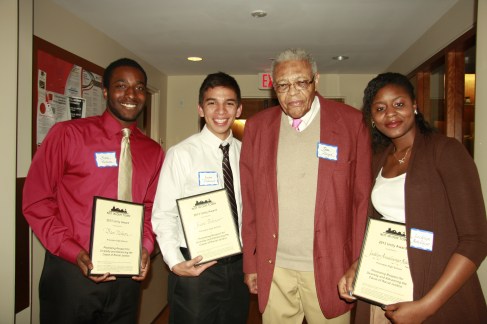
George Reeves, camp cook at Blairstown and grandfather of Jim Floyd, who graduated from Princeton in 1969. In the picture, he is shown with graduating PHS seniors Sam Nelson, Juan Polanco, and Jacklyn Adebayo, who received Unity Awards from Not in Our Town last month. (Floyd was so impressed by their accomplishments that he offered an additional gift toward their books at college.)

The speaker,  Rivers,  was one of three black students in a class of 700 in September, 1949. His account of the segregation and desegregation at this university, delivered at the Pan African Graduation in 2008, is an eye-opener. (This year’s event is Sunday, June 2 and I learned about this speech from a Facebook post from the Center for African American Studies.)

He concluded his speech in 2008 with appreciative words: But 55 years later, I count my blessings because I have been richly rewarded by unpredictable opportunities – and Princeton has changed.

Yet 55 years later, remnants of past attitudes emerge, as documented in Looking Back: Reflections of Black Princeton Alumni. Whites still have privileges that minorities do not.

On Commencement Eve, Not in Our Town will host Continuing Conversations on Race at Princeton Public Library. That’s Monday, June 4, at 7:30 p.m. In a discussion entitled Tongue Tied? Rehearse What to Say, we will talk about how to have a meaningful dialogue with people who have differing views about race and white privilege. You are invited.

Responding to Abundance: Cornerstone Community Kitchen

Cornerstone Community Kitchen serves free dinners every Wednesday, in partnership with the Trenton Area Soup Kitchen, at the corner of Nassau and Vandeventer Streets, just inside the doors of Princeton United Methodist Church. Everyone is welcome, no questions asked. From 5 to 6:30 p.m. volunteers serve plates heaped high with a main dish, vegetables, salad, fresh fruit, and dessert — with plenty of take-home bagels available. Cornerstone Kitchen is well into its second year of “never miss a Wednesday.”

Lots of people help serve this abundance, and here are three examples — one from a congregation, one from a small business, one from an individual.

Jeannette Timmons of The Jewish Center of Princeton volunteers weekly. Now that the Methodist church kitchen is undergoing renovation, the “prep” for the fresh veggies and salads is being done at the Jewish Center. Jeannette Timmons, a weekly volunteer, wrote this account of how the gift of a stove has warmed the friendship ties between the two congregations.

Evan and Maria Blomgren, of the Rocky Hill Inn , furnished the main course last Wednesday. Owner and chef at the Rockh Hill Tavern, Evan prepared delicious chicken masala, roasted potatoes, and asparagus and peppers. Panera Bread and the Bagel Hole regularly donate baked goods, and Zorba’s Brother has also donated a meal. More donors welcome!

Maurice Galimidi, of Allegra Printing, made a generous donation to CCK, and he tells why:

I am not a well-to-do man but I try to remember that in spite of that – I live in abundance.
My father taught his children to never feel that they are better than others just more lucky.
If I can make a small donation to allow myself a sense of connection to those with less than I have, it will keep me in my Father’s graces (he is now resting in peace).
I am a Jewish refugee from Egypt.  One of the most powerful images from Egypt  that my Father left me was on the eve of each Sabbath before going to temple he would go to the local bakery.  He would ask the baker if he can buy the remaining bread that was yet unsold – and he would purchase the lot. He left the bakery without the bread and homeless people would be on line in the street waiting for their chance to take a loaf of bread. It was different time in another country but it was testimony that he felt he was living in abundance.
I thought I would share.

Thank you, everybody.