Category Archives: Faith and Social Justice

items from Not in Our Town Princeton (http://niotprinceton.org) and Princeton United Methodist Church (http://princetonumc.org)

New Lens for Racial Literacy

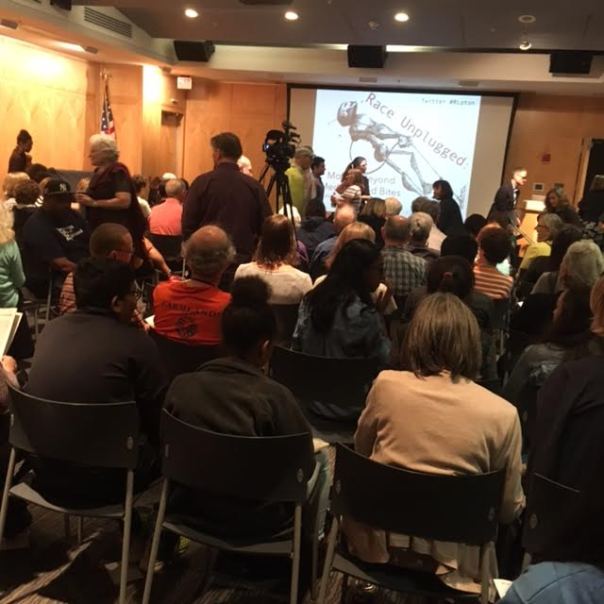
firstSurely Michele Alperin’s superb October 19 cover story in U.S. 1 Newspaper on Ruha Benjamin helped to enhance awareness of the value of Racial Literacy. Benjamin’s first lecture drew an enthusiastic standing-room-only crowd at the Princeton Public Library, and on Tuesday, October 25, at 6:30 p.m. she will facilitate the discussion at the Garden Theatre’s screening of the three-part documentary “Race, the Power of an Illusion.”

This first segment, “The Differences Between Us,” examines the science -including genetics – that challenges the assumption that human beings can be bundled into three or four fundamentally different groups according to their physical traits.

Racial literacy is a much-needed, often neglected skill that — in the 21st century — we all need in order to live and work successfully in a diversifying society. But conversations on race are not easy to have. But as Benjamin said in her lecture,  “Racism doesn’t belong to few bad apples; it is coded in our psyches and institutions. Pretending we don’t see it is not a cure.”

The five-part Racial Literacy series is cosponsored by Not in Our Town Princeton, Princeton Public Library, and the Garden Theatre. It continues with Benjamin’s second lecture at the library on Tuesday, November 1 and film screenings on Monday, November 7 and Tuesday, November 15, all starting at 6:30 p.m. In the coming months, Not in Our Town Princeton will continue its monthly “Continuing Conversations on Race and White Privilege” on first Mondays at 7 p.m. at the library. For details go to niotprinceton.org.For social media, use #Racial Lit and tag partner organizations, @PrincetonPL, #niotprinceton, and @PrincetonGarden

As quoted in Alperin’s article,  Benjamin aims to help people put on a new pair of spectacles and see that “what I’ve learned about this is actually wrong.” Who among us does not need new lenses?

Before Bridgegate: Bennett Barlyn

10-5 Cover & Front (1-7).indd

“We were there first,” says Bennett Baryln. “Bridgegate has been fascinating because it lifts the veil of what we saw in Hunterdon, the taking over of agencies to serve only political ends.”

Barlyn finally got his just due — a $1.5 million payment from New Jersey settling the case against, as the U.S. 1 article states, a  “Bridgegate-like web — that includes small town shenanigans connecting to statehouse leaders, respected legal professionals getting fired, and a lone lawyer’s quest to find the truth.”

Dan Aubrey wrote the investigative article in this week’s U.S. 1  here. Aubrey’s first person similar investigation from 2014 is here. If you are a fan of Governor Chris Christie, either article will make you very uncomfortable. How could this happen? Bridgegate may have the answer.

Choose – to tell stories vs racism

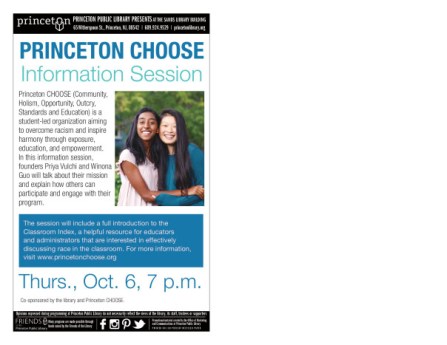
princeton-choosePriya Vulchi and Winona Guo choose to make a difference in overcoming racism. With their cohorts at Princeton CHOOSE, they collected stories, from all over New Jersey, with the goal of inspiring harmony, and compiled them in a classroom guide. I am eager to hear the founders of Princeton CHOOSE present the Classroom Index at the Princeton Public Library on Thursday, October 6, 7 to 8 p.m.

The pair, seniors at Princeton High School, founded Princeton CHOOSE as a student-led organization aiming to overcome racism and inspire harmony through exposure, education, and empowerment. They are fellow board members with me at Not in Our Town Princeton and I am continually amazed at their energy, efficiency, and effectiveness. Deservedly, they have won prestigious awards, including NIOTPrinceton’s Unity Award and the Princeton Prize in Race Relations. 

At the library  Vulchi and Guo will talk about their mission and explain how others can participate and engage with their program, including a full introduction to their Classroom Index a guide that includes statistics, research, and personal anecdotes from people all across New Jersey.

I’m looking forward to buying my copy!

11 Green Street

11-green-really

My dilemma about 11 Green Street was explained well by Vincent Xu in this edition of the Princeton Echo . Can the historic preservation ordinance ‘save’ the Witherspoon Jackson neighborhood.

Taxed out, deathed out, rented out

witherspoon jackson

What happens when a house worth $250,000 sits on property worth much more?  It’s a a problem for many aging Princeton residents and a particular dilemma for the historic Witherspoon-Jackson Neighborhood. Residents and experts gathered Saturday, August 13, to discuss it. Some details here. 

The Shoulders They Stand On

The Witherspoon-Jackson Community saluted Floyd Phox along with seniors, Black Families of Princeton, and athletes. Here is my account of the Friday night 8/12 service on the Not in Our Town Princeton website.

On Saturday morning 8/13 a blue ribbon panel of architects and community leaders addressed the dilemma of the gentrification of the Witherspoon Jackson neighborhood. Here are some brief notes on that.


“By giving to others, we can be who we say we are”

soaries better
Rev. Dr. DeForest “Buster” Soaries  at Princeton Regional Chamber,  photo by Victoria Hurley-Schubert  of Creative Marketing Alliance @CMA @dbSoaries @princetonregion
Engaging and inspiring, Rev. Dr. “Buster” Soaries simultaneously aggrandized his Princeton chamber listeners and challenged them.  The pastor of the 2,000-seat First Baptist Church of Lincoln Gardens dealt with the latest Trumpisms right away. “This country has survived even more turbulent times,” he reassured. “Our strength is not only in the election of candidates, but also in our infrastructure of voluntary associations to preserve the integrity of our society — people who recognize others’ talents and are willing to share their resources, to invest in who we have been and who we will become.”
Partnerships are key, he said, referring to podium banners touting the chamber’s gold, silver, and bronze sponsors. “To be who we are called to be in history, we have to prove that the freedoms we enjoy work for everybody. To say ‘what’s mine is yours if you need it.’ By giving to others, we can be who we say we are.

To combat  “a Bermuda triangle of deprivation” three decades ago, he partnered with, for instance, United Jersey Bank’s Joe Semrod to transform the “worst public housing I have ever seen in my life” into what now looks like private condos. But he might also partner with current and former gang leaders to muster support for community change.

Three requirements for successful partnerships:

  1. Partnerships must be relational not just transactional. It’s not just writing checks. Without spending extra money, a hospital can move its health screening facilities to a needy community. Police offers can visit schools. People can tutor other people’s children.
  2. Partnerships must be horizontal. Those with money should trust the knowledge and talent that are in the community. For instance, a Thanksgiving turkey giveaway went awry because the people standing in line were just reselling the food. The ‘respectable’ church ladies needed to consult with those less ‘respectable’ to get their charity to the right people.
  3. Partnerships must be sustainable, not seasonal. “As political seasons change, there go our projects. The government can fix a street but it can’t fix a broken heart. We are nurtured by the neighborhood we build. We need to focus on what it takes to build each other up.”

Helping people to live within their means is an important part of ministry, says Soaries, who believes that churches should teach people how to budget. He learned the hard way. As a young man he was a big spender, buying a Cadillac because he assumed preachers drove expensive cars and spending for expensive clothes. “I had more money on my back then I had in my bank account.”

Don’t blame government for the legacy of poverty, he says. “We could raise the minimum wage to $200 an hour and some people will still be broke.” Instead, switch from premium cable to basic cable and use the extra $75 for a life insurance policy. “Then you will close the gap for your children.”

Ken Kamen of Mercadian asked how to help people change their spending ways. “We live in a culture of entitlement that thinks fantasy and reality are twins,” Soaries said. In the first three chapters of his book, Breaking Free from Financial Slavery, “I trick people into confessing that they have a problem.”

At my table, eager to hear Soaries tell about partnerships, were life coach Tamarra Causley Robinson, Victoria Hurley-Schubert of CMA (thanks for the photo, Vikki), and LaToya Norman, of the Susan G. Komen CSNJ staff. Also at the lunch were members of my faith community, Princeton United Methodist Church,  Iona Harding and Ida Cahill.

Among those accompanying Soaries was the former Princeton University communications director, Lauren Robinson Brown, now known as Lauren Ugorji, who has just launched her practice, Smooth Stone Consulting.

Phil Slater of Omega Financial Services , a new chamber member at the Carnegie Center, revealed his company might be hiring loan processors.

jerry yeager oneill
Chip Jerry, Audrey Yeager and James O’Neill (Sam’s Club)

And I was delighted to introduce Audrey Yeager, new on the staff of the Princeton Symphony, to Chip Jerry, brother of the late Philip Jerry, —  a Joffrey Ballet star who spent part of his career at American Repertory Ballet/Princeton Ballet School — where Audrey studied when as a student at Rider. It was a serendipitous way to welcome her to Princeton’s business community.


Princeton Community Event: Humanizing Our Responses to the Recent National Tragedies

Mayor of Princeton Liz Lempert, Police Chief Nicholas Sutter, Rabbi Adam Feldman of the Jewish Center, and Rev. Matthew Ristuccia of Stone Hill Church invite the entire community to join them in an important event in response to the recent police shootings of African-American men and the sniper attacks on police in Dallas.On Wednesday, July 27, 2016 at 7:00pm, in the John Witherspoon Middle School auditorium, 217 Walnut Lane, Princeton, NJ 08540, members of the Princeton community will be gathering together to process our reactions to the deep fissures exposed by these national tragedies. The bulk of the evening will be devoted to hearing from a representative of the African-American community as well as a representative of the law enforcement community, giving them the opportunity to share their personal perspectives. In listening to these stories, we as a community will be challenged to examine our own narratives, and to put a human face on the statistics and headlines that have confronted us in recent weeks. Such a challenge is a vital first step in building bridges and taking positive steps toward real reconciliation and growth in our community and our nation.Join us for this evening of grieving together as we acknowledge the pain and fear engendered by these events, and as we strive for hope and forward movement as a community.

Source: Princeton Community Event: Humanizing Our Responses to the Recent National Tragedies

No longer overwhelmed spectators: NIOT

P1080025
Marietta Taylor, long-time NIOT Princeton activist, with me, at the Unity Awards 6-5-15

For those of us who can’t watch sad or scary things (Simona, this is for you!) here is a New York Times article, The Benefits of Despair, suggesting that’s the reason why we are activists. “A feeling of general badness calls for no specific actions, you feel lousy and trapped by your circumstances.” But with what Lisa Feldman Barrett calls “higher emotional granularity,” you might react with a “more specific emotion, such as righteous indignation, which entails the possibility of specific action…You are no longer an overwhelmed spectator but an active participant.”

Yesterday’s Not in Our Town Princeton’s Unity Awards Ceremony, where we heard the inspiring stories of eight activist young people, ratcheted up my “emotional granularity.” Hurray, hurray, and hurray! Read about it here.

P1080029 lineup
some past and present board members of NIOT Princeton at the Unity Awards 6-5-15

Reunions: Faith & Work Initiative

A dual career couple will be at the podium on Friday, May 27, 3 p.m.in the Faith and Work Initiative , part of Princeton University Reunions Weekend. On the panel: Marian Ott ’76 S75 P06, Chairman of the Nashville Metropolitan Transit Authority, President of the Tennessee League of Women Voters, Civic Leader, Volunteer and Activist; and Craig Philip ’75 S76 P06, retired CEO of Ingram Barge; now research professor, Vanderbilt University. It’s free at McCosh Hall Room 4.