Category Archives: Healthcare

Eric Newton: Cancer Survivor


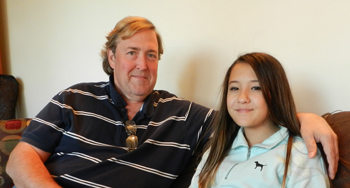
Here is a link to my story in this week’s U.S. 1 Newspaper, on stands until Wednesday, December 16.  It’s about Eric Newton, pictured above with his daughter Jasmine. He had the same kind of cancer that my husband had — George’s was diagnosed early and he is fine now. And the same kind of cancer that my cousin had, but hers was not diagnosed early enough. Eric’s prognosis was grim until he entered a Phase II clinical trial of an immuno therapy drug similar to the one that has given Jimmy Carter a new lease on life. It’s an exciting development.

Three Techies for Thursday

“How come you can go on Kayak and book a flight while you’re talking to me on the phone? But if you have a stomach ache you can’t make an appointment with a doctor on your iPhone. You should be able to put ‘stomach ache’ into your iPhone and immediately get a Jefferson physician.”So said  Dr. Stephen K. Klasko, MD, MBA, president and CEO of Thomas Jefferson University & Jefferson Health System. His ideas are right up my alley and I hope others will like them too. Click here for the U.S. 1 article. 

Klasko speaks at the Princeton Regional Chamber’s October Monthly Membership Luncheon at the Forrestal Marriott, 11:30 to 1:30, Topic:  What We Can Learn From Google, Facebook and Adidas: Reinventing Healthcare Is Not Impossible! .Click here for info or to register.

(I can’t go to this — if any readers can go and take notes I’d be happy to print them as a guest post on this blog).

In addition to the chamber’s unusual angle on technology on Thursday, Princeton University’s Entrepreneurs’ group has two more techie events on its Thursday calendar.

And you probably already knew about NJEN’s crowdfunding lunch on Wednesday, October 7. For the U.S. 1 article, click here. It’s OK to be a walk-in.

Here are the Princeton University listings:  THESE ARE MOSTLY FOR STUDENTS BUT THE COMMUNITY CAN ATTEND

Perspectives from a Young Alumni Founder, Patrick Wendell ’11
Where: The Hub, 34 Chambers Street
When: Thursday, October 8th, 5:30 PM
This talk will feature Patrick Wendell, class of 2011. Two years after graduating from Princeton in Computer Science, Patrick co-founded Databricks, a company commercializing the Apache Spark software platform for large scale data processing. Databricks helps companies extract value from large amounts of data. Over the last two and a half years, Databricks has raised more than $40 million in venture funding from lead investors Andreessen Horowitz and NEA Ventures. The company employs more than 70 people at its San Francisco headquarters.

Tech Talk by Nest Labs  
WhenThursday, October 8th at 5:00 PM
Where: Lewis Library, Room 121
Who: Peter Grabowski ’13 (Data Integration), Rosie Buchanan (Algo)
Nest reinvents unloved but important home products, like the thermostat and the smoke alarm. The company produces programmable, sensor-driven, Wifi-enabled home devices. Acquired by Google (now Alphabet) in 2014, Nest has rapidly grown into a company with over 1000 employees, and is one of the leading companies in the Internet of Things (IoT) space.
In this talk, they’ll be covering a few different aspects, such as what it takes to bring a product to market, how the company uses data to influence their feature development, and also the technical challenges that the company has run into in the past few years. Pizza and drinks will be provided!

Stem Cell Scientists Beware: Ruja Benjamin Challenges Your Ethics

Biotech scientists take note: Ruja Benjamin challenges your ethics. You may have unconscious racial bias.

Benjamin, author of “People’s Science: Bodies and Rights on the Stem Cell Frontier,” will speak on “What Kind of Future Are We Designing?” at noon on Tuesday, May 12, at the Princeton Public Library. ruja benjaminOn the faculty of Princeton University in the Center for African American Studies, she is a faculty associate in the Program on the History of Science, the Center for Health and Wellbeing, and the Program in Global Health and Health Policy.

Here is her TED talk about why scientists and clinical trial directors must actively seek the input of those who might be harmed by new biotechnology.

Her sharp wit gets, perhaps, too close to the truth for comfort.

(this post originated at Not in Our Town Princeton).

Listen, Then Prescribe.

Barile at hospital

Dr. David Barile’s aim is sky high — to effect a culture change in medical decision making. He speaks on Wednesday, April 15, at 7:30 p.m. at the Nassau Club, for the Princeton Regional Chamber. Barile, a foremost expert in palliative care, has a mobile platform, Goals of Care, to help align what patients need with what doctors prescribe. The platform is powered by a Princeton start-up, V  Read about it here. Sign up for the breakfast here — or just come. Networking at 7:30, breakfast at 8.

This Huffington Post post, “6 things I wished I had known about cancer” has no real Princeton connection, other than all the people I’ve known who had and have cancer.

talking head wayne cookeWell, that’s not quite true. There IS a Princeton connection — to Wayne Cooke, who wrote “On the Far Side of the Curve: a stage 4 colon cancer survivor’s journey.” Cooke far outlived his expected years and shared his tips in this U.S. 1 article and then in his book (now downloadable for free).

Both sets of tips are valuable. I put them here so I can supply them “just in time” to those who will need it.

John Springrose: “Prototype your imagination”

Sometimes a better chamberspeaker says what they said to a U.S. 1 reporter as published in the previous issue. Not so this time. Diccon Hyatt’s interview with John Springrose was way different from his talk at the Princeton Regional Chamber breakfast this morning. Springrose’s company (formerly inDimension3, now Philadelphia-based Koine) pioneers in 3D printers, more aptly named “rapid prototyping machines.

An IBM-er turned investment banker, Springrose  began with a “then and now” show of how innovation increases productivity, even though jobs are lost along the way. For instance, IBM’s first middle market computer, System 32, cost $40,000 and had only 5k of memory but in 1975 it could replace accounting functions. Checkers were replaced by self checkout and scans, tellers by ATMs, German auto workers by robots, and so on. “Innovation does lead to productivity,” he tells students, “and it forces us to think.” Be an innovator or run the risk of losing your job.

Examples of how a rapid prototyping machine can work: High school student gets an idea for jazzing up the wine drinking experience. Prints a prototype of a new wine holder, gets it manufactured in China, sells several hundred units on ebay for $40 each, total cost of each unit $1.89, accomplished this in less than a month. Product: a wine bottle holder that is lit from underneath, sending colors through a bottle of white wine. Cool. True story.

A plant “goes down” for lack of a part? A 3-D printer could make that part in a snap. A corporation could have a rapid prototype machine in the lobby and greet clients is greeted with a logo or miniature product from their company. Now that’s hospitality.

Three-D printers like toys can cost as little as $700 but, to be reliable, one should cost at least $5,000 for business use. Customers are mostly overseas. Springrose worries that the U.S. is getting left behind.

In addition to plastic, products can be in wood, metal — “anything that will melt.’ His industry today is where IBM’s System 32 computer was in 1975. “You give me the industry, I give you the use,” he offered.  “Prototype your imagination,” he challenges. “If you think about it, you can do it.”

As for the difference between the interview and the talk — the reporter dug into the not-so-successful early stage of Springrose’s company, when it was making cheap printers that were not reliable and got scathing online reviews. That’s why Springrose moved to the high end. More than 700 startups make 3 D printers but just three– including Koine — are working on business-quality tools.

Springrose has a very personal interest in the medical applications for his devices. He looks forward to the day when a rapid prototyping machine can print out a liver or a kidney. That’s because he has lived through a liver transplant. But printable organs won’t happen any time soon. Springrose came without a demo machine because — the day before, he demoed to doctors at Jefferson — and they broke the machine.

Photo: L to R, Grant Somerville (chamber program committee), John Springrose, Peter Crowley (chamber CEO).  
Capstone for a Career, Strategy for the Next One

JaneTervooren2

Jane Tervooren has had multi-layered careers,  chronicled  in U.S. 1, most recently in a December 10 cover story by Diccon Hyatt. Tervooren’s departure from one fulfilling job to invest in an exciting new company was occasioned by a health event. As Hyatt describes, “surviving cancer is what led her to put a capstone on an 18-year career.”

Being diagnosed with a fatal disease, no matter what the outcome, inspires change.

Tervooren’s advice is appropriate for the New Year: “it’s never too late to re-invent yourself. Don’t settle if you’re unhappy in a relationship or a job. have the guts to make a change. If you are stuck, it’s because you feel stuck. People have options.

We received a notice from the Princeton Health Department regarding reports of increased gastrointestinal illness, with Novovirus the suspected cause.

Among the prevention tips from the department’s Jeffrey C. Grosser:

Don’t touch your face or put your hand near your mouth

Use soap, not sanitizer, when washing your hands. “Hand sanitizers are not effective against most GI causing organisms, including norovirus.”

I didn’t know that.

For more information on norovirus  visit the Centers for Disease Control and Prevention.

Princeton Firm Helps Fight Ebola

Peter Lentini, CSO of Carnegie Center-based Microdermis, says the U.S. Army will deploy its new antiseptic product, Provodine, in its fight against Ebola in West Africa.

Press release quote: “Unlike most branded antiseptic products – which are contra-indicated for eye, mucosal surfaces (nose and mouth), ear and genitals – Provodine® can be safely used on the most sensitive areas of the body.”

This is an important article, if I do say so myself.  Read about David Barile to discover what you may need to know — what you will need to know — in the future, about palliative care.

11-12 Cover & Front (1-7).indd