Category Archives: Around Town

Personal posts — some social justice (Not in Our Town), some faith-related (Princeton United Methodist Church), some I-can’t-keep-from-writing-this

ADA is old hat now

wheelchair-symbol-handicapped-parking-signs-4

I remember when the American Disability Act emerged 25 years ago. It signaled a sea change not equaled until the Y2k scare, which also provoked dire predictions of ruin because of projected costs. At U.S. 1 we reported on which restaurants had wheelchair-friendly bathrooms. We interviewed lawyers in the suddenly popular disability field.

Now accommodations are standard everywhere, no big deal. But according to the feds, accessibility is still an ongoing problem. 

Rich and Reclusive on Spring Street

Back in 1987, when U.S. 1 Newspaper was still a monthly and everyone on staff was also on the delivery team, my  route was downtown Princeton. I tried to deliver to Princeton Newport Partners at 33 Witherspoon, on the corner of Witherspoon and Spring Street. Later Spring Street would be publicly notorious in the scandal of Lyle and Eric Menendez, owners of Chuck’s Spring Street cafe. But the 33 Spring Street building would be quietly notorious as an address associated with Princeton Newport Partners, raided by the feds in 1987 for its possible involvement in the Michael Milken junk bond case. (The charges were later dropped, as explained by my boss Richard K. Rein in his column last week.)

But when I arrived at the Princeton Newport Partners office I didn’t know about the investigation. All I knew was that no one at that office wanted to talk to me. And for later visits the office was closed.

Venture capitalists, private investors, investment bankers — all are notoriously close mouthed, none more so than Andrew Shechtel. He apparently still has an office at 33 Witherspoon and is now listed as the third richest man in New Jersey. As reported by NJ Biz, and also by Zachary R. Mider in Bloomberg News,  Shechtel put $9.7 billion into two trusts . . .some of it going to camps for Jewish youth, most of it to a Forrestal Village-based foundation dedicated to research into Huntington’s disease.

Rein explains more, in his column this week. .

There goes the neighborhood….

I live in the Riverside neighborhood. A long while ago I heard that the Butler Apartments were going to be turned into a parking lot. Now it’s a reality. Earlier, I posted about the university’s taking over Alexander Road. Now it’s coming close to home. 
As below, this letter from the Riverside Neighborhood Association. There’s a meeting this Thursday. 
Did you know that Princeton University is preparing to demolish the Butler Apartments? The Butler Tract (bordered by South Harrison Street, Sycamore Road, Longview Drive, and Hartley Avenue) comprises 33 acres and over 300 apartments. The demolition and future use of the site will have a major impact on the Riverside neighborhood.
 
Questions raised by this project include:
 
-Given the age of the buildings, it is likely that asbestos, lead paint, and other environmental hazards are present. What steps will be taken to ensure the health and safety of the community?
 
-Princeton University has announced that it is not currently planning any new construction on the site, and instead will use it intermittently for overflow event parking. How will the presence of a large vacant lot, used intermittently as a parking lot, affect the quality of life and property values in the neighborhood?
 
-Is Princeton University willing to consider input from community residents about plans for the Butler Tract? What are your ideas for possible uses of the land? For example, instead of an unsightly vacant lot doubling as a parking lot, could the area become a park, field, or garden?  
 
Princeton University is going to hold a meeting to provide information about the demolition and answer questions from area residents. All community members are urged to attend:
 
Thursday, July 30
7:308:30 p.m.
Lewis Library, Bowl 138
Corner of Ivy Lane and Washington Road
Parking will be available in the university parking lots located on Ivy Lane across from Lewis Library. An interactive campus map is available here: https://m.princeton.edu/map/[m.princeton.edu]
 
If you have questions or are interested in working with other neighbors on this issue, please contact me. Feel free to share this with others. Thank you.
 
Sincerely,
Sally Goldfarb <sfg@camden.rutgers.edu>
100 Sycamore Road
Chair, Butler Tract Demolition Committee,
Riverside Neighborhood Association

One Less Gas Station

Just when the controversy about tax exempt status for Princeton University is heating up, Philip Sean Curran reports in the Packet that the university has bought Larini’s service station on Alexander Road. As a reporter for U.S. 1 I’ve been watching the university inexorably acquire property on the “back door to Princeton” for 25 years — starting with its purchase of the Princeton Ballet School building — and that goal was never secret.

Campaigning for a change in the tax status, Roger Martindell wrote an impassioned letter to the editor in Town Topics to make the case that the university should pay taxes, not merely donate “in lieu of taxes’ to the municipality.  He cites (1) government grants (2) intellectual property licensing and (3) ticket sales as proof that the university is making a profit.

I have no personal connection to the university and have not studied the tax question recently, but I seriously doubt that the university’s vast wealth derives from ticket sales. Intellectual property income paid for the new chemistry building, and government grants pay for research. I believe the university’s wealth comes from having a lot of money to begin with, thanks to wealthy – privileged — alumni, and it was invested well. .

The “privilege” that alumni (and now alumnae) enjoy is a topic for another day. But as an owner of property near the university, I do not support the movement to strip tax exempt status from the institution that increases the value of my property.  People — and this includes me — want to live here because of the university, not because of the shops in Palmer Square.

Midsummer in Palmer Square

chamber plaza

Palmer Square turns into a street fair several times a year, none more exciting than the Princeton Regional Chamber’s Midsummer Marketing Showcase.

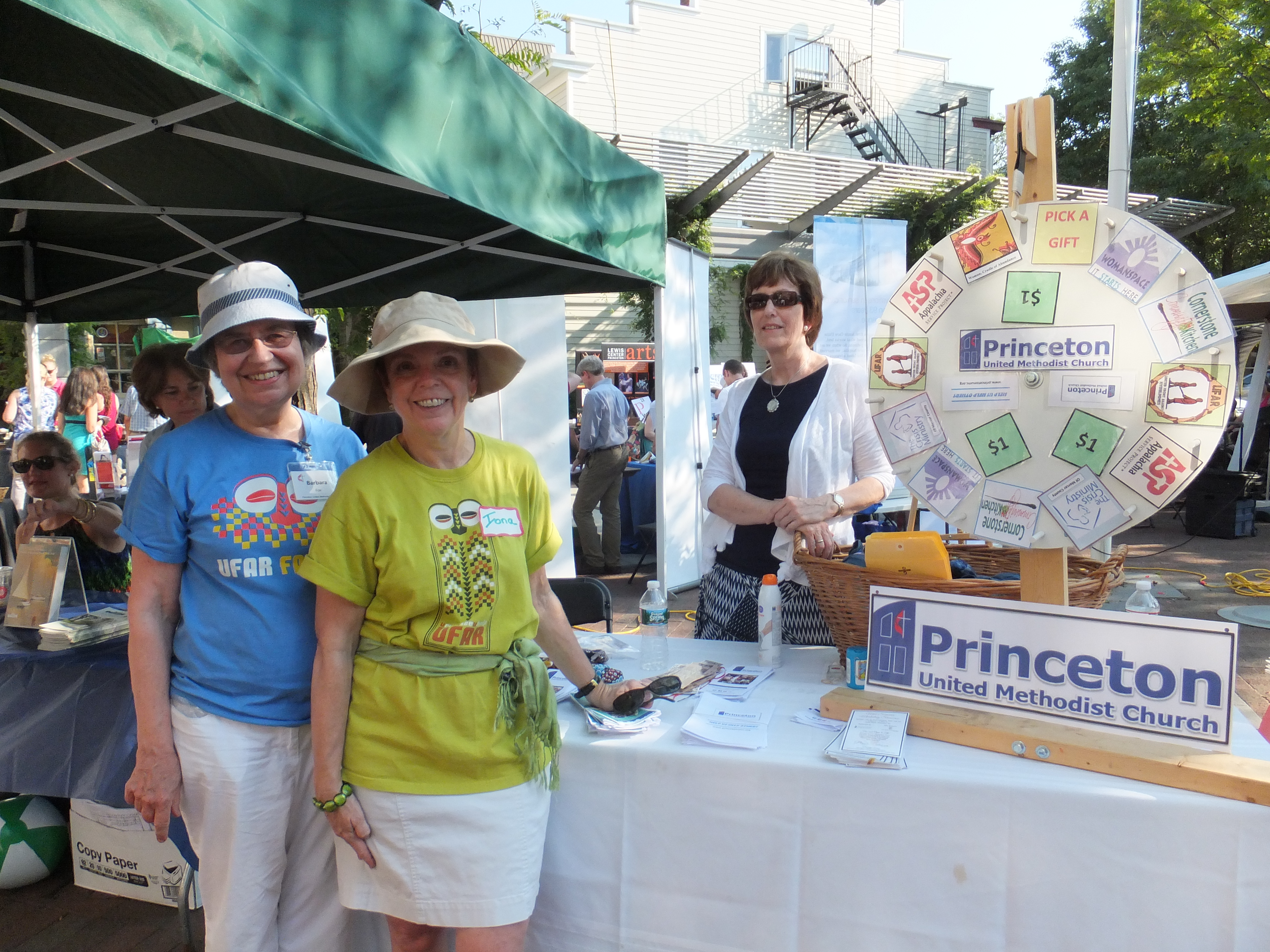
Sometimes my church — a member of the chamber — participates, as above. But on Tuesday, July 21 I’ll be an onlooker, enjoying the tastes and freebies and greeting old and new friends.  It’s set for 4 to 7 p.m. — and it’s free!

Dress for the heat!

Stories told, stories to tell

sharon rein b & WThe guy who hired me to work at U.S. 1 Newspaper in 1987, Richard K. Rein, has just published a column, a mini memoir, recalling his 50 years in journalism, starting with a summer job as a high school intern.

My BFF, Sharon Schlegel, said goodbye to her column today in the Trenton Times because she is moving to St. Augustine. I won’t reveal her age but I’m betting she can count at least to 50 years in the business if she starts with her own newspaper, as a kid, and counts her stint as the first woman reporter on the U of Penn newspaper.

Both talk about what journalists call their “voice.” Rein says he turned down a theoretically more prestigious job in order to “find a writing style of my own.” Schlegel says that developing a voice of her own was “an evolving process, an opportunity to explore myself as well as my subjects.”

My style is not as distinctive as hers, but I’m trying to preserve what I do have by continuing with this blog. Use it or lose it applies to wordsmithing as well as to exercising.

I also resonate with a point that Rein makes. He says, “If I see a story (and somehow I see stories in the strangest places) I need to tell that story. I can’t help it. If I edit a story, I want to make it better. Can’t help it.”

Me too. I can’t help it. Hence this blog.

Schlegel’s readers will miss her voice. I’ll miss it in newsprint, but I’ll get to hear it on email — and in person. We plan to Skype a lot, and Florida is just a plane flight away. Perhaps I can persuade her to be a “guest columnist” for Princeton Comment from time to time, or maybe she will write for a Florida paper. I’m betting she’ll have stories to tell.

SCOTUS on fair housing

Affordable (fair) housing is in the news all around the state, and especially in Princeton. Here are guidelines, set out by the Supreme Court

bfiggefox's avatarNot In Our Town Princeton

The four things we need to know about this week’s Supreme Court decision, a blog post by Eric Halperin and Deidre Swesnik of the Open Society Foundation

1. The court recognized that unconscious or implicit bias is a form of intentional discrimination.

2. The FHA should be used to break down structural barriers to racial integration, not merely to prevent current discrimination

3. Where you live impacts the education you receive, how you are treated by the police, and your access to economic opportunity

4. The Court’s decision extends beyond segregation to our financial markets

View original post

Mr. Ahmed Goes to Washington

Ziad Ahmed, whom I know as a youth member of the board of Not in Our Town Princeton, was invited to the White House for dinner with the president. Reason: he had been inaccurately targeted, as a child, for the “do not fly” list. He responded to that experience by founding an anti-bias organization.

Ahmed, now a rising junior at Princeton Day School, established ziad photo ReDefy to “boldly defy stereotypes, embrace acceptance and tolerance, redefine our perspectives positively, and create an active community.”  He has also made many valuable contributions to the NIOTPrinceton organization as well. He is doing important work. Here is the link to Nicole Mulvaney’s coverage in the Times of Trenton.

Writing as Sacrament: Frederick Buechner

Surely I am the only writer at this week’s Frederick Buechner writers’ workshop who had never heard of Frederick Buechner until nBuechnerow. More than 200 other writers are attending the four-day workshop at Princeton Theological Seminary.

Even without the event, Buechner had enough Princeton connections for me to write about him here. He graduated from Lawrenceville School  in 1943 and, after a hiatus for military service, from Princeton University in 1948.

Virtually all the other attendees, mostly clergy or retired clergy, are avid fans of Buechner, who influenced several generations of seminarians. One attendee described him as an American C.S. Lewis. Buechner did not achieve Lewis’s phenomenal popularity, yet somebody found the money to establish a Frederick Buechner Institute, based in Tennessee at Kings College.

Belatedly curious, I wondered how the attention to Buechner is being funded. As a business reporter, I feel impelled to answer that question. The puzzle became clearer when I discovered that Frederick Buechner’s father-in-law was the son of the founder of the American branch of the pharma company, Merck. The source was my favorite trove of personal information about business executives who omit personal info from their biographies: a wedding announcement in the New York Times. 

Perhaps the institute and the workshop are funded solely from royalties and not from a Merck legacy. Doesn’t matter. Either way, I am profoundly grateful for the insight that, in Buechner’s words, spiritual autobiography is a form of prayer. 

Craig Barnes: The Writer and the Whirlwind

seminary photoDespair is always at hand and it is the demon most difficult to exorcise.

Words haunt you from the basement of your soul. Angels or demons make their way into the souls of your readers, carried by your words.

In the encounter with Job, God took Job’s preoccupation with Why and replaced it with WHO.

God refuses to be accountable to us. God is determined NOT to give us hope. Hope comes from the turn in the plot, because we have dropped the question Why — because our hearts are so full of WHO.

So said Craig Barnes, president of Princeton Theological Seminary at the opening worship for the Frederick Buechner writing workshop at Princeton Theological Seminary. He used two texts (Job 38: 1-7 and Psalm 119: 105-112) for his sermon entitled “The Writer and the Whirlwind.” Several at this workshop asked for my notes, so here they are, as much of what Barnes said as I could write down. (Corrections welcome). Barnes’ audience was 250 plus writers (some clergy, some lay people) from around the country. 

CRAIG BARNES: 

Job has two chapters of narrative followed by 35 chapters of lament. When it is your life that is interrupted, the chapters are long. Grief, hurt, anger returns.

Words were used by the . . . .

Messenger: disaster

Friends: judgment

Elijah: anger at bad theology

Job: wanting to prove his integrity, Job asks “why?”, complains he does not deserve this fate, he is devoted to a capricious God who makes no sense.

When YOU write, yours are not the first words people encounter.

People are hurt by words, people are inspired by words.

Angels or demons make their way into the souls of your readers, carried on the backs of your words.

As children, we learned that “Sticks and stones don’t break my bones.” What a crock.

Words haunt you from the basement of your soul.

Writers know the power of words.

Ps: 119: words have power to lead us to hope and to salvation.

Your word is a lamp for my feet,  a light on my path.

But even God’s words have a modest intention: lamp to feet, light to path — he gives us just enough to take the next step. Mary at the Annunciation — it was Grace that she did not know the future. Job did not have much light.

Job lost everything, including his former vision of God. But he is not in despair — he refuses to curse God and live (despite the encouragement of his wife!)

Despair is always at hand and it is the demon most difficult to exorcise.

 There is a “designer despair” shown by Tarantino, Manson, Jerry Springer, and the models for J Crew who seem to show “all the cool people are sad.” Versus the old-time Sears catalog with a model that smiled, selling jeans.

Message to teens: “there is no such thing as a bad idea” is one of the worst ideas. Despair is a bad idea.

Someone who knows how to write needs to interject words of hope and light that can take on despair!

In the desert, the Hebrews could not go back. They had to move forward to the Promised Land, but they needed a new vision of God.

Where is your own Promised Land? Do you have wrong numbers, wrong expectations, walls crumbling or at least leaking? What God most wants to give you — and your reader — is God!

God talks. God does not answer “why.” God says ‘remember who you are, remember who I am.”

In the encounter with Job, God took Job’s preoccupation with Why and replaced it with WHO.

So much of what people need in 35 chapters of WHY is, they need a better question. Job drops the Why. Explanations, justifications of integrity, don’t matter. Salvation — especially from despair — requires a new vision of God.

But the human side of it is that you have to struggle through it to be authentic. The story curve, is down, then up. After two chapters of telling how Job got there, the rest of the book is the recovery plan, a reoriented life and  anew vision of God is the turning point.

God refuses to be accountable to us. God is determined NOT to give us hope. Hope comes from the turn in the plot, because we have dropped the question Why — because our hearts are so full of WHO.