Category Archives: Uncategorized

Carpool for Dumping Those Monitors


This a responsible way to recycle electronics, especially old CRT TV’s and monitors, all of which contain lead and other toxic materials that will leach into our drinking water.

Electronics Disposal Day to be held on Saturday, May 2 from 9 am to 2 pm,rain or shine, at the Sovereign Bank Arena – Lot 1, at 80 Hamilton Avenue in Trenton at the intersection of Hamilton Avenue and Route 129.

This event, sponsored by the Mercer County Improvement Authority, is for household electronics waste only (but if you have a home  office, that would count, right? You’re supposed to bring proof of residence.


 Items that can be disposed of include: camera equipment, central processing units, circuit boards, copiers, electric wire, fax machines, keyboards, laptops & peripherals, microwave ovens, mouse, networking equipment, phones, printers, scanners, stereo equipment, televisions, and VCRs. For further information, visit http://www.mcia-nj. com or call 278-8086.

So what happens to her house?


It’s not the saddest thing that has happened to the legacy of Doris Duke. That dishonor belongs to the tell-all books and movies. But it’s still sad that the contents of her Hillsborough home, “Duke Farm,” suddenly are up on the auction block, and not even at Sotheby’s. Both the art and the domestic items will be on sale in Morristown on Friday, May 1.

I had two pangs of sadness when I saw it. I’ve written about her for U.S. 1, and have visited two of her three houses — in Hillsborough and Hawaii. I’m not sure I agree with the trustees’ decision to close the one in Hillsborough and devote it to outdoor education. More on that later.

The other pang was because I learned about it today in the pages of U.S. 1 Newspaper, where I worked for 22 years. If I had been in the office, I would have seen the press release and the photo of Doris’s bedroom come in.

But I rejoice that the savvy folks there spotted it and were able to run the picture that caught my eye. And that I had time to page through today’s edition and see it. So maybe I can change my plans and get there, just for curiosity.

It’s ironic that I am torn between the Duke auction and an all-day seminar on the potential demise of newspapers, both on the same day. I had not heard of either event until I found them, today, by reading U.S. 1 Newspaper.

Shop Local

Nick Hilton, owner of the men’s & women’s clothing store on Witherspoon Street, is setting up an informal group to market the “shop local” concept in Princeton.

1) to foster and reinforce the contribution owner-operated specialty shops make to our community, to underline the social, economic and ecological benefits to “shopping local” and to encourage local patronage in preference to chains and on-line stores; and,
2) to establish a regional reputation for Princeton as a desirable shopping destination.

The shop owners  met for the first time on April 27 (Shown here, Jennifer and Nick Hilton, Louis Wildman of Jordan’s, and Fran McManus of Whole Earth). The operative word is “owners.”  Members would need to have a locally owned and operated retail store of the brick and mortar variety. Unlike other trade groups, such as the Princeton Borough Merchants or the Princeton Regional Chamber, this group will have no franchisees, no chain stores, no attorneys or lawyers or stock brokers — only “real” stores within Princeton Borough and Township.


Said Hilton: “The simplest idea is the one that works.” 

Now We’re In Phase Four

If, in anticipation of the pandemic, you are buying quantities of surgical masks for your office, note that they are not all alike, and what good do they do? According to OSHA, surgical masks serve to protect other people from your germs. They don’t do much to protect you from other people’s germs — except that they do keep your germy hands from touching your nose and mouth.

I got this consoling information courtesy of a Duane Morris e-pamphlet, a checklist for employers on preparing the workplace for a pandemic. The law firm offered the obvious, like have plenty of hand sanitizers, and the not so obvious:

“Support employees who are out of work by reviewing and liberalizing leave policies, but recognize that what is done in this context may have precedent in other contexts.”

Other contexts, hmm?? Useful lawyer speak.

Also of concern, what happens to people who merely suffer from allergies. Will they be booted off planes? If you look closely at the CDC’s advice to airline personnel, regarding how to identify traveler’s with swine flu, maybe the pollen-sensitive traveler should carry a doctor’s note that says, “I just have allergies. Really.”

The Best Communiversity Yet

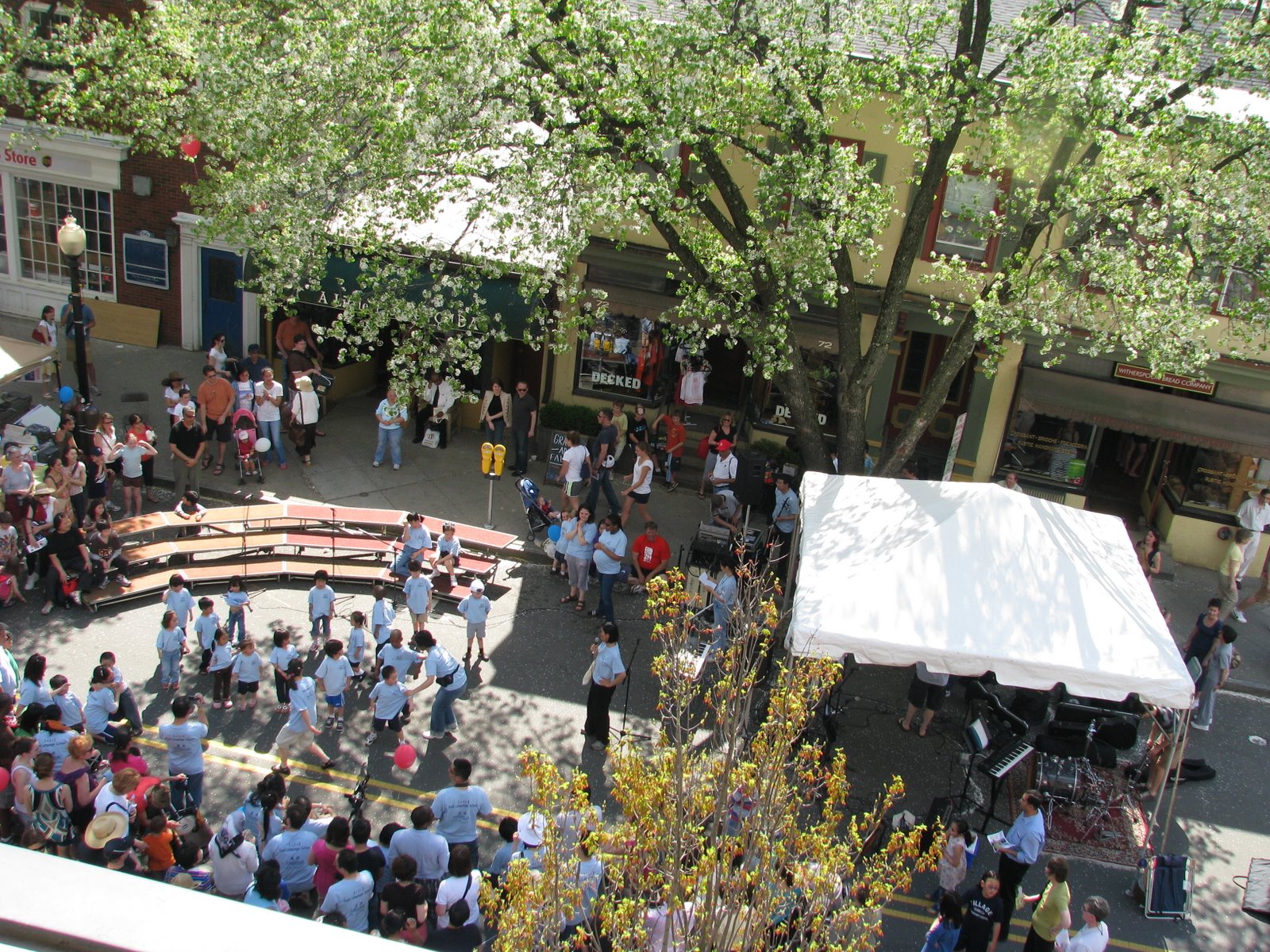
The same folks who partied at Pinot 2 Picasso last night had to get up today and put on the annual town gown celebration, Communiversity. I walked into town from our home on Cedar Lane to find the Chinese School that meets just up the street was performing on Witherspoon Street.

Everybody was having a good time in the hot sun. I met, and snapped photos of, Anne Reeves (the founder of the feast), and a bunch of other people who help people make Princeton what it is: Nancy Kieling (of Princeton Area Community Foundation and the Princeton chamber), Madolyn Greve (of Gloria Nilson and the chamber), Nancy Robin (the founder of Hands on Helpers) and the organization’s current executive director, Adrienne Rubin, and Steve Kruse, who is an activist for the bicycling cause. The Methodists were out in force — Judy and Dick Miller, Susan and David Gange (at the Stonybrook Orchid table), and the youth from Princeton United Methodist Church, who were selling baked goods for their Appalachian Service Project.

Even the Obamas were there! Well almost. See them here.

The Left Bank: Arts Council at University Square

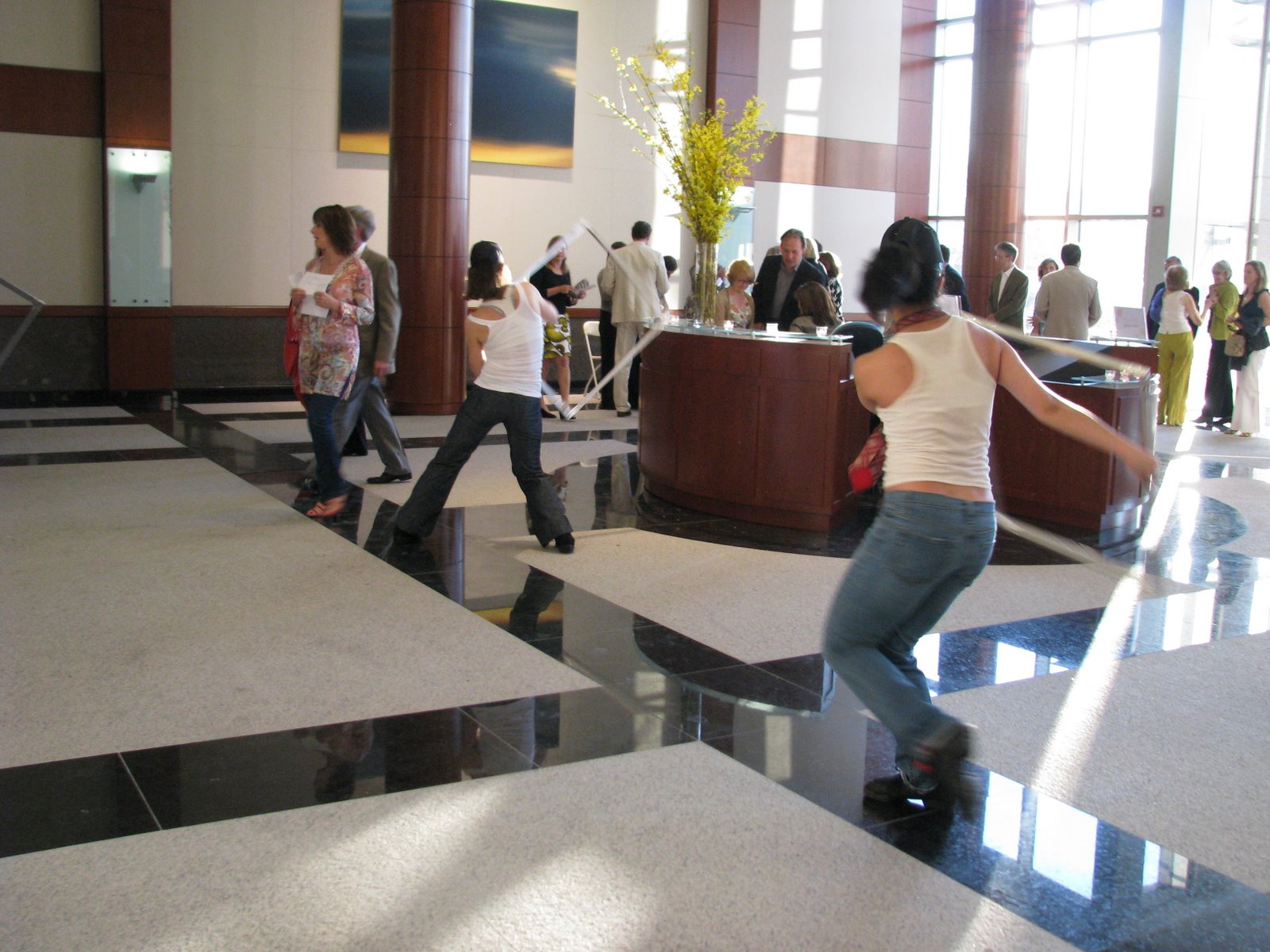
How long has University Square remained empty? No matter, it was transformed into the Left Bank tonight for Pinot 2 Picasso, the Arts Council of Princeton’s pre-Communiversity Gala.

Here are some
photos, no more than snapshots really, of the evening.

New this year was SureTech.com‘s fabulous custom-designed wall-sized video display. Before the auction it randomly showed the various art work. During the auction it showed the matrix. When someone made their choice, that picture popped up large on the screen and then was covered by their number on the matrix. It must have been a challenge.

Very creative, very high energy party. And great weather predicted for tomorrow. Anne Reeves must surely be pleased.

Einstein Lecture: Harness the Sun


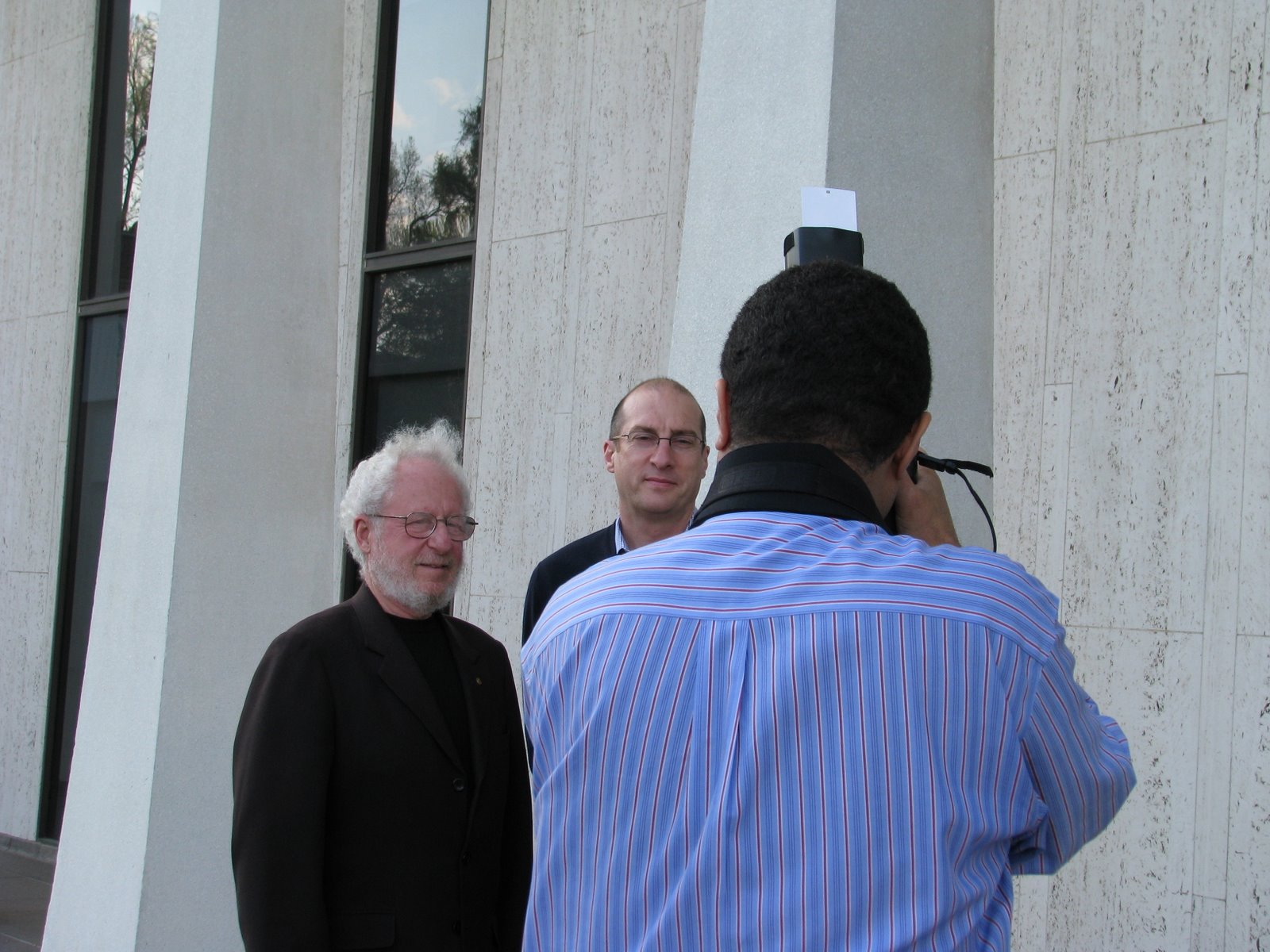
Alan Heeger (on left) charmed the eager audience at the Princeton Chamber’s Albert Einstein Memorial Lecture yesterday at Princeton University’s Robertson Hall. The 2000 winner of the Nobel Prize in chemistry, whose lab is in Santa Barbara, told how to turn the dream of low cost plastic solar cells into reality: “We receive on earth in one hour enough energy to take care of the needs of the planet for a year. The question is how to use it. We need to decrease the cost by at least a factor of five.”

I’m not going to try to explain “self assembly of bulk heterojunction nano materials by spontaneous phase separation” even though Heeger was so clear that I almost understood it at the time. Afterward, Aaron Wadell offered to go over it with me. As COO of Global Photonic Energy Corporation, a spinoff of Universal Display, he works in this space. Thanks, but no thanks, Aaron. There is a limit to what I will write for free.

As an aside, Heeger noted that the very word “photon” was coined by Einstein. And the first time Heeger referred to images taken by the electron microscope, I got a sudden twinge and looked over to Bob Hillier, sitting in the fourth row on the center aisle. Hillier’s father invented the electron microscope, and I thought again about how, here in Princeton, great accomplishments are commonplace. Just five days ago I was sitting in this room listening to the CEO of Google, interviewed by Princeton’s cyberspace guru, Ed Felten.

The “money” question came from Michael Hierl. Heeger said that throwing money at the problem might not speed up the process of commercializing plastic solar cell technology. Konarka Technologies (the former Polaroid facility, now converted to making the thin film) “has been able to raise the necessary funds.” (Since a family member is an expert in film manufacturing technology, I was intrigued when Heeger said that the soon to be defunct Kodak film plants can be converted into thin film production.)

Re money, “in my lab I’m not too worried,” said Heeger, adding, “my real concern is the public’s attitude toward fuel consumption. We should not be burning oil. Instead, “we should use it to make high value products.”

The sponsor roster for the lecture, in addition to the Princeton Regional Chamber Foundation, reveals who still has money to contribute to something like this: a construction firm (Bovis Lend Lease) an energy company (NRG), a chemical firm (Firmenich), and two pharmas, Bristol-Myers Squibb and Ortho-McNeil-Janssen. (Though Heebink’s topic was energy, he also co-founded Cynvenio, which does micro fluidics for cell sorting, and Cytomx Therapeutics, a drug delivery firm.) Plus Greg Olsen’s investment firm. GHO, and his former imaging company, Goodrich ISR Systems.

Guys who do high tech business development were out in force and Paula Durand, technology & life sciences venture officer of the ubiqitous New Jersey Economic Development Authority, was on the front row. (See photos).

Saying he is confident of early prospects for success, Heeger cited another Nobel winner, Richard Feynman, (roughly quoted): “All the molecules in my brain are different from six months ago when I saw you last, but I still know who you are.” It’s the structure of the brain that counts. “It’s the network structure that is stable. That gives me confidence that (in our life time) we can (do this).”

Googling Social Discourse: the CEO of Google

“Technology can increase the quantity of discourse, but can it increase the quality?” asked Ed Felten, “Think carefully about the way you design social software to get conversations that are more likely to be fruitful. There is a tremendous amount of science to be done to make any progress on this issue. If we make any progress at all it can have tremendous benefit.”

Felten (above, right), a professor at Princeton University, moderated a discussion on how technology will transform the global landscape, part of the April 17, 2009 Princeton Colloquium on Public and International Affairs. His guest, the CEO of Google, Eric Schmidt (Princeton, Class of ’76, above left),  responded to a wide-ranging discussion, including comments on the latest products, Street View and Latitude. For my more complete notes, click here. Some highlights of Schmidt’s comments: 

On international differences: “The key insight is that people are the same everywhere. They want to talk to each other. And people really do care about Britney Spears. It is really very disheartening. The only difference is language.”

Cell phone revolution: “People are carrying phenomenal computing resources. I like history so when I walk down the street, my cell phone could tell me the history of each of the buildings as I walk by. Why not? Google has the information, and the phone has GPS. Now you can have the Encyclopedia Britannica streaming to you. History is the mildest example I can think of.” (They discussed less benign examples.) 

“Now feature phones for $50 to $70 can be subsidized in developing countries for the poor, just living in their huts. If you are a farmer, your wealth is determined by the temperature, weather, agriculture prices, the need to know whether you have to sell the cow to get through a bad month. We think it is fundamental to get that kind of information.” 

International affairs: “I worry that we are locked in the old zeitgeist. The citizens of Cuba would benefit from fax and communication. If you were a dictator, the first thing you would do is shut off all communication and make sure that no one could see what you were doing. The internet works against that. The way you invade these countries is with information.” 

Media: “We use newspaper content with their permission. They have chosen to give that info in return for sending traffic to their sites, which they can monetize. But it does not make up for loss in print revenue, and that’s not a problem we know how to solve.” 

Healthcare: “Why is there not a wikipedia for doctors. Imagine in medicine the collective wisdom on outcomes.” 

Blogs: “There are 100,000 blogs created per day, and the average number of readers is one.”

Personal note about attending a celebrity event at Princeton University: I watched the morning events “live,” managing to get a seat by arriving well in advance of the Google talk. For the 3 p.m. Paul Krugman talk (see below), I was not so lucky. I could have watched from a different room, but since it was to be streamed live from the princeton.edu website, I went home and it worked pretty well. It was hard to read the small print on the PowerPoint slides. And before Krugman had finished (how long before I don’t know, he was answering questions), the website went down and on came some really bad music and a series of announcements about events that had already taken place. There must have been an automatic cut-off at 4 p.m.  So it’s worth it to get there early. 


Krugman: Don’t Worry About National Debt

Don’t worry about the national debt, said Paul Krugman, speaking at an April 18 Princeton Colloquium on Public and International Affairs. “Wealthy countries have been able to run up to 100 percent debt vs GDP without going into crisis. We did run at 100 percent after WWII. We come into this with debt at 60 percent of GDP and 100 percent is $6 trillion. It’s not a blank check but does give you running room.”

For my transcript of Krugman’s notes, click here.

Krugman didn’t have much else cheerful to say. He talked about “astonishing times” that he never expected to see in his lifetime, and that whether or not we spiral into a Great Depression, we are in depression economics. “The extent to which it is happening, is not supposed to happen. It is like some disease we thought was controlled has emerged in an antibiotic resistant form.”

“So far we are on track to having a slump as bad as the Great Depression, plunging just as fast. In world trade, we are plunging faster.”

“Where we are now is the fall of 1930, which by no means was the worst it got. What followed was the worst — the bank failures in the US, a corresponding wave in Europe. Destructive policies like raising interest rates to attract gold in 1931. Our best hope is that we have learned from our grandfathers.”

“Believe it or not, the disruption in our financial markets is worse than it was then.”

“The forecast is based on the federal budget returning in five years, but it is not at all clear where recovery comes from.”

“The striking thing is how hard it turns out to be to do anything forceful about the banks.
This morning, banks are being subjected to a stress test. But they don’t know what to do with the results.”

“Another of the shocks is Europe’s inability to act as a unit in this crisis, one of the major disappointments of this whole story.”

Still, Krugman tried to put a good spin on the current state of affairs.

“There was about 4 months when every single piece of news came in, it was worse than you expected. Yet for the last six weeks or so, things are not getting worse quite as fast as they were the previous six weeks. Even that is positive news.”

“But there was kind of a pause in the late 1930 before ‘It’ broke loose. We are hoping that doesn’t happen.”

“Even if it does stabilize, this will be very prolonged and very nasty.”
Past recoveries have been fueled by exports. “But this is a global slump. We can’t all export our way out of it unless we can find a planet to sell to.”

“At a fundamental level, this is a malfunction. It is not a case where the planet has run out of resources, or that we don’t have the ability to recover. It is a snafu. We ought to be able to fix it and get it moving again.”

“But we don’t know as much about it as we thought we did. And we need the political will to do things that are controversial but are essential. The policy response in the U.S. was much better than nothing, but is not enough. We needed $1.3 trillion not $8 billion, and more revenue to state and local governments. “

“Meanwhile, all I can say, is, Oh boy. This time is intellectually interesting, and personally terrifying. The scariest thing I ever thought I would witness in my years as an economist.”.
White Privilege: ‘The Hidden Wound’


Sarah Halley made the distinction between safety and comfort. As the facilitator for the first of four Not in Our Town workshops on White Privilege at Princeton Public Library, she wanted everyone to feel safe but not necessarily comfortable. “If you start to feel uncomfortable, get a little curious,” she suggested. “Use it as a way into the work as opposed to the way out of the work.”

Full disclosure: I represent Princeton United Methodist Church on the steering committee for Not in Our Town (NIOT), a faith congregation-based social action group that works to combat racism and bias in Princeton. The workshops are NIOT’s response to the often-heard comment, voiced in inter-race discussion groups, “We really wish white people would teach white people about racism.”

The result: this series, “Engaging Together to Explore White Privilege.” White privilege has been defined as a right, advantage, or immunity granted to or enjoyed by whites beyond the common advantage of all others. It differs from racism in that the people benefiting from white privilege may not necessarily hold racist beliefs and can be unaware of the privilege.

About 60 people came to the first workshop, and the next Monday, 7:30 p.m. sessions are on April 20, 27, and May 11. Co-sponsored by the library, the sessions are free. For information, email niot.nj@gmail.com or me at bfiggefox@gmail.com

Halley explained the “Paradox of Diversity.”

All people, no matter what race, share the same values and hopes.
Some people are like each other in terms of race, gender, or group level identities.
Each person is also an individual, like no other person, in terms of DNA, life experience, and upbringing.

White people are more likely to be seen as individuals, Halley noted, then members of minority groups. “Why would you have part of you erased?,” she asked. “I don’t want my identity erased, but I don’t want to be seen as a group.”

Participants journaled for 7 minutes on what and where they had learned about race, and then shared some of their observations.

This is what Wendell Berry had to say on the subject, on page 62 of his 1989 slim volume, “The Hidden Wound,” available at the Princeton library.

“I am a good deal more grieved by what I am afraid will be the racism of the future than I am about that of the past. . . I have the strongest doubts about the usefulness of a guilty conscience as a motivation; a man, I think, can be much more dependably motivated by a sense of what would be desirable than by a sense of what has been deplorable.”

About a dozen people who could not come to the first session have made plans to attend the second session – everyone is welcome.