Category Archives: Uncategorized

From Optigrab to Endeca to Oracle

This week’s top tech pick is a talk by a former Princeton student (left, Steve Papa) who cooked up an idea in his Harvard MBA dorm and sold it to Oracle for perhaps a billion dollars. It started as Optigrab but by the time of the Oracle sale was known as Endeca. The Keller Center notice: 

Steve Papa ’94: Luck Favors the Prepared
Thursday, October 18, 2012 a
t 4:30 p.m. in the Carl A. Fields Center Room 104 
(campus map)The Keller Center is pleased to welcome Steve Papa ’94, founder and CEO of Endeca Technologies, Inc., to the Princeton campus on Thursday, October 18 at 4:30 pm. Reception to follow. Steve will share his story and some of the lessons learned for aspiring entrepreneurs and anyone interested in the good, the bad, and the ugly when building a successful technology company. Steve Papa ’94   founded and, with the help of a very talented team, built the software company Endeca from an idea in his grad school dorm room to Oracle’s 6th largest acquisition when announced in 2011. 

Alas, that Princeton alum started his company in Boston.

At the Princeton Regional Chamber  on Wednesday morning, you can hear about what’s being done about job creation in THIS area. Rep. Rush Holt speaks at the Wednesday, October 17 breakfast. It’s a different venue from the usual, it’s at the College of New Jersey’s new education building. That’s because the breakfast is a partnership with Trenton Small Business Week.    After Holt speaks about New initiatives in Washington and how they will impact the Princeton Region” Stick around for a workshop on government contracts. 

Entrepreneurs and startups are invited to “Celebrate Entrepreneurship at Princeton,” quoting from the Keller Center.
Tuesday, October 16, 2012 at 4:30 p.m. in the Carl A. Fields Center Room 104 (campus map The Keller Center will host its second annual “Celebrate Entrepreneurship at Princeton” event on Tuesday, October 16th in the Carl A. Fields Center on the Princeton campus. At the event, students who participated in the 2012 Princeton Entrepreneurial Internship Program will give presentations on their summer internship experiences working at startup companies. A light reception will follow.

If you have a startup or entrepreneur or just curious, you are welcome to attend to network with faculty, staff, and students. Here is a list of last year’s intern sponsors. 


The Year of Sufjan Stevens & Justin Peck @NYCB

The music of Sufjan Stevens lured me to New York City Ballet on Saturday, to see the second performance of Justin Peck’s Year of the Rabbit. (Another is Saturday night, October 13, and it starts again in February).. Thanks to an insider in the music world, I already knew about, and was fascinated by, Sufjan’s eclectic genius, both on his electronically produced albums (he intuits and lays down all the tracks himself) and on his rare tours to small venues (Here, my account of a concert in 2009 scheduled just after he had ‘played in’ with a friend’s band at the Princeton Theological Seminary. Yes, at the seminary chapel.)
Sufjan premiered his orchestral work, BQE, on the big stage at the Brooklyn Academy of Music, and Philip Glass is one of his mentors, yet he has also written rock music for dance, so it’s hard to describe his music.His record label, Asthmatic Kitty, bills him as “mixing autobiography, religious fantasy, and regional history to create folk songs of grand proportions.” The ballet music is taken from an album of programmatic songs, Enjoy Your Rabbit.Inspired by the zodiac signs on a menu at a Chinese restaurant, the episodes refer to these animals: the ox, the rabbit, the tiger, the dragon, the rooster, and the boar. Michael P. Atkinson brilliantly orchestrated the electronic score for strings and conducted the NYCB orchestra as well.

 
You can read here about how Peck – who knows his fellow dancers so well —  choreographed to their strengths. You can watch some excerpts here, in a revealing three-way panel of Sufjan (shown left), Peck, and Atkinson. Here is the rave review from the New York Times and one from critic Tobi Tobias. And here’s a promo, although in a beach setting. 
The music feels blissfully like Stravinsky – percussive violins, raspy cellos, shifting meters. It feels comfortingly like Glass, legato phrases repeating and extending. It feels as grounded as Bach, with its plucked counterpoint, and like Bartok with over arching folk-style melodies. Mostly it feels danceable and 25-year-old Justin Peck, a choreographer who is emerging from the ranks of the NYCB corps, mixes just the right combo of whimsy and earnestness for six principals and 12 members of the corps.
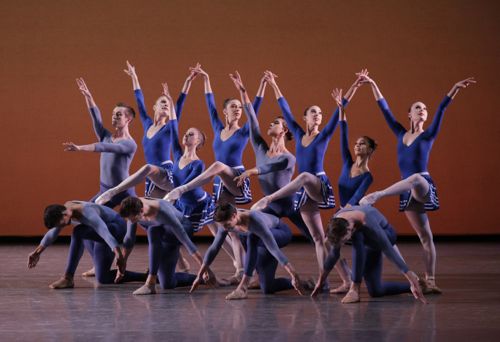
For the “Year of the Ox” opener, blue-clad dancers are led by Ashley Bouder. Sometimes, arranged in a three-line design (pictured above), the corps evokes the oxen and carts, sometimes, in a driving march rhythm, the concept of sturdiness, or, in a gesture of wiping the brow, the weariness of work. In “Year of the Rabbit” — the music, the floor plan for the corps, and the limbs of Joaquin de Luz – zig zag unpredictably. In one section – I think it was Year of the Dragon, the dancers get to lie down on the job. They recline half in and out of the wings, rousing themselves to react at various moments. I think they must have been guarding the dragon.
In a world that does not generally accept heart-on-your-sleeve religion, Sufjan is an acknowledged Christian, and he inserts a non-zodiac section, “Year of Our Lord,” near the end. Peck’s evocative pas de deux for Janie Taylor and Craig Hall (the only section without the corps) has an echoey legato Gregorian-chant atmosphere. “Year of the Boar” abruptly blusters the closing contrast.
My overall take – that Sufjan Stevens is lucky to have Justin Peck as a choreographer and vice versa. Sufjan’s music is full of repetitious phrases, but instead of just “sitting there,” they go somewhere. They get longer or louder or change meters or take side trips but they remain in the same groove in your head. Such imaginatively extended phrases allow Peck to wring the last ounce of invention out of each movement theme and it is oh-so-fun to watch.
The matinee opened with a piece that made me think of Brigadoon: Benjamin Millepied’s Two Hearts to a score by Nico Muhly with an affecting folk song solo by Laura Mulleavy. Muhly and Sufjan Stevens are musically connected and have shared the same stage. The program closed with a forgettable, by contrast, Les Carillons, by Christopher Wheeldon to Bizet’s L’Arlesienne suite. If you go on next Saturday night (October 13), and you loved the Year of the Rabbit, you might want to catch an earlier train home to New Jersey. Though your preferences may be different from mine. The man in back of me, when Les Carillons principals took their last curtain call, pronounced. “Now THAT was a dance.” .  

October Opportunities

From this list of opportunities, the only one I’ll guarantee to attend is Saturday’s UFAR 5k to Combat Riverblindness. Registration starts at 8:30 and the starting gun goes off at 10. It’s OK to walk, and if you keep a steady pace it takes less than an hour. It’s going to be extra fun this year, with extra prizes! There’s no prettier route — starting and returning to the seminary. But there’s lots more going on this weekend.

In the Pink Fashion Show on Friday, October 5, 6 p.m. benefits the very worthy Breast Cancer Resource Center of Princeton.

Three back-to-back dance concerts and I can’t attend. (Does anyone want to write about them for this blog?) American Repertory Ballet premieres two works from the Joffrey repertoire on Saturday, October 6, at Raritan Valley College. Yes, it’s worth the drive. Outlet Dance Project offers new work at Grounds for Sculpture on Sunday, October 7, at 2 p.m. There is also another site-specific concert, this one at Trenton’s Cadwalader park on Saturday, October 6., cosponsored by Passage Theater.

Palmer Square has its Birthday Bash (75th) on Sunday afternoon, October 7. I have mixed feelings about this and am saying so here.

On a more serious note, the Troubling Issues series at Princeton United Methodist Church presents a forum on world economics, with economists native to three different countries. It’s Sunday, October 7, at 4 p.m.., at Nassau & Vandeventer.

Next week’s business opportunities:

NJEN offers “Where’s the Money?” at lunch on Wednesday, October 10, at the Marriott. It’s highly advisable to register ahead for this one, so your contact info is on the handouts.

Eileen’s Sinett’s day-long presentation training intensive, Speaking That Connects, is on Friday, October 12, and I can attest you will be a different and better speaker after that day.

The Painful Economics of Traffic Court

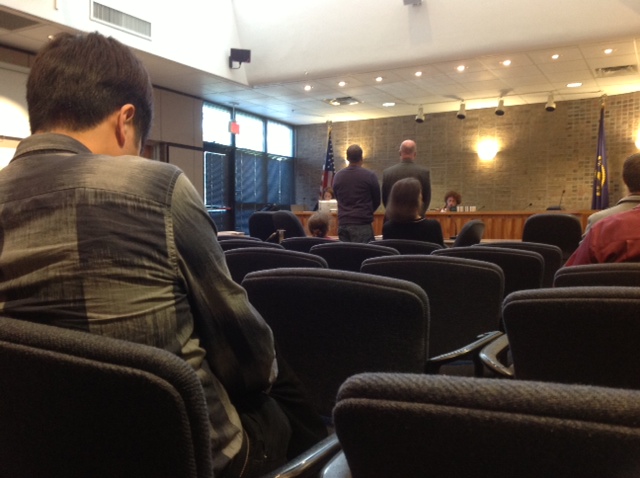
Such a small thing as a traffic ticket, even a couple of parking tickets, can wreak terrible financial hardship for some families in today’s economy. That was the lesson I learned from sitting for 2 1/2 hours in traffic court today, watching the mini-dramas unfold.

Say you get fined $500 and can’t pay the fine, it mounts up. Pretty soon there is a warrant for your arrest, you lose your license, and now you owe more than $1,000. If you have lost your job, where do you get the money? The court can’t, or doesn’t care. Pay or lose your license.

What could you do that would amount to nearly $500? Merely fail to yield to a pedestrian in the crosswalk. A Manhattan resident who was delivering her daughter to Princeton University did that, in a moment of confusion. The fine was $250 and a point on her license. To avoid the point, she could pay a “surcharge” of $156 plus $33 in court costs for a total of $439. Fortunately this woman could afford it.

Others were not so fortunate. One speeding ticket, including the surcharge, cost $469. About half the people claimed they couldn’t pay their fine, and bleeding heart liberal that I am, I believed them. The response from the court: “Make some phone calls today. Owe someone other than this court.”

I don’t blame the judge or the court officials. They are doing their job. Nor the police officers. But such high fines result in just another case of The Rich Get Richer, the Poor Get Poorer. Delay in paying your fine because you can’t pay your rent, because you don’t have a job, and it doubles, then triples.

I realize the general lesson is, drive very. very, very carefully. Don’t get a ticket. But the specific lesson for me is, avoid Nassau Street like the plague. If I should fail to see a pedestrian in the crosswalk, perhaps because another pedestrian is darting out in front of me who is NOT in the crosswalk — well, I wouldn’t be happy paying $250 to $439. I’ll stay on Wiggins and Hamilton where pedestrians don’t lurk behind parked cars.

White-Collar Crime: Not in our town, not this time

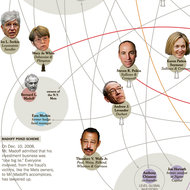
Check out the NYT special section today, DealB%k, about the future of white-shoe law firms, especially the terrific full-page graphic White-Collar World on page 4 by Guilbert Gates (under the direction of the reporter, Peter Lattman). The excerpt at left shows about 20 percent of the fascinating diagram of “big trouble lawyers” and the scoundrels (or the accused but acquitted) financiers they defended. (Aside: only two women are in the former group, only one — Martha Stewart — in the latter.)

Since I devour Style’s wedding pages for any mention of brides or grooms from Princeton,  I pounced upon this with similar intent and found, yes, one person that I knew from the late 1980s. Well, I didn’t actually know him, because he never would talk to me, but I delivered papers to Jay Regan at Princeton/Newport’s third-floor office on Spring Street, corner of Witherspoon.

It was during the 1980s insider trading scandal, when then attorney general Rudy Giuliani was going after “everyone and his brother,” including Richard Milliken and Martin Segal. (For an in-depth account of one of those trials, see this Money-CNN piece. Michael Powell detailed Giuliani’s excesses in a 2007 New York Times article) . Regan and Princeton/Newport got caught up in the prosecution. Powell wrote:

In 1987, about 50 armed marshals raided and locked down the investment firm Princeton/Newport Partners. A federal appellate court overturned that racketeering conviction, but the firm remained shuttered. “We were in the wrong place at the wrong time,” said financier Jay Regan, a principal at Princeton/Newport. “It’s strange to be sacrificed on someone’s altar.”

It was a very tense time around that office on Spring Street. When you deliver papers for U.S. 1 — and every staff member was a deliverer in the early years — you taste the vibes in an office as soon as you open the door. For that route I went first to the three-story building on Palmer Square, then in and out of the retail shops along Nassau and Witherspoon, chit chatting with the real estate people and the hoagie people — but when I opened the Princeton/Newport door — immediate shut down, icy cold. Initially I didn’t know what was wrong. Shy folks, I thought. Then I read the papers and realized what was going on.

I never got to do the Diane Henriques thing (Henriques is the NYT financial reporter who wrote the book on Bernie Madoff). I never did get to interview Jay Regan, the little fish caught in the Millken pool; it was a NYT and WSJ story. Thanks in part to big trouble” lawyer Theodore V. Wells Jr. of Paul, Weiss, Rifkind, Wharton, Garrison (headshot in the excerpt above), all but a few of the charges were dropped. It cost Regan six years of litigation; he is now general managing partner at Harbourton Enterprises on Hulfish Street.

Postscript I:  Diane B. Henriques is keynoting the Mercer Institute’s Executive Leadership Summit on Tuesday, October 9.

Postscript II: I can’t help but compare this account of the White-Collar World with The New Jim Crow, as exposed by Michelle Alexander. Untold millions are spent on defending against charges of white collar crime. Very little, reports Alexander, is spent on defending African Americans snared in the legal quagmire of required minimum sentences. For instance, statistics show showed that black teenagers disproportionately represented in the juvenile justice system in New Jersey.

Since the survey was done in 2004, some efforts have been made to correct the problem of how black juveniles are treated differently from white juveniles, but overall, I believe, this is a scandalous state and national problem. So do others in Princeton who are working, not just to raise everyone’s consciousness, but to actually change the system. I’ll be posting blogs about their work at Not in Our Town Princeton, and you’ll be hearing more about it from various sources in the coming months. It will be the topic for Continuing Conversations on Race on Monday, October 1, 7:30 p.m., at the Princeton Public Library. In the meantime, mention this post and get a discount on the Michelle Alexander book at Labyrinth Books.

Not everyone indicted for white collar crime is a criminal in our town. The same is true for those accused of other crimes, but not everyone has the money for the good lawyer. This results in a new caste system that can be far more damaging to African Americans than the indignity of separate drinking fountains

.

Kickstart Tech: Kickstart Dance

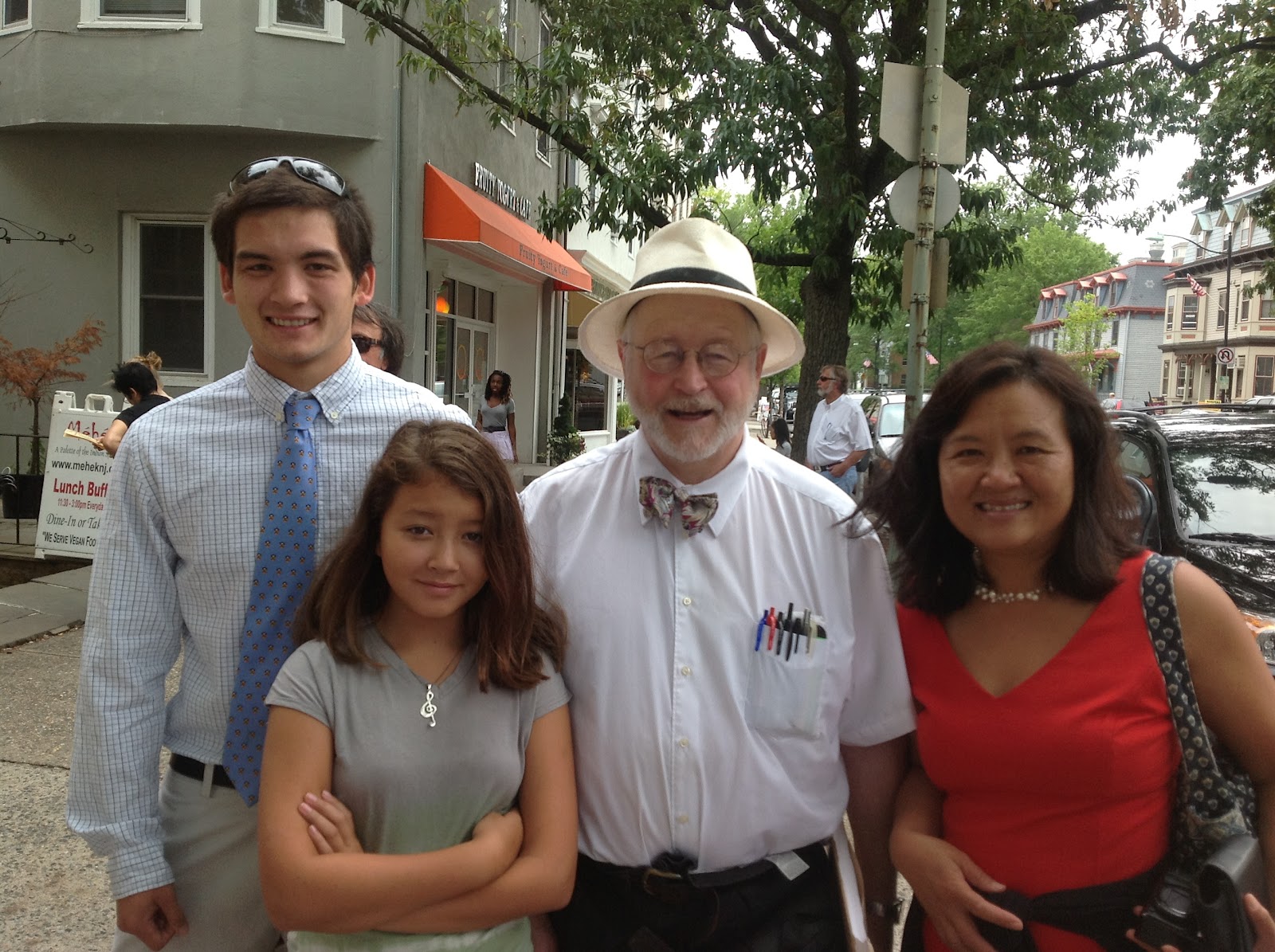
I first met Savraj Singh at an Einstein Alley Entrepreneur’s Group meeting– or was it first at NJEN? and then in September, 2010, at the World Day of Prayer (photo at right), where he was representing his Sikh congregation. Full of energy for his company, WATTVISION, he was struggling for funds. 

Earlier this year he emailed me about his Kickstart program. Kickstart is the social media version of asking friends and family to chip in on your new venture. An article by Lynn Robbins in U.S. 1 Newspaper re
ported that his company had raised $37,000 as of September 4


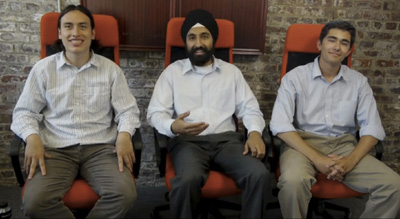
Good news! Singh and his partners (shown left) passed their $50,000 goal yesterday, raising $67,293 from 497 contributions, ranging from $1 (which gets you listed on the website) to more (which gets you discounts on the product, a gateway and energy sensor.) Some of the higher end contribution categories are still open. 


Today another would-be Kickstarter emailed me — dancer and choreographerny, Jamuna Dasi, the producer of a very successful annual concert at Grounds for Sculpture on Sunday, October 7. She seeks a modest amount — $5,000 
Says Dasi: I have been producing The Outlet Dance Project for 8 years. Until today, the dancers and myself have never been paid and I have barely been able to cover the costs of producing this popular, well-attended, and highly valued community event. This year I would like to be able to give a $200 stipend to each choreographer and not have to worry about covering our modest production costs. ‘=

It’s not the first arts cause to do a Kickstart (Robbins’ article reported on 4 local efforts) and maybe this is a viable alternative to waning corporate funds. The minimum pledge of $1 will receive a dance-related haiku, but sponsors of $500 will have a dance especially choreographed for them at any location they choose.  If Singh’s venture gives you the opportunity to be the next Rockefeller, the arts ventures let you be the next in the line of the Medici family. The deadline is October 4, the performance is October 7. 

Tying a Tourniquet on the Economic Crisis

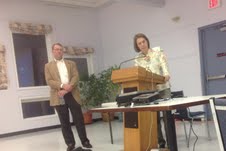
Elizabeth Bogan, senior lecturer at Princeton University (shown here with Jim Solloway) addressed the West Windsor Republicans on September 12 with a non-partisan discussion on the economy. She considers herself a market oriented economist, taking the middle ground between the Krugmans and the tea partiers. Her charts were, of course, predictably discouraging, but she had some unpredictable insights on why that’s true.

DISABILITY: For 42.7 million to be on disability is way too many, in her view (and, in today’s news, Congress’s view). People who could be working, aren’t. 

HEALTHCARE. In Medicare — elders are getting $3 of care for every $1 they paid in, and that is unsustainable, she says. We must attack the myth that everyone has the best of care.” We don’t all drive the same cars, we don’t all have the same food budget, maybe we don’t all get equal care, after all. 

Ryan’s plan is not soon enough or not radical enough, she says, but it does set limits on what you are going to spend. “There is no tooth fairy.” She doesn’t think that a Romney/Ryan administration would actually eliminate Obamacare. “But they do understand efficiency.”

Of her strategies below,  # 3 (better use of computers) is my fave, since I’m all for efficient digital health records and personal health records. (Whatever happened to that company, birthed in Princeton, that would put your health record, your insurance, and your bank account all on the same card? Now that would be efficient.)  I also like #4, change the rules, because it would let my doctor get paid for emailing me. 

BEYOND HEALTHCARE: Because we had two wars without raising taxes (nonsense! says Bogan), we are addicted to public and private debt that is being picked up by the Chinese. When China turned to a capitalistic-style economy (eating our lunch with manufacturing jobs), the world’s labor force increased exponentially. In this country, the lawyers, accountants and consultants are doing well, but jobs disappeared for the lesser educated, who must now focus on personal service jobs.

One strategy, says Bogan, is to quit giving the day traders a free ride. Tax each and every financial transaction at a rate of 1/10th of 1 percent. Every stock sale. Every mutual fund buy. It would have a minimal effect on most of us, but it would hit the nano-second traders right where it should. 

Raise the retirement age to align with today’s life expectancies. Raise it to 67 (for the early stage) and 70 (for the final stage). 

Tax the returns to hedge fund managers as ordinary income instead of as a capital gain (and this, from the spouse of a hedge fund manager.) 

Tighten leverage rules to require 10 percent down on anything — houses, appliances, anything. 

And what about taxes? Surveys show, she says, that folks from all income levels think that 25 percent is about right. Clinton got it right. He reduced the number of brackets. “We don’t have room to make huge tax cuts now,” she says. “The Obama rhetoric confuses business. If we grow the economy, fewer people would choose food stamps and welfare. I am comfortable with debt if I believe it will solve long-term problems.” 


`

Woodbridge Runs for Mayor

A Republican running for town office in Princeton? Sounds like an oxymoron.
But Dick Woodbridge has filed to run, not for the first time. He has served many terms on council, for both the Borough and the Township, and he has been the township’s mayor.

He opens his campaign office today at 162 Nassau Street. That’s in the block opposite New York Camera and Thomas Sweet; last campaign season it was the Obama headquarters.

Small glitch — some media outlets say 62 Nassau. No, 162 Nassau, and the grand opening was today, Labor Day.

May the best candidate win — and in this race (unusually) I have an opinion.

Basketball: Fake Shots, Not Feelings


If there are two kinds of college basketball coaches, those who recruit well and those who are fired, Courtney Banghart must be recruiting well. In an article in U.S. 1 Newspaper by colleague Kathleen McGinn Spring, Banghart shares the leadership lessons she used to transform Princeton University’s women’s basketball team into champions. 


Point: Genuinely care about the people you lead. There is “just no way to fake this,” she says.  


Point: Choose the harder right over the easier wrong.


In probably her only “free” month, in between recruiting and coaching, Courtney Banghart speaks to the Princeton Regional Chamber on Thursday, September 6. We will all be intrigued to hear the from the court” stories that sh
e’ll tell

Bloom Where You Are Planted


After seven moves and three kids, accomplished early in our marriage, we landed here in Princeton and have stayed planted for more than 30 years. (We love it here, but the cost of NOT moving is more clutter! It’s hard to get rid of stuff when you stay put.)
Cheryl Mart and Karin Brouwer have more recent experience with the joys and challenges of moving.  They are leading a non-denominational Christian study, based on a Susan Miller book and video, at Princeton United Methodist Church on Wednesdays, starting September 19, 10:30 to noon. m. 
This free one-semester study is designed to help in the process of letting go, starting over, and moving ahead with your life after a move.  Women do not need to attend the church to attend the free classes, which involve videos, reading, and discussion.
“Over the last 25 years I’ve lived with my husband and three children in five different countries,” says Brouwer. “With every move I have experienced God’s sustained love to overcome difficulties and the importance of having a church family. It helped me to bloom where I am planted.”
Mart, a registered nurse, had a difficult transition in moving from Texas to Princeton and leaving her married children behind. “I found encouragement in ‘After the Boxes are Unpacked’ by Susan Miller,” she says. “By offering this study, we hope to reach out to those who are struggling with similar issues.”

For more information click here or email movingon@princetonumc.org, or call 609-921-0730.  (Disclosure — I’m a member at PUMC).
Perhaps the “Moving On after Moving In” study is “right” for the newcomer you know. Or maybe another resource is. The Women in Business subset of the Princeton chamber comes to mind. In any case, the very best resource is probably YOU. Make time. Reach out. Have coffee.

NO COMMENTS:

POST A COMMENT