Category Archives: Uncategorized

Tooth and Nail: Biz Plan Contest

Tooth and nail — that’s how the five entrepreneurs go at it for the 16th annual Princeton Entrepreneurs Network business plan competition on Friday, June 1 at the Friend Center, part of the Princeton University reunion activities.

Ben Lerer — co-founder and CEO of the digital media firm  Thrillist.com, members-only shopping club JackThreads.com, and local experiences firm ThrillistRewards — will keynote at 10 a.m.

The lunch — with four additional speakers including Tom Szaky, founder of Terracycle — requires registration. The always exciting business plan pitches begin at 1:15 p.m., with 5 companies making 10 minute pitches followed by 25 minutes of grilling by the judges.

The business plan competition is planned as a reunions event but there’s generally room for observers. Just don’t try to stay for lunch unless you’re registered!

Lots of stuff is happening in the next week — mostly business/techie events, one for hard core dance aficionados:

The American Women in Science/NJ group has a meeting on mentoring tonight (Thursday) in Piscataway.

Princeton Ballet School presents its faculty and staff concert on Saturday, June 2, at 6:30 p.m. at the studio in Princeton Shopping Center.

Princeton Regional Chamber’s Women in Business Alliance celebrates its first anniversary on Tuesday, June 5, 5 to 7 p.m. at PNC Bank on Nassau Street.

NJEN’s “Gathering of Angels” lunch is Wednesday, June 6 at the Forrestal Marriott.

Joseph Herring, CEO of one of the nation’s biggest clinical trials firms, Covance, speaks at the Princeton Regional Chamber lunch on Thursday, June 7, at the Forrestal Marriott.

The Einstein Alley Entrepreneurs Collaborative meets Monday, June 11, at 6 p.m. Contact Marion Reinson if you have an entrepreneurial bent in a technology field and want to join this group.

Robert Carr of Heartland speaks for ACG/NJ on Tuesday, June 12, 5:30 to 8:30 p.m., at Forrestal Village

A women & technology all-day workforce summit is Tuesday, June 15 at Mercer County Community College.

May 20 is for Ballet

Tonight in New Brunswick I saw the first of two performances of American Repertory Ballet’s ‘Celebration.’ I’m writing about it ‘with a hot needle and a burning thread’ as the saying goes, because I’m recommending that it’s well worth spending a Sunday afternoon indoors to see it. The second performance is Sunday, May 20, at 2 p.m. The company is dancing fabulously, the costumes (by Michelle Ferranti and others) are excellent, and the dancers communicate with all their corpuscles.

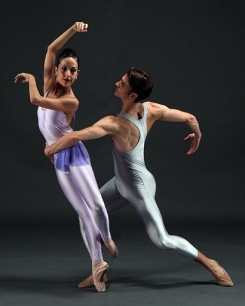
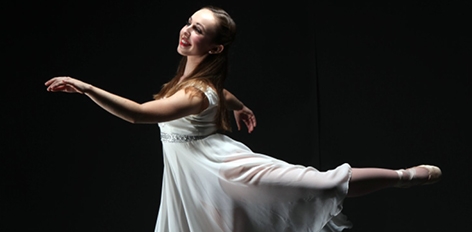
Company director Douglas Martin previews his full-length Prokofiev-based ‘Romeo & Juliet’ with the first act ballroom and balcony scenes. I was impressed. All the fine points of believable drama were there. Only the Montagues are masked, so we can easily tell who is who. Karen Leslie Moscato (pictured above, photo by Peter Cook) and David DuBois, as J & R, manage to fall in love before our very eyes yet evade the eyes of her parents. Each detail, each glance — especially in the dance where Romeo joins Juliet’s family — contributes to the tension. In Martin’s version, Juliet’s parents are a strong, calming influence on Juliet’s brother, Tybalt. Paris (Juliet’s intended) is a nice guy — not a nasty one, as in Nureyev’s version for Paris Opera Ballet. (Did I just name drop that I saw Nureyev’s version for Paris Opera Ballet last year. Mmm, yes. My excuse is that I liked Nureyev’s much better than the Macmillan one, especially for its interpretation of the plot, and I think I’m going to like this one too.)

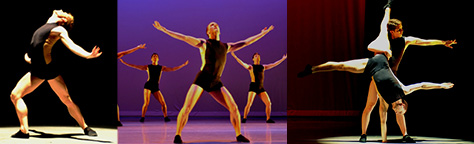
The two-hour program also includes Gerald Arpino’s 1970 Confetti (an Italian tarantella romp with tambourines), Patrick Corbin’s 2011 Follia (left, photos by George Jones), and Mary Barton’s new Straight Up with a Twist (below left, photo by Peter Cook). In this last piece, a showcase for the full company, the women’s unitards were trimmed with a fun ‘hip hanky,’ right for this flirty, quirky jazzy piece that might have been set in a New York singles bar. But along with all the dialogue — questions asked and questions answered — there was real dancing.

Throughout, the dancers communicated, with each other and the audience. For instance, Shaye Firer, in Confetti, had an especially conspiratorial eye; she let you in on her secrets. Stephen Campanella let you in on his joy.  These dancers knew, with each movement, what they wanted to say and they said it.

If you go, and I hope you do, be sure your GPS has the right address for the Victoria J. Mastrobuono Theatre, at 85 George Street, It’s part of the Rutgers Mason Gross Theatre complex, and traffic patterns off Route 18 have changed.
I’d like to say more, but Sunday morning calls…

For Women: Branding Yourself- May 22

I don’t have time to rewrite it, but here is a promo from the Princeton Regional Chamber. This Woman in Business Event  costs $25 for members, $30 for non members…..Barbara

Come join us for a glass of wine

and light hors d’oeuvres!
Tuesday, May 22, 2012
5:00 to 7:30 p.m.
Springdale Golf Club

Judy Lindenberger, President ofThe Lindenberger Group,

will share the secrets to branding yourself,

both the tried-and-true way and with the latest social media!

Register here

This event is proudly sponsored by

Transportation Forum May 23

Transportation Forum: Preparing for Route 1 Changes

Date: 5/23/2012
Time: 9:30 AM TO 11:30 AM

New Jersey Hospital Association
760 Alexander Road PO Box 1
Princeton, NJ 08543

Phone: (609) 924-1776


This event is sponsored by the New Jersey Petroleum Council.

The Princeton Regional Chamber of Commerce, Mercer Regional Chamber of Commerce and Capital Region Minority Chamber of Commerce have partnered to bring you a Transportation Forum for Route 1 Businesses. This discussion will include representatives from the Department of Transportation, local community leaders and businesses to learn what businesses are doing in preparation for the upcoming jughandle closures. Participants include:

  • Kimberly Nance, Department of Community Relations, New Jersey Department of Transportation
  • Robert Sheehan, Township Administrator, Plainsboro Township
  • Mayor Chad Goerner, Princeton Township
  • Mayor Jim Kownacki, Lawrence Township
  • Mayor Shing-Fu Hsueh, West Windsor Township
  • Karen Jezierny, Princeton University
  • Carly Meyer, Princeton Merchants Association
  • Pam Hersh, Princeton Healthcare System
  • Lori Rabon, Nassau Inn and Princeton Regional Convention and Visitors Bureau
  • Moderator: Cheryl Kastrenakes, Greater Mercer Transportation Management Assocation
Learn how your business might also prepare for these upcoming changes!

The event is free but preregistration is requested. 

Directions:

For directions, please click here

Scholars Up in Arms

The May 16 WSJ article “New Vision for Library” caught my attention for several reasons. It tells about the plan to remove 3 million books to the ReCAP storage facility on Forrestal Road. When the Research Collections and Preservation Consortium first opened, U.S. 1 Newspaper’s photographer Craig Terry took a cover photo of the in-charge librarian in charge on top of a fork lift. I marveled at how the books were stored by bar code according to size, and how they could be retrieved and shipped quickly. Currently it houses more than 9 million items, one-third from the New York Public Library and the rest from Princeton University, and Columbia. It’s supposed to take just 24 hours to retrieve a book and ship it to New York. A librarian’s marvel.

Just last November, U.S. 1 quoted Curt Emmich of Picus (the firm that manages the Forrestal Center) as saying ReCAP would expand soon add 5 million volumes. It also reported that ReCAP could build out its facility for up to 35 million items.

So — more books, more jobs, more square feet — that’s a good thing for Princeton.

Not so fast. A tornado has erupted over this plan and folks from another Princeton-based institution, the Institute for Advanced Study, are in the eye of the storm.  Joan Wallach Scott, Harold F. Linder Professor of the School of Social Science at the Institute for Advanced Study, wrote a protest letter that has acquired 750 signatures so far. (In the original print story, Joan’s name was spelled John, the unkindest cut of all, especially when you know that Scott’s portfolio focuses at least partly on “the vexed relationship of the particularity of gender to the universalizing force of democratic politics” — but I’m no one to talk, I mis-identified someone at IAS just six months ago.)

Scott’s point was that, No Virginia, scholars can’t do all their research on the Internet. And waiting a day for a book or item is not acceptable. Objectors say the promised one day delivery often expands to three days because — even though ReCAP staffers get all the books on the trucks in one day — there are delays, partly due to traffic, partly due to distribution problems in New York.

Anthony Grafton, Princeton University historian, weighed in with an essay in the Daily Princetonian, applauding Firestone Library for keeping books on its shelves and lamenting how he believes the iconic building at Fifth Avenue and 42nd Street will be turned into the equivalent of an internet cafe.

The opposition has called an open meeting for next Tuesday night. 

Meanwhile a former Princeton University president (and former Harvard president, now an advisor to a mega digital book trove) Neal Rudenstine, took up a position on the defense. As chairman of the New York Public Library’s board of trustees, he told the WSJ that there must have been “a very very considerable misunderstanding. It’s up to us to try to correct it.” Citing a crumbling building without the proper climate controls, NYPL officials are, according to the WSJ, “fanning out” to do damage control.

With IAS and Princeton University protesters on one side, Neil Rudenstine and NYPL officials on the other, that’s sufficiently interesting controversy, but it gets better. Near the end of the WSJ story we learn that “library officials said an unfortunate misunderstanding helped turn scholars against the renovation.” And here we go with citizen journalism. A prominent blogger and critic of the new plan, Caleb Crain, was invited to weigh in as a member of the advisory committee. Crain’s blog is called Steamthing, as in “Steamboats are ruining everything.”

And here I began to get steamed. Crain wrongly assumed that it was OK to write about the confidential meetings. He admits he committed a journalistic error by going to the meeting without disclosing his desire to write about it, and asking permission afterwards. Then — barred from future meetings — he retaliated by mounting a campaign.

I can certainly understand his frustration. When the Einstein Alley Entrepreneurs Group first started in 2004, founders John Romanowich and Steven Georges invited me to attend with the caveat that I couldn’t write about what was said. Okay, I agreed, but it was and is hard not to report the juicy revelations at these meetings. When I joined the Princeton Regional Chamber Board (I’m off, now), I was on my honor not to tell my boss, editor and publisher of U.S. 1 Newspaper, about the inner secrets of the chamber (honestly, there weren’t that many, but it was still hard because I’m a secret teller, not a secret keeper.) Last year I was importuned by a group of angels to attend their meetings on the proviso that it would be ‘just background’ for a nice big story. I cooperated (though I never did get around to writing that story). Then when I was invited, as a member of Duke alumni group, to meet and listen to the CEO of Johnson & Johnson, and I politely asked the J&J; handlers if I could report on the occasion for my blog, I got a horrified NO. So I didn’t.

So Caleb Crain — I think you knew in your heart that your opinions were being solicited by the library on a confidential basis. I know it was frustrating to be asked not to report the committee’s deliberations on your blog, which has 994 official readers and exponentially more supporters. Whether you are right or wrong about the library’s plans, is your use of your blog a scary demonstration of citizen journalism?

No, says Charles Petersen, who calls Crain a “respected essayist” not a journalist, and said that Crain wrote about the advisory board “quite circumspectly.” In a well-reasoned (and lengthy) explanation of the controversy for n plus 1  (a print magazine of politics, literature, and culture) — he takes the long view — he criticizes the “managed democracy” of library officials influenced by business wonks. If the reconstruction goes through,  says Peterson, scholarly research “will be more concentrated in the handful of inordinately wealthy and exclusive colleges and universities.” 

I have no idea who is right, but this controversy has attracted almost as much attention as the plan to move the Dinky Station, and the emotional level of discourse approaches that of talk radio. 

Full disclosure: No original reporting was done for this blog post.
Guest Post: Outlook for Thin Film Solar

Here is a report on the May 10 Andlinger Center talk by Dr. David Eaglesham, Chief Technology Officer of First Solar, Inc., maker of thin film solar panels. The reporter is an engineer friend of mine, Ed Sproles. A Penn State and MIT graduate, Ed worked for 23 plus years at Bell Labs and its successors, most recently as senior manager. Now he co-chairs the Power and Energy Society of IEEE. Thank you for this report, Ed! 

Eaglesham’s talk was interesting, both from a business and technical point of view. He says they are still breaking even, even at the low panel prices of today.  He says that Chinese are losing money at these prices, $6B in the last 9 months, but they have subsidies to carry them through. The expiration or elimination of subsidies for installed systems in Europe and US has caused the collapse of panel prices.  So far they have installed 5GW of capacity worldwide.

Eaglesham states that First Solar’s panel costs are lower based on their technology.  First Solar’s panels are based on cadmium telluride (CdTe) while all the Chinese and others are using silicon either single crystal or poly.  Presently CdTe panels are slightly lower in efficiency than silicone (Si) panels, but fundamentally cheaper to manufacture.  He believes that they can improve cell efficiency to equal or surpass Si, and presented his arguments based on the higher bandgap of CdTe and the comparatively smaller effect of temperature. So far, the highest efficiency that First Solar has achieved in the lab is 17.3%. The typical efficiency of operating systems is 13% at operating temperature which is around 70C in full sun.

His company has constructed systems in the 300MW range, and has a 600MW system under construction in southwest United States.  Systems this size cover square miles.
  
The business has been on a wild ride.  Two years ago they had huge margins and stock price bouncing around $150.  Today they have closed their German factory, are barely breaking even and the stock is around $16.  So, will they survive?  Eaglesham believes yes, based on their technology advantage.  Presently no one is replicating their design, and the barrier to entry is high. 

Nobody Puts Baby in a Corner

Patrick Swayze

The line — “Nobody puts Baby in a corner” is now iconic, as I discovered when a group of women were crowding into a small space, and someone urged me to move out from a tight corner spot. I muttered that line and everyone instantly knew the reference and laughed. The line now is right up there with “I’ll Have What She’s Having,” which is now the title of the Princeton YWCA’s annual dance concert for over-40 choreographers. 


Dirty Dancing is one of my all-time favorite movies — plus the script was written in Princeton by Eleanor Bergstein (whom I interviewed for U.S. 1 when the movie came out) and a Princeton-trained dancer was in the cast. I wish Jennifer Gray had had a longer career, but here is more info about Swayze in the Princeton-based online mag, Obit. 


This movie has enduring appeal, as shown by a blog, Dirty Dancing Analysis, that, for two years, discussed each and every aspect. That the basic idea, evocative dance movement, still brings controversy is shown by the cancellation of a Princeton High School dance (yes, even here! last year!). It made national news. I don’t disagree with the cancellation — I’ve always been a bit of a prude about dancing that is “the vertical expression of a horizontal desire” — but that frisson of forbidden fruit is part of Swayze’s appeal. 


The Methodist Dragon

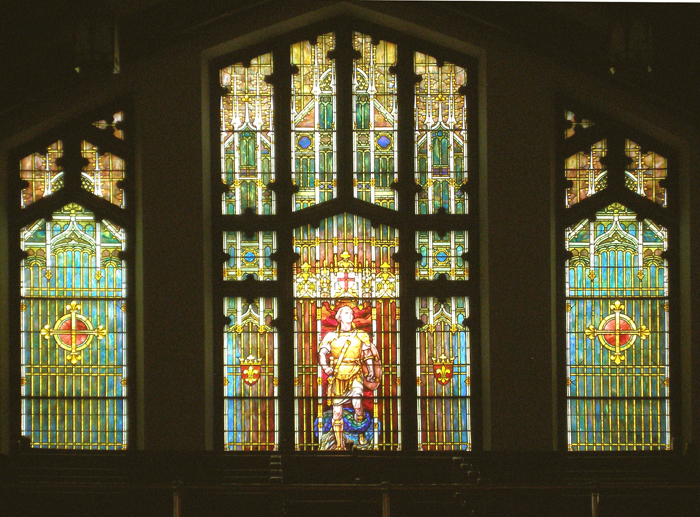
On the corner of Nassau and Vandeventer is a scary looking dragon. No worries: the dragon isn’t real, and it’s also dead. It’s in a stained glass window depicting St. George, and you can see his gaping jaws. The spectacular window, over the balcony of the 101-year-old sanctuary of the Princeton United Methodist Church, is from the renowned Tiffany studio.


Though there are lots of Tiffany windows in other cities, I know of only two other Tiffany windows in Princeton. One is at Alexander Hall (Richardson Auditorium.) Richardson Auditorium’s Tiffany (link to photo by Matt Pilsner) consists of four circular panels, totaling 10 feet by nine feet, representing Homer. 


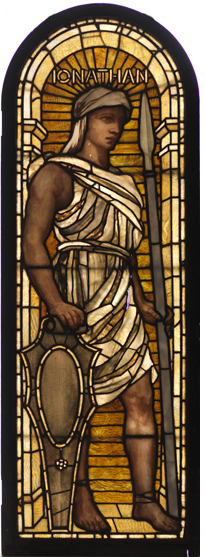
The Princeton University Art Museum owns the other Tiffany window, currently located at Jadwin Hall. The museum’s current exhibit, Princeton and the Gothic Revival also has a scale model of a  window by Francis Lathrop, a follower of Tiffany. It used to be in the Marquand Chapel, before it burned down. Lathrop (according to publicity info) rolled and shaped the glass to mimic the folds of cloth, a technique popularized by the studio of Louis Comfort Tiffany (sepia and brown window shown at left). 


In an article for Baltimore magazine Elizabeth A. Evitts explained Louis Comfort Tiffany’s innovations: While the Europeans fired paint directly on the glass, effectively dulling its natural transparency, Tiffany managed to create vivid color in the glass itself. He layered multiple panels to create unparalleled clarity, and the windows shimmered on both sides. 

Tiffany also redefined the use of leading. Traditionally, it was purely functional and thought of as little more than support for the glass. As a result, the lead tended to distract from, rather than enhance, the artistic vision. That is until Tiffany developed new techniques that allowed the metal to become an integral part of the design, and the once clunky lead lines were transformed into elaborate outlines for things like tree branches and butterfly wings. Perhaps because of such innovations, Tiffany prized his windows above all his other work. 


The $64k question, of course is — why does a Methodist church have a window of dragon, let alone a saint? Protestant churches acknowledge saints but unless the saint was a disciple of Jesus, they aren’t generally pictured in our churches. (As you may have figured out, I’m a member of Princeton United Methodist Church, PUMC).

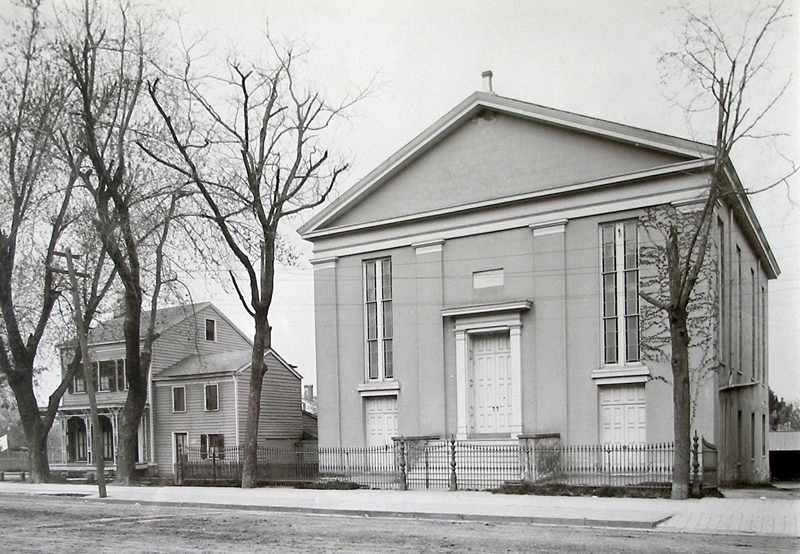
We used to think that the window was “a reject from West Point Cadet Chapel.” That would have made sense. West Point likes war pictures and the two sanctuaries were built at the same time. But no. The real story is that a Princeton University college student, Eddie Durrell, a Methodist preacher’s son, made PUMC his church home in the late 1880s, when the church looked like the picture to the left. The pulpit was occupied by Charles H. McAnney, “an evangelistic preacher of great power,” according to Ruth Woodward in A Journey of Faith for One Hundred Fifty Years: A History of Princeton United Methodist Church.  Eddie graduated in 1889 and two years later met an untimely death — apparently in an automobile accident in Italy. His family — grateful for what the church had offered him — donated the window for the new sanctuary, built in 1910 on the property occupied by the old church and the house shown in the picture. 


Wrote Ruth Woodward: The magnificent window in the facade of the sanctuary, depicting St. George and the dragon, was the gift of the Reverend Edward Hicks Durrell and his family, in memory of a deceased son and brother, William Edward Durrell, who was a Princeton graduate of 1889. Eddie Durrell died in Italy in 1891 and was buried in the Protestant Cemetery in Rome. Because he was the youngest member of his class, and the first to die, his classmates arranged for a flat marble slab to be erected on his grave as an expression of their love and esteem. The family was probably happy to have an opportunity to provide a memorial of their own.This window was crafted by the Tiffany Studio of New York City, and the Tiffany signature can be found in the lower right corner.


Until I reread the history, I assumed that the deceased student’s name was George. I was wrong. Then my next  question is, how could a Methodist pastor’s family afford a Tiffany window?

Because he was also an entrepreneur. While serving a pastorate in Tuckahoe, New Jersey, writes Woodward, he bought a cranberry bog and became one of the largest cranberry growers in the state.

Come and visit George sometime — and all our other beautiful stained glass windows. Email me, and I’ll give you our Dragon Tour.


Photovoltaics versus Fracking?

As fracking continues and natural gas prices drop, enthusiasm for alternative energy sources seems to dim. On Thursday, May 10, at 4:30 p.m., David Eaglesham, chief technology officer of First Solar, will lecture for Princeton University’s Andlinger Center for Energy and the Environment. He will speak on challenges faced by a high-tech area in which Princeton had been a leader — the photovoltaic industry. 


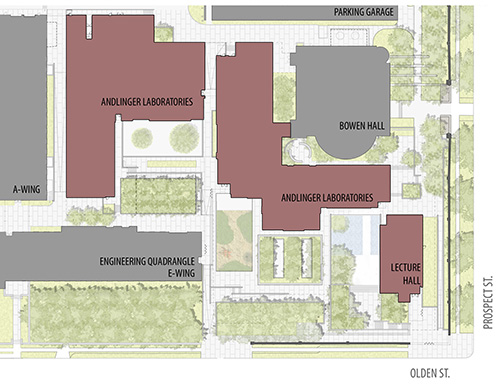
The Andlinger Center building, marked in brown, is under construction. The former Carl A. Fields Center (the Third World Center) was demolished and has reopened in a renovated space across the street. Its footpring will be occupied by a lecture hall and a public garden. Much of the center will be several stories underground. The new buildings are slated for completion in spring 2015. 


Eaglesham will speak in Computer Science building Room 104. Click here for a map of where to find that building — it is attached to the Friend Center but it faces Shapiro Walk. A reception follows and all members of the community are invited.


Educated in Great Britain, Eaglesham worked at Lawrence Livermore and Bell Labs before joining First Solar. Based in Bridgewater First Solar is a global privder of comprehensive photovoltaic solar systems using advanced thin film modules. In a press release Eaglesham says,  “I will show that the underlying economics and energy-balance continue to favour PV as the long-term solution, with minimal carbon footprint and excellent scalability. However, the precipitous drop in margins presents a barrier to the growth of the industry that can only be overcome by a new round of radical innovation.”
On a similar topic for the university’s reunion crowd, there will be a panel discussion on Saturday, June 2, at 10:30 in McCosh 50. Emily A. Carter, the founding director of the Andlinger Center, will discuss “Managing Our Expectations; Long Term Energy Solutions.” 

New Hospital’s Top Ten

So — go! It’s your only chance to view the new operating rooms while you are standing vertical. Yes, there will be a mob at this Saturday’s open house for the new University Medical Center of Princeton. Yes, you will have to park on College Road and take a shuttle. From what I saw on a private tour for the Princeton chamber board a couple of weeks ago, it will be worth the effort.

The open house is Saturday, May 12, noon to 6. The hospital is just off Plainsboro Road on Route 1 North. Park at 600 College Road — east of Route 1 — and take the shuttle bus. Those who preregister (www.princetonhcs.org/openhouse) have a chance to win a flat screen TV.

I’m curious to know what you think of the grand, imposing entrance atrium (artist’s rendering shown). With ceilings several stories high, it’s on the scale of Philadelphia’s Penn Station. The entrance was empty when I visited, and maybe it will seem more welcoming with lots of people inside. In any case, the traffic planning works. Opposite the window wall is a line-up of portals — an entrance for cancer, an entrance for cardio vascular, an entrance to have tests done, etc. Once you find your portal, you don’t have to run around the hospital; everything you need is right there.

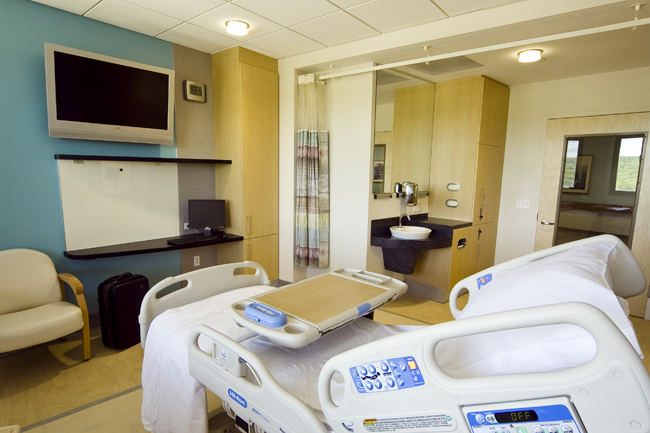
Another good feature: The research-based patient rooms, as at left. You’ll be hearing a lot about them, how they did mockups and studies and tweaks to make them more comfy, more healthy, and more efficient. For instance, virtually all the rooms are single and all are “same handed,” i.e. the plumbing fixtures don’t “back up” to each other. Such exactly alike rooms are supposed to promote accuracy. One wonders what it added to the cost.

So — here is my list of the Top Ten Things that the New Hospital Has Fixed

10. Restrooms in the Emergency Room. They’ve fixed a lot of things in ER, including replacing those flimsy curtains with floor to ceiling walls for privacy. Most important: the rest room inside the ER, versus me holding my gown closed as I snuck into the hallway hoping not to be seen. Better yet, the rooms for we old people (geriatric) have a toilet in each room.

9. Accurately targeted lights in the delivery rooms. The lights reflect against mirrors that the docs can adjust to shine a spotlight on just the right spot. It’ll be great for the videos – or for that difficult delivery.

8. Closets that open to the hall. No longer will laundry carts clog the hallway because sheets, towels etc. can be loaded into patient rooms at night. Staff can access these items from inside the patient room. Medications can be pre-loaded in a locked box. (You can see them in the patient room picture, just beyond the luxurious-looking elevated sink bowl.

7. Reading lights. When you are a family member attending a patient, you want to be able to read, but you don’t want the bright lights on. Now the family chair (there is also a pull-out sofa for overnights) has a reading light. These lights were so popular during the testing phase that the patients asked for them – and got them – as well.


6. A significantly beautiful chapel accessible to both visitors and staff. Before the chapel on the second floor was used mostly by staff. This one – donated by Blackrock’s Bob Doll and designed by Bob Hillier’s staff – evokes all religions but specifies none.

5. Designs to prevent blah fatigue. Each room has a large glass “picture” with some kind of abstract design. Easy to clean, easy to appreciate. The radiation machine has a lighted ceiling showing a design of cherry trees against the sky.

4. Uber efficient and clean operating rooms. The surgeon can take a biopsy and send it by pneumatic tube to the lab, then the pathologist can show the results to the surgeon on the big TV screen in case anything else needs to be done. Plus it’s super clean – air filtered twice and all but two items are off the floor or on wheels for easy cleaning.

3. Elevators only for visitors. No longer will you share an elevator with a gurney or a meal cart.

2. Ease of check in. No longer will you have to check in twice or three times and wait to be escorted to the next station. Enter the new building and you will see a giant curve with arcade entrances. Be greeted and get checked in at any one of the specialties – neuro, cancer, cardio, testing or whatever – and you will be taken care of right in that area.

1. Natural light everywhere. All the patient rooms have it. And when you are on a gurney, you aren’t looking up at fluorescent lights in the ceiling. Hallway lighting is vertical, as at left, emanating from slabs outside the patient rooms, so you can be comfortable when you are horizontal.

Don’t wait to check out the new hospital until the next emergency. See it standing up.