Monthly Archives: October 2012

Social Media 101: Selling Never Works

Why social media for nonprofits? This is Americaand this is fast, said David Yunghans of Constant Contact. He led a pretty fabulous morning workshop, sponsored by the Princeton Regional Chamber, at the Nassau Club on October 24. I attended along with four others from Princeton United Methodist Church, and I also took notes on behalf of Not in Our Town Princeton and United Front Against Riverblindness – as well as for my personal blog, Princeton Comment. The next session is Tuesday, November 20, and I highly recommend it. It costs $20 for chamber members, $25 for others.
Information is everywhere, Yunghans noted. People are using Facebook as a search engine. His first anecdote was about how one tweet “How about helping a charity that helps kids” resulted in a sponsored fundraiser netting $75,000. (It was his Tweet, and it helped the charity his wife runs.) He says he can reach 1 million people in 60 seconds. 
The secret sauce of 21stcentury marketing: Selling never works.  Don’t ask for anything. Just report what is happening. Show people what you have done with their money. Tell them what you are going to do with their money. Always tell the truth. The new style of advertising: deliver a value statement, not a donate or buy me statement. 
Be patient. People will not give money until they are ready. You may or may not get paid today, but you will get paid. Don’t give up on them (He told the story of the chef who unfriended him, because he never opened her emails, but he just happened to be ready to pay her $5,000 for a birthday trip for his wife. He could have found her but didn’t). 
Reject the old marketing paradigm, the top down funnel, known as A.I.D.A. The new marketing – a reverse funnel – is a pyramid. Instead of trying to get the most possible clients, focus your time on the small group of people who already know you, love you, care about you, who will be heartbroken if you fail. Ask them to speak well of you. But you must ask. The difference between asking and not asking is huge. (Example, helping an author whose business was in the tank, and 18 months later, she is keynoting in Paris and has a 230,000 Twitter following. Now, if he asks a return favor, asking her to tweet something, he gains 25 new followers.)
People will not donate until they are ready. Don’t give up on them (story of the chef who unfriended him, because he never opened her emails, but he just happened to be ready to pay her $5,000 for a birthday trip for his wife. He could have found her but didn’t). 
Show value. The economy has changed everything. What matters is the value you provide. Show photos of children being helped. Show what is happening to the money.
Here are some of his quick tips.
Save time: Clean up your inbox — use www.nutshellmail.comto organize and combine your comments, alerts, etc. on Facebook, Twitter, and LinkedIn. You can choose how often you want to look at them.
Learn how: www.socialquickstarter.com,  a free Constant Comment product, shows you how to do everything on the major social media platforms. His company’s motto, a good one for every organization, is “give away relevant information for free.” Says Yunghans, “People follow me because I find information and let other people know about it. I am building trust.”
Add followers. Start with one, build slowly and honestly. Think of Aunt Minnie, the town gossip on the party line. You want the Aunt Minnies to talk about you. With social media we can, as one person, talk to many people. (Yunghans suggests you don’t need to, and shouldn’t, share personal information on your organization account or even your personal account that you are using for business. I have heard differing opinions about this. Other experts say ‘it makes you real.’)
Keep checking your reputation with Socialmention.com. You can set the search to find anything said about you in the past 24 hours or in the past week or month. Among other measures, it measures sentiment and passion (more than one visit). Use a Boolean search (in quotes) for a more accurate search.
Overcome objections of a dinosaur board with statistics. The fastest growing segment on the Internet is people older than 55.  It is free. They have time. They want to put up photos of their grandchildren.   
Tell the truth.People will verify it. On the web, 98 percent speak of you in a positive or neutral way. One percent are trolls, so ignore them, don’t engage. The other one percent may be telling the truth – a perfect time to engage. People believe yelp and trip advisor because real people are telling their version of the truth, and you have to sift through that.
Brand yourself on the Internet. Put logos on everything you send out – and don’t change the color. When people sign up they have to know and recognize your brand. Make sure your colors and logos are correct and they know who you are. Secure the vanity URL.
Use videos. They work if it is something fun.. When I checked socialmention.com for my church I found the most adorable video of a festival of children’s choirs, held in Princeton, and the kids are singing Dona Nobis Pacem. What a great video to use on our Facebook page. (Yes, I know there might be copyright problems but I betcha Dona Nobis is out of copyright!)
If you were at this workshop, chime in! Comment or tweet your favorite tip! 

Pictured, from left — me, Sarah Harris, Andrea Spuck, Yunghans, and Iona Harding. Not shown, Lula Crawford). 

Social Media: The Architect of Our Intimacies?

Get a double dose of communications skills on Wednesday, October 24. Particularly if you work for a charity — or support one with your time — you will want to take the first of three social media sessions designed by the Princeton Regional Chamber for those in the non-profit arena. In this breakfast workshop at the Nassau Club, 8 to 10:30 p.m., a rep from Constant Contact will teach why social media is important (DUH), how social media has changed the non-profit landscape, and how to get started with it, get content, and find success. The discussion will include Twitter, Facebook, and Instagram. Cost for non-profit chamber members: $20, $5 more for non-members. That includes a full breakfast.

Although I already tweet and (obviously) blog I’m eager to attend. For instance, I tweet and Facebook for myself and my church, and I blog for myself and Not in Our Town, but it’s often a challenge to figure out which “voice” I’m using when. I’ve never used Instagram, and I’m still distributing this blog the old-fashioned way, with emails. I want to pick up some pointers.

That same evening, New Jersey CAMA presents Sarah Morgan, 6 to 8 p.m., at the Delaware Raritan Greenway. After drinks and munchies she will talk about “Writing for Results: Why Writing Matters.” A communications manager at Merck, Sarah has a personal blog at sarah-morgan.com and tweets at twitter.com/sarahmorgan. Though it seems like a general topic, social media is sure to be included in her talk, because she wrote her Fordham master’s thesis on how social media is changing language. It’s $25 for members, $30 for nonmembers, and you can reserve by PayPal.

The CAMA event is for everyone. The more in-depth chamber workshops are theoretically only for nonprofits, but if you work in a for profit business, why not register as a representative of the charity you support? The chamber’s morning workshops will continue on November 20 and December 11, and, if you go to all three, you save money — the third session is free. The November focus is on best practices in email — how and why your email does or doesn’t get opened. The December discussion will range from brand awareness to driving donations.


Does all this social media worry you? You’re concerned about the lack of face to face interaction? You have reason to be. says Shelley Turkle (left) interviewed on Fresh Air this week and author of Alone Together, Why We Expect More of Technology and Less of Each Other. “Technology proposes itself as the architect of our intimacies,” she writes.

If it’s getting so important, as ubiquitous as Turkle warns, we need to learn to do it right. 


Tennis, Dolphins, and Kitchen Kits

Tennis, dolphins, and kitchen kits — they are all helping combat veterans make their way in civilian life. Matt McCarville put together a benefit for the Wounded Warrior Project at the Salt Creek Grill on Wednesday. The Wounded Warrior Project provides basic comfort items for wounded soldiers, stages adaptive sporting events and clinics to foster independence among those with severe injuries, transports soldiers and their families between homes and hospitals, and offers peer-mentoring programs.

Along with sumptuous food, and a silent auction replete with many treasures, guests learned about how recovering veterans get help from the United States Tennis Association and, locally, the  National Junior Tennis and Learning of Trenton which introduces skills and love for tennis in both the vets and their families. Dolphins? the Florida-based Dolphin Research Center offers swimming with dolphins as a therapeutic pleasure.

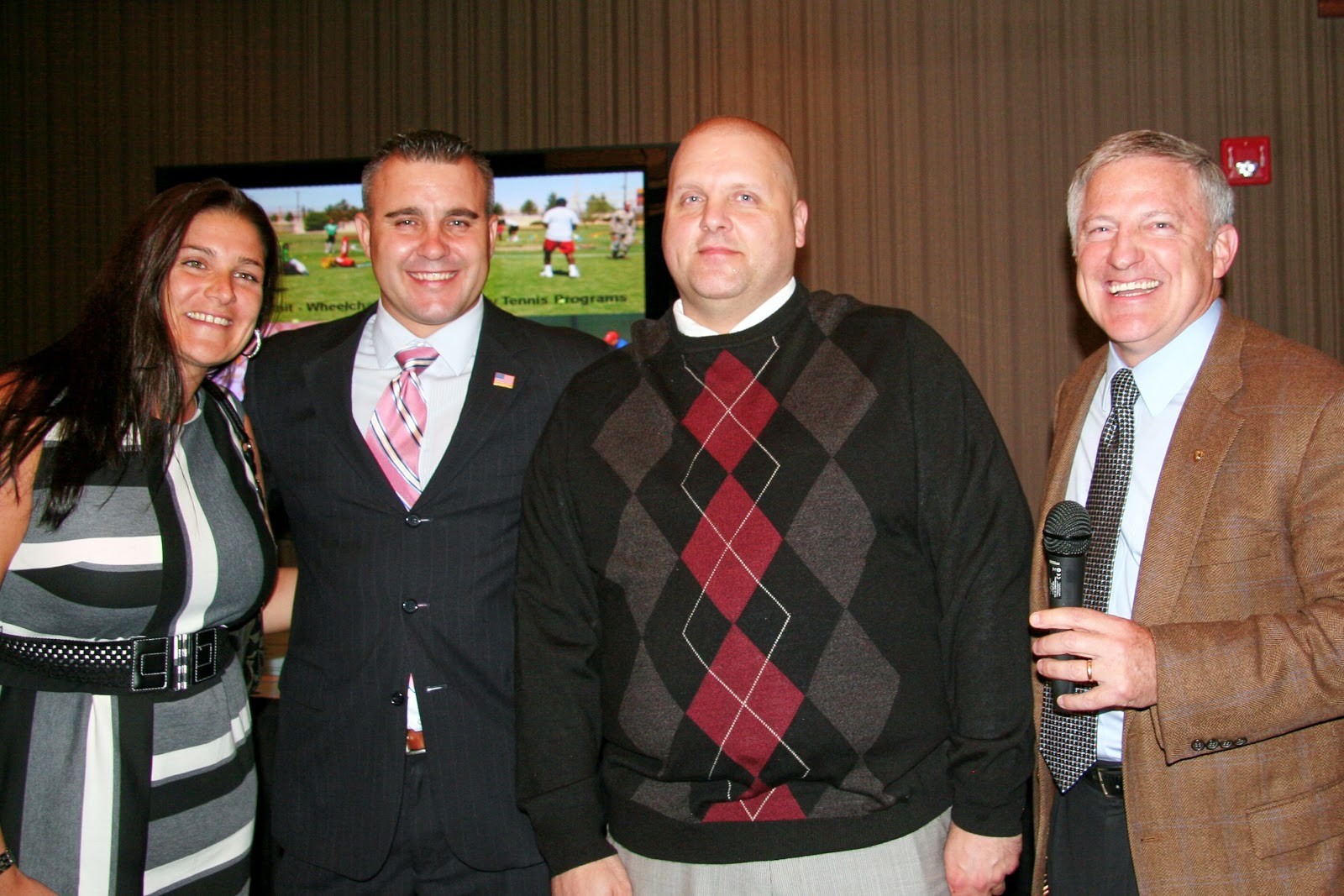
One of the stars of the evening (other than the food!) was John Fernandez, a West Point graduate  (U.S. Army First Lieutenant, retired) whose lost his feet in Iraq. He considers himself the lucky one, because those with him — his gunner, his driver, his first sergeant — lost their lives. In the photo at top, McCarville  (far right) speaks with the three Wounded Warriors at the event. From left;  U.S. Marine Corps Lance Corporal (Retired) Nancy Schiliro, Fernandez, and  U.S. Army Staff Sergeant John Gierke. 

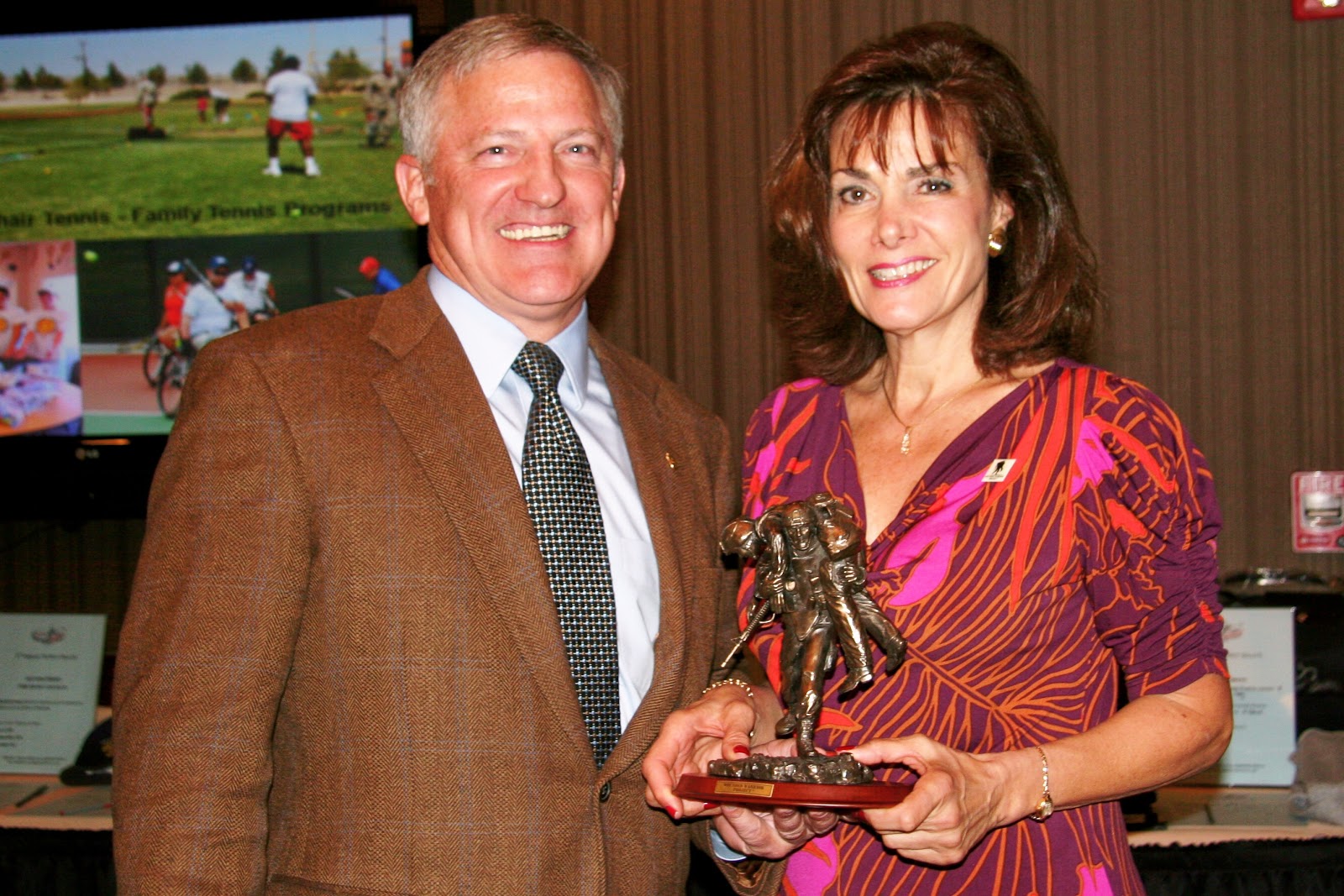
Another star of the evening was Linda Munson of the Charles Evans Foundation (in the second photo with McCarville). The foundation helps fund the Wounded Warriors and also contributes to the soldiers’ rehabilitation through the tennis and dolphin charities. (Photos by Judith Arnold)
As for the kitchen kits, they are provided by Daniel Griffin, a Vietnam veteran, who told of  Basecamp Westchester, which helps homeless veterans in Westchester County, New York. This subgroup of the Vietnam Veterans of America provides security deposits, computer training, and other services for previously homeless veterans. The kitchen kits? Plates, knives, forks, spoons — and a microwave — they recently helped a family of four that had been living in a car. All donations go directly to the cause. With the motto ‘never again  will one generation abandon another,’ all the workers at Basecamp Westchester are volunteers.

Extra note: The third annual Patriot Salute raised $30,000, as announced by Matthew McCarville in the comment below. He also notes: A closing THANK YOU to U.S. Army Staff Sergeant John Gierke, U.S. Marine Corps Lance Corporal (Retired) Nancy Schiliro, and U.S. Army First Lieutenant (Retired) John Fernandez, our three wounded veterans who attended the event last night.  We are all grateful for your service, and hope to honor your sacrifice as we try to live each day to the fullest under the safety and freedom that you helped to provide us.


Stoolmacher: Hunger’s Not a Game

This is an endorsement, nay, an earnest recommendation of Phyllis Stoolmacher as a speaker for any community group. She is the for-forever director of the Mercer Street Friends Food Bank, which distributes 50,000 pounds of food a week to some 60 organizations to help feed 25,000 people in Mercer County who don’t have access to enough healthy food.

Feeding the hungry — that doesn’t sound like a fun topic, one that you would like to contemplate over a meal. But at a breakfast at my church last Sunday she quoted poignant stats like a politician, dispensed the folk wisdom with the aplomb of a culinary Dr. Ruth, and inspired like a preacher.

To be sure, she was preaching to the choir. Some at the gathering had just taken the food stamp challenge, to live for a week on the meagre amount provided by what is now called the Supplemental Nutrition Assistance Program (SNAP). And the 25-year-old food bank partners with the Trenton Area Soup Kitchen which in turns partners with our church to deliver a weekly Wednesday meal at the Cornerstone Community Kitchen.

I learned new facts and confirmed what I already knew. Federal contribution of commodities has been cut by two thirds. A family of four can qualify for SNAP if the household income is less than $23,500, and this number does not account for the high cost of living in Mercer County. “It’s not a welfare program,” says Stoolmacher, “and we send our people out into the community with laptops to help people qualify.” Nutrition dollars come on a debit card so nobody can tell whether someone is swiping a credit card or the SNAP card. People stay on SNAP for an average of 9 months.

Restaurants can’t donate because of health issues. Supermarkets do donate, but not prepared food. The state provides funds to buy Jersey Fresh fruits and vegetables. Children who would otherwise go hungry on weekends get sent home with a backpack of easy-to-prepare microwavable meals. Simple recipes go into regular bags of groceries.

It’s best to give dollars rather than canned goods because the food bank can buy in bulk. “You would be surprised at what comes from food drives,” she said wryly, “how much cranberry sauce we get at Thanksgiving and how much matzoh we get in April. Who likes  matzoh? I want tuna fish! Give me tuna fish and I am a happy camper.”

What else can you/we do? Realize that someone you know may be “nutritionally challenged.” Encourage somebody who is looking for work, maybe they’ve run out of unemployment benefits, to sign up for the SNAP program. Or bring them to Cornerstone Community Kitchen on Wednesdays, from 5 to 6:30 p.m., at Princeton United Methodist Church, Nassau at Vandeventer.  Nobody knows the difference between the people who come for nutrition or those who come for conversation and companionship. There’s plenty of food on the plates, and there are flowers on the tables.
Some of that food found its way to Princeton via Stoolmacher. She won’t countenance empty or unhealthy calories — not soda, not Gatorade, not ramen noodles, not sweet cereal. Besides tuna fish, her most coveted item is shelf stable milk-in-a-box. “It tastes like real milk.”

From Optigrab to Endeca to Oracle

This week’s top tech pick is a talk by a former Princeton student (left, Steve Papa) who cooked up an idea in his Harvard MBA dorm and sold it to Oracle for perhaps a billion dollars. It started as Optigrab but by the time of the Oracle sale was known as Endeca. The Keller Center notice: 

Steve Papa ’94: Luck Favors the Prepared
Thursday, October 18, 2012 a
t 4:30 p.m. in the Carl A. Fields Center Room 104 
(campus map)The Keller Center is pleased to welcome Steve Papa ’94, founder and CEO of Endeca Technologies, Inc., to the Princeton campus on Thursday, October 18 at 4:30 pm. Reception to follow. Steve will share his story and some of the lessons learned for aspiring entrepreneurs and anyone interested in the good, the bad, and the ugly when building a successful technology company. Steve Papa ’94   founded and, with the help of a very talented team, built the software company Endeca from an idea in his grad school dorm room to Oracle’s 6th largest acquisition when announced in 2011. 

Alas, that Princeton alum started his company in Boston.

At the Princeton Regional Chamber  on Wednesday morning, you can hear about what’s being done about job creation in THIS area. Rep. Rush Holt speaks at the Wednesday, October 17 breakfast. It’s a different venue from the usual, it’s at the College of New Jersey’s new education building. That’s because the breakfast is a partnership with Trenton Small Business Week.    After Holt speaks about New initiatives in Washington and how they will impact the Princeton Region” Stick around for a workshop on government contracts. 

Entrepreneurs and startups are invited to “Celebrate Entrepreneurship at Princeton,” quoting from the Keller Center.
Tuesday, October 16, 2012 at 4:30 p.m. in the Carl A. Fields Center Room 104 (campus map The Keller Center will host its second annual “Celebrate Entrepreneurship at Princeton” event on Tuesday, October 16th in the Carl A. Fields Center on the Princeton campus. At the event, students who participated in the 2012 Princeton Entrepreneurial Internship Program will give presentations on their summer internship experiences working at startup companies. A light reception will follow.

If you have a startup or entrepreneur or just curious, you are welcome to attend to network with faculty, staff, and students. Here is a list of last year’s intern sponsors. 


The Year of Sufjan Stevens & Justin Peck @NYCB

The music of Sufjan Stevens lured me to New York City Ballet on Saturday, to see the second performance of Justin Peck’s Year of the Rabbit. (Another is Saturday night, October 13, and it starts again in February).. Thanks to an insider in the music world, I already knew about, and was fascinated by, Sufjan’s eclectic genius, both on his electronically produced albums (he intuits and lays down all the tracks himself) and on his rare tours to small venues (Here, my account of a concert in 2009 scheduled just after he had ‘played in’ with a friend’s band at the Princeton Theological Seminary. Yes, at the seminary chapel.)
Sufjan premiered his orchestral work, BQE, on the big stage at the Brooklyn Academy of Music, and Philip Glass is one of his mentors, yet he has also written rock music for dance, so it’s hard to describe his music.His record label, Asthmatic Kitty, bills him as “mixing autobiography, religious fantasy, and regional history to create folk songs of grand proportions.” The ballet music is taken from an album of programmatic songs, Enjoy Your Rabbit.Inspired by the zodiac signs on a menu at a Chinese restaurant, the episodes refer to these animals: the ox, the rabbit, the tiger, the dragon, the rooster, and the boar. Michael P. Atkinson brilliantly orchestrated the electronic score for strings and conducted the NYCB orchestra as well.

 
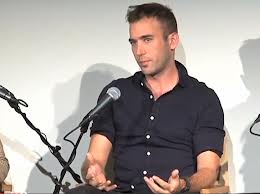
You can read here about how Peck – who knows his fellow dancers so well —  choreographed to their strengths. You can watch some excerpts here, in a revealing three-way panel of Sufjan (shown left), Peck, and Atkinson. Here is the rave review from the New York Times and one from critic Tobi Tobias. And here’s a promo, although in a beach setting. 
The music feels blissfully like Stravinsky – percussive violins, raspy cellos, shifting meters. It feels comfortingly like Glass, legato phrases repeating and extending. It feels as grounded as Bach, with its plucked counterpoint, and like Bartok with over arching folk-style melodies. Mostly it feels danceable and 25-year-old Justin Peck, a choreographer who is emerging from the ranks of the NYCB corps, mixes just the right combo of whimsy and earnestness for six principals and 12 members of the corps.
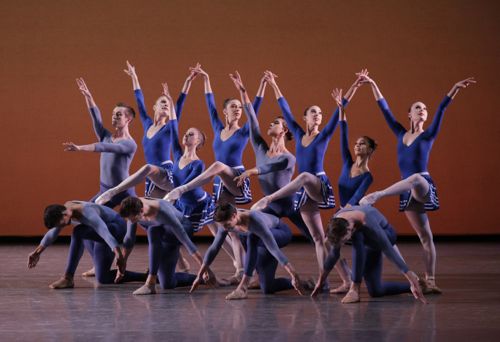
For the “Year of the Ox” opener, blue-clad dancers are led by Ashley Bouder. Sometimes, arranged in a three-line design (pictured above), the corps evokes the oxen and carts, sometimes, in a driving march rhythm, the concept of sturdiness, or, in a gesture of wiping the brow, the weariness of work. In “Year of the Rabbit” — the music, the floor plan for the corps, and the limbs of Joaquin de Luz – zig zag unpredictably. In one section – I think it was Year of the Dragon, the dancers get to lie down on the job. They recline half in and out of the wings, rousing themselves to react at various moments. I think they must have been guarding the dragon.
In a world that does not generally accept heart-on-your-sleeve religion, Sufjan is an acknowledged Christian, and he inserts a non-zodiac section, “Year of Our Lord,” near the end. Peck’s evocative pas de deux for Janie Taylor and Craig Hall (the only section without the corps) has an echoey legato Gregorian-chant atmosphere. “Year of the Boar” abruptly blusters the closing contrast.
My overall take – that Sufjan Stevens is lucky to have Justin Peck as a choreographer and vice versa. Sufjan’s music is full of repetitious phrases, but instead of just “sitting there,” they go somewhere. They get longer or louder or change meters or take side trips but they remain in the same groove in your head. Such imaginatively extended phrases allow Peck to wring the last ounce of invention out of each movement theme and it is oh-so-fun to watch.
The matinee opened with a piece that made me think of Brigadoon: Benjamin Millepied’s Two Hearts to a score by Nico Muhly with an affecting folk song solo by Laura Mulleavy. Muhly and Sufjan Stevens are musically connected and have shared the same stage. The program closed with a forgettable, by contrast, Les Carillons, by Christopher Wheeldon to Bizet’s L’Arlesienne suite. If you go on next Saturday night (October 13), and you loved the Year of the Rabbit, you might want to catch an earlier train home to New Jersey. Though your preferences may be different from mine. The man in back of me, when Les Carillons principals took their last curtain call, pronounced. “Now THAT was a dance.” .  

October Opportunities

From this list of opportunities, the only one I’ll guarantee to attend is Saturday’s UFAR 5k to Combat Riverblindness. Registration starts at 8:30 and the starting gun goes off at 10. It’s OK to walk, and if you keep a steady pace it takes less than an hour. It’s going to be extra fun this year, with extra prizes! There’s no prettier route — starting and returning to the seminary. But there’s lots more going on this weekend.

In the Pink Fashion Show on Friday, October 5, 6 p.m. benefits the very worthy Breast Cancer Resource Center of Princeton.

Three back-to-back dance concerts and I can’t attend. (Does anyone want to write about them for this blog?) American Repertory Ballet premieres two works from the Joffrey repertoire on Saturday, October 6, at Raritan Valley College. Yes, it’s worth the drive. Outlet Dance Project offers new work at Grounds for Sculpture on Sunday, October 7, at 2 p.m. There is also another site-specific concert, this one at Trenton’s Cadwalader park on Saturday, October 6., cosponsored by Passage Theater.

Palmer Square has its Birthday Bash (75th) on Sunday afternoon, October 7. I have mixed feelings about this and am saying so here.

On a more serious note, the Troubling Issues series at Princeton United Methodist Church presents a forum on world economics, with economists native to three different countries. It’s Sunday, October 7, at 4 p.m.., at Nassau & Vandeventer.

Next week’s business opportunities:

NJEN offers “Where’s the Money?” at lunch on Wednesday, October 10, at the Marriott. It’s highly advisable to register ahead for this one, so your contact info is on the handouts.

Eileen’s Sinett’s day-long presentation training intensive, Speaking That Connects, is on Friday, October 12, and I can attest you will be a different and better speaker after that day.

Palmer Square: Not Without Pain

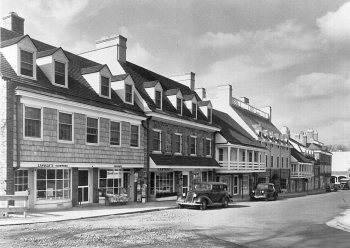
Palmer Square is celebrating its 75th, and here is the best of the articles that I’ve seen about it — not in the established weeklies, not in the paper I used to work for, but in the free paper delivered by mail, the Echo. (Photo of the square in 1937, just after it was built.)
Why do I say it’s the best? Because the reporter, Joe Emanski, put David Newton’s feet to the fire and brought up the tough issue about how Princeton’s African-American neighborhood was torn down to make room for what is now a beautiful town center. Emanski gave Newton a chance to express regret and yet affirm the result. As below.  
“Newton says in a way, it was brave to build something like Palmer Square in the middle of the Depression, because it might have been a failure. He doesn’t discount the resentment the displaced residents felt then, or that their descendents feel now, but said that Palmer and his colleagues were in a position where they had to make difficult decisions.
“With the benefit of full hindsight it’s easy to be critical, but we’re 75 years on, and I think the benefits to downtown are very positive. The end product was good; the cost it took on families and forced relocation, and plain old racism, was immense,” Newton said…..
“Princeton, along with bigger cities like Kansas City, prefigured the town center-style urban renewal we see today. Princeton also showed, to anyone who wanted to see, that urban renewal was going to require difficult choices, and that not everyone will benefit equally from the decisions that are made.”
Reporters need to ask the painful questions, so that the source has a chance to respond. I liked Newton’s response. 
Read the full article for great details, like the underground tunnel system where the Christmas tree lights get laid out. Also, find proof positive that you are right when you tell someone, no, this is not the original Nassau Inn. I’ve had knock-down-drag-out arguments about that with visitors who were certain sure that this building hosted the Continental Congress. But what is authentic, as Mimi O of Princeton Tour Company would be sure to say, is the Norman Rockwell in Princeton’s version of a rathskeller, the Tap Room
Full disclosure: I used to work for U.S. 1 which is now part of Community News Service, to which U.S. 1 now belongs.  As a representative of Not in Our Town Princeton, an organization that works against racial bias, I chafe at unmitigated adulation of the Palmer Square development. It’s OK to admire Palmer Square for the great place that it is, but at least let’s remember that this area had been the heart of the African-American neighborhood, and that removing those homes caused a lot of pain.  (The gentrification of this neighborhood is another painful topic, but for another time.) 

The Painful Economics of Traffic Court

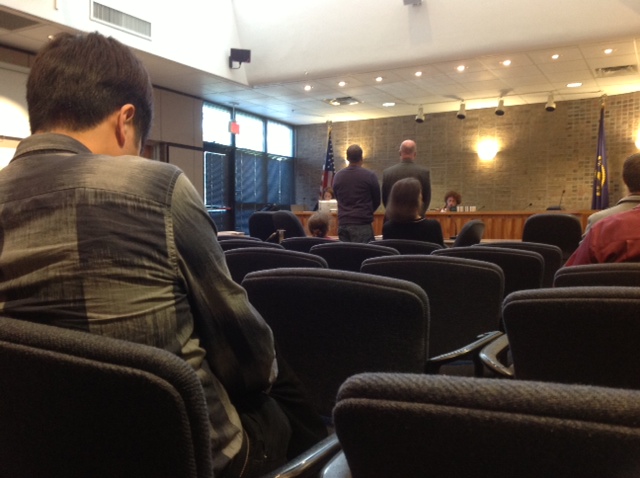
Such a small thing as a traffic ticket, even a couple of parking tickets, can wreak terrible financial hardship for some families in today’s economy. That was the lesson I learned from sitting for 2 1/2 hours in traffic court today, watching the mini-dramas unfold.

Say you get fined $500 and can’t pay the fine, it mounts up. Pretty soon there is a warrant for your arrest, you lose your license, and now you owe more than $1,000. If you have lost your job, where do you get the money? The court can’t, or doesn’t care. Pay or lose your license.

What could you do that would amount to nearly $500? Merely fail to yield to a pedestrian in the crosswalk. A Manhattan resident who was delivering her daughter to Princeton University did that, in a moment of confusion. The fine was $250 and a point on her license. To avoid the point, she could pay a “surcharge” of $156 plus $33 in court costs for a total of $439. Fortunately this woman could afford it.

Others were not so fortunate. One speeding ticket, including the surcharge, cost $469. About half the people claimed they couldn’t pay their fine, and bleeding heart liberal that I am, I believed them. The response from the court: “Make some phone calls today. Owe someone other than this court.”

I don’t blame the judge or the court officials. They are doing their job. Nor the police officers. But such high fines result in just another case of The Rich Get Richer, the Poor Get Poorer. Delay in paying your fine because you can’t pay your rent, because you don’t have a job, and it doubles, then triples.

I realize the general lesson is, drive very. very, very carefully. Don’t get a ticket. But the specific lesson for me is, avoid Nassau Street like the plague. If I should fail to see a pedestrian in the crosswalk, perhaps because another pedestrian is darting out in front of me who is NOT in the crosswalk — well, I wouldn’t be happy paying $250 to $439. I’ll stay on Wiggins and Hamilton where pedestrians don’t lurk behind parked cars.

Animals Do It: Stretch after Sleeping

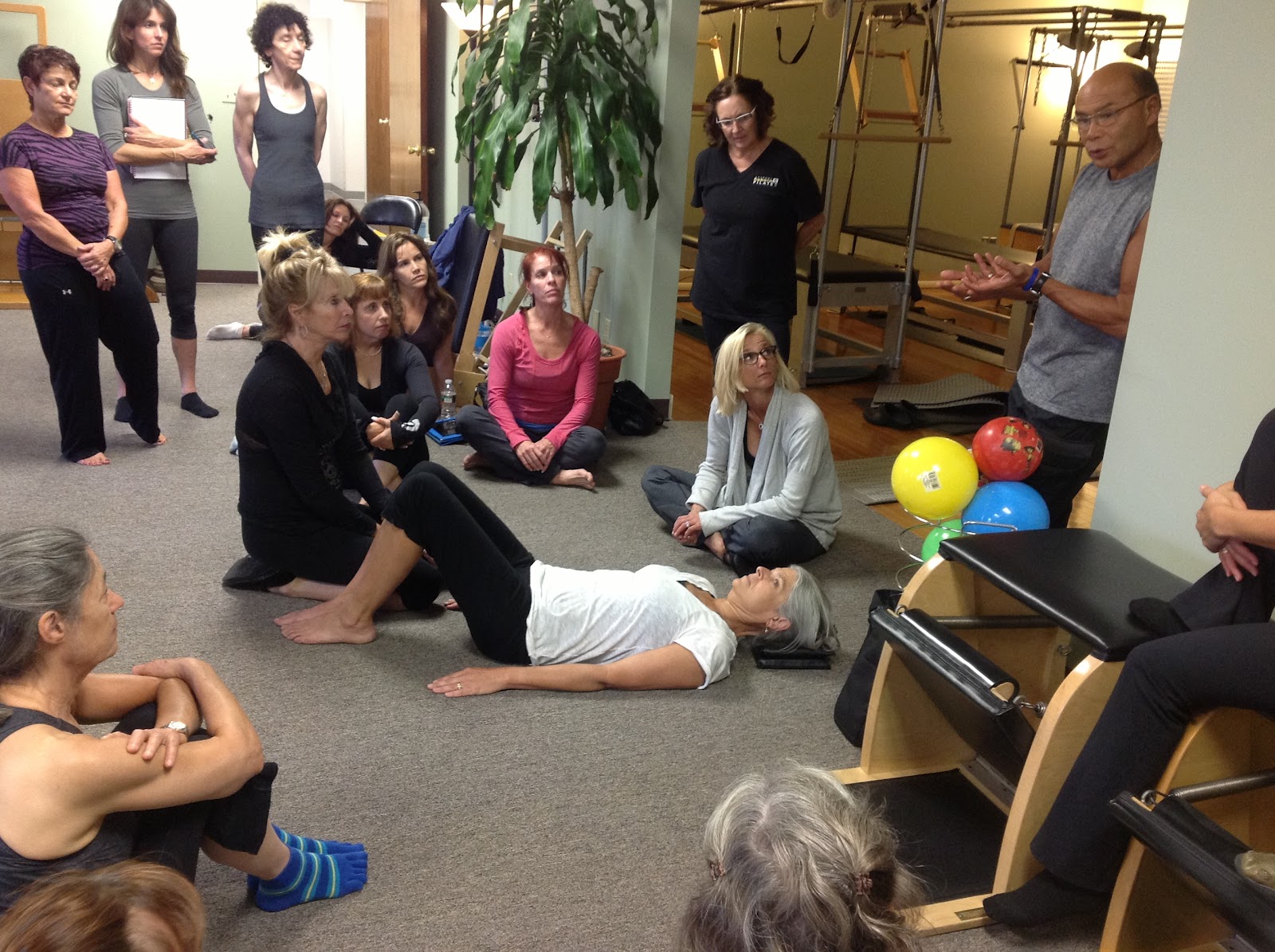
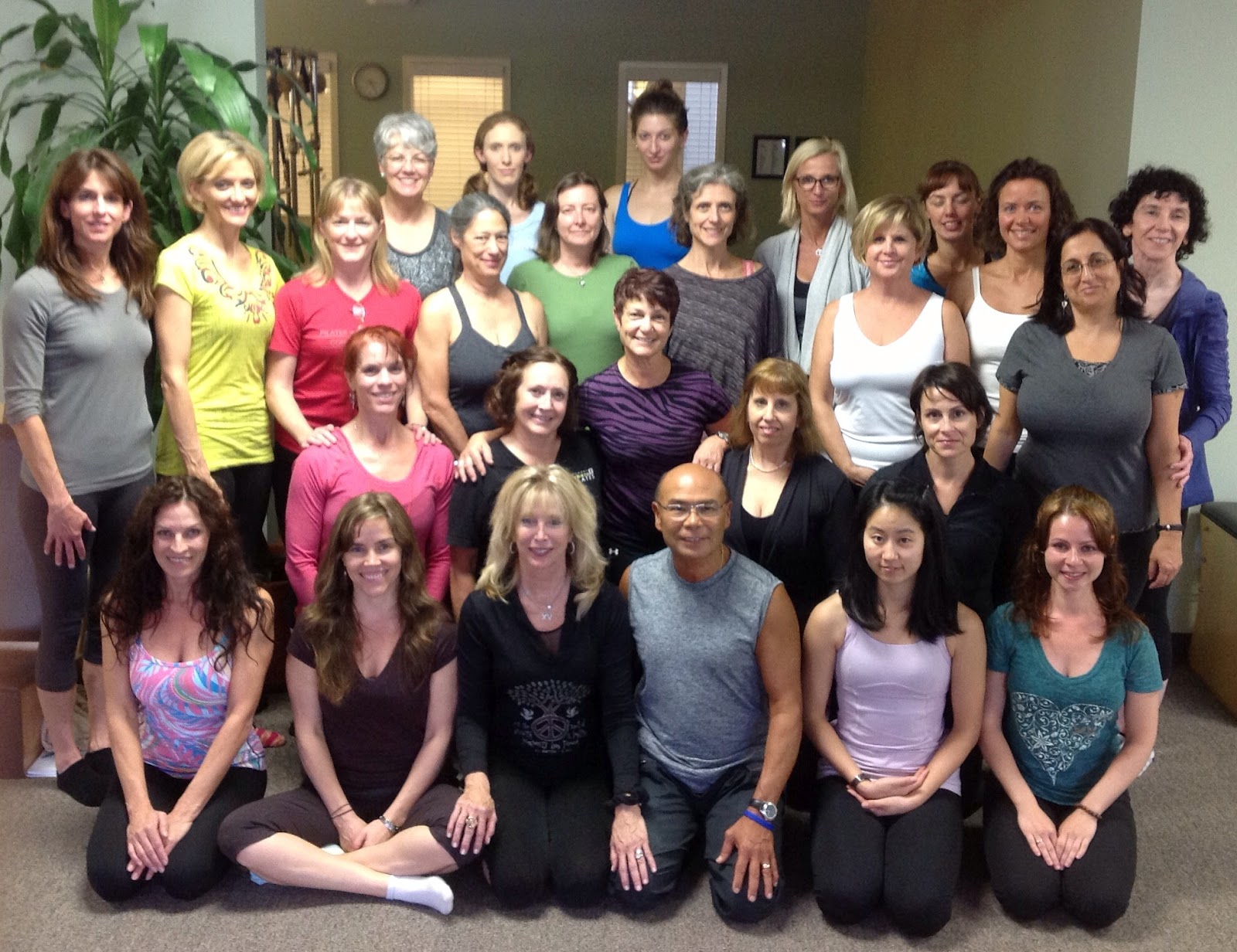
Trish Garland, who premiered the role of Judy, the “tall, gawky, and quirky dancer,” in Chorus Line, taught a workshop for Pilates instructors on how to work with aging clients at Anthony Rabara’s Pilates studio last weekend. Garland has a studio in California, and Rabara’s studio is in Research Park, but both are committed to teaching the authentic Pilates method as they learned it at the original New York studio from Romana Kryzanowski


Though Garland’s body looks like it hasn’t changed a bit — she’s still tall and skinny — she claims that, in her early ’60s, she is feeling the effects of aging, and so she is focusing on what to do about it. (In the group photo, she and Rabara are in front row center; she’s the blonde.) 

I was one of the “aging clients” in respectful attendance at the workshop and was reprimanded — yet again — for my habit of standing with hands behind my back, stomach out, not standing tall. (I know better. Anyone hereby has my permission to remind me about it. What’s that expression…it takes a village to change an aging person’s habits?)


The take-away from the Pilates workshop that we all can use is that, to protect your back and the rest of your aging bones, stretch like a cat before you get out of bed. We’re talking a serious stretch and here are some of the ways she suggested.

Knees up, roll back and forth to massage your back. Cross your ankles and hold your toes. Pull your feet to your  bottom. Shrug your shoulders to your ears. Turn your head from side to side (unless you have vertigo). Bend your forearms, hands up, open and close your hands and circle them. With knees up, flex and point your feet. Roll over to sit on the edge of your bed and pound your toes, rat a tat tat, against the floor. All this before you get out of bed. 

I won’t go into medical history about why I need this, but, trust me, this kind of wake-up stretching is good for all of us. As Joseph Pilates used to say — animals do it. So it must be good for us.