All posts by bfiggefox
 “Let’s hear it for ‘unruly’ Andrea Mitchell.” Bold face mine.
Book Review: Simona L. Brickers
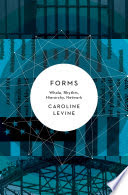 Simona L. Brickers, my colleague on the board at Not in Our Town Princeton, reviewed this book by Caroline Levine. Thank you, Simona, for drawing my attention to Forms: Whole, Rhythms, Hierarchy, Networks (192 pages, $19.95, Princeton University Press).
Levine’s book is a fascinating journey through Forms, defined as the “fluid overlap of social and cultural order, patterns, and shape that open up to the “generalizable understanding of political power” (Chapter 1). It brings together, nicely outlined, literary work by Charlotte Brontë, Charles Dickens, Jacques Derrida, and Ralph Waldo Emerson along with many others. It weaves the literary examples into accounts of lived examples of institutionalized, systemic, freedoms and constraints that influence social collaboration and chaos.
In relating the act of punishment to rhythm, Levine highlights African music as repetitive, cyclical, polyrhythmic and dialogic and expressing pleasures that produce a participatory and embodied collective singing. Rhythms turned out to be the repressive form used against African captives by slave masters to impose solidarity, control, and subjugations through chain gang songs (Chapter 3).
Levine’s central concern, as reflected in her title (Forms: Whole, Rhythm, Hierarchy, Network), was to present a platform to explore the phenomenon called “path dependency.” Path dependence is learned helplessness depicted as a systematic composition that constricts diversity (race and gender) with barriers that prohibit reversal because of social and organizational cost. The mechanism of sex is a device that produces hierarchical distinction (Chapter 4). The implicit disconnect in the various forms creates constraints and differences. Various forms overlap and intersect. They travel and influence political policies in particular historical contexts (Chapter 1).
Nevertheless, the whole theoretical concept is misleading when it is carefully examined to reveal the social advantages that differ according to the traditional rhythms of the hierarchical color-coded network . Levine quotes Derrida’s work because the desire for bounded wholeness has grave political consequences (Chapter 2). Levine addressed the underpinning of social order, pattern, and shape by examining the dysfunction of forms. She also studied how the web translates into “literature as landmarks,” depicted as advanced transgression. “Repetitive temporal patterns impose constraints across social life…standard repetition, durations, and arcs of development organize our experiences of everything from sleep and sex to governments and the global economy (Chapter 3).
Levine writes brilliantly. Each word captures an essence of social order, patterns, and shapes (norms) that have become invisible, taken for granted without acknowledgement of the transhistorical or macro-environmental influences on society and the policies governing our daily routines. The reader learns that we are not authentic — but domesticated, trained to behave, believe, and act according to a socialized outline that serves some differently than others , with no regard to how overlapping forms influence injustice.
Her masterful last chapter discusses The Wire (2002-2008), the David Simon HBO series. This conventional cop drama exploration of the ways that social experience is structured within African American communities (Chapter 5). The Wire rendered radically unpredictable and overlapping social forms. Levine ends the book by leading readers to contemplate the unsettled, unexpected and bewildering effects of an ideologically coherent society with power lodged in the hands of a few. The challenge is self-reflective, aiming to push the reader to seek beyond what is controlled by a few — the societal whole, rhythms, hierarchies, and networks that influence social order, patterns, and shape individual and collective Forms.
Levine asked this question on page 18: “Which form do we wish to see governing social life, then and which forms of protect or resistance actually succeed at dismantling unjust, entrenched arrangements?”
The book is a masterpiece. It offers an opportunity to read, reread, and discuss the forms that are accepted as “unchangeable.”
Simona L. Brickers
Funding the Innovation Makers

Chris Owens, Joe Montemarano, Lou Wagman

Diccon Hyatt interviews Joe Montemarano

Photo session

First prize winner

Second prize winner
Techies play in a high stakes intramural tournament every February at one of the state’s best – free — networking opportunities. On February 15. at Princeton Innovation Forum (PrincetonIF) the Andlinger Center for Energy and the Environment, they gave away $30,000 in one afternoon. All the teams were from Princeton University with Princeton profs as advisors or main participants. Sponsored by the Keller Center, PrincetonIF focuses on commercializing technology developed at Princeton University.
Diccon Hyatt made it the cover story in this week’s issue of U.S. 1. It reads best in hard copy, so grab one today from a newsbox before it gets replaced tomorrow. Or read it here.
With angels, venture capitalists, lawyers, and supporters watching, each team made a three-minute pitch. Then that power crowd emptied out into the crowded lobby, mobbed the wine bar, and the noise level rose as those-in-the-know and those-with-money interviewed the presenters and each other.
My favorite moment was introducing Chris Owens of Oppenheimer Nexus to Lou Wagman and Joe Montemarano (photo top right). More on that in another post. Also (apparently I can’t control random order) are photos of second prize winner Niraj Jha, professor of electrical engineering, who is working on Internet security; first prize winner Robert Pagels presenting his technology for manufacturing microparticles for delivering biologic drugs; Pagels and his team get their pictures taken, and U.S. 1’s Diccon Hyatt interviews Joe Montemarano.
Read the story here to learn about exciting technology and get on the Keller Center’s mailing list here. Always something exciting going on at the Equad.
Jay Regan: the story behind the story

A few nuggets from Richard K. Rein’s fascinating story on Jay Regan, in the new issue of the Princeton Echo:
“A young man on Wall Street became interested in the work of a mathematician who had developed a system for beating blackjack and was using that system to pick stocks that would outperform the market average. . . . Princeton Newport Partners became the first quantitative hedge fund.”
“Google his name (James S. ‘Jay’ Regan) and the first two words that might come up are ‘racketeering charges.’”
At the office on the corner of Witherspoon and Spring Street, “armed marshalls presented a search warrant to the startled receptionist. Regan first thought it was some college buddies playing a joke.”
“Even in the darkest days Regan maintained his sense of humor, even if it had a certain gallows cast to it.”
“the sentence was later overturned…. prosecutorial over-reach. The prosecutor, incidentally, was Rudolph Giuliani, even then political ambitious.”
“For all that he and his family went through, Regan remains a bright and cheerful soul, and as enthusiastic about his work as he must have been when he first got involved on Wall Street.”
My personal note to parents of liberal arts majors: Regan was a philosophy major.
The Echo comes to the mailboxes of Princeton residents once a month and is available in newsboxes throughout town. On the cover: a story on card shark/mathematician Bradley Snider.
Photo of Jay Regan by Suzette Lucas.
What does e-patient mean?

When I use the term epatients, people ask me what that means? I stumble to explain.
Here is an example from a glossy magazine, Good Housekeeping.
I started getting connected with other EB parents through my blog. It was a tool God used to save Jonah. I’d describe issues we were facing, like acid reflux or not eating or bandages that stuck, and moms would suggest what worked for their kids. To our doctors’ credit, they didn’t look at me like I was a crazy person when I brought in suggestions but gave them a shot. We all partnered to try to get him as stable as possible.
Read the whole article “My Son Blisters When I Hug Him” here.
Until I get my elevator speech smoothed out, here is another explanatory link.
Just tell it so they get it: gerrymandering

As Sam Wang talked this morning on how to countermand the evils of gerrymandering — legislative districts structured to favor one party — I kept thinking “he’s the perfect person for this.” Wang spoke this morning at the Princeton Regional Chamber breakfast.
The battle to redistrict Congress will be fought in the courts, probably leading to the Supreme Court, which has turned down several cases for lack of a manageable standard. As Wang said, lawyers don’t go to law school because they like math. (Nodded agreement from the 80+ attendees, with more than the usual number of lawyers.) Lawyers might be good in math but it’s probably not their forte.
So if you want to use algorithms to uproot gerrymandering, you’d better figure out how to make that math accessible to the lawyers’ brains, especially the SCOTUS brains.
If any one can do that, Wang can. He is an eminent neuroscientist with an unusual facility to state complicated concepts in simple ways, as in his first book “Welcome to Your Brain.”
Though Wang is still doing neuroscience he is also consulting on political statistics via the Princeton Election Consortium. During the question page he talked about testifying in various court cases and presented various “manageable standards.”
His webpage even has an option to do the math yourself – pick a data set and work out whether those districts are configured fairly.
On that page, Wang says he wants to do more than use math and polls to explain politics. He wants to stimulate people to act. Not just Democrats, but “all Americans who want to save institutions – whether they are liberal or conservative, Democratic or Republican.” He recommends that we all
- joining our U.S. Representative’s party (even though that may be hard to do)
- work to keep the media ‘on task’
Are you looking for ways to make change? Read his action items for democracy’s survival here.
Says Wang: “Voters should choose their representatives, not the other way round.”
Sam Wang talks – consumes no crickets
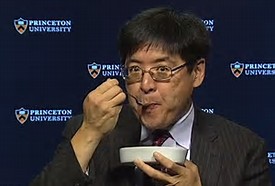 Sam Wang speaks to the Princeton Regional Chamber TOMORROW (if you get this on Tuesday), i.e. Wednesday, February 15.
He spoke to the chamber back in 2009 on the title of his book “Welcome to Your Brain.
He made some election predictions last September at the Princeton Public Library.
He famously ate crow (or, rather, crickets) in a post-election mea culpa. :
He was included in the U.S. 1 cover story “Living in a Trump World” in January.
On Wednesday, February 15 for a Princeton Regional Chamber breakfast at the Nassau Club his title is The Long Collapse: A Data-Based Look at U.S. Politics from 1994 to 2017.
Sorry for the late notice but if you see this before Wednesday at 7 a.m. it’s not too late to attend.
Talk can bridge the political divide
I found this Atlantic article on Twitter and borrowed it from the Not in Our Town website
Discrimination x three: Princeton stories
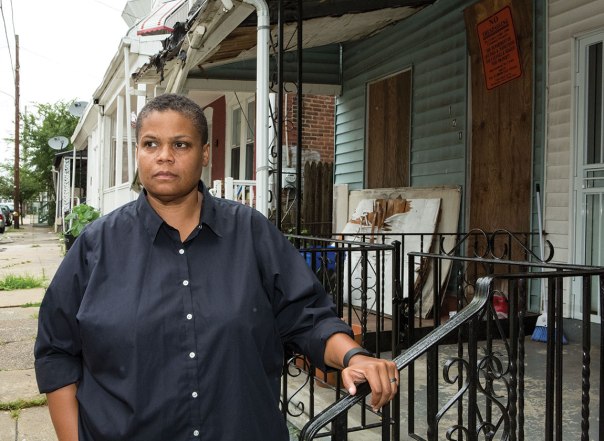
Thanks to Planet Princeton’s Princeton Wire newsletter for the news roundup that alerted me to an article on housing discrimination research at Princeton University by Keeanga-Yamahtta Taylor, assistant professor of African American studies and author of From #blacklivesmatter to Black Liberation. She has a fascinating biography.
“Putting the blame on the individual suggests that racism can be overcome by education alone,” said Taylor. She is quoted in the article as reminding us that throughout history racism has been used as a way for the powerful to control others for material gain — and it is still used that way.
Another amazing but grim story from the Planet Princeton lineup is about the wrongfully imprisoned Princeton alumnus from Iran.
If first aired on the Moth Radio Hour, which if you didn’t know about, you want to.
Less grim but still unsettling is the Daily Princeton article on research showing that, at the tender age of six, kids think boys are smarter than girls.
Race discrimination, nationality discrimination, gender discrimination — does this go on forever? Parents, start with your two year olds, they have to be carefully taught.
Not a New York State of Mind
Geographic diversity is connected to something crucial re what journalists need: audience trust in their work. The Columbia Journalism Review takes a hard look at how coastal newsrooms ignore middle america in this article.
When reporters “parachute in” to cover a story, they are likely to miss the nuances.
“Often people outside of these major city bubbles see themselves depicted in print and on television in a sensationalized way, without any nuance,” says a journalist who lives in South Carolina.“The thought is ‘well, if they’re getting depictions of us wrong, what else are they getting wrong?’
We in Princeton recognize that everybody thinks New York is better.Where do we go when we are really sick? What newspaper do we need when we really want the truth? Here is the Saul Steinberg cartoon about that self-effacing city, followed by two journal items inveighing against New York-centric viewpoints.

Journal item #1 : I lived outside the New York sphere when I worked as a freelance dance writer in Philadelphia and then Pittsburgh. For dance critics, even those big cities are considered boondocks. A New York critic’s move to Philadelphia drew condolence letters.
To survive, vampires need blood; dance critics need to see and review dance, and New York is the best place to do it.
Back then, to qualify as a voting member of the Dance Critics Association, you had to have had a review published in a print newspaper during the previous year. Features (advance stories based on a critic’s experience with previous performances) didn’t count.
Fine for New Yorkers and big city papers, but in the boondocks, few newspapers would print reviews. I brought this up so often that I got to be known, somewhat affectionately, as the “lady from Philadelphia” even when I lived in Pittsburgh.
Journal item #2: Reporters treasure good sources. Reporters from small papers — from areas unknown to the “big city guys” — particularly treasure sources that respond with the same attention and respect that they might give to a Washington Post or New York Times reporter.
How I ran across this CJR story was because I follow the path of a former assistant managing editor of the Wall Street Journal, Richard Tofel, who always made himself available when I was a reporter at U.S. 1 Newspaper. (We weren’t a boondocks paper — we delivered to the Dow Jones building on Route 1 North, but it was still gratifying to always get a return call.)
Tofel is now president of the Pulitzer Prize-wining nonprofit newsroom, ProPublica. It’s expanding to Chicago. Not exactly the boondocks, but at least it’s not New York. ProPublica offers a new model for investigative journalism. Whether that comes from New York or the boondocks, we need that now.
To Pro Publica, you can contribute information. You can also contribute money. And if you care about the future of journalism, subscribe to the Columbia Journalism Review.
 Princeton Comment