Category Archives: Around Town

Personal posts — some social justice (Not in Our Town), some faith-related (Princeton United Methodist Church), some I-can’t-keep-from-writing-this

The Artist Next Door

On Cedar Lane, the Fox family lived next to the Kruse family. We were the age of their parents. They were “us” when we first came to Princeton, their girls in middle school and high school. We were lucky to have them — and the Zimmermans across the street — as neighbors. They helped us out and — with unfailingly gracious hospitality — included us in their circle of friends, often gathering around a table on their patio, overlooking both of our back yards.

Alison Kruse, amazingly, grew up to be the artist she always wanted to be. Her exhibit “Painting Life” is on view in the Considine Gallery at Stuart Country Day School through Thursday, November 20. Alison says she hopes each piece is a “visual journal entry, rooted in truth and lived experience, exploring the interplay of memory, place, and emotion.” I believe the oil and charcoal work above, titled “NJ,” captures the spirit of gathering at that table in the twilight.

I’m delighted by Alison’s success. She went to Princeton High, studied in after school classes with Heather Barros, and majored in fine arts at Queen’s University in Kingston, Ontario. She has earned foundation grants and residencies and has stayed true to her vision. I’m also impressed by the support she had. Not every parent would have wholeheartedly supported a daughter’s painting vision.

Thanks also to Phyllis Wright (show below), the art teacher at Stuart who brought her class to network with the artist, and to Sara Hastings for drawing my attention to this exhibit by featuring it on the cover of the Princeton Echo. I’m proud to say that I own an early work by Alison Kruse.
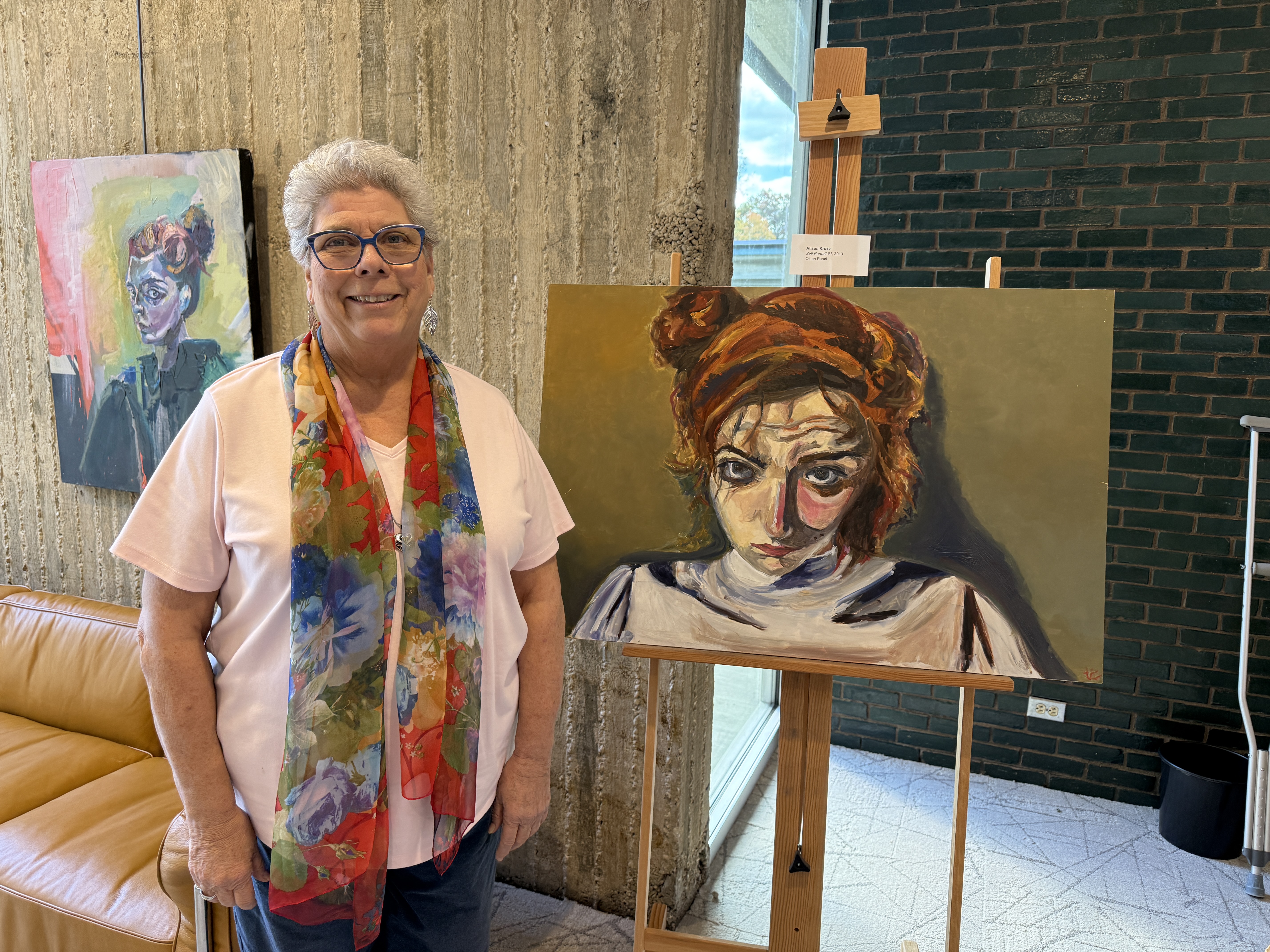

Alison’s mother, Kate Kruse with the Princeton Echo cover image.

Canonical Research: ‘Seeking Meaning’

When what you did 30 years ago has significant relevance today — how gratifying that can be!

The 30th anniversary edition of my friend Carol Kuhlthau’s book celebrates, as the publisher says, the lasting value and enduring legacy of the Information Search Process (ISP) framework that she devised. The ISP model explained in the first edition of Seeking Meaning: A Process Approach to Library and Information Services dramatically influenced how educators can prepare students, from kindergarten on up, to navigate complex information environments.

The ISP method is even more relevant in today’s “information environments,” so much more complicated than those from 30 years ago.

To quote the publisher, Bloomsbury, “Kuhlthau’s canonical research, accompanied in this anniversary edition by new essays exploring the text’s legacy and continued importance, is required reading for students of library and information science in the United States and abroad and an invaluable resource for anyone providing library and information services.”

Congratulations, Carol!

Kudos Deserved: TAPinto

As the editor of U.S. 1 Newspaper, Richard K. Rein specifically avoiding entering contests, because if you were busy filling out those applications, you weren’t reporting the news. Which was true. I once read that big city newspapers hired staffers just to game the entries.

I’m happy to notice that Rein is getting recognized for unflaggingly reporting local news in Princeton. He didn’t put out the press release — the TAPinto franchise did. I learned, that, as editor of TAPintoPrinceton, he and reporter Carolyn Jones brought home one of 11 statewide prizes from the Center of Cooperative Media.

Rein publishes once a day, the important news for Princeton, whether it’s an event or just the seemingly mundane agenda for a public meeting, it’s sometimes useful and, with the Rein spin, likely interesting.

As below, the press release.

TAPinto Princeton’s reporter Carolyn Jones and owner/publisher Richard Rein were awarded for an investigation into the impact of flooding on historic properties in Princeton.

The press release continues with Rein’s quote:

“This award to journalist Carolyn Jones and TAPinto Princeton Community News was gratifying in two ways. First it recognizes Carolyn’s ability to cut through the procedural details and present the big picture of how the planning process works (or doesn’t work) in the face of a changing climate,” Rein said. “It also shows that TAPinto Princeton’s meeting-by-meeting coverage of the planning board and other official committees pays off. Some fascinating stories occasionally do surface. 

“It’s great to publish once a day every day, as we do at TAPinto. It’s also great to be able to step back and look at the big picture, as Carolyn Jones did with this story,” Rein added.

Full disclosure: I used to work for Rich and, very occasionally, now help with the calendar. The image was generated by AI.

Job Fair for a Friendly Place

Tara Graham is the HR Director at Stonebridge at Montgomery

I am fortunate to be able to live at Stonebridge at Montgomery, a Continuing Care Retirement Community. That means that no matter what my state of health, I am home here. Now I’m in “Independent Living” but there’s also Assisted Living, Skilled Nursing, and memory care.

Recently I shared an elevator with a CNA, a Certified Nursing Assistant, and asked her why she was working here. “Because everyone is so friendly here,” she said. Of course I was glad to hear that. So I’m passing on this info to anyone looking for a job – not just nurses, but all kinds of jobs. Springpoint (the parent nonprofit company for Stonebridge) is having a Job Fair here on Tuesday, March 25, 10 to 2 p.m.

The posters say: RNs, LPS, and CNAs are invited to find out about the excellent benefits including sign on and referral bonuses at the Job Fair at Stonebridge at Montgomery, 100 Hollinshead Spring Road.  Other jobs and various internships are also available.  For the complete job list, go to springpointssl.org/careers. Or contact Mikhaila Watters at mwatters@springpointsl.org.

I have a little cottage here, just north of Princeton. I’m always (well, most always) happy to have visitors. Drive north on 206 past the ShopRite and turn right on Montgomery Road at the bus stop. The campus is on the left. Ask the concierge to ring me.

U.S. 1 Newspaper’s 40 Years

U.S. 1 Newspaper survives, somehow, after 40 years, delighting its readers. Kudos to editor Sara Hastings for printing cover images of the 39 other anniversary editions.

I was there for 23 of those years, glad to be working for the founder, Richard K. Rein. Then, it was “Princeton’s Business and Entertainment Journal.” Two years after he started the paper, when it was still a monthly, I was the first editorial hire.

For each of the anniversaries he posed as a cub reporter to interview himself. This week, he was interviewed by Mark Freda.

Rein now has an online journal, TAPintoPrinceton, which if you don’t get it, you should. He’s got terrific writers covering a variety of Princeton subjects. In his own column, Shots from Cannon Green (Can Princeton Help Make America Safe Again? Or Sane Again?) he has 10 savvy suggestions for what Democrats should do for the next four years.

Some of my favorites from this column:

4.) Engage people from the other side. Don’t cancel or block them. You don’t want the other side to ban books. Don’t ban the other side.

“Listen” is my new mantra. I like the old saying, “A man convinced against his will is of the same opinion still”

8.) Don’t scold people. I’m convinced that every time someone gets called out for cracking an inappropriate joke, making a risqué remark, or otherwise failing a test of wokeness, another Trump voter is created. (Yes, I realize I am scolding some people here, but it needs to be said.)

When someone makes an obnoxious statement with which you disagree, don’t reply angrily, just counter with “Hmm, I wonder why you said that.”

3.) Make sure your candidate has a story or a narrative that encapsulates their position. A position paper will never be read.

I like this one, because it’s what Rein taught me to do — don’t cover the issue, find a person who represents the issue and tell their story.

Rein counters the MAGA slogan with one of his own.

And of course there must be a disclaimer: “Shots from Cannon Green represents the opinions of Richard K. Rein, and not necessarily those of anyone else at TAPinto Princeton

Helping U.S. 1 readers feel like they belonged in the greater Princeton community was always my goal. To quote Hastings: … the most important things remain constant: U.S. 1 was founded with a commitment to serving an audience of people who work and live in a narrowly defined geographic area centered around the Route 1 corridor in Mercer County through a mix of business and entertainment coverage. That community is still U.S. 1’s most important asset and one it aspires to continue serving for years to come.

Spotting Joy: Fox and Rock

comfort symbols

What helps me know that God will take care of me? That God will be with us . . .

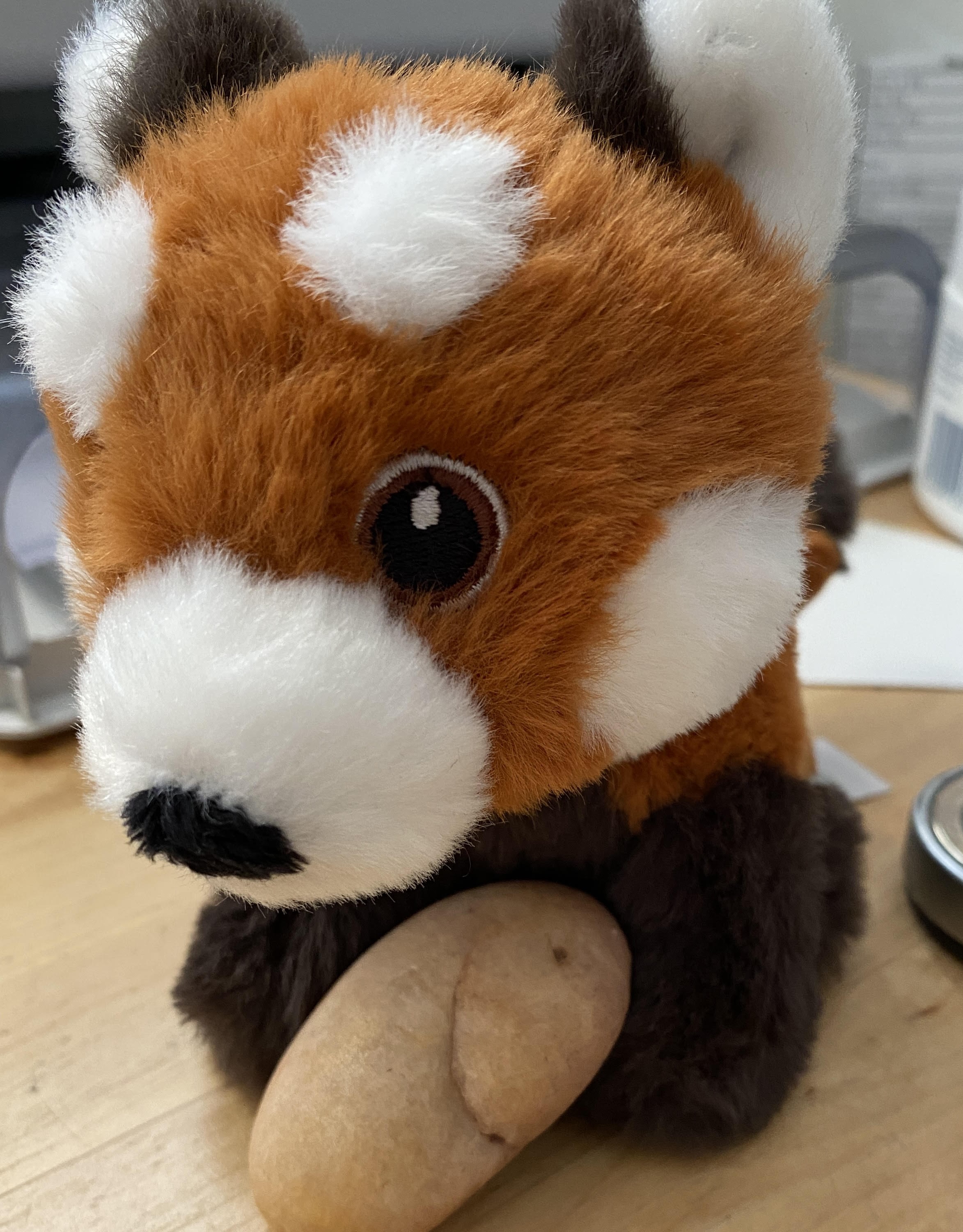
If I am alert, the messages come. In a vat of half-price stuffed animals at a grocery store, I spied this little red fox,* small enough to stuff in my purse, cuddle-firmness just right to squeeze for comfort. 

On the trail, as I stooped to inspect a bird feather, I spotted this little rock. It has a face, with a little hole for an eye, and a smile!

One of my three stated goals for fall is to Think Positive, to see the glass half full. As you may know, that’s not my natural attitude. So I take joy in this little rock, which reminds me – like George would say — to smile.

May we be alert to the signs and symbols that come to us. May we find joy. 

—- Barbara Fox

* The “fox” upon close inspection turned out to be a red panda by Aurora from EcoNation. But I can consider it an ‘honorary’ fox ! Consider it poetic license or “spiritual believer’s license”

Rituals and Routines: Recipes for Longevity

As children, when we had little power over our environment, we craved rituals, for a sense of security  Repeating a bedtime ritual eased the transition between our desire to keep going and our need for rest. With my first child, I told her the stories of the pictures on her bedroom wall before putting her in the crib.

As middle life adults, we could get along without rituals and routines. So many factors interfere with ordering our lives — the demands of the job, the disruption caused by a family member, the excitement of travel. I didn’t have enough focus to stick to a routine but I had enough energy – and power over my own life – to deal with change.

As elders, I believe we require routines, to be safe. My mother survived till age 96 because she always did everything in a certain order.  Now I — who rarely did things twice the same way – find that I am beginning to be anxious about making changes. Is it safe for me to travel? Will I remember to do the right things in the same way in another place?

Children gain power, as they grow. That’s how it should be. We elders, whether we want to or not, are giving up power, ever so gradually. I am learning to embrace the necessary concept of sticking to routines. That’s how it is.  

(image generated by AI)

‘Christmastide’

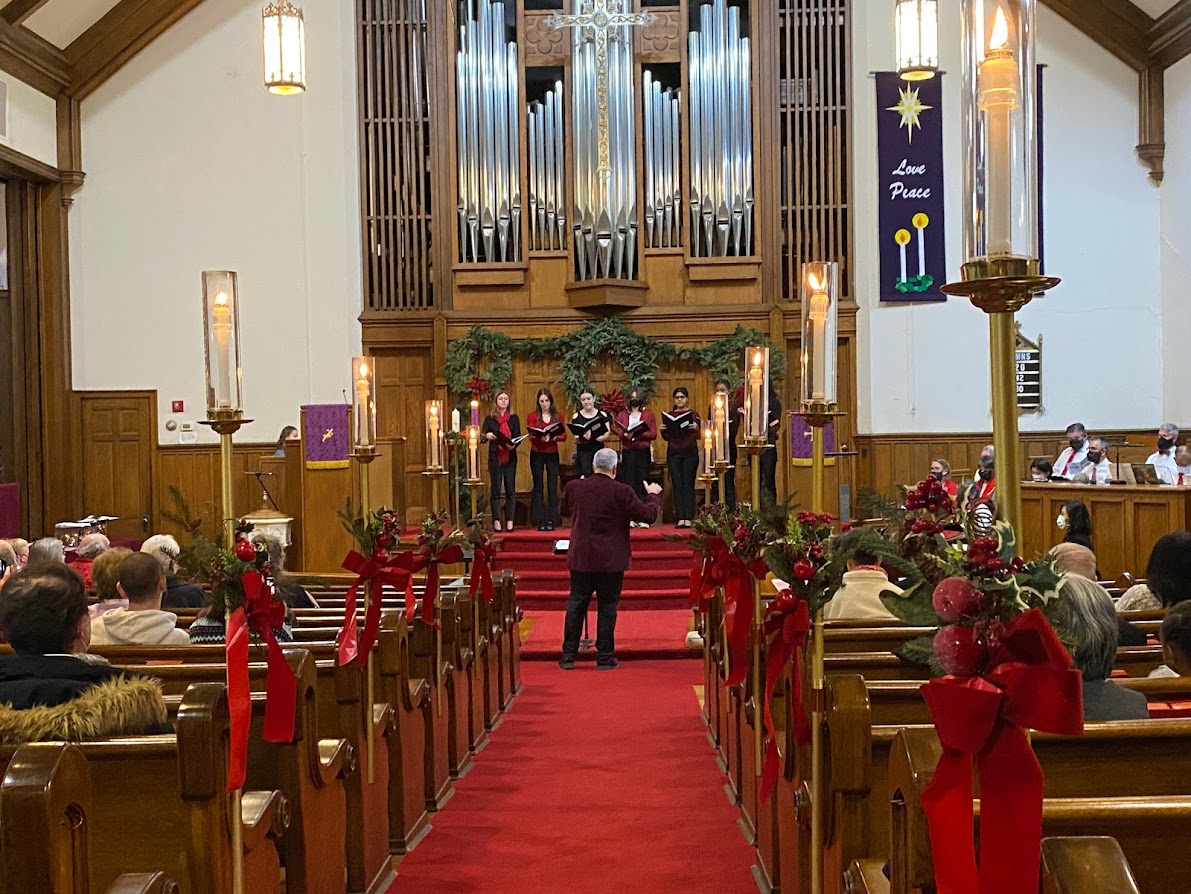
Christmastide, an anthem by Tom Shelton, sends chills down my spine whenever I hear it. Today I was fortunate to hear Shelton’s Youth Choir render it twice, in a day of beautiful music, first at morning worship, when the Chancel Choir also sang one of my favorites, Bach’s Jesu Joy of Man’s Desiring. They reprised it tonight, along with joyful music from the Chancel and Handbell Choirs, directed by Hyosang Park, in a concert entitled “Rejoice!”

Here is the link to hear Christmastide, from Sunday, December 17 at 10 a.m.

This post is a thank you to the musicians at Princeton United Methodist Church – and to musicians around the globe – who put their hearts and souls into bringing the hopeful strains of Advent and Christmas music into churches and concert halls everywhere. How can anyone not believe in the divinity of our Creator when listening to these harmonies?

So – thank you to these musicians, and as you read their names, you will see that several do double and triple duty. Many of them perform in professional ensembles. But there’s nothing like hearing your own friends make music in your own house of worship. Kudos to Park, who put the program together, as well as to Shelton.

In the Chancel Choir are Mandy Du, Yvonne Macdonald, Joan Nuse, Lori Pantaleo, Françoise Maitre, Karen Hoagland, LaVerna Albury, Jenni Collins, Lindsay Diehl, Stephen Offer, Curt Hillegas, Yannick Ibrahim, and Jim Frisbee. They gave us Handel’s Christ is Born (arranged by Jon Paige) and Shepherds Come Rejoicing by Joseph M. Martin, and Purcell’s Rejoice in the Lord Always.

 In the Youth Choir are Elli Collins, Juli Collins, Maggie Collins, Shermel Morgan, Julia Potts, and Aditi Rapaka. After joining the Chancel Choir for the Purcell, they sang two old world carols and then, with Jenni Collins as soloist, Shelton’s Christmastide.  

The Handbell Choir played News of Great Joy in an arrangement by Arnold Sherman and O How Joyfully, arranged by John Behnke. Ringing were Irene Yu, Diane Peterson, John Macdonald, Yvonne Macdonald,  Joan Nuse, Bob Nuse,  Amy Gardner,  Bill Gardner, Julia Ciccone, Mary Ciccone,  Sarah Betancourt, and  Heather Hansen.

The orchestra closed the program with Handel’s Rejoice Greatly, featuring Bill Gardner on trumpet, along with Elizabeth Rouget, Violin; Myles McKnight, Violin; Paul Manulik, Viola; Gabrielle Hooper, Cello; Scott Collins, Clarinet; Amy Gardner, Clarinet; Bill Gardner, Trumpet; Julia Hanna, Piano. Ian Macdonald and Eric Gillette managed the video stream, available here on this Facebook page. Or on the website.

As Rev. Jenny Smith Walls said, in using the words of Kate Bowler for the benediction, “We have quieted our souls to listen, for your word made flesh is life to us.”  

                       ———————- Barbara Fox

On Christmas Eve at 4 p.m. the Children’s Choir leads a family-friendly candlelight service — and at 8 p.m. a traditional service features the Chancel Choir, Youth Choir, and instrumentalists. All are welcome.

He Wanted Us to Pray

I just watched the “Beautiful Day” movie – how did I manage to wait so long? As a young mother, everything I knew about child psychology, I learned from Fred Rogers, never mind Spock. I’m basking in the memory, playing the trailer, remembering how I started to write a Vacation Bible School curriculum focused on The Neighborhood, was encouraged by the Fred Rogers people, but never got it done.

Basking, I’m looking up various references that you might enjoy. He grew up in Latrobe where his sister has an art center. In this interview he talks about the lessons he earned early in life, and at minute 18 he tells how he learned how it felt when someone turned you down. People desire to be in touch with honesty (minute 20).

“The very first view that we have of our whole world is that view of our mother’s face during nursing. And so we get our very first impressions of what this world is like through our mouth and our eyes. And, if what’s good is coming into our mouth and what’s good is coming into our eyes, we have a mighty strong beginning.”

Tom Hanks was sooo good, but he had to be persuaded to take that role.

“It’s in the pause that the greatest potency is found…” says Matthew Rhys, the Welsh actor who, when he played the Esquire writer, managed to lose his Welsh accent. He and Hanks were interviewed by Judy Woodruff on PBS News Hour.

I didn’t know that the movie plot was based on a true story, that there really WAS an Esquire writer, Tom Junod, who was changed by his interviews with Fred.

Said Junod:  He was leading me to that moment of prayer that whole time that I was with him. And what did Fred want from me? He clearly wanted me to pray. He clearly believed in prayer as a way of life. He prayed every day of his life. He woke up in the morning and prayed, and wrote, and prayed for people. And so I wrote that. The answer to: What did Fred want? He wanted us to pray.

I saw this movie with 30 people at Stonebridge at Montgomery on a Saturday night. The lights went up, people were leaving, but the credits were still rolling and somebody was still singing and I was transfixed. I knew it had to be the REAL Fred Rogers. Finally the credits parted and showed a glimpse of the real Fred’s face.

Alone among those thirty, I was the one — TA DA! – who recognized the real Fred. Here’s the real Fred singing “It’s You I Like.”

Joseph Pilates, Anthony Rabara — and Jacqueline Winspear

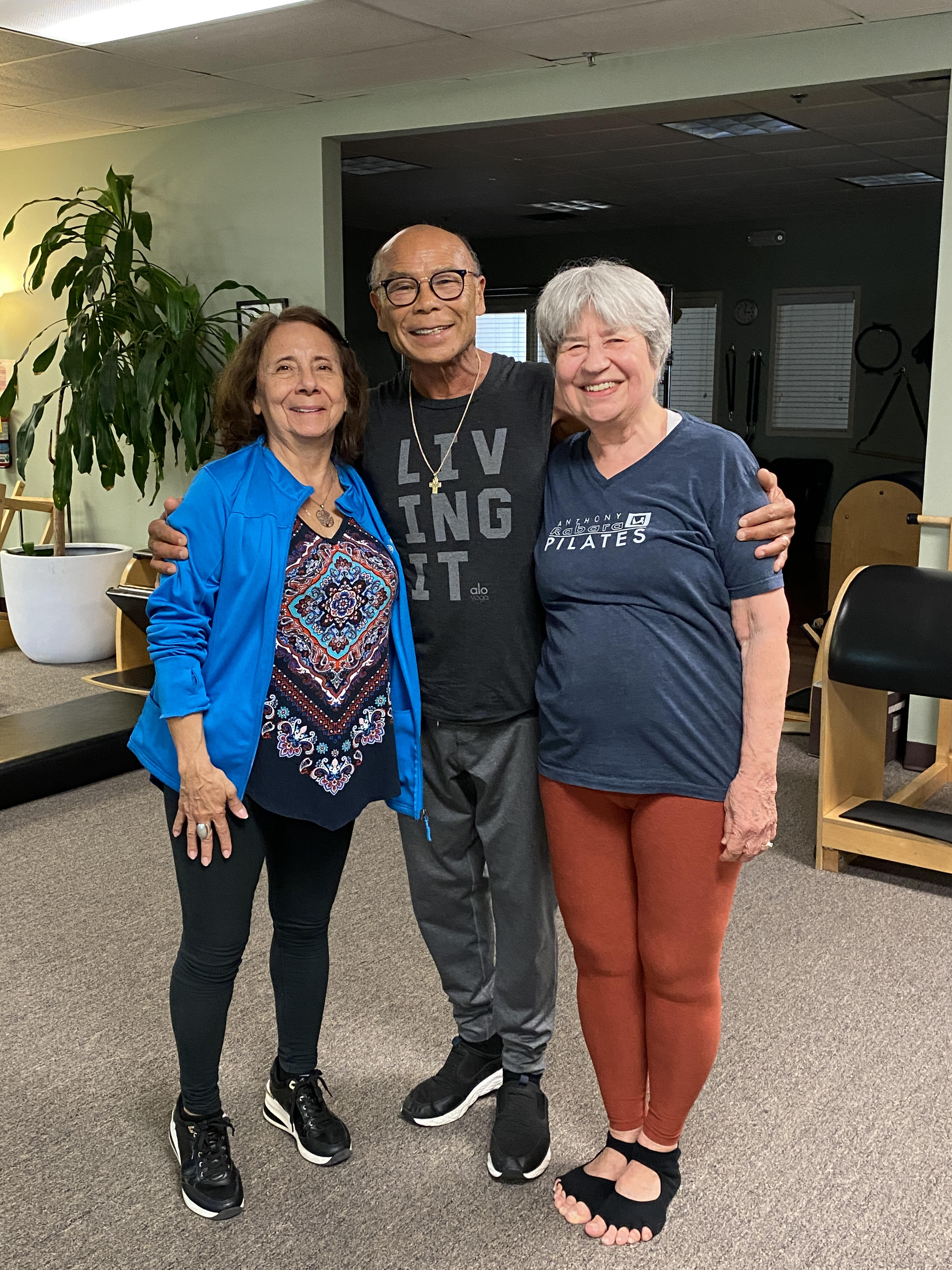
Sari Mejia Santo, Anthony Rabara, Me

I’ve been taking classes in the Pilates Method ever since Anthony Rabara brought it to Princeton in the ’90s. He teaches the purest form of the now famous body work devised by Joseph Pilates. Back then, this method was known mostly in the New York dance community. Rabara was one of the first eight trainers certified by Joseph Pilates’ protegee, the late Romana Kryzanowska.

Thanks to Rabara and his studio’s expert teachers – they go through more than 600 hours of training — my severe arthritis is held at bay. With discerning eyes they can spot the slightest misalignment and cue the corrections that prevent injury and strengthen muscles that you didn’t know you had.

This week I had the very exciting opportunity to study with Romana’s daughter, Sari Mejia Santo. She leads Romana’s Pilates International, which operates a global instructor network in 40 countries and 30 U.S. States. My lesson turned out to be a demo for a dozen instructors in the room. It was challenging, to say the least, but she made it fun.

In a delightful coincidence, I had just come across a passage in a Maisie Dobbs mystery by Jacqueline Winspear that mentions Joseph Pilates, who developed his technique on wounded soldiers during World War I. In “Birds of a Feather,” set in England between the wars, Maisie’s assistant, Billy, gets to “study exercises and movements to counteract the lingering effects of war time injuries.”

“What ‘e says, Miss, is that I’m increasing my core. . .

“Your core?” Maisie watched Billy brush out the mane of a mare with an enviable track record…

“There are all these different exercises, some to stretch me legs, some me arms, and me middle, and some are really small movements right ‘ere,” Billy pointed to his stomach with the curry comb, “which is me core.”

“Well, it seems to be doing you a lot of good. I saw you walk across the stable yard with barely a limp.”

“The main thing is that the pain ain’t what it was.”

So says Billy. The main thing, for me, is that going to the Rabara studio is fun – and the “really small movements,” as Billy puts it, keep me feeling young.

: