Category Archives: Dance and the other arts

Sassy Latina? Maybe not always.


alicia 2

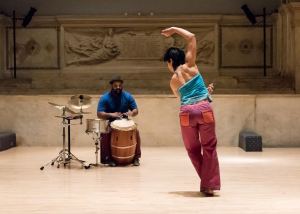
“I am inspired by lessons from the Caribbean that underscore creativity, resilience and the capacity for both resistance and celebration in the midst of difficulty,” says Alicia Diaz, a professional dancer who grew up in Princeton. She will participate in an unusual lecture demonstration this Friday afternoon  at Princeton University. Entitled “Diasporic Body Grammar: an encounter of movements and words,” it will be December 2, 2 to 5:30 p.m. in the Wilson College Black Box Theater.

Asked, in an interview, whether she struggles with stereotypes, Diaz brought forward the stereotype of the “sassy Latina.” “Here ethnicity, gender, and sexuality come together to be consumed and dismissed at the same time. I struggle with rejecting the stereotype and its negative implications while also acknowledging and owning its potential power.” 

Diaz, assistant professor of dance at the University of Richmond, will perform with her partner, Matthew Thornton. Here is a video of her work. Also participating will be a Brazilian artist, Antonio Nobrega. For information, contact Pedro Meira Monteiro pmeira@PRINCETON.EDU


Each photo with a story

hartley
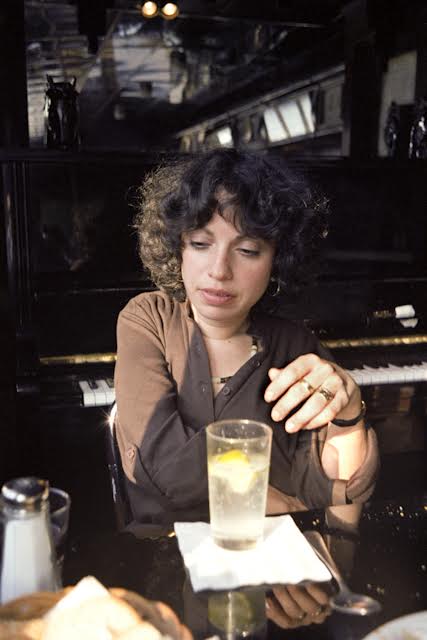
Lunching at the Empire Diner, Chelsea, New York

In these fraught moments, when some rejoice and many despair, I find comfort in Duncan Hartley’s photographs.

 Hartley had pursued several careers. Most recently he was in charge of multimillion dollar donations for prestigious health institutions. But he began as a photojournalist in high school, and continued ‘shooting’ for 50 years. The photographer’s “eye” that could tell the story behind a face helped him breach the facade of deep-pocketed givers.

Hartley is readying a book of his New York photographs from then and now. “Then” was 1957 to the Bicentennial. “Now” is as recent as last September, when he revisited the Feast of San Gennaro for the umpteenth time.  Paging through his work, online now at duncanhartley.com, I am struck by the contrasts between despair and joy even in the supposedly halcyon days.  In black and white, a man in a tailored suit, nicely groomed, bent over bags of newspapers gleaned from trash cans.  Passing by a legless veteran playing the accordion in Times Square are two haughty women, described by Hartley, in the language of e e cummings, as having “comfortable minds.”

In contrast to the harried commuters and the desolate staircase at Grand Central Station and the man with the Armagedon sign — is the 1974 photo of an African American couple — he in bell bottoms, she in a kilt skirt, facing each other, holding both hands, titled “Loving Couple Enraptured.” And the 1976 color image of a jubilant crowd in the bleacher ready to welcome the tall ships — with the twin towers in the background.

Hartley documents the passage of time. At Grand Central, men look up phone numbers in the display of telephone books and we people watch at the now defunct Empire Diner. He shows us how Little Italy – with Canola Man and Pretzel Man — has gradually accessed Chinatown, by picturing a gaggle of girls from different ethnic origins and an elderly Asian couple lost in the San Gennaro crowd.

I take photos. I come from a family that placed a high value on photography. I grew up in Baltimore, where we revered the work of A. Aubrey Bodine. I like to take photographs of people. I like to think I have “an eye” for a good shot. And I am in complete awe of these pictures, each with its compelling story.

He shows us poignant. He shows us despair. He shows me that — no matter how fraught I think today’s political situation is — life will go on. New York will go on. We will all get through this.

Full disclosure: the photographer is a friend and compatriot at my church. But I am among the last and least in a queue of experts and luminaries who offer fulsome praise for his work.

Beethoven: An edge of aggression and danger

beethoven

For Princeton University Concerts today, the Takacs String Quartet played for a stage-full of people who came to meditate while listening to Beethoven. This session — free including sandwiches afterward — helped to celebrate the 6-concert Beethoven cycle. The quartet played the first movement of Beethoven’s Opus 18 #2 (it was on the first program, Tuesday) and the adagio from the E-Flat Major quartet, Opus 127, which is scheduled for the 4th program, January 19.

Princeton’s classical music audience is generally quite respectful. No unwrapping of candy, no shuffling of feet, coughers are embarrassed, sneezers more so. But rarely have I been in a listening group where everybody tried so hard to sit still. Today at Richardson Auditorium an overflow crowd filed into the auditorium, onto the stage, for Mindfulness and Music, a guided meditation. The posters overhead celebrated the Takacs quartet’s six-concert Beethoven cycle. The quartet was surrounded with people sitting on chairs and kneeling on pillows. Matthew Weiner of the Office of Religious Life explained the rules and struck a gong three times. Long silence. More long silence. We all meditated our hearts out. Than the quartet began to play.

First violinist Edward Dusinberre said later that it was a whole new experience to begin from silence — no entering with adrenaline pumping, no prep to get ready, just — lift the bow and break the silence. “It was a fragile moment,” he said.

Andras Fejer, cellist, confirmed that – with this meditation group, so receptive, in such an intimate space, the quartet felt they could just present the music, with no need garner attention by ramping up dramatic contrasts.

Geraldine Walther, the violist, was nearly overcome with emotion as she described how, as she played (and I hope I’m being accurate here), she feared for the values that she held dear. Yet she knew that these values have survived since Beethoven’s time, for 200 years, and she found comfort in that.

Mary Pat Robertson, one of my long-time friends in the dance community, had this response. It was so moving to be able to experience chamber music up close, and with a group of people coming to the experience with a specific desire and intentionality to their listening.”

Robertson offers a way to think about how Beethoven can help us get through what many of us believe will be a period of national and international turmoil:

“When we think about music to meditate to, we might think of anodyne “spa” music.  Beethoven’s music has an edge of aggression and danger that are far from that.  It is music made in a time of uncertainty and political instability, declaring the power of the individual soul.”

beethoven-poster-img_2213“We have been living (up until now) in a time of great peace and prosperity, relative to his era.  Those of us who shared this experience together took away a heightened sense of the risk-taking of great art, and the importance of sharing our emotions with each other with the materials of spirit that are uniquely given to each of us.” 

“As one of the quartet said, “we are only the vessels.”
 

Momentary Quartet October 29

jane-buttars-quartetExperience the excitement of music created live! The Momentary Quartet plays Saturday, October 29, at 7:30 p.m. at the Unitarian Universalist Church, 50 Cherry Hill Road,  in Princeton. Tickets at the door, $15.   Experience the excitement of music created live! Jane Buttars, piano, Harold McKinney, trombone, Patrick Whitehead, trumpet, and Lin Foulk, horn, improvise in styles from classical to blues to world music. With Daniel Harris, poet, and Aurelle Sprout, dancer. 

To continue in this vein, Buttars offers a workshop on Sunday, October 30, 1-3pm.   Enjoy inventing music with others in a fun, supportive atmosphere. Beginners to professionals welcome. $10 donation suggested. 

www.MomentaryQuartet.wordpress.com, 609-683-1269, janepiano2@comcast.net


Day of Dance October 30


outlet-dance-project

Shoemaker’s child? 9/10 at 2 p.m.


2016-9-10-button-fox-photo

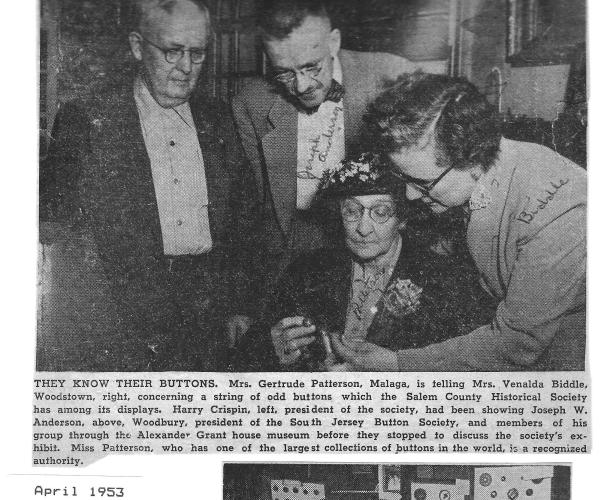
On Saturday, September 10, at  2 p.m. at the New Jersey State Button Society Show and Sale, I will give an illustrated talk “Button Pioneers of New Jersey,” looking at how devoted button collectors operated in the 2oth century, aiming to inspire collectors in the 21st century.

Everyone is invited! The show is amazing — a dozen dealers, thousands of buttons to admire and/or buy and there’s even a raffle. It costs just $2 and is at the Union Fire Company Banquet Hall in Titusville. 

It’s a case of the shoemaker’s child. You’d think I’d have posted on my own blog before now, but I am having too much fun putting together at talk with adorable pictures like the one below. gertrude-patterson-1953


Dirty Dancing’s Princeton Connection


The author of Dirty Dancing, Eleanor Bergstein, lived in Princeton in 1986 when she wrote the movie (she was married to English professor and poet Michael Goldman). U.S. 1 Newspaper did a cover story on her. I remember her telling me what a tight time budget she had (less 2 months), how she wished she could have reshot some scenes, and that she based it on her adolescence doing what they called ‘dirty dancing’ (actually the mambo) at basement parties.

This article tells how they kept the cameras running during rehearsal breaks in case there  was usable film, how she prepared to write the movie by emceeing dance parties in her Princeton home, how she was pressured to take out the abortion scene, which was central to the plot.

Another Princeton connection was one of the dancers, Jennifer Stahl

What brought it up now?  An Urban Joker post on  35 things you probably didn’t know about the movie. And I fell in love with this movie all over again.


Master Juba!

juba 1848
A newspaper’s depiction of Juba performing at Vauxhall Gardens in London in 1848. Credit Illustrated London News

With Shuffle Along closing on Broadway (yes, did you hear, Audra Macdonald is pregnant and ticket sales had slumped) I assuaged my disappointment (I meant to see this reincarnation of the historic black musical, but never did) by picking up a book at the Princeton Public Library’s youth section.

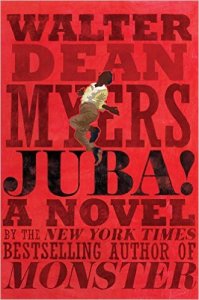
The engrossing and poignant “Juba: A Novel” by Walter Dean Myers is a must-read page-turner for young people interested in dance history and anyone interested in black history. Juba was both the name of a dance and the name of a legendary dancer, William Henry Lane, known as Master Juba, the first black man to dance for white audiences. Read about Juba in the New  York Times Magazine account of Shuffle Along. 

Myers describes how Juba danced for Charles Dickens, who famously wrote about him. In Juba’s (imagined) words, “I let the music take me over and sweep me across the f51m+Xs3h2LL._SX329_BO1,204,203,200_loor. I spun, I moved across the floor on one leg and back on the other, I double-stepped, slid on one leg as I moved backward, switched to a six-beat clog step. I danced faster than I had ever danced, and with more precision than I ever had before, and with more joy in my heart. When the piano player got to the last chorus, I was tired and exhausted, and as happy as I had ever been in my life.”

The dancing part is the fun part. The being black in the 19th century is the hard part, but for youthful readers, Myers makes it OK.


‘Art flows out of my studio’

Heather Barros, talented artist/teacher, has an exhibit at the D&R Greenway through June 17. Janet Purcell wrote about it here 

‘She can make you a dancer…

. . . even if you never danced before. ‘

That’s a quote from the “Rate my professor’ page for Janell Byrne, who quietly retires as director of Mercer Dance Ensemble after, by my count, 36 years at Mer2016 5 toxiccer County Community College. (Her 30th anniversary concert was in 2010).

I’ve attended almost all of these concerts and this stands top of the list. Perhaps I’ll have time to explain why later, but I’m sending this out now because the final performance is today, Sunday, May 22 at 2 p.m. at Kelsey Theatre.

Here is the list of MCCC dancers: Amy Annucci of Ewing, Kayla Johnson of Wrightstown, Caitlin Kazanski of Robbinsville, Diego Montealegre of Lawrence, Terrell Moody of East Windsor, Sabrina Rahman of Lawrenceville, Brianna Rapp of East Windsor, Victoria Smalls of Hamilton Township, and Kourtney Tremaine of Trenton. Alumni and community dancers include Rebecca Brodowski, Nicole Colossi, Maleek Colvin, Jennifer Gladney, Delany Hoffman, Maria Laurenti, Stephanie Maher, Danielle Marchant, Ashley Miller and Taylor Miler.

Few choreographers have had Byrne’s opportunity — and burden — to produce, every year, handfuls of imaginative works on dancers of various body types and abilities. I love to see how she does it, how she makes dancers out of people who never danced before.