On Cedar Lane, the Fox family lived next to the Kruse family. We were the age of their parents. They were “us” when we first came to Princeton, their girls in middle school and high school. We were lucky to have them — and the Zimmermans across the street — as neighbors. They helped us out and — with unfailingly gracious hospitality — included us in their circle of friends, often gathering around a table on their patio, overlooking both of our back yards.
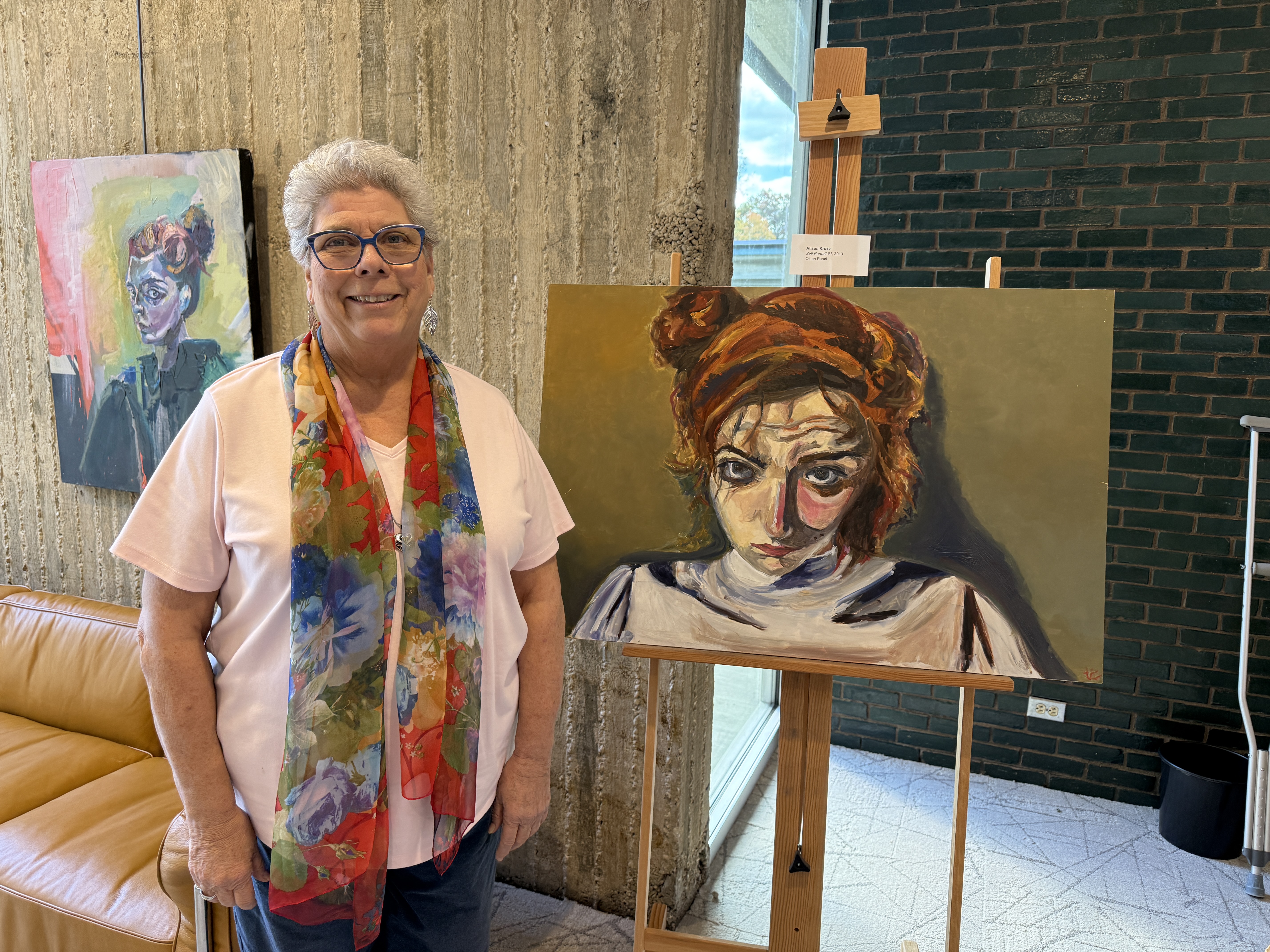
Alison Kruse, amazingly, grew up to be the artist she always wanted to be. Her exhibit “Painting Life” is on view in the Considine Gallery at Stuart Country Day School through Thursday, November 20. Alison says she hopes each piece is a “visual journal entry, rooted in truth and lived experience, exploring the interplay of memory, place, and emotion.” I believe the oil and charcoal work above, titled “NJ,” captures the spirit of gathering at that table in the twilight.
I’m delighted by Alison’s success. She went to Princeton High, studied in after school classes with Heather Barros, and majored in fine arts at Queen’s University in Kingston, Ontario. She has earned foundation grants and residencies and has stayed true to her vision. I’m also impressed by the support she had. Not every parent would have wholeheartedly supported a daughter’s painting vision.
Thanks also to Phyllis Wright (show below), the art teacher at Stuart who brought her class to network with the artist, and to Sara Hastings for drawing my attention to this exhibit by featuring it on the cover of the Princeton Echo. I’m proud to say that I own an early work by Alison Kruse.
Alison’s mother, Kate Kruse with the Princeton Echo cover image.
I was there for 23 of those years, glad to be working for the founder, Richard K. Rein. Then, it was “Princeton’s Business and Entertainment Journal.” Two years after he started the paper, when it was still a monthly, I was the first editorial hire.
For each of the anniversaries he posed as a cub reporter to interview himself. This week, he was interviewed by Mark Freda.
Rein now has an online journal, TAPintoPrinceton, which if you don’t get it, you should. He’s got terrific writers covering a variety of Princeton subjects. In his own column, Shots from Cannon Green (Can Princeton Help Make America Safe Again? Or Sane Again?) he has 10 savvy suggestions for what Democrats should do for the next four years.
Some of my favorites from this column:
4.) Engage people from the other side. Don’t cancel or block them. You don’t want the other side to ban books. Don’t ban the other side.
“Listen” is my new mantra. I like the old saying, “A man convinced against his will is of the same opinion still”
8.) Don’t scold people. I’m convinced that every time someone gets called out for cracking an inappropriate joke, making a risqué remark, or otherwise failing a test of wokeness, another Trump voter is created. (Yes, I realize I am scolding some people here, but it needs to be said.)
When someone makes an obnoxious statement with which you disagree, don’t reply angrily, just counter with “Hmm, I wonder why you said that.”
3.) Make sure your candidate has a story or a narrative that encapsulates their position. A position paper will never be read.
I like this one, because it’s what Rein taught me to do — don’t cover the issue, find a person who represents the issue and tell their story.
Rein counters the MAGA slogan with one of his own.
And of course there must be a disclaimer: “Shots from Cannon Green represents the opinions of Richard K. Rein, and not necessarily those of anyone else at TAPinto Princeton“
Helping U.S. 1 readers feel like they belonged in the greater Princeton community was always my goal. To quote Hastings: … the most important things remain constant: U.S. 1 was founded with a commitment to serving an audience of people who work and live in a narrowly defined geographic area centered around the Route 1 corridor in Mercer County through a mix of business and entertainment coverage. That community is still U.S. 1’s most important asset and one it aspires to continue serving for years to come.
As children, when we had little power over our environment, we craved rituals, for a sense of security Repeating a bedtime ritual eased the transition between our desire to keep going and our need for rest. With my first child, I told her the stories of the pictures on her bedroom wall before putting her in the crib.
As middle life adults, we could get along without rituals and routines. So many factors interfere with ordering our lives — the demands of the job, the disruption caused by a family member, the excitement of travel. I didn’t have enough focus to stick to a routine but I had enough energy – and power over my own life – to deal with change.
As elders, I believe we require routines, to be safe. My mother survived till age 96 because she always did everything in a certain order. Now I — who rarely did things twice the same way – find that I am beginning to be anxious about making changes. Is it safe for me to travel? Will I remember to do the right things in the same way in another place?
Children gain power, as they grow. That’s how it should be. We elders, whether we want to or not, are giving up power, ever so gradually. I am learning to embrace the necessary concept of sticking to routines. That’s how it is.
I just watched the “Beautiful Day” movie – how did I manage to wait so long? As a young mother, everything I knew about child psychology, I learned from Fred Rogers, never mind Spock. I’m basking in the memory, playing the trailer, remembering how I started to write a Vacation Bible School curriculum focused on The Neighborhood, was encouraged by the Fred Rogers people, but never got it done.
Basking, I’m looking up various references that you might enjoy. He grew up in Latrobe where his sister has an art center. In this interview he talks about the lessons he earned early in life, and at minute 18 he tells how he learned how it felt when someone turned you down. People desire to be in touch with honesty (minute 20).
“The very first view that we have of our whole world is that view of our mother’s face during nursing. And so we get our very first impressions of what this world is like through our mouth and our eyes. And, if what’s good is coming into our mouth and what’s good is coming into our eyes, we have a mighty strong beginning.”
“It’s in the pause that the greatest potency is found…” says Matthew Rhys, the Welsh actor who, when he played the Esquire writer, managed to lose his Welsh accent. He and Hanks were interviewed by Judy Woodruff on PBS News Hour.
Said Junod: He was leading me to that moment of prayer that whole time that I was with him. And what did Fred want from me? He clearly wanted me to pray. He clearly believed in prayer as a way of life. He prayed every day of his life. He woke up in the morning and prayed, and wrote, and prayed for people. And so I wrote that. The answer to: What did Fred want? He wanted us to pray.
I saw this movie with 30 people at Stonebridge at Montgomery on a Saturday night. The lights went up, people were leaving, but the credits were still rolling and somebody was still singing and I was transfixed. I knew it had to be the REAL Fred Rogers. Finally the credits parted and showed a glimpse of the real Fred’s face.
Alone among those thirty, I was the one — TA DA! – who recognized the real Fred. Here’s the real Fred singing “It’s You I Like.”
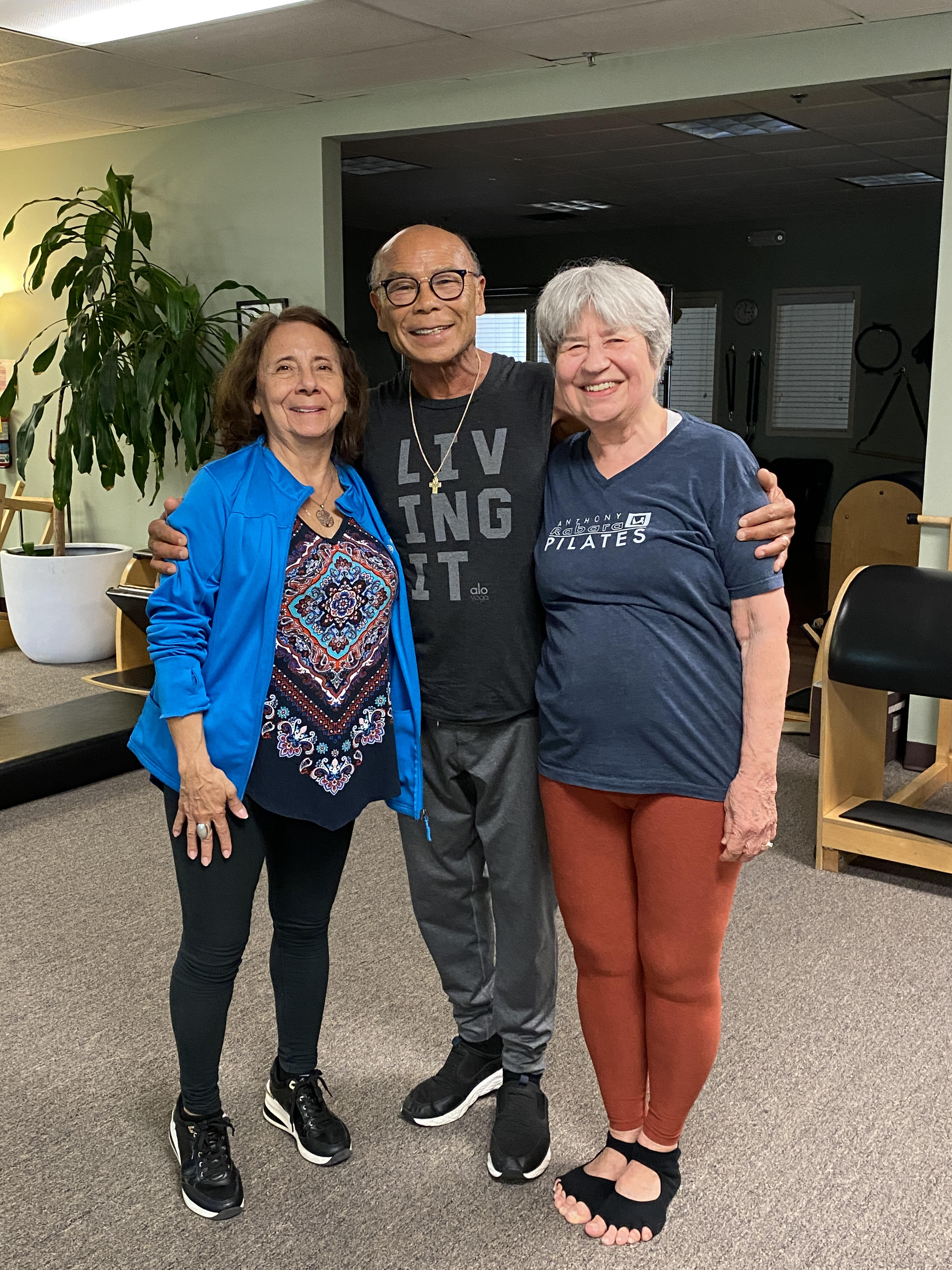
I’ve been taking classes in the Pilates Method ever since Anthony Rabara brought it to Princeton in the ’90s. He teaches the purest form of the now famous body work devised by Joseph Pilates. Back then, this method was known mostly in the New York dance community. Rabara was one of the first eight trainers certified by Joseph Pilates’ protegee, the late Romana Kryzanowska.
Thanks to Rabara and his studio’s expert teachers – they go through more than 600 hours of training — my severe arthritis is held at bay. With discerning eyes they can spot the slightest misalignment and cue the corrections that prevent injury and strengthen muscles that you didn’t know you had.
This week I had the very exciting opportunity to study with Romana’s daughter, Sari Mejia Santo. She leads Romana’s Pilates International, which operates a global instructor network in 40 countries and 30 U.S. States. My lesson turned out to be a demo for a dozen instructors in the room. It was challenging, to say the least, but she made it fun.
In a delightful coincidence, I had just come across a passage in a Maisie Dobbs mystery by Jacqueline Winspear that mentions Joseph Pilates, who developed his technique on wounded soldiers during World War I. In “Birds of a Feather,” set in England between the wars, Maisie’s assistant, Billy, gets to “study exercises and movements to counteract the lingering effects of war time injuries.”
“What ‘e says, Miss, is that I’m increasing my core. . .
“Your core?” Maisie watched Billy brush out the mane of a mare with an enviable track record…
“There are all these different exercises, some to stretch me legs, some me arms, and me middle, and some are really small movements right ‘ere,” Billy pointed to his stomach with the curry comb, “which is me core.”
“Well, it seems to be doing you a lot of good. I saw you walk across the stable yard with barely a limp.”
“The main thing is that the pain ain’t what it was.”
So says Billy. The main thing, for me, is that going to the Rabara studio is fun – and the “really small movements,” as Billy puts it, keep me feeling young.
Robert Geddes, the founding dean of Princeton’s School of Architecture, the William R. Kenen Jr. Professor of Architecture, renowned urbanist and innovative educator, died on Feb. 13, 2023. He was 99.
Robert Geddes Photo courtesy of Princeton University Press
Engaged with his projects and liberal politics to the last, Robert Geddes entertained and informed fellow residents of Stonebridge at Montgomery at occasional presentations. Aided and encouraged by another resident, the politically savvy Ingrid Reed, he railed against the potential destruction of his beloved Liberty State Park and fretted about the future of Philadelphia’s Roundhouse. He also loved to speak about his former students who now lead departments at prestigious universities, and he devoted time and energy to the work of Princeton Future.
Richard K. Rein, in his column for TAPInto Princeton. tells about the work of Princeton Future. Rein also discusses how Geddes’ students founded the movement known as “the new urbanism.”
Geddes’ students, carrying on the broad view of architecture and looking purposefully not just at buildings but also at the space between the buildings, became the founders of the movement known as the “new urbanism.” The husband-and-wife team of Andres Duany, Princeton Class of 1971 and Elizabeth Plater-Zyberk ’72, along with Stefanos Polyzoides ’69, were joined by Elizabeth Moule, who earned a masters in architecture at Princeton in 1987 and is now the wife and partner of Polyzoides, to form the Congress for the New Urbanism along with Peter Calthorpe (from Yale), and Daniel Solomon, (Columbia and Berkeley).
The founders were joined by several more Princeton alumni to become early leaders of the movement. These include environmentalist and architect Douglas Kelbaugh ’67 *72, landscape architect Douglas Duany ’75, and writer and educator Ellen Dunham-Jones ’80 *83. (Full disclosure: This reporter was a Princeton roommate of Polyzoides, who is now the dean of architecture at Notre Dame.)
Geddes’ obituary from Princeton University summarized how he was “a pioneer in forging deep connections between architecture and the humanities, social sciences, public affairs and urban design. He always focused on the social basis of design — for buildings, landscapes and cities.”
From an early age, Geddes was known to be a convener, locally as a co-founder of Princeton Future. He continued that at Stonebridge, co-founding a “Guys Group” to meaningfully engage with ethical and social problems. After his cherished wife Evelyn died, he was especially lonely on Sunday afternoons and instigated — with help from Julia Bowers Coale, president of the Residents’ Association — informal teas on Sunday afternoons.
Geddes and his wife Evelyn moved to Stonebridge when they were in excellent health and were still traveling abroad. With their new Stonebridge friends, George and Barbara Wright, they visited museums in New York and Philadelphia and attended performances on Broadway and at Caramoor in upstate New York, Many Stonebridge friends helped Geddes in his last years. After Geddes’ wife died, two residents who knew what it was like to be suddenly alone – Jeff Tener and Barbara Wright –committed to have pizza with him every Friday.
As for me, busy with my own too many doings, I had only limited time to be with Bob. I wish I had had more time. But I can immerse myself in his website and in his book “Fit,” to glean his “lively, charming, and gently persuasive” wisdom.
Barbara Hillier’s memorial service was yesterday at the Princeton University Chapel. She died at age 71 on November 21, 2022. How she combined motherhood and an atypical but impressive career was explained in detail – perhaps for the first time, for most of us — in her obituary.
One of her stellar projects was the convention center in Irving, Texas. As described, “She created a vertical convention center that soared 170 feet into the Texas sky with convention rooms at different levels, all connected by amazing escalators and with expansive terraces protected from the hot Texas sun. The design minimized its land consumption, and the center had a huge visual presence from the highways to the Dallas airport. The building has won every imaginable award…”
Bob and Barbara Hillier at the opening of the Copperwood Apartments
As explained by Pam Hersh in this Tap Into Princeton column. Barbara earned her master’s degree in architecture from Princeton University without taking a required course — because it was taught by her husband.
Bob Hillier’s presence as a community activist and founder of Studio Hillier looms large in a good way, but perhaps the most visible image of his influence is the Princeton Public Library, led by an architect in his previous firm, the Hillier Group. Less obvious is the library constructed at NJIT by the Hillier Group and the Hillier family’s notable gift in 2019 to NJIT. The current firm, Studio Hillier, is embedded in the Witherspoon-Jackson Neighborhood and recognized for its commitment to his home town.
The snapshot of Bob and Barbara Hillier was taken at the opening of the Copperwood apartments in 2014. Barbara Hillier received the first Woman of Achievement award, given in 2013 by the Women in Business Alliance at what is now the Princeton Mercer Regional Chamber.
On All Saints Day I was remembering Mary Hultse, who left this earth in 2018 and left Princeton before that. In preparation for the All Saints Day service on November 6 at Princeton United Methodist Church, we were asked to think about who were the saints in our lives
The name “saint” implies perfect, but according to Derek Weber, who quotes Psalm 149 in his All Saint’s Day meditation for the Upper Room Disciplines book, “saints of God are those who accept the invitation to dance. A saint is someone who knows something of the joy of living, even in the hardest moments of life. A saint is someone who knows something of the exuberance of praise, even when tears fall like rain and sweat falls like great drops of blood.”
As a successful advertising executive at Bristol-Myers Squibb, Mary Hultse commuted to Princeton from an apartment on the Upper West Side, where she was a regular at Riverside Church. Then she bought a second apartment, a fourth-floor corner walkup on Palmer Square, so that she could look out over Princeton University and enjoy walking around town. She retired in 1990.
Mary had such joie de vivre – going dancing, loving beautiful art, anything Hungarian, and clothes. She told stories of escaping Hungary with gold coins sewn into the hem of her dress. With a passion for the arts – she loved to sing, act, and dance – she joined local theater groups and played Aunt Eller in “Oklahoma” at Washington Crossing. She was beloved by the staff at Richardson Auditorium, where she volunteered as an usher. Devoutly faithful, she enthusiastically participated in the life of Princeton United Methodist Church (PrincetonUMC) and was in charge of the Altar Guild. She reveled in her Hungarian heritage and loved the daughters of a Hungarian family as if they were her grandchildren.
She was a trooper – not just in drama, but in stamina – even with arthritis and knee surgery, she trudged up four flights, 67 steps, to keep her view. She had Moxie, like the name of her former German shepherd. She had faith and extreme hospitality. But what we loved about Mary is that she helped us to be our Best Selves.
Everyone she met was perfect – beautiful, wonderful, perfect. When you think about Mary glowing with compliments — that’s the kind of love that Jesus offers. Unconditional love. Like at PrincetonUMC, when we say “You are enough because God is enough.”
The same qualities that made her a good executive – persistence, insistence – eventually evolved into just plain obstinance, masking depression and the beginning of dementia. When she began to fail, she refused to move away from her apartment. It was so hard to help her, because she would agree to something one day and refuse the next day.
An ad-hoc care team of a dozen PrincetonUMC people did help her stay in that apartment. We alternated taking her places. One woman did her wash. Others brought her home for meals and took her shopping. Walking behind her, we pushed her up those stairs and fetched cappuccinos from the Palmer Square kiosk. We worked with Princeton Senior Resource Center. We worked with Palmer Square management and (surreptitiously) with her doctors. We worked with McCaffrey’s. (Wanting to be independent, she would go to McCaffrey’s on the bus but not be able to get home. They would call us to come pick her up and we would dispatch someone on the Mary Team.) A couple from the church put in endless hours to organize her finances and pay her taxes. Along with her Hungarian friends, we were her family.
In the end, we were the benefactors, because in helping Mary, we got to be the best we could be. We surprised ourselves. We found out how good it felt to act out our faith.
In his meditation Weber refers to the English carol Tomorrow Shall Be My Dancing Day. “In his own voice and with his life, Jesus calls all to dance with joy for this gift of life eternal. . . On All Saints’ Day, we remember those whose dancing with their Lord has given us all hope. And we aspire to follow them in the music and dance Jesus is leading.”
Mary Hultse embodied the spirit of the eternal dance.
I had never heard of Christopher Smart, though as an English major I should have. My passion was Renaissance and 20th century poetry, and I kissed off the 18th century with one semester.
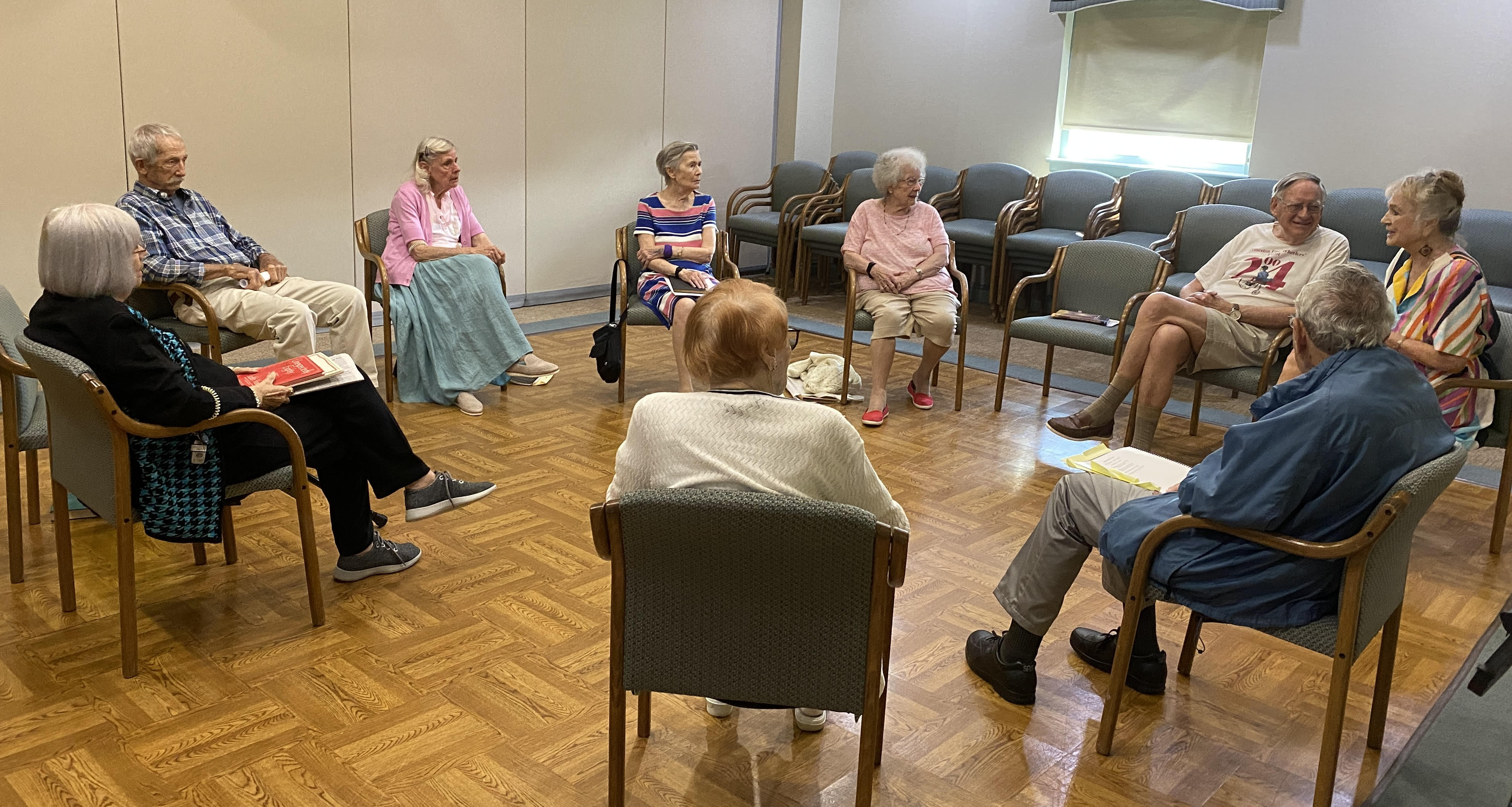
At the Poetry Circle at my elder residence, Stonebridge at Montgomery, curated by my new friend Hope, some read selections and some listen. Yesterday the coincidental links were giving me, as a wanna-be English teacher, delight. Perhaps “time present and time past” lurks in lots of poems, but every poem read that day — by Joyce, by Len, by Lois and by me — seemed to connect to that subject. Len’s contribution, a poem that he wrote to go with one of his collages, was even called ‘Connections.’
My contribution was potentially daunting: ‘Burnt Norton,’ the first of T.S. Eliot’s Four Quartets. I had lived into these lines in college and choreographed a dance about them:
….Only a flicker Over the strained time-ridden faces Distracted from distraction by distraction….
Time past and time future What might have been and what has been Point to one end, which is always present.
but since I’d handed out copies and distributed the reading, everyone happily dived in to share Eliot memories and favorite lines. So satisfying.
Then Nancy came up with a long but wryly amusing selection written by 18th century poet Christopher Smart. Drat, I thought, that’s the only poem read today that doesn’t have something to do with time. It doesn’t have a connection to the others.
I like connections. Sometimes I allow myself the belief that they are arranged by a higher power.
This morning I reached for my daily devotional guide, couldn’t find it, and absentmindedly opened a book that I hadn’t allowed myself the time to read, Lawrence Block’s’ The Burglar Who Counted the Spoons, given me by button friend Ann Wilson, who promises that ‘buttons’ are featured in the plot. Fast skimming to page 19 and, lo, there is Christopher Smart, explained as a contemporary of Samuel Johnson and Oliver Goldsmith. Says the first person narrator: He was unquestionably talented, but he was also mad as a hatter, and given to fits of religious mania that led him to implore his fellows to join him in public prayer. “I’d as soon pray in the street with Kit Smart as anyone else in London,” Johnson allowed, but others were less tolerant, and Smart spent the better part of his mature years clapped in a cell in Bedlam, where he wrote a line of poetry every day.
I choose to believe that it was not a coincidence that I picked up that book, read to page 19, and found the connection to what Nancy read the previous day.
You may believe what you will. And I won’t ask you to pray in the street.
Here’s my confession: I’m such a Dr. Ruth fan. A couple of decades ago, when I was scheduling an interview with her, she left a message on my phone mail that I kept for weeks, delighting in that throaty signature voice.
Here is Dr. Ruth Westheimer’s prescription for Covid positivity, published in the AARP newsletter. Memo to freelancers: she pitched her own story. It wasn’t the editors’ idea but they bought it. Memo to photographers and stylists: This is how to make an elder look good!










 Princeton Comment