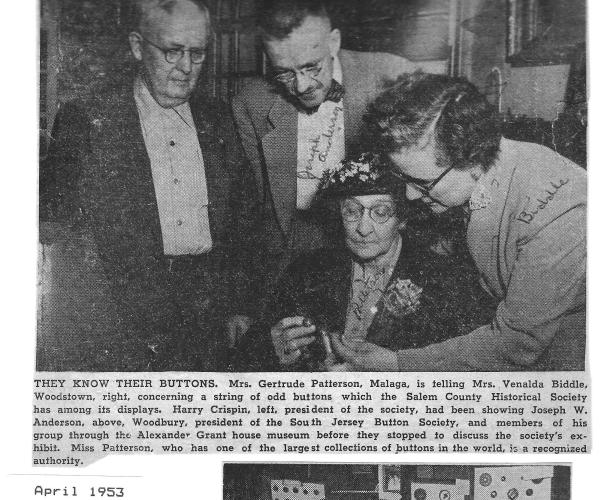
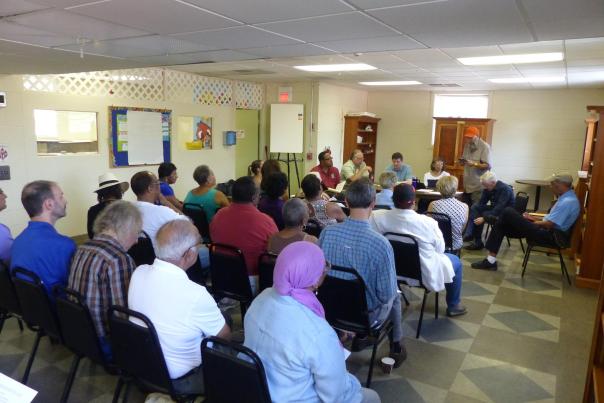
On Saturday, September 10, at 2 p.m. at the New Jersey State Button Society Show and Sale, I will give an illustrated talk “Button Pioneers of New Jersey,” looking at how devoted button collectors operated in the 2oth century, aiming to inspire collectors in the 21st century.
Everyone is invited! The show is amazing — a dozen dealers, thousands of buttons to admire and/or buy and there’s even a raffle. It costs just $2 and is at the Union Fire Company Banquet Hall in Titusville.
It’s a case of the shoemaker’s child. You’d think I’d have posted on my own blog before now, but I am having too much fun putting together at talk with adorable pictures like the one below.
My dilemma about 11 Green Street was explained well by Vincent Xu in this edition of the Princeton Echo . Can the historic preservation ordinance ‘save’ the Witherspoon Jackson neighborhood.
The author of Dirty Dancing, Eleanor Bergstein, lived in Princeton in 1986 when she wrote the movie (she was married to English professor and poet Michael Goldman). U.S. 1 Newspaper did a cover story on her. I remember her telling me what a tight time budget she had (less 2 months), how she wished she could have reshot some scenes, and that she based it on her adolescence doing what they called ‘dirty dancing’ (actually the mambo) at basement parties.
This article tells how they kept the cameras running during rehearsal breaks in case there was usable film, how she prepared to write the movie by emceeing dance parties in her Princeton home, how she was pressured to take out the abortion scene, which was central to the plot.
Another Princeton connection was one of the dancers, Jennifer Stahl
What brought it up now? An Urban Joker post on 35 things you probably didn’t know about the movie. And I fell in love with this movie all over again.
Believe that what you are doing is important — to you if not to anyone else, no matter how trivial your current assignment might appear to be.
I also like knowing that — no matter how far Rein seems to veer from where he begins, he always ties it up at the end. This week’s ender is more subtle than usual.
What happens when a house worth $250,000 sits on property worth much more? It’s a a problem for many aging Princeton residents and a particular dilemma for the historic Witherspoon-Jackson Neighborhood. Residents and experts gathered Saturday, August 13, to discuss it. Some details here.
The Witherspoon-Jackson Community saluted Floyd Phox along with seniors, Black Families of Princeton, and athletes. Here is my account of the Friday night 8/12 service on the Not in Our Town Princeton website.
On Saturday morning 8/13 a blue ribbon panel of architects and community leaders addressed the dilemma of the gentrification of the Witherspoon Jackson neighborhood. Here are some brief notes on that.
Find ‘Electabuzz’ at the corner of Nassau & Vandeventer!
It all started with a video from the United Methodist Church alerting me to the possibility that my faith community, Princeton United Methodist Church (PUMC), might be a Poke’stop in the new Poke’mon game.
What is this new mobile phone game? I quote my granddaughter in an article she wrote this summer: … gamers young and old have been glued to their phones, perpetually catching all of the Pokémon from the original game released in 1996. In this version, the user must download the application, developed by Nintendo in collaboration with Niantic, on their mobile device, and an augmented reality begins.
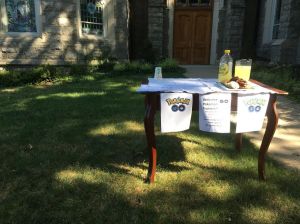
Sure enough, PUMC is a Poke’stop where gamers fuel up on the Poke’ balls used to trap characters. Two other Poke’stops are nearby. So, egged on by millennials — staffers and church members — we set up a lemonade and cookie stand in front of the church and
Lemonade and Poke’mon Balls at Princeton United Methodist Church
spread “lure” a virtual enticement that attracts Poke’mon characters and, therefore, Poke’mon players. The combo of the lemonade and the “lure” attracted at least 100 people in one hour. — some for the game, some for the refreshments, many just curious to see our beautiful stained glass windows or even just recharge their phones.
Now I am hooked on the game. Part of its appeal is, frankly, to combat ageism prejudice. “YOU, playing THAT!” is what I often hear. The game is invaluable as a conversation topic with grandchildren. But mostly it’s fun to acquire cute animal characters. On that first Sunday morning, my first catch was Electabuzz, and my current count is 26 characters. Does anyone know where I can find a Wigglytuff?
Rev. Dr. DeForest “Buster” Soaries at Princeton Regional Chamber, photo by Victoria Hurley-Schubert of Creative Marketing Alliance @CMA @dbSoaries @princetonregion
Engaging and inspiring, Rev. Dr. “Buster” Soaries simultaneously aggrandized his Princeton chamber listeners and challenged them. The pastor of the 2,000-seat First Baptist Church of Lincoln Gardens dealt with the latest Trumpisms right away. “This country has survived even more turbulent times,” he reassured. “Our strength is not only in the election of candidates, but also in our infrastructure of voluntary associations to preserve the integrity of our society — people who recognize others’ talents and are willing to share their resources, to invest in who we have been and who we will become.”
Partnerships are key, he said, referring to podium banners touting the chamber’s gold, silver, and bronze sponsors. “To be who we are called to be in history, we have to prove that the freedoms we enjoy work for everybody. To say ‘what’s mine is yours if you need it.’ By giving to others, we can be who we say we are.“
To combat “a Bermuda triangle of deprivation” three decades ago, he partnered with, for instance, United Jersey Bank’s Joe Semrod to transform the “worst public housing I have ever seen in my life” into what now looks like private condos. But he might also partner with current and former gang leaders to muster support for community change.
Three requirements for successful partnerships:
Partnerships must be relational not just transactional. It’s not just writing checks. Without spending extra money, a hospital can move its health screening facilities to a needy community. Police offers can visit schools. People can tutor other people’s children.
Partnerships must be horizontal. Those with money should trust the knowledge and talent that are in the community. For instance, a Thanksgiving turkey giveaway went awry because the people standing in line were just reselling the food. The ‘respectable’ church ladies needed to consult with those less ‘respectable’ to get their charity to the right people.
Partnerships must be sustainable, not seasonal. “As political seasons change, there go our projects. The government can fix a street but it can’t fix a broken heart. We are nurtured by the neighborhood we build. We need to focus on what it takes to build each other up.”
Helping people to live within their means is an important part of ministry, says Soaries, who believes that churches should teach people how to budget. He learned the hard way. As a young man he was a big spender, buying a Cadillac because he assumed preachers drove expensive cars and spending for expensive clothes. “I had more money on my back then I had in my bank account.”
Don’t blame government for the legacy of poverty, he says. “We could raise the minimum wage to $200 an hour and some people will still be broke.” Instead, switch from premium cable to basic cable and use the extra $75 for a life insurance policy. “Then you will close the gap for your children.”
Ken Kamen of Mercadian asked how to help people change their spending ways. “We live in a culture of entitlement that thinks fantasy and reality are twins,” Soaries said. In the first three chapters of his book, Breaking Free from Financial Slavery, “I trick people into confessing that they have a problem.”
Phil Slater of Omega Financial Services , a new chamber member at the Carnegie Center, revealed his company might be hiring loan processors.
Chip Jerry, Audrey Yeager and James O’Neill (Sam’s Club)
And I was delighted to introduce Audrey Yeager, new on the staff of the Princeton Symphony, to Chip Jerry, brother of the late Philip Jerry, — a Joffrey Ballet star who spent part of his career at American Repertory Ballet/Princeton Ballet School — where Audrey studied when as a student at Rider. It was a serendipitous way to welcome her to Princeton’s business community.






 Princeton Comment