Category Archives: Around Town

Personal posts — some social justice (Not in Our Town), some faith-related (Princeton United Methodist Church), some I-can’t-keep-from-writing-this

“By giving to others, we can be who we say we are”

soaries better
Rev. Dr. DeForest “Buster” Soaries  at Princeton Regional Chamber,  photo by Victoria Hurley-Schubert  of Creative Marketing Alliance @CMA @dbSoaries @princetonregion
Engaging and inspiring, Rev. Dr. “Buster” Soaries simultaneously aggrandized his Princeton chamber listeners and challenged them.  The pastor of the 2,000-seat First Baptist Church of Lincoln Gardens dealt with the latest Trumpisms right away. “This country has survived even more turbulent times,” he reassured. “Our strength is not only in the election of candidates, but also in our infrastructure of voluntary associations to preserve the integrity of our society — people who recognize others’ talents and are willing to share their resources, to invest in who we have been and who we will become.”
Partnerships are key, he said, referring to podium banners touting the chamber’s gold, silver, and bronze sponsors. “To be who we are called to be in history, we have to prove that the freedoms we enjoy work for everybody. To say ‘what’s mine is yours if you need it.’ By giving to others, we can be who we say we are.“

To combat  “a Bermuda triangle of deprivation” three decades ago, he partnered with, for instance, United Jersey Bank’s Joe Semrod to transform the “worst public housing I have ever seen in my life” into what now looks like private condos. But he might also partner with current and former gang leaders to muster support for community change.

Three requirements for successful partnerships:

  1. Partnerships must be relational not just transactional. It’s not just writing checks. Without spending extra money, a hospital can move its health screening facilities to a needy community. Police offers can visit schools. People can tutor other people’s children.
  2. Partnerships must be horizontal. Those with money should trust the knowledge and talent that are in the community. For instance, a Thanksgiving turkey giveaway went awry because the people standing in line were just reselling the food. The ‘respectable’ church ladies needed to consult with those less ‘respectable’ to get their charity to the right people.
  3. Partnerships must be sustainable, not seasonal. “As political seasons change, there go our projects. The government can fix a street but it can’t fix a broken heart. We are nurtured by the neighborhood we build. We need to focus on what it takes to build each other up.”

Helping people to live within their means is an important part of ministry, says Soaries, who believes that churches should teach people how to budget. He learned the hard way. As a young man he was a big spender, buying a Cadillac because he assumed preachers drove expensive cars and spending for expensive clothes. “I had more money on my back then I had in my bank account.”

Don’t blame government for the legacy of poverty, he says. “We could raise the minimum wage to $200 an hour and some people will still be broke.” Instead, switch from premium cable to basic cable and use the extra $75 for a life insurance policy. “Then you will close the gap for your children.”

Ken Kamen of Mercadian asked how to help people change their spending ways. “We live in a culture of entitlement that thinks fantasy and reality are twins,” Soaries said. In the first three chapters of his book, Breaking Free from Financial Slavery, “I trick people into confessing that they have a problem.”

At my table, eager to hear Soaries tell about partnerships, were life coach Tamarra Causley Robinson, Victoria Hurley-Schubert of CMA (thanks for the photo, Vikki), and LaToya Norman, of the Susan G. Komen CSNJ staff. Also at the lunch were members of my faith community, Princeton United Methodist Church,  Iona Harding and Ida Cahill.

Among those accompanying Soaries was the former Princeton University communications director, Lauren Robinson Brown, now known as Lauren Ugorji, who has just launched her practice, Smooth Stone Consulting.

Phil Slater of Omega Financial Services , a new chamber member at the Carnegie Center, revealed his company might be hiring loan processors.

jerry yeager oneill
Chip Jerry, Audrey Yeager and James O’Neill (Sam’s Club)

And I was delighted to introduce Audrey Yeager, new on the staff of the Princeton Symphony, to Chip Jerry, brother of the late Philip Jerry, —  a Joffrey Ballet star who spent part of his career at American Repertory Ballet/Princeton Ballet School — where Audrey studied when as a student at Rider. It was a serendipitous way to welcome her to Princeton’s business community.


Startups in the Nation’s Service

demo day

A quick way to cure a hangover, a new medical imaging technique, an innovation in American Sign Language, a hackathon tool kit, a robot sous chef, and a fashion discovery engine  — some of the best and brightest Princeton undergraduates are launching exciting startups. List here.

They’ve been working all summer in the Keller Lab, and their Demo Day in Princeton is Tuesday, August 9, 2:30 p.m. at the Friend Center. You need to register!

I can’t attend. If anyone who reads this can go, and wants to write it up for this blog, I’d welcome that. If you don’t have my email, put in the comments that you’d be willing to be a guest blogger.


Reverberations in speech and print

In his U.S. 1 Newspaper column this week, Richard K. Rein reprises his chamber speech and referred to this blog’s report on his speech.

So if you missed the chamber event, this column gives you a taste of how he used silence.

Here’s how he ended the column, but you have to read the whole thing to ‘get it.’

The lessons of an oral presentation linger after the applause and post-presentation chit chat has ended. Hopefully a printed piece will reverberate for a few moments, as well:


If I’m lucky maybe even for four seconds.


Join the Maker Movement

Today is Maker’s Day in Trenton. A couple of weeks ago my daughter hosted Maker’s Day at Health and Human Services in Washington. “Innovation is a force for good” and “Creative thinking is a muscle we must exercise” are some of my favorite quotes.

The future of our society may be in creating change at scale across government and industry.

In Trenton, the future starts at Roebline Wire Works, noon to four.

Princeton Community Event: Humanizing Our Responses to the Recent National Tragedies

Mayor of Princeton Liz Lempert, Police Chief Nicholas Sutter, Rabbi Adam Feldman of the Jewish Center, and Rev. Matthew Ristuccia of Stone Hill Church invite the entire community to join them in an important event in response to the recent police shootings of African-American men and the sniper attacks on police in Dallas.On Wednesday, July 27, 2016 at 7:00pm, in the John Witherspoon Middle School auditorium, 217 Walnut Lane, Princeton, NJ 08540, members of the Princeton community will be gathering together to process our reactions to the deep fissures exposed by these national tragedies. The bulk of the evening will be devoted to hearing from a representative of the African-American community as well as a representative of the law enforcement community, giving them the opportunity to share their personal perspectives. In listening to these stories, we as a community will be challenged to examine our own narratives, and to put a human face on the statistics and headlines that have confronted us in recent weeks. Such a challenge is a vital first step in building bridges and taking positive steps toward real reconciliation and growth in our community and our nation.Join us for this evening of grieving together as we acknowledge the pain and fear engendered by these events, and as we strive for hope and forward movement as a community.

Source: Princeton Community Event: Humanizing Our Responses to the Recent National Tragedies

‘Dust does not discriminate’

A shout out to Telequest who produced this great video for Isles on how to fight dust with effective house cleaning methods. Watch it if you need motivation to use a vacuum cleaner more often. I just found the video and like the tip about getting an extra damp mop bucket instead of using the kitchen sink.

Silence and Scooplets: Eileen and Barbara

HERE’S A DUAL POST — FROM ME AND GUEST WRITER EILEEN  N. SINETT.  EILEEN GOES FIRST...

“Stories Still Matter: In Print and Online” was the theme of the Princeton Chamber’s Business before Business breakfast networking meeting this morning.  Richard K. Rein, founding editor of  U.S. 1 Newspaper, shared stories that only dig-deeper news people would know. His speech was informative, entertaining and well-delivered.

As a Speech Coach, I was especially taken by his smart opening which was void of verbiage.  Yes, Rein opened with silence, four seconds worth (as the audience later learned).  He created the “verbal white space”™  that level-sets audience attention and highlights opening remarks.  Silence is often scary for societies that talk a lot.I noticed one or two people in the audience getting antsy after 2 seconds of quiet, but saw the other 90 people in the audience palpably poised to listen and patiently await the stories that would soon unfold.

Starting a speech with silence makes perfect sense.  It can feel risky and uncomfortable at first, but the positive impact is quite rewarding. Silence is to speech, what margins are to writing.  The ability to be present without words in speaking and in life, can be a strong differentiator.

eileen and rich
Eileen Sinett  with Rich Rein

Rein pointed out that his four seconds of silence equals the four seconds needed to read a Tweet of optimal length, 100 characters. Other statistics show that our focused attention is just 8 seconds, one second less than that of a goldfish. We want instant gratification and can google just about anything and be instantly satisfied.  

In this digital age, we have become great multi-taskers and short-cut communicators.

However, I’m not sure that these gains offset our low tolerance for silence or our reduced listening attention.

— Eileen N. Sinett, Speaking that Connects

Narratives can change opinions, said Rein, citing the late John Henderson (a former reporter who built his real estate business on the lyrical descriptions of his listings) and Jerry Fennelly, who issues real estate analytics in story form. Long form narratives can also clarify the thinking of the writer (as well as the of the reader) and help establish credibility for both writer and subject.

me rich michele
Barbara Fox with Richard K. Rein and freelancer Michele Alperin

Then it was story time:  Rein told of almost-missed stories about Colin Carpi, lawyer Bruce Afran,  and Muhammed Ali (as written by himself and fellow Princetonian sports writer Frank Deford) and he related a bit of gossip about Larry L. King. (Based on observing Ted Kennedy at a party, King vowed to do everything he could to keep that Kennedy from being president.)

In a lively Q&A Irv Urken asked about the value of print in a digital world: Brandishing the articles he used in his speech, he said, “you don’t have to worry about your batteries going down.” He also cited “the science of touch” and suggested that some presentations and pictures “require a bigger screen.” That print media has a limited space means that somebody must edit it to fit the space, and when editors get to do more than just run a spell check, readers read more carefully. Then Rein gave a shout out to Urken’s offspring who have media careers — one works for Newsweek and Street, the other for Yahoo.

vickie
Hurley-Schubert

Former reporter Vickie Hurley-Schubert (now with Creative Marketing Alliance) asked which was his favorite story. Hard to pick, but Rein cited one early in his career, for New Jersey Monthly, on the scandal surrounding Circle of Friends.

I liked his answer about whether the media has a liberal bias: “When you spend time with people, you begin to assimilate their values. Media does have an ego, but it also bends over backwards to present other points of view.”

So — down with ‘scooplets,’ which, as Rein explained, are what Jill Abramson calls the focus on quick content that spawned $1.9 billion in free publicity to the Trump campaign.

Up with narrative journalism. Long live the long form stories in the likes of U.S. 1 and Princeton Echo.

But I still get good info from Twitter.

— Barbara Fox 


Tuesday and Wednesday

madnessRich Rein (Princeton, Class of ’69) will speak at the Princeton chamber breakfast on Wednesday. I’m looking forward to my former boss telling stories old and new. And I also like the tradition, at the breakfasts, that everyone gets to stand up and introduce themselves. Perhaps I’ll see you there?
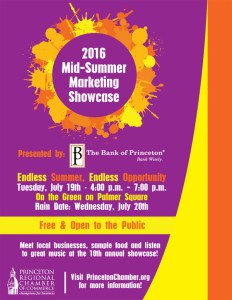
The day before (Tuesday) is the chamber’s  Midsummer Marketing Showcase  starting at 4 p.m. In past year’s it’s been plagued with weather cancellations, but predictions are good for tomorrow. And it’s one of my favorite Princeton Regional Chamber events, in part because it’s free.


Frances S. Meginnis, age 95

frances bill

A beloved high school English teacher, Frances Shores Meginnis, died at the age of 95. She gave me some low grades in English composition, which let me know, appropriately, that I wasn’t as smart as I thought I was. As one student recalled, “You quickly realized she was asking you to be better than you were, and there were lots of challenges.”

Her obituary was featured in the Baltimore Sun (among the few remaining newspapers that honors the art of good obituaries).

There’s more to her story, regarding the Fox family. But for now, here is the account of her amazing life. 


Car jockeys come to town


0
Jackson Bush (left) and Cris Hrabar ‘at the ready’ for Open Door Valet

Two problems solved with one pop-up business — where can townies can park at the eatery nexus near Hoagie Haven, and where can tourists can park downtown?. Douglas English founded the Philadelphia-based Open Door Valet in 20o9 and Chris Hrabar (above right) joined him a year later. His car parkers serve such restaurants as the Peacock Inn and Eno Terra and he opened this freestanding location of Open Door Valet in mid June.

Park your car yourself across from the Ivy Inn (the parking lot behind 245 Nassau Street) and pay $5. (What? no more snitching a parking place to pick up a Number One?) Valet park at Hinds Plaza and it costs you $15, $10 on a slow night like July 2 when two stones-throw-away garages had lots of space.

Even better deal: Park it yourself, go pub hopping or people watching, and “text-2-retrieve,” they will pick you up wherever you happen to be. Tips? (“They usually give us a $20 bill and say keep the change.”

A townie inside tip: Ivy Inn couldn’t get permission to expand because it didn’t have enough parking. Will paid parking get the town fathers/mothers to reconsider?

Valet services: definitely not for townies. We parked behind 185 Nassau (free on weekends). And we walked.