Category Archives: Around Town

Personal posts — some social justice (Not in Our Town), some faith-related (Princeton United Methodist Church), some I-can’t-keep-from-writing-this

Yellow journalism for a “Yankee Drummer?”

19th century journalists could be as nasty as today’s radio talk show hosts.

I was curious to learn more about a lovely room at my church (Princeton United Methodist). We are renovating the ground floor of our century-old building, and the Sanford Davis room — which opens onto Nassau Street and onto the sanctuary — is getting lots of use.

I found a fascinating and laudatory account of Charles H. Sanford in a book on PUMC’s history by the late Ruth Woodward. And because a tribute book to Sanford was auctioned last June, additional material has surfaced. A unsigned New Zealand newspaper article castigated his business practices in Brazil and excoriated him as a “Yankee drummer” (salesperson) “for the sale of pills and toilet preprations.” Here is my post with links to the New Zealand article. Fair and balanced? You decide.

Connie Campbell, Pillar of Witherspoon Community

Len Newton called to tell me about the funeral for Connie Campbell, an active member of Witherspoon Presbyterian Church who died at age 84 on August 23. She typified the leaders of the black community, says Newton, lauding her career. He cites her obituary in Town Topics. She was a buyer at Claytons, a department store on Palmer Square, at a time when it was difficult for African Americans to get anything but a government job. 

Newton, who is white, has long been a champion of interacial communities. He was among those who founded the group of homes on Dempsey Avenue, built to be an interracial and affordable community, and he joined Witherspoon Presbyterian Church which, in 1952, was mostly black. “When I came from Philadelphia to work at Opinion Research, I went at least once to every church in town. The choir director at Witherspoon recruited me because they needed a tenor.”

Fewer and fewer people remember how it was in Princeton in the ’50s, Newton says. In the late 1930s, AFrican Americans were pushed out of what is now Palmer Square to make room for the town center. Schools were segregated until 1948.

“The African-American community was invisible to the white community at that time. But people knew each other. If went to a party on the West Side, I would find Connie and her husband, Floyd, serving the food.”

Newton celebrates all she did, including being an ordained deacon and elder of Witherspoon Street Presbyterian Church; member of the original Verse Speaking Choir; board member at Princeton Nursery School, Princeton Arts Council, and Princeton Senior Resource Center, and serving as a volunteer at Princeton Hospital.

The funeral service will be held at 2 p.m. on Saturday, August 31, 2013 at Witherspoon Street Presbyterian Church, 124 Witherspoon Street, Princeton. Calling hours will be from 1 p.m. until time of service at the church. Interment will be held at the Princeton Cemetery.

Calling hours will be from 6-8 p.m., Friday, August 30, 2013, at Witherspoon Street Presbyterian Church. Organizational service will be conducted at 7:30 p.m. at the church.

Beginning a Beautiful Friendship

This post, by Jeanette Timmons, is on the blog at http://www.princetonumc.org. She wrote it for the newsletter of the Jewish Center of Princeton, honoring the cooperation and support between the congregations:
The Jewish Center has offered support to the Cornerstone Community Kitchen, an outreach program that feeds Princeton area residents a hot dinner every Wednesday evening at the Princeton United Methodist Church. PUMC congregant Larry Apperson conceived and implemented the program in June 2012, which serves 60 meals each week. Currently, TASK delivers the main course and CCK volunteers prepare side dishes and serve the meal in a restaurant-style environment.

TJC congregants Jeanette and Forrest Timmons began volunteering at CCK in August 2012 as part of Forrest’s Hesed project. Jeanette enjoyed the experience so much, she has volunteered weekly ever since. Other TJC families, including the Glassers and Zinders, have since volunteered too.

In August 2013, PUMC began a renovation of its kitchen so that the CCK can prepare its entire weekly meal on-site. TJC offered the use of its dairy kitchen so that CCK could continue its food preparation uninterrupted during the nine-month-long project. While forging this relationship, PUMC donated its 10-burner Vulcan stove with double oven to TJC. This timely act of generosity came just as the oven in TJC’s meat kitchen broke down.

Both guests and volunteers come to CCK’s Wednesday dinners for a variety of reasons, be it need-based, for companionship, or the feeling of camaraderie that pervades the environment. Friendships have formed as many volunteers and guests are regulars. “The greatest unexpected pleasure that’s come from our service has been the coming together of people from throughout the community to serve,” says Apperson. Guests sit at tables decorated with centerpieces, are served by volunteers, and are entertained by a pianist. The relaxed atmosphere invites lively conversation. Besides the dinner meal, bagels, sandwiches, children’s breakfast bags and gently used clothing are available for guests to take home.

The CCK is truly an interfaith, community-wide effort. Besides congregants from TJC and PUMC, CCK has welcomed volunteers and support from Beth Chaim, St. Paul’s, and Queenship of Mary Roman Catholic churches, Quaker Friends, Princeton University, local Girl Scout troops, and the Princeton Historical Society. Local businesses such as Panera and the Bagel Hole regularly donate baked goods, and Zorba’s Brother and the Rocky Hill Tavern have provided an entire meal. For more information about CCK or to get involved, please email cck@princetonumc.org.

Jeanette Timmons

Ticker Tape for Rocky Hill’s Bernanke?

The New York Times ran a huge article about Ben Bernanke today. Let us not forget that he is a resident of Rocky Hill. (As the Times pointed out, he served on the Montgomery school board.)

Do we welcome him back in January with the equivalent of a ticker tape parade? And, if so, what would be the Princeton equivalent?

Cub Reporter Interview: Julie Harris

julie harris

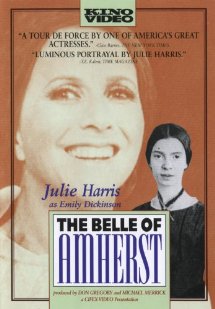
Julie Harris died. What an actress. My interview with her, when she portrayed Emily Dickinson in Belle of Amherst, was an early lesson in the freelance journalism business. Besotted with Emily Dickinson, I saw her in that one-woman play in Philadelphia and went backstage with my daughter, age 13. Harris agreed to speak to me by telephone at her next stop, St. Louis.

Harris had just made a movie, The Hiding Place, based on the true story about Corrie Ten Boom, the Dutch Christian who survived a Nazi concentration camp and managed to forgive her captors.
corrie ten boom
That book made a deep impression on me (it fueled my desire to memorize Bible verses in case I was ever trapped without a book, either incarcerated or lost in the woods or whatever).

So I assumed Harris was a Christian. I sold a story on her to a national Christian magazine, and then set about to track her down — because somehow she had failed to tell me how to reach her. Publicity agents were not helpful to a newbie writer, but I knew she was in St. Louis, so I methodically called all the hotels in St. Louis until, bingo, I found her and we talked for about 15 minutes.

Then the story fell apart. Julie Harris was a very spiritual person, but she avowed that the deities that she valued most highly were, in this order, Gandhi, Mother Theresa, and Christ. Maybe the first two were reversed.

That wasn’t sufficient for the Christian magazine. I don’t think I ever managed to sell the story to any publication, but I did get to talk to the actress I adored. The Hiding Place seems to have passed into oblivion; it was not even mentioned in the New York Times article. RIP, Corrie Ten Boom and Julie Harris.

Ralph Schlegel: Retrospective

Ralph chair 2

A visual thinker I’m not, so I am always amazed by how an illustration can indeed be worth a thousand words. For years I looked forward to the editorial cartoons by Ralph Schlegel in the Sunday edition of the Times of Trenton. I freelanced there in the early ’80s and his wife Sharon, Times columnist, is a dear friend.

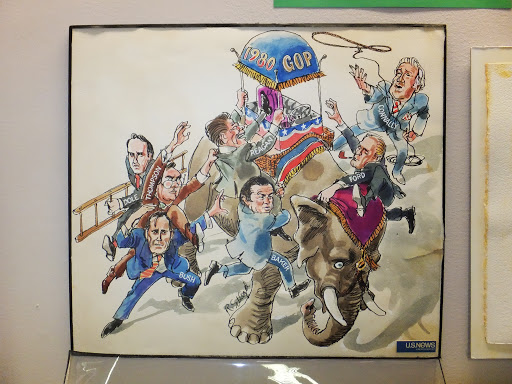
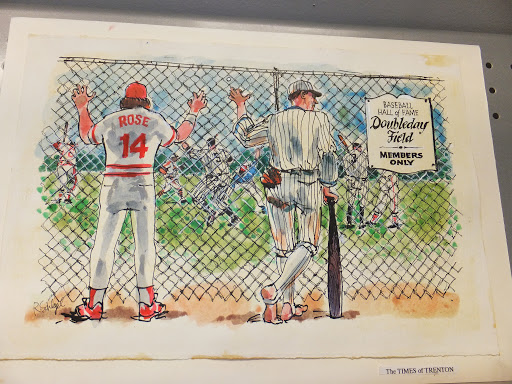
Now that he is retired, I have to stifle the impulse to look at that page first, because I will miss the visceral energy of his caricatures, his sly wit, and his finely tuned jabs — some gentle, some acerbic — at the folks who run our city and state. As U.S. 1’s Dan Aubrey wrote, these images “scream of recurring political shenanigans and the constant need for a free press to keep an open eye.”

draw usnews gop<

Through August, Lawrence Library has an exhibit of Schlegel’s work, not just his editorial cartoons for the Trenton newspaper, but also his freelance work for such publications as the New York Times, Business Week, and U.S. News & World Report. Go for a good chuckle, or for nostalgia, but you will also come away with a new appreciation for how an illustration can get closer to the real truth than words can.

draw Rose<

Architects Celebrate

mercer architecture

Meet  Mercer County architects today at an all-day symposium at Lawrenceville School. that celebrates the county’s 175th birthday. Bob Hillier and Michael Graves are on the speakers list, along with Phillip Hayden and Michael Mills. It’s at TCNJ, details here. Though it costs $20, most of that cost is for lunch, so I bet you could get into the afternoon session easily by just showing up. This weekend, historic houses will have special opening hours.

Sorry for the late post —

and here is a way-in-advance notice for the county’s celebration of technology. Mark your calendar for Friday, October 4, at College of New Jersey.

Rejected by the IAS: Sociology of Religion

I’m a big fan of the Institute for Advanced Study — funded by department store moguls, home of Albert Einstein, headed now by a Dutchman of formidable talent.

But it made my blood boil to read the obituary written by Margalit Fox (no relation) of Robert Bellah, “Sociologist of Religion Who Mapped the American Soul,” in the New York Times today.

When the IAS named him to a professorship, according to the obit, “many of the institute’s faculty — whose members were overwhelmingly scientist and mathematicians — called his scholarly credentials into question.” Sociologists, I would suggest, have traditionally been the Cinderellas of the sciences. Further, according to his colleagues, “in the ardently secular canon of the hard sciences, religion was deemed an insufficiently rigorous subject for scholarly scrutiny.”

Amid the hullabaloo, Bellah rejected the appointment and remained at Berkeley.

Let’s be fair, that was 1973 and this is 30 years later. Few of those voting faculty members are still there, and times have changed. But we in Princeton missed having, in our midst, the author of The Broken Covenant: American Civil Religion in the Time of Trial (1975), Habits of the Heart: Individualism and Commitment in American life” (1985) and Religion in Human Evolution: From the Paleolithic to the Axial Age” (2011).

He was called “the greatest living sociologist of religion.” Had he been at IAS, I would have found out about him before. But I’m glad to know now.

Plucked from Obscurity: Lou Draper at MCCC

draper girl

I may have written the first ever first press release on Louis Draper’s photography at Mercer County Community College. I was working in MCCC’s PR department at the time, 1981 to 1984. Now an article on Draper is among the most emailed stories in the New York Times.

Entitled “Louis Draper: Plucked from Obscurity…” the article credits Mercer County Community College’s Gary Saretzky with jumpstarting the attention to Draper’s photographic eye.

At the time of his death, his extensive collection of photographs, negatives and slides was not an archive in any meaningful sense. It was an unorganized mass of material that nearly overwhelmed his office at Mercer County Community College, where he had led the photography program. The task of bringing order to chaos fell to his friend Gary Saretzky, an archivist and photographer, with the assistance of John Sunkiskis, a colleague at the college.

He taught at MCCC for 20 years. We at the college knew we had a treasure. So did his students. He told me then that “The Family of Man” was his inspiration and the photographs in the forthcoming book will be show that.

Photo by Louis Draper, date not known

Billionaire Bezos, now News Mogul, is from Princeton

weymouth2

The National Public Radio Morning Edition story on how the Amazon founder bought the Washington Post, fails to mention that Jeff Bezos is a Princeton alumnus, Class of 1986. He delivered the Class Day address in 2010.

The Washington Post story adds that detail to the Bezos biography. The New York Times sidebar implies it, saying “After Princeton”

Might it seem like a lucky coincidence that the New York Times just happened to print a big piece on the Post editor, Katharine Weymouth, on the day before? The reporter defended it, saying that she had been assigned the story a while ago but “didn’t get around to it” till July.  I believe her. (Memo to self and other reporters: Don’t Drag Your Feet on the Good Story.) But it certainly was nice for Weymouth to get her spot in the sun before the storm broke.

And in the Snarky Section, that article drew darts for announcing what Weymouth wore to get her photo taken, and that she was able to wear a sleeveless dress thanks to her workout schedule. I say, Good for her! And I would want to know those details.


Photo of Katharine Weymouth by Matt Roth for NYTimes