Category Archives: Uncategorized

Eat. Pray. Floss.

I’ve been getting some good, interesting feedback from the thoughts on turning 70 that I shared in last week’s issue of U.S. 1., which also has dozens of mini-profiles of “elderly” people who are actively contributing to the community.

Some of the feedback is from friends who, like me, fear that their personal roads are paved only with good intentions.

So I was intrigued to pick up WebMD magazine in the Princeton hospital waiting room (only there for tests, no big deal) and find an interview with Elizabeth Gilbert, whose “Eat. Pray. Love.” book is famously being made into a movie starting Julia Roberts as Gilbert.

My marketing friend, Heather Stephan, tells me that the travel world is now offering Eat/Pray/Love tours of Italy and Bali, with one of the tours offering a consultation with a shaman who can remove black magic.

In the WebMD interview with Kim Caviness, Gilbert says that the book “seems to remind people of some divine and glorious aspect of themselves that they had forgotten to take care of as they moved through life….and then…they dare to explore that.”

Here’s the take home: Gilbert says that “when I take care of these things, everything takes care of itself.” Her Top Ten:

take a walk
write something
read something
don’t eat too much
spend some time in silence
stretch
send a message of love to somebody
drink water
mess around in the garden and..
floss

That’s a good list. I had already instituted my own versions of six of them and so I added four more.

An aside: I can’t offer the direct link to this story because the July/August digital edition of Web MD the Magazine is not available yet. It’s a scandal that an organization like WebMD doesn’t have the current edition of its free magazine up yet. Here’s the link in case, by the time you read this, the issue is up.

One more Gilbert tip: “Just because you can do anything doesn’t mean you can do everything.”

Guest Comment: -dick swain-

Since I couldn’t attend the July 16 concert in Palmer Square, I put out a call for guest writers and dance aficionado and musician -dick swain- responded, along with another volunteer I’ve never met. Thank you!

Here is his account.

It turns out that Palmer Square is a dandy place for a dance concert! The space is
wide, the ground is pretty even, the grass is soft, and the trees tower. A very hot night produced a cool evening of dance — a soft breeze helped — back lit as the sun sank behind the Nassau Inn. Lots of folks of all ages were out and about looking for fun, entertainment, dance — and ice cream!

The best thing about the dances was the variety — from classic modern dance to quirky modern dance to jazz dance to salsa. An hour was just about right.

Christine Colosimo (Princeton YWCA) opened with one of her beautiful and mysterious pieces — a huge white cloth-for billowing and with holes for emerging bodies. A variation on “What Happens Next” that she did for Rider in the spring, this dance was considerably more dangerous and frightening and perfect for the outdoor space.

Dawud Jackson’s jazz dance piece was a sexy girls’ contrast to Colosimo’s abstraction.

Then Loretta diBianco Fois lightened things up considerably with one of her “dance-a-logues”- a very clever and funny one in which she explained and showed us what she was THINKING of doing for tonight’s performance. Her talk/dance finished with the Announcement — “Ms. diBianco Fois will not be able to perform tonight” which got a big laugh.

Next up was Marie Alonzo Snyder’s (Princeton Dance and Theater Studio) with a lovely sweet and sad lovers’ duet from her “Songs of Nilad”-and “Homelands” — a “structured improvisation,” site-specific piece of nostalgia in which the dancers drew out audience members for props.

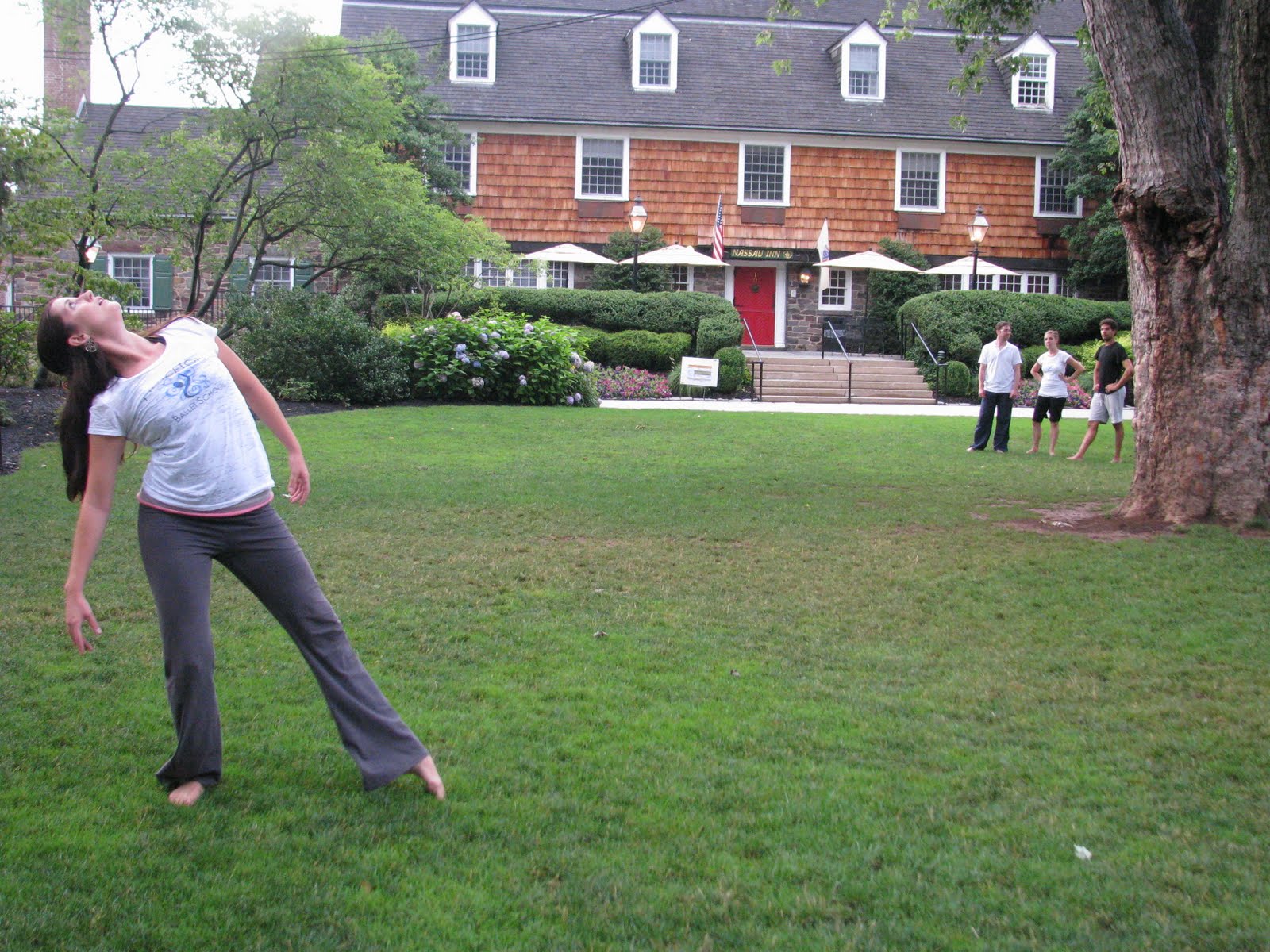
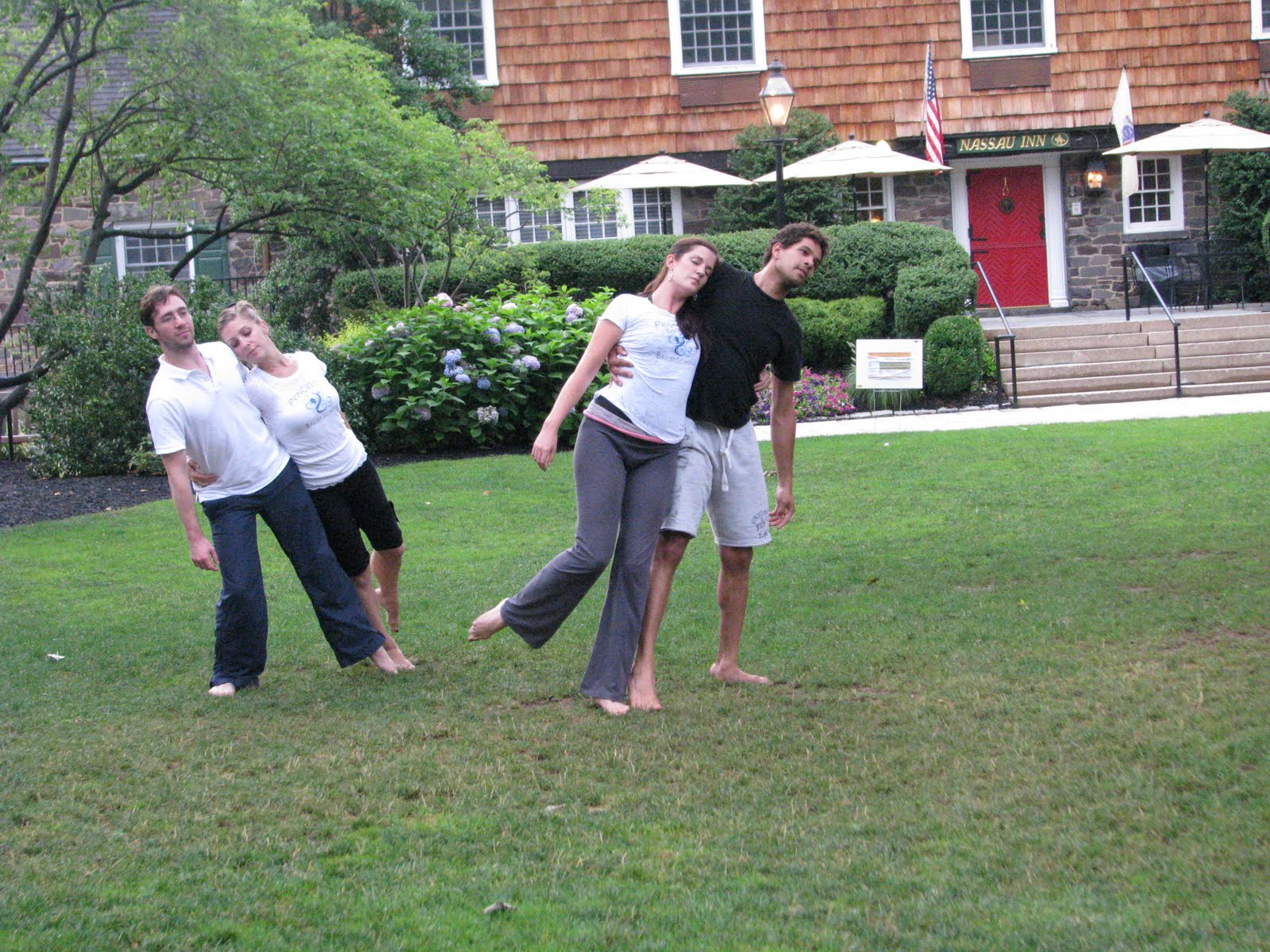
Mary Pat Robertson (Princeton Ballet School) revived for the occasion a piece created years ago for Teamwork Dance — the ‘Crickets” section from “Field and Stream.” Four dancers swayed back and forth and broke apart and came back together in serious slow motion to a tape of — you guessed it. This controlled elegance segued perfectly into a new solo for Katie Scibienski (an extremely beautiful, very long-limbed dancer), by Janell Byrne called “In Liquid” to a tape of — you guessed it. The appropriateness of both dances to the al fresco occasion was wittily clear.

I guess my favorite piece was part two of Susan Tenney’s “Je Me Souviens” (“I Remember..”) – her evening-long-memory-dance-in-progress. Her company dancers were joined by glorious young students from Rome, Italy who are participating in the Princeton Ballet School’s summer program. The charming opening trio for young girls — presumably Susan at different ages — was broken into by an extremely lively “surreal” dance of circus performers (it felt Fellini), high-stepping horses who spread out wide across the lawn. Nostalgic, dreamy, witty — typical Tenney. And it was over.

To finish off this dandy evening of dance, Henri Velandia of HOTSALSAHOT gave a HOT salsa demonstration and lesson to a whole lot of folks, young and not so young, who had been twitching all evening to get up and dance. As the HOT — in the 90’s! — dancers moved forward in a hot salsa line, and s the sun set behind them, the evening ended.

DO IT AGAIN! Make it a regular summer feature on the Square — PLEASE!

by -dick swain-

The photo, taken in rehearsal, is of Katie Scibienski in Byrne’s piece “In Liquid.”

The cast for “je me souviens” includes three original American cast members (Gary Echternacht, 12 yr. old Kylan Hillman, and 8 yrs. old Cynthia Yank) – with 2 new Americans: her 10 year old sister Jacqueline Yank, and Princeton University’s Elizabeth Gunnerson plus six young adult Italian dancers who are dancing with Princeton Ballet’s Summer Intensive program for pre-professionals: Valentina Cassutti, Stefano Rufini, Franco Conquista, Carola Goldoni, Tullio Cata,and Davide Internullo. The cast for “Crickets” included Stephen Campanella, Erika Mero, Cameron Lussier, and Katie Scibienski.

Guest Comment: J.J. Vandiver on Dancers in the Square

I asked for guest comments on a concert that I could not attend, Dance in the Square on Palmer Square, and J.J. Vandiver — whom I do not know — responded, to my delight. Welcome to my blog, Josh, and thank you. Anyone may comment — anonymously if you wish. Above, photos of “Homelands” by Eri Milrod. Below, Vandiver’s account. BFF

Princeton’s Palmer Square at 7 p.m. on a summer Friday night is normally the site only of couples wandering after their dinner or stop by a local dessert parlor. July 16 was rather different. The center of the lawn, in front of the giant evergreen, was roped off and a large crowd gathered at its edges.

The event: Dancers in the Square.

Nine pieces were presented and the event concluded with a salsa mini-lesson by Henri Velandia. This post will focus on three: the first piece by Christine Colosimo, Untitled White, and the two central pieces, Songs of Nilad and Homelands, by Marie Alonzo Snyder. Since I am trained in neither dance nor choreography, these are simply the impressions of an interested observer.

Untitled White: Colosimo’s piece starts with a striking image: a huge white sheet, several dozen square yards, laid flat on the grass. Gaping holes in the sheet, about a foot each in diameter, at intervals allow glimpses through to the green. The eyes of the audience seem to ask: What will this thing be used for, or is it perhaps the stage? Five women, dressed in white, move to stand at the edges of the piece. One lifts a corner high over her head and brings it down forcefully, her back and legs striating with effort. Air is now trapped under the sheet, a billow which rushes to the other side to escape. As it does, it brushes the faces of children sitting at the front.

All the dancers now lift the piece. A wailing horn, peaceful, vaguely native American, plays over the loudspeaker. The women suddenly dive underneath the massive sheet and disappear from view.

Movement occurs beneath the white cloth. It billows now with bodies rather than air.
Body parts, ‘gnarled hands’ as one observer put it, begin sticking out of the holes in the sheet. The rest of each body, still masked by the sheet, moves in unidentifiable ways. Elbows, shoulders, and then heads, work their way out of each hole. Torsos emerge. Each dancer works her way through a hole until each hole is fitted around a dancer’s waist. The sheet seems to have become a massive dress, linking in a single gown multiple ‘brides’. Not all white dresses are bridal dresses, however, and in this case there seems to be no groom(s).

What links these dancers? What does the sheet represent? Soon the dancers have wormed their way entirely through each hole. They are back on top of the sheet, which now is manipulated in various ways. They begin to drag the sheet off the green even as one dancer remains lying on top of it.

Silence. The dancers return to the green and reassemble, the sheet in a circle 10 feet in diameter, the women lying underneath it with their heads revealed. Drums, rapid, threatening. Periodically, a dancer bolts upright into a sitting position and twists her torso to face outside the circle in alarm, like frightened deer taking turns searching for a predator.

They are back on their feet. The sheet is pulled along by the dancers across the green. Sometimes the dancers wrap the sheet around themselves, seeming to take refuge in it. As they pull, the dancers seem to be struggling with each other. Or are they struggling with something unseen, offstage, to which the sheet is linked. Fear is again on their faces. Are they afraid of each other? Or of something we do not see?

The dancers spring about the green in alarm. The drums grow more rapid. The piece ends with the women lined up, standing on the sheet, hands caressing their legs and torsos. There is a final, sharp, burst from the loudspeakers as the drums crescendo: shouting voices, rather tribal-like, of men.

Songs of Nilad: Snyder’s introduces her piece as choreographed to the music of Joseph Cysner, a member
of the Jewish Diaspora in Manila during WWII. The music and the piece are meant to commemorate friendship.

Cysner’s music starts, slow, a piano. Danielle Mondi and Henri Velandia enter the space with Velandia. He takes a long and deep step forward. Mondi comes alongside him. They meet briefly, and for a moment the movement of each is a mirror image of the other. Another long, deep step forward. For another moment, equally brief, they face. Hands raise to touch, only just, the face of the other.

They part, backing away. Mondi arches backward as if in anguish, hands now to her face. She moves to the center of the green, Velandia turning, proceeding slowly to stand to one side. Mondi’s movement, confined to the center of the space, is searching, grasping outward. The movement becomes more hurried. Abruptly, she stops. The piano falls silent. Her hands rise and reach out to touch a face, a face which is there only in being absent. The hands turn inward, moving as if to touch her own face. They do not. They fall in resignation to her side, clenching into fists.

The piano resumes, the movement resumes, equally searching. Mondi ends down on the grass, crawling backward. She stops, begins to stand, and the music changes. The music now is harsh, shrill, unsettling, not piano but new and unguessed instruments. Velandia enters the scene, pausing occasionally. Mondi’s movement, now resumed, is also intermittent. Hands occasionally rise, never as high as the shoulder, reaching out, but never towards the other.

The music becomes melodic again, horn and string. Both begin to dance, their movement more bold, and encompassing more of the space, than before. At times they seem to respond to each other, even synchronizing briefly, but at others they are independent. Finally, Velandia approaches and, tentatively, their movement begins to match, to mirror, and then transitions to partnering. They, and the music, are unhurried, soothed and soothing.

The piece ends with them side-by-side, his arm around her shoulder, hers around his waist, faces facing each other and both taking a long, deep step in unison.

Homelands: Alonzo Snyder’s introduces her second piece as an interactive one meant to elicit audience participation. The audience is invited to join in and imitate the ‘simple movement’ of the dancers, ‘to see the piece from a different vantage point’ with the stipulation that, if they join, they must stick with the piece to the end.

The music throughout is symphonic, with the addition of drums and an occasional, unintelligible, male vocal seemingly of south Asian provenance. The piece begins with five female dancers, of which Alonzo Snyder is one, standing and leaning into one another, their heads and shoulders touching.

When the vocal begins they break out of this formation, forcefully taking several steps outward.

They then freeze with arms outstretched. They hold this for several moments, then reunite in their original formation, now with arms held high. One of the dancers moves as if to break from the formation. The others attempt to hold her back, grasping her trailing leg, six arms acting as restraint. She is pulled back into the fold.
Another seems to try to break free from the formation, only to be held back by her trailing arm. Then all five dancers attempt to free themselves from the others, all linked however at a central point where their five hands meet. One finally breaks free, then the rest.

The dancers move to occupy all the space with bold, outwardly directed movement, unsynchronized.

Suddenly four young women from the audience dart into the space, moving to block four of the dancers. Upon blocking, the young women then stand still, arms raised, treelike, turned now from obstacles into props, structural elements around which the dancers flow.
The four young interlopers move from their frozen position to assemble in a line, linked hand to hand, each with a wide stance, three facing one direction, the fourth facing opposite. The dancers take to this new structural element, which seems to function as a barrier of variable permeability, and interact with it in various ways. Sometimes they probe the spaces between the dancers, briefly and sharply poking an arm through in an exploratory fashion. Sometimes they plunge through the spaces. One wiggles her way backwards, on her backside, through the legs of the barrier.

The barrier seems to be broken, the linking arms fall to the young women’s sides. The original dancers spiral off into their own, independent, movement around the green, taking notice neither of each other nor of the young women, who each simply rotates slowly in place. The original dancers now seem aimless. Or are they triumphant?

***

The task of description is always interpretive. Writing is forced to select among thousands of moments in a piece, each a subtle combination of music, space, comportment, expression and movement, to highlight only a handful. Not even a video, one-dimensional as it is, can capture the experience of viewing a piece in person. And, as Alonzo Snyder’s introduction to Homelands suggests, to experience a piece as a participant qualitatively changes the act of observation yet again.

Ultimately, no one in the audience leapt in to join Homelands. Perhaps more encouragement, or some indication of when they should do so, would be helpful. And one is uncertain of the reference of the title. The music, and the dress of the dancers, suggests south Asia. But why that homeland, if indeed that is the intended reference?

Song of Nilad is a beautiful piece at every level, including the music, and while the relation between the two dancers is sensitive and evocative, heartfelt even, it is utterly free of eroticism.

Colosimo’s piece has the startling effect of staying in the mind long after it is finished. The sheet, as it changes shape and moves around the space, renders the movement of the dancers concrete. To remember what the sheet was doing at a particular moment is to remember what the dancers were doing. Perhaps this is an insight into that most mysterious thing—at least to me—the mind of the choreographer. How does one structure a piece, so complicated when several bodies are put into movement together for several minutes, in the mind? Perhaps, to choreographers, each dancer is linked to the others by a plane which is manipulated in three dimensions, a massive sheet to be lifted,
twisted, pulled and penetrated.

The act of describing a piece to someone else, whether in speech or writing, changes how we relate to it. Just as when we attempt to draw an object that we see, small details emerge, connections become apparent, that a more passive viewing had missed. Only the choreographer knows, however, if those are the most significant details.

Lesson one: next time, go in person to see the performances.

Lesson two: if they let you join in the dance, do it.

By J.J. Vandiver

The cast for “Homelands” and “Untitled White” included Christine Colosimo, Linda Mannheim, Fara Lindsay, Debra Keller, and Marie Alonzo.
What It’s Like to be 70


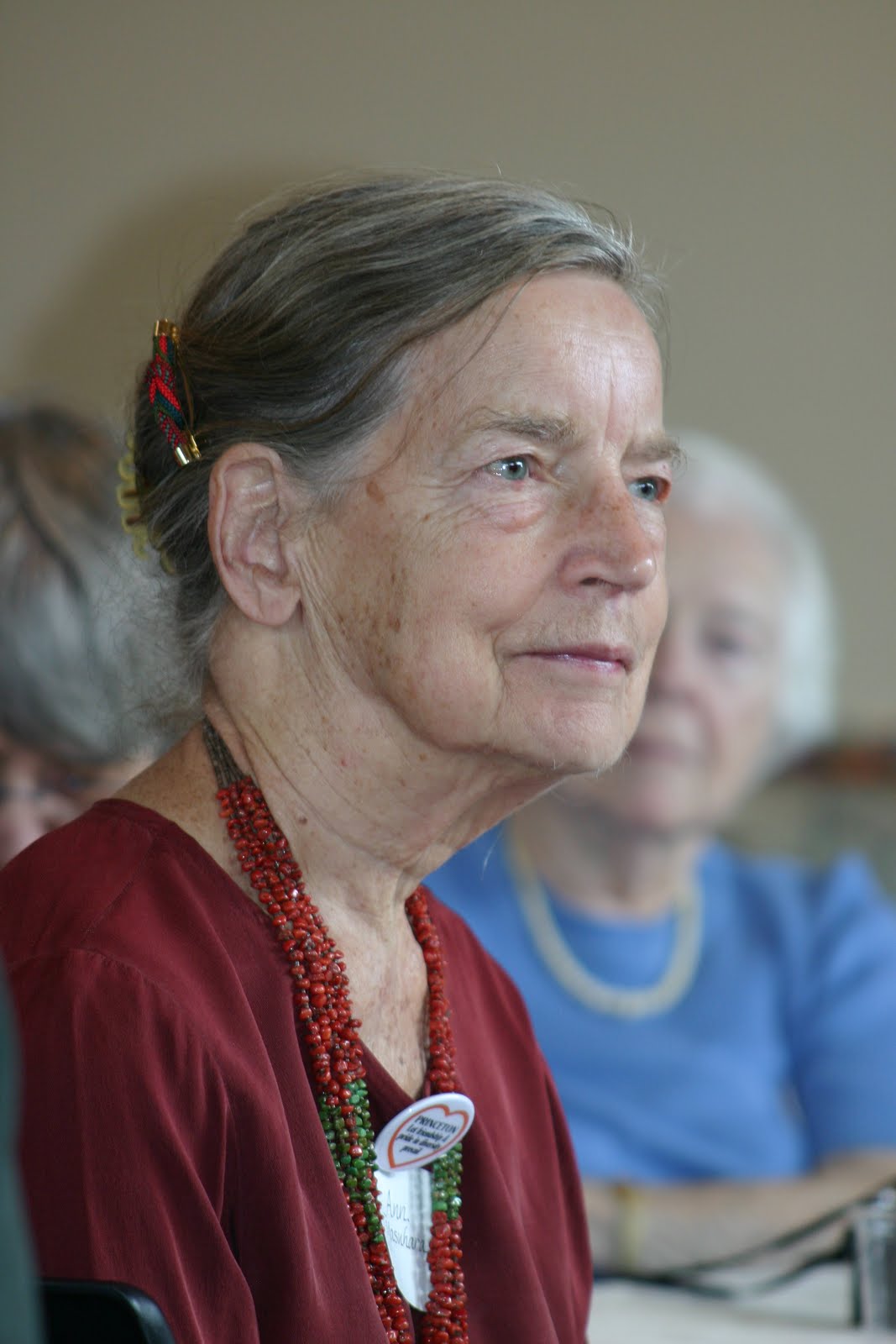
Last month I turned 70 and this month I wrote about it in U.S 1 Newspaper, part of a cover story “Off Their Rockers: Super 70s.” Among the aging luminaries featured: my first cousin once removed, Ann Yasuhara, and I hasten to say I had nothing to do with her inclusion. Her picture was on the cover between Harold Shapiro and John McPhee, not bad company. To read about her, her profile is the last in this file (The photo here, not the one used in the paper, was taken by Roland Glover.)

Ingrid Reed, who has just retired at 70 plus, was featured in this cover story, and I was surprised and pleased that she and I are on the same wave length. “We’ve got to make time for ourselves,” she says. “The structure of my life is our life now.”

To read my riff: click here.

The takeaway: At 70 you face the brick wall. However you want to improve your soul, whatever you hope to pass on to the next generations, whatever good you will do in the world — if you thought you would have time for it later, now is later. You need to start immediately..

Toddler’s Delight: Really Big Machine

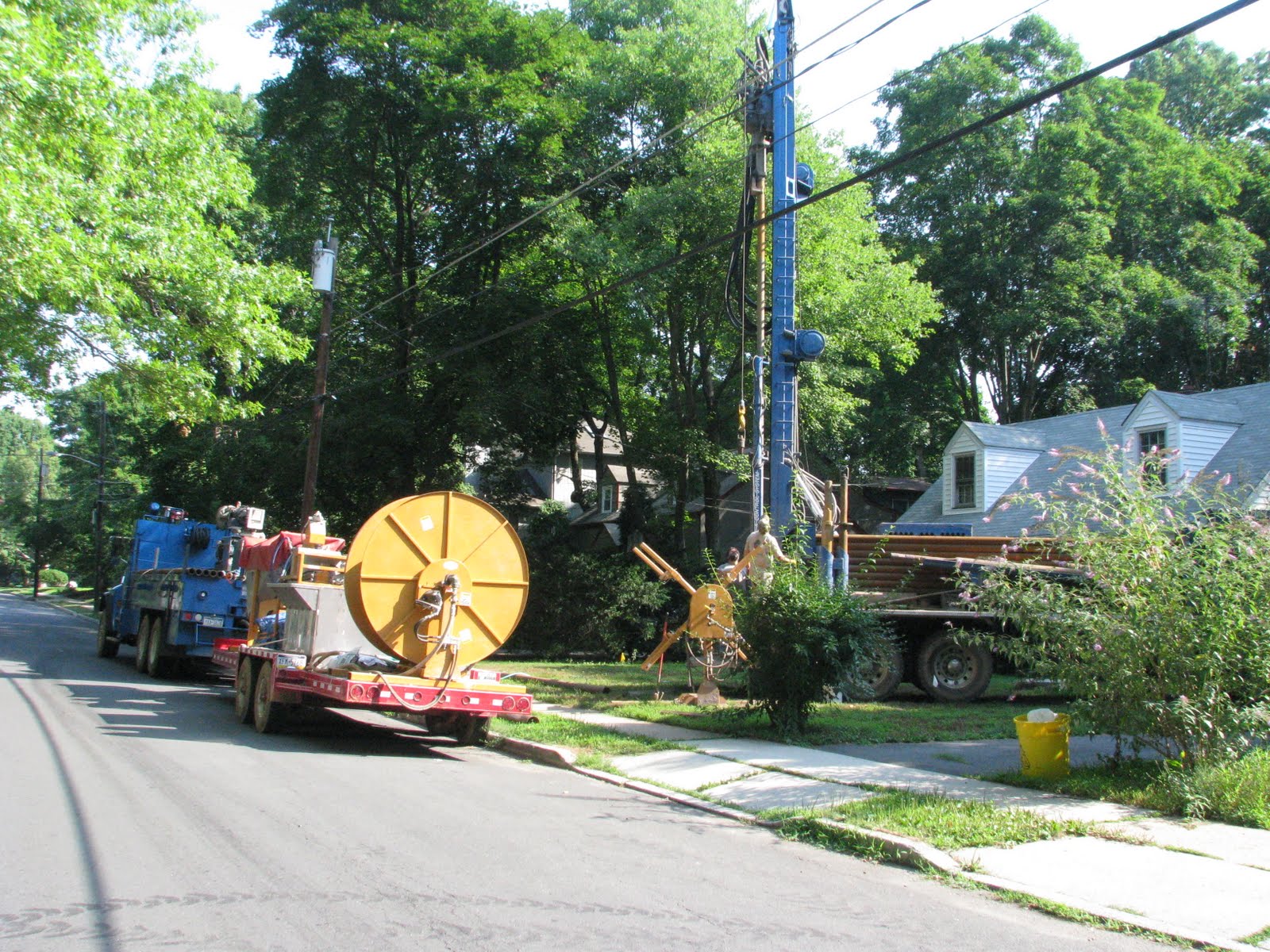
If you are curious about geothermal heating systems — or if you have a toddler who loves construction equipment — stop by Cedar Lane in Princeton today (Monday, July 19) to see a Really Big Machine drill 300 feet down into my front lawn and make a Really Big Mess. Please park far away and don’t get in the way. You’ll hear it from afar.

The rig arrived a day early, before we had a chance to warn our neighbors. I thought briefly about playing a practical joke, telling them that we had struck oil, or that they were mining for natural gas.

But it turns out that’s no joke. Upstate New York residents, where natural gas is indeed being mined, have found that their “windfall” of cash from selling drilling rights resulted in the pollution of their aquifer. Read it here.

Josh Fox (no relation) has made , Gasland, a documentary about it, which is being aired on HBO, likely to be featured at Princeton Public Library’s environmental film festival in January.

The reformers are at work.

Here in our neighborhood the Delaware River Basin Commission promises the drillers to hold hearings on strengthening or weakening its moratorium on natural gas drilling in the river basin. For the AP story click here.

Though I belatedly apologized to my neighbors, one already has geothermal and two more — seeing the process — are interested.

Dancing — and Marketing — on the Grass


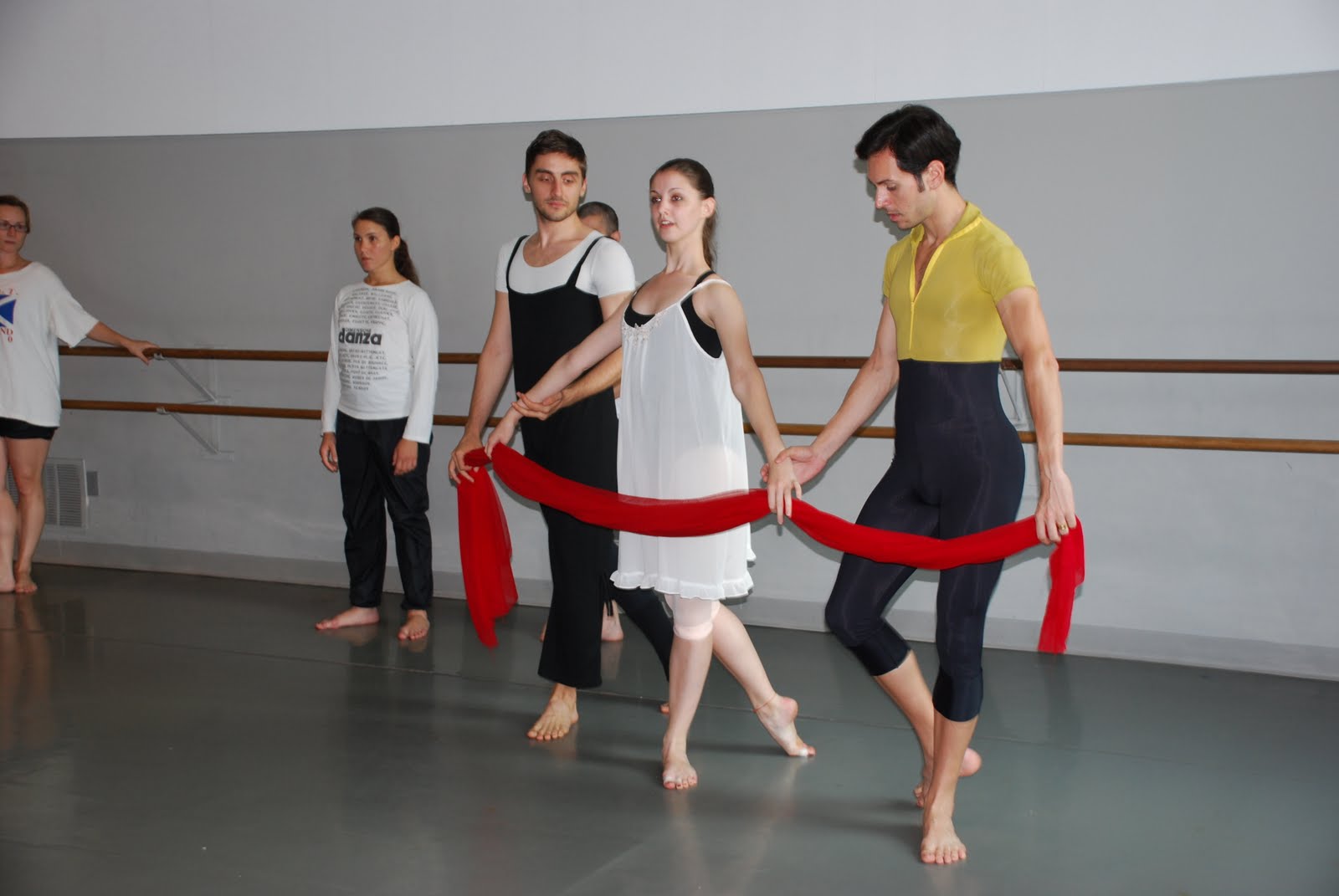
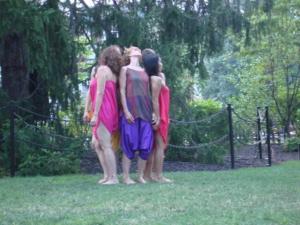
Dancers converge on Palmer Square tonight (Friday, July 16 at 7 p.m.) for a “dancing on the grass” performance, free (bring lawn chairs or blankets). More details later but here’s a preview: I had the chance to watch two dances in rehearsal. Top: a revival of the Crickets section of Mary Pat Robertson’s “Field and Stream” made for her company Teamwork Dance in the ’80s. What fun it is to see, and it’s followed by a solo, choreographed by a former Teamwork Dance member, Janell Byrne, for Katie Scibienski. That’s the Nassau Inn in the background.

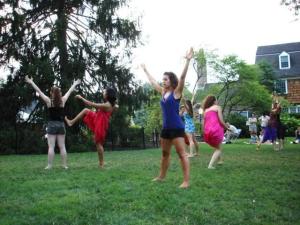
Below, a rehearsal shot of Susan Tenney’s “je me souviens.” The first section premiered earlier this spring and this section features a handful of dancers from Rome, Italy. I will long remember Davido Internullo as a carousel steed; “je me reviens” the carousel in the town square in Florence.

I can’t imagine what the grass will be like. More than 1,200 people were tromping on it the day before for the Princeton Regional Chamber’s Midsummer Marketing Showcase. It was a hot, sunny day and I was there for five hours, helping to staff our church’s table and schmoozing with chamber friends, but I wouldn’t have missed it for anything. Great fun.

A guest reviewer has promised to report on the evening; stay tuned.

The top picture shows Iona Harding and me in the church booth. In the middle snapshot of “Crickets” are, left to right, Stephen Campanella, Erika Mero, Cameron Lussier, and Katie Scibienski. The bottom photo is a rehearsal shot of Tenney’s piece, showing a trio with (left) Davido Internullo, Valentina Cassutti, and Tullio Cata. Other dancers from Rome include Stefano Rufini and Franco Conquista.

Silver Lining in Palmer Square


Every cloud has a silver lining, right? The Midsummer Marketing Showcase, planned by the Princeton Regional Chamber for Tuesday in Palmer Square, was rained out. The good news is that you didn’t miss it — you still have a chance to go! The rain date is Thursday, July 15, 4:30 to 7:30 p.m. There’ll be more than 70 vendor tables, a DJ, and area restaurants will provide free food tastings. The event is free (609-924-1776 or http://www.princetonchamber.org).

Look for Rich Rein at the U.S. 1 Newspaper table and get a coupon for U.S. 1 Business Directory at half price.

And look for me and fellow Methodists at the table sponsored by Princeton United Methodist Church. With the theme “Help Us Help Others” we’re featuring ways to pitch in to help with five charities — Appalachian Service Project, Isles, Trenton Area Soup Kitchen, The Salvation Army, and the United Front Against River Blindness. We’ll even have a wheel game with a chance to win a free T-shirt.

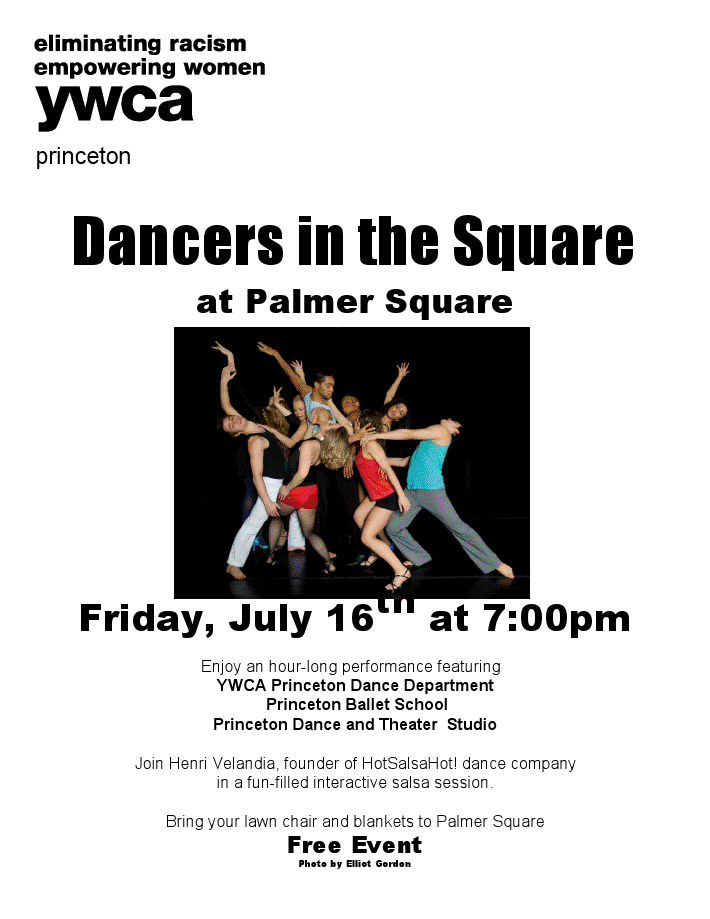
But stop, there’s more. Same location, next night, a different kind of free showcase: “Dancers in the Square” presents professional dancers from the Princeton YWCA, Princeton Ballet School, and the Princeton Dance and Theater Studio. Marie Alonso Snyder will present a site-specific dance, “Homelands.” Among the works in “A Choreographer’s Showcase” will be those by Christine Colosimo, Dawud Jackson, Loretta diBianco Fois, Mary Pat Robertson, Janell Byrne, Susan Tenney, and Henri Velandia (609-921-2333 or visit http://www.palmersquare.com). It’s at 7 p.m., Friday, July 16, and it’s free!

Velandia will teach salsa dancing afterward, Venezuelan style. Cap your evening and start your weekend with salsa! Bring lawn chairs or blankets.

Photo on the flyer by Eliot Gordon.

Event Planners, Take Note

June 27 can be a proud day for the citizens of Princeton. On that day in 1876, the borough, the college (then College of New Jersey, now Princeton University), and state politicos combined forces to celebrate the centennial of Princeton’s role in the American Revolution.

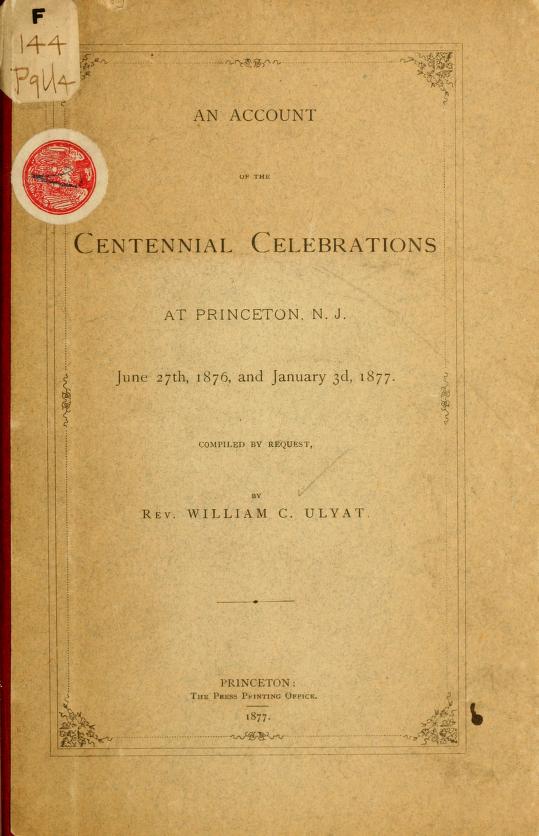
Thanks to the wonders of digital media, we can peruse the archival records: Rev. William C. Ulvay published an account of the celebration on June 27, 1876, and another of the re-enactment of the Battle of Princeton on January 3, 1877.

Today’s event planners could learn from this; the planning was a model of public efficiency. The city fathers set up a Committee of 13 with 18 subcommittees to arrange everything from acquiring a tent, to firing the guns and ringing the bells, to appointing the keynote speaker. Princeton Borough voters cooperated by voting for a special tax, amounting to $1,500, to pay for the celebration. It’s a fascinating and instructive account of how to put together a Big Community Event.

I loved Ulvay’s statement at the end of his account of June 27: “We now look back to it with pleasure and feel no shame in transmitting its record for generations to come. Not less than six thousand patrons took part. The day was rounded up with a sense of duty performed, and an increased fervor of patriotism. It was worth all, and more, than it cost.” (p.29)

What hard work it was, and what pleasure they took in it. If only all gala events could be so successful.

In one part of the record, a history professor recounted the Battle of Princeton. Some have doubted the story of the British bullet decapitating a portrait of King George in Nassau Hall. But this account relays that story as gospel – so as far as I’m concerned, it’s true. Here’s a particularly poignant excerpt.

“Washington reckless of danger, exposed himself to the fire of both parties. Colonel Fitzgerald, his aide, expected his fall and drew his hat over his eyes so that he might not witness it.” (p. 34, an account of the Battle of Princeton delivered on January 3, 1877).

Immigration was just as hot a topic then as it is today. The orator of the day, a Reverend Duryea, challenged his listeners, comparing them unfavorably to their ancestors, saying that they were “hasting to be rich” and that they hire immigrants to do the real work so they can “live in brownstone houses, sip wine until midnight, and wake in the morning too beastly for citizenship.”

Only the ethnicities have changed.

Salman Ahmed: The Whisper in your Heart

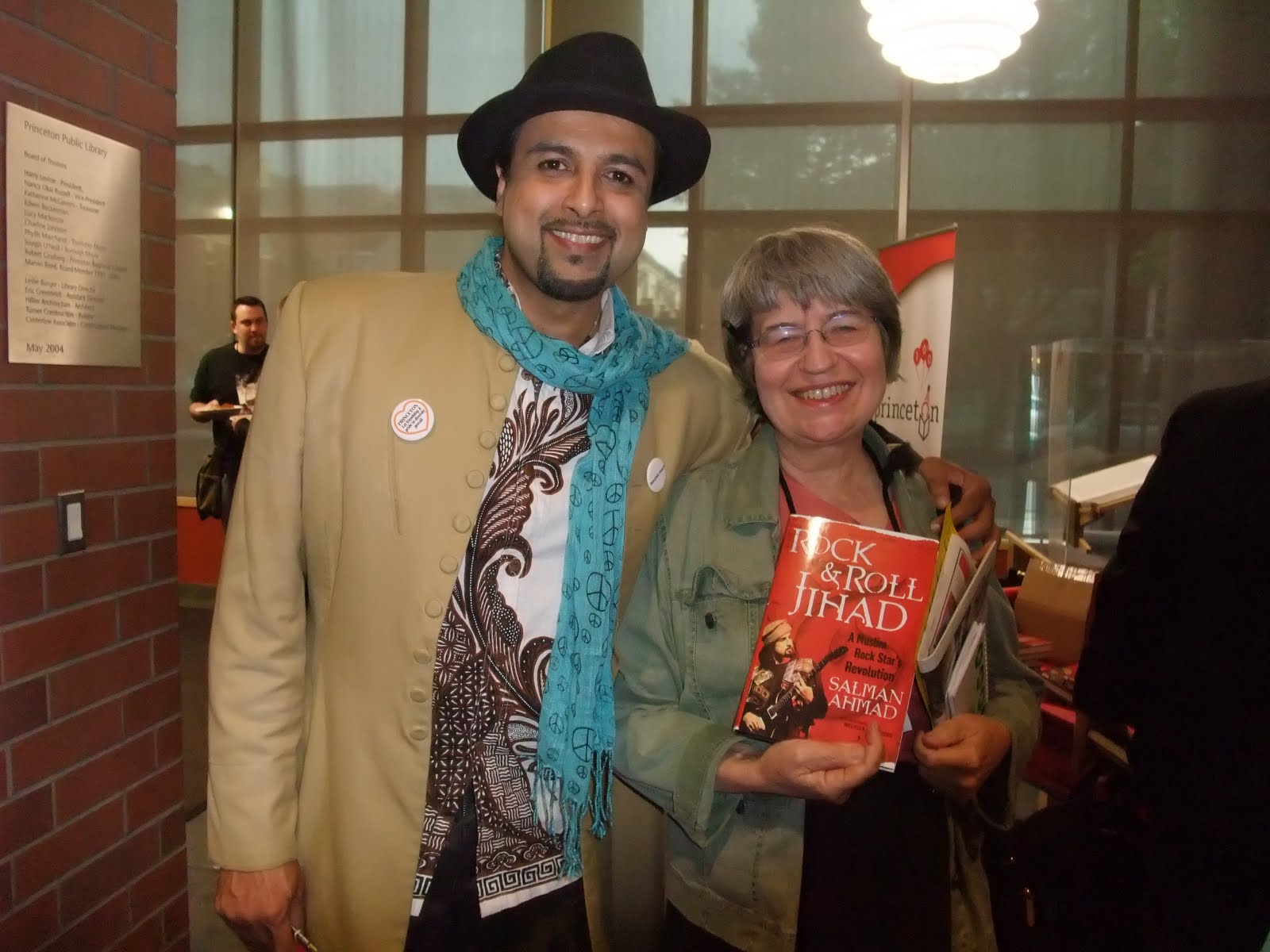
In a presentation called Sounds Intersecting and Overlapping Cultures, Pakistani rocker Salman Ahmad told a selected audience at Princeton Public Library: Let the mind shut up and let the heart take over. Ahmad, a United Nations ambassador and a Muslim rock star, spoke at TEDxNJ. TEDx is a national organization that aims to leverage ideas to change the world, and this was New Jersey’s contribution, hosted by Princeton Public Library. Ahmad charmed and inspired the audience with his story, including a priceless account of attending his first rock concert, Led Zeppelin at Madison Square Garden.

The TEDxNJLIbes event could accommodate only 100 people, and you had to make a formal application to attend.

But if you missed, it, here’s another chance to hear Ahmed. Next week — along with African dancers, a klezmer band, and a gay gospel choir – he will perform at Fellowship in Prayer’s 60th anniversary conference on Saturday, June 26, at 7 p.m. in Princeton University’s Richardson Auditorium.

The conference begins with a reception on Thursday evening, June 24, and continues with two full days of presentations on Friday and Saturday, June 25 and 26, culminating in a worship service at Princeton University Chapel on Sunday, June 27. The conference costs $250 (discounts for students and seniors), but the worship service is open to all, and the concert is $20 at the door. Call 609-924-6863 or http://www.fellowshipinprayer.org.

Called “the unlikely champion of a more moderate version of Islam,” Ahmad has a band, Junoon, billed as the biggest and longest lasting rock band in South Asia, and his book, “Rock & Roll Jihad” has just been published.

Ahmad’s chanting song captivated me. He sang the same chant at another TEDx event, at USC, but the audience was more responsive here.

“Follow that whisper in your heart. It may not have wings, but it has the power to fly,” says Ahmad. That thought captured the spirit of the TEDxNJ day.

Now More Than Ever, Capital is King


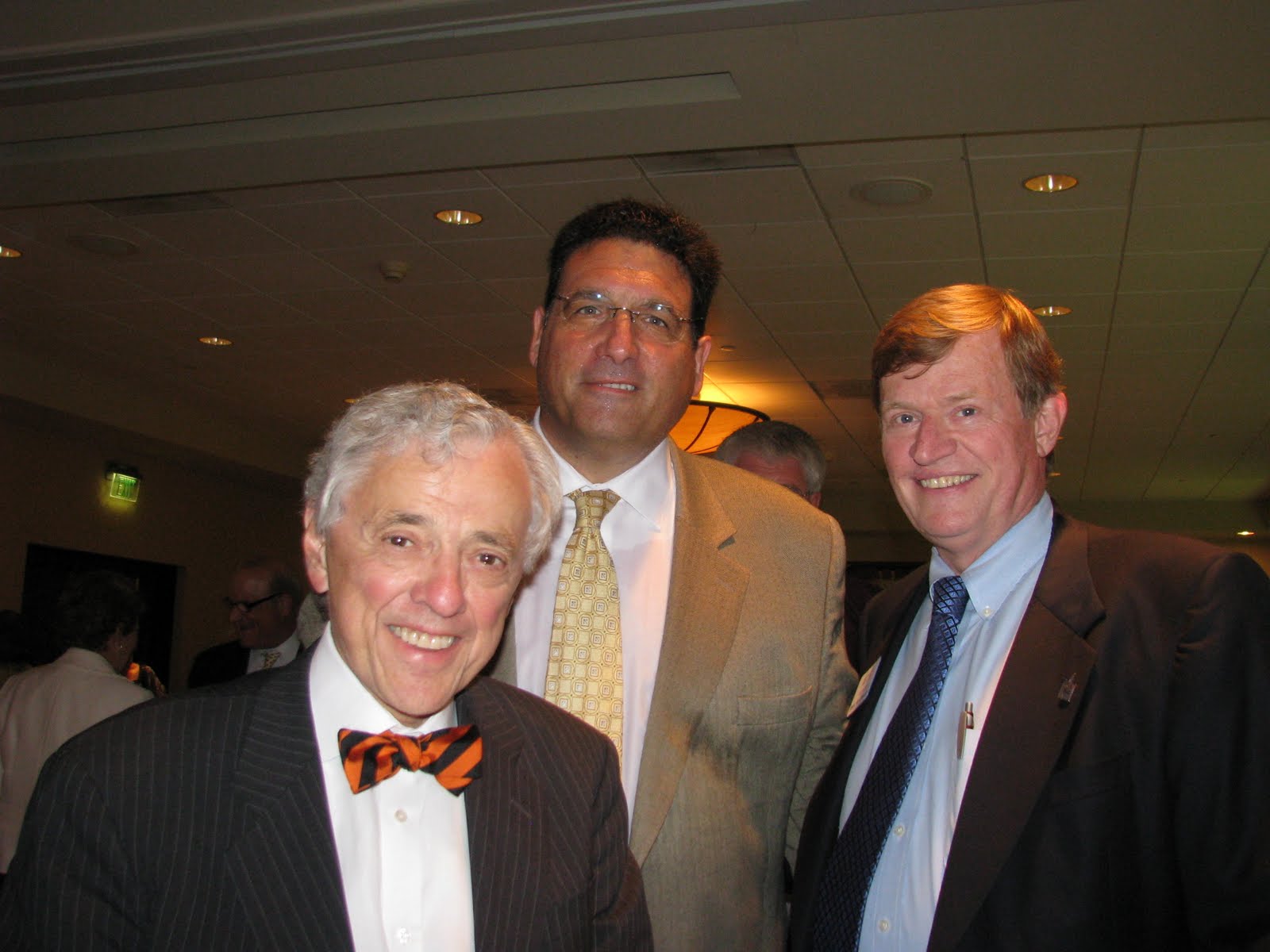
Those who have capital will be in the drivers’ seat, predicted Joe Battipaglia, chief market strategist for Stifel Nicolaus (shown here with Princeton Chamber president Bob Hillier (left) and chamber CEO Peter Crowley (right). Famously bearish, and noted as a raconteur, he told a chamber audience on June 3 that, though the market will recover, the recovery will be excruciatingly slow. “If you have capital, guard it. You have the advantage. Those with heavy debt will have trouble with indebtedness unlike the last 30 years.”

The capital crunch is especially difficult for small business owners, who find loans hard to come by.

If that’s you, consider attending the Lender and Small Business Matchmaker Conference to be held on Thursday, June 24, 8:30 to 12:30 p.m. at the Liberty Hall Corporate Center, 1085 Morris Avenue, in Union. The U.S. Small Business Administration aims to match SBA lenders with qualified small business owners who need start-up or expansion capital, ranging from $5,000 to $4 million. It is the first such event for the New Jersey District Office. To RSVP barbara.sturdivant@sba.gov or SBDC@kean.edu.

“The small business owners I talk with in New Jersey tell me that a major challenge they face is the lack of credit and tight lending standards,” said U.S. Rep. Rush Holt in a press release.

As part of the House Job Creation Task Force, Holt helped pass the Small Business Jobs and Credit Act, which would create a Small Business Lending Fund. The proposed $30 billion fund would help community banks lend up to $300 billion to small businesses.

For existing state lending programs, such as those in New Jersey, the bill would also support a $2 billion State Small Business Credit Initiative. These monies use small amounts of public dollars to generate substantial private financing.

Other encouragements for small business: the bill would exclude 100 percent of capital gain income for stock in small businesses purchased from March 15, 2010 to January 1, 2011, and it would increase the tax deduction for business start-up expenses. The bill was passed by the House this week.

Battipaglia might disagree that more credit will help. “It’s not just the lack of availability of credit,” he argued in a CNBC appearance on the day after his chamber talk, when the quarterly jobs report had squashed the Dow. Small businesses and investors are discouraged, he said, citing deflationary pressure and dashed expectations for a V-shape recovery. “We are on a decline path. The U.S. economy is expanding but it is just going to be extraordinarily slow.”

Battipaglia predicted, at the lunch, that politicians will change the rules of engagement. Instead of promising everything, the successful politician will promise nothing. “We can’t push the public any further to spend money we don’t have. This is a different world we are in.”

As for where to put your money: he likes capital rich companies that can nimbly jump to clients that will pay their bills.