Category Archives: Uncategorized

Persuading One-on-One

There are networking groups, and then there are workshops. Lately, combos of those two are proving successful.

Communications coach Eileen Sinett (www.speakingthatconnects.com) has begun to hold breakfast meetings on “last Fridays,” and I fetched up at her door, on Plainsboro Road, on July 31. So did nearly two dozen other people, eager to network but also ready to sponge up wisdom from Eileen on how to present themselves better. Scott Melzer, an Ameriprise financial advisor, was the co-host and Biz4NJ the co-sponsor of this Speaking For Biz program.

After chatting with an unusually diverse group of people, ranging from my colleague, Bart Jackson, and Warren Pick, a TV producer – to Cindy Urken, a realtor, and Sherry Waryasz, a certified laughter leader – we settled down to introduce ourselves. Eileen suggested an intriguing departure from the typical “elevator” speech. Instead of “my name is and here is what I do,” we were to begin with “Clients say…” or “People tell me….” or even just “When….”

If you think of the typical introduction as like a news story, with the Who, What, When and Where at the top, this kind of “alternative introduction” is like a mini-feature story, a nifty little narrative. We learned a lot about each other in a very short time.

Then we puzzled over the difference between providing information and persuading. Having just returned from Italy, and my first visit to Pisa, I was intrigued by the answer from Prakash Rao, a time management coach. It seems that Galileo proved the theory of gravity by dropping things from the Tower of Pisa, but for 100 years the faculty at the University of Pisa did not teach his theory. Galileo had failed to persuade.

Here is a snippet from Eileen’s mini-lesson on persuasion, memorable with the rubric Smart Individuals Head Big Companies. Setup or frame your context with three irrefutable statements, that no one can contest. Then and only then present your Idea, followed by How it would work, and then by telling the Benefits. Or just tell the benefits and wait for your target to ask how he can get it.

Sinett runs some other low-cost opportunities to pick up speaking tips, but the next Biz4NJ breakfast is Friday, August 28, at 8:30 a.m. at 610 Plainsboro Road, on the topic “Tweaking Pitches for a Different Audience.” Cost: $10. Please RSVP at 609-799-1400 because space is limited. Photo: From left, Nicolette Datri, an intern, and Eileen.
Too Many Baskets

George Amick, long-time editorial writer for the Times of Trenton and now a political columnist, always makes a lot of sense. Monday’s column on “perp walks” and political corruption in New Jersey not only made sense, it made me feel better about the Garden State. Of the several reasons he offered on why New Jersey has a reputation for corruption, the one that makes thevery most sense “is that New Jersey has more dishonest public officeholders because we have more public office holders, period.”

Where I grew up, Baltimore County, is no stranger to corruption. The county’s most famous bribery villain, Spiro Agnew, resigned as Nixon’s vice president because of bribery charges dating back when he was Baltimore County Executive. He was the only U.S. vice president to resign because of a criminal charge.
But even Baltimore County can’t match New Jersey, because it has no sub-fiefdoms. Its school systems has 22 high schools.
Mercer County, in contrast, has 13 municipalities, each with just one or two high schools. Amick points out are that these municipalities are “governed by part-time officials…whose only guide is a woefully inadequate and erratically administered state ethics code.”
I can’t link this blog to Amick’s column until tomorrow, so support newspapers and go buy today’s edition. But I must quote his quote of Mark Twain.
“It was Pudd’nhead Wilson who recommended, contrary to the old proverb, that you put all your eggs in one basket — ‘and then watch that basket.’ New Jersey has far too many baskets. “

Hurrah for Staying Put

If Fort Monmouth does pull up its drawbridge, as it’s slated to do, thousands of specialized tech workers would have to uproot their families and move to Maryland.

But maybe not. In the federal defense budget, two U.S. Representatives (Rush Holt and Frank Pallone), have inserted $3 million for a new New Jersey Technology Center, where the specialized techies could continue to provide intelligence and communications support to the U.S. military.

Don’t confuse the to-be-created New Jersey Technology Center with the Technology Centre of New Jersey, the tech park owned by the New Jersey Economic Development Authority. (When checking on TCNJ I found that Chubb Institute has changed its name, which slipped by me. Chubb’s education arm went deep into the red, was bought by private equity, separated from the insurance company, and is now called Anthem Institute. It’s across the street from what must be its arch rival, DeVry Institute.)

The bill passed the House on July 30 and still needed Senate approval, as of Friday, July 31.

“The men and women of Fort Monmouth — the scientists, engineers, and acquisition specialists who make the IED jammers and related devices — have acquired their skills over decades of service,” said Holt in a press release. “You can’t buy this kind of talent off the street and certainly not fresh out of grad school, which is why funding the Center and utilizing those workers who will stay in New Jersey is so important.”

Here’s an idle, obstreperous idea: Could those defense techies have found another home in Einstein’s Alley, for instance at the Sarnoff Center, which is busy with defense contracts as well? From the New Jersey shore to Maryland is too long a commute, but from the shore to Princeton is doable. And Sarnoff has extra space and like minds.

Arrivaderci, Esther


The subject of jet lag came up when Esther Dyson addressed the Princeton Chamber on July 9. Dyson had just returned from Russia, and she was working on almost no sleep, but gave a wow of a talk.

Directly after the lunch I left for the airport, with husband and granddaughter, for 10 days in Italy and have had plenty of time — a week — to recover, but am still not clicking on all cylinders. Perhaps if I had adopted Esther’s healthy lifestyle (to swim every morning) I would have done better.
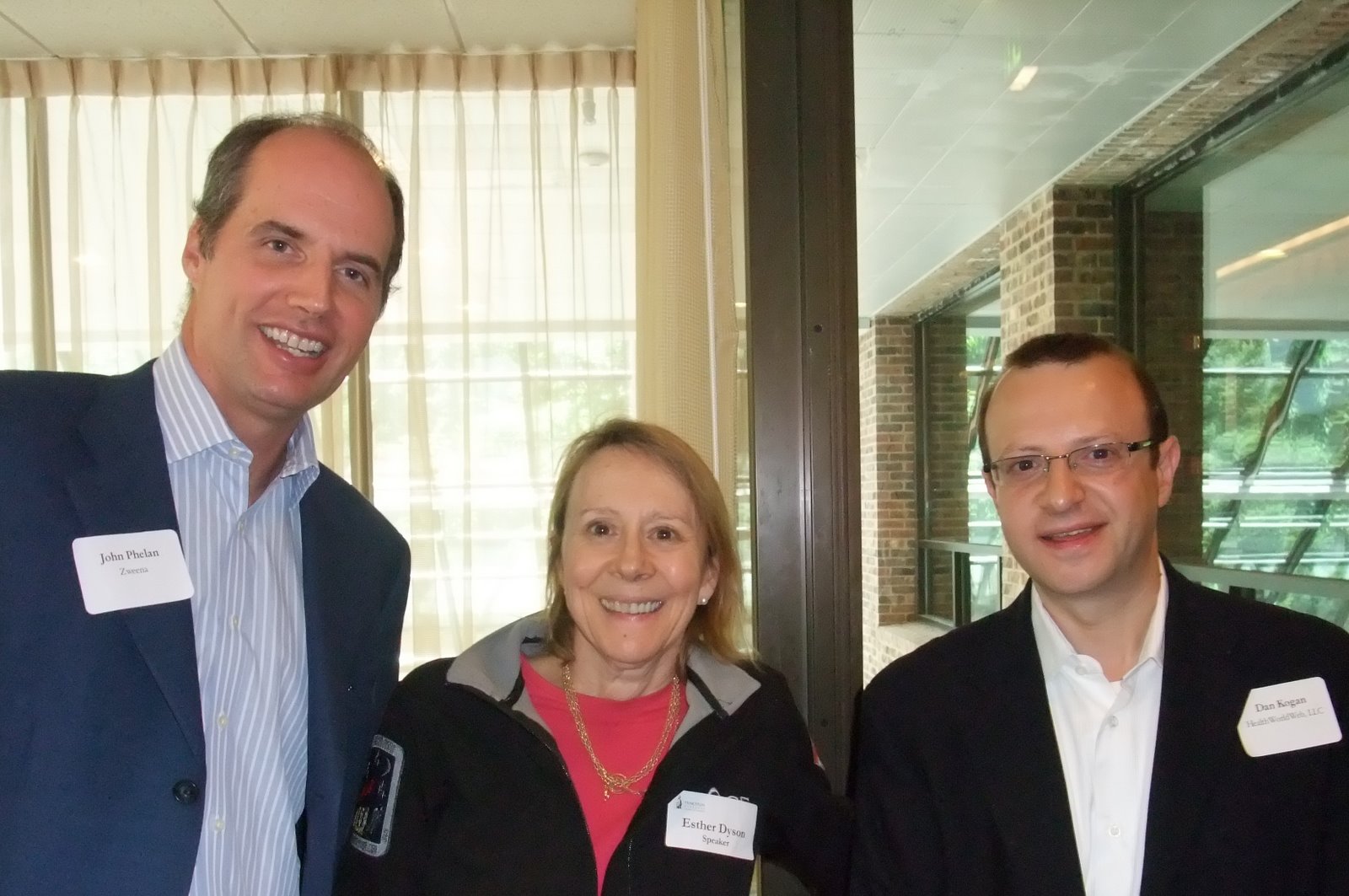
Since I left before I could comment on Esther’s talk, here is a link to her complete address, recorded for You Tube by Daniel Kogan of MyHealthExperience.com, which co-sponsored her chamber appearance. (In the photo, John Phelan of Zweena is on the left and Kogan on the right.) Also here is Dilshanie Perera’s excellent account in Town Topics.
And if you have your own memories of Italy, here’s an online album. Glad you asked.

Paying for Content?

In the ever perplexing discussion about whether readers will pay for news content, here is an apt summary from Editor & Publisher’s Steve Outing, quoting former Trenton publisher Dean Singleton. My previous entry featured commentary from Richard Bilotti, another former publisher at The Times of Trenton.

This is certainly a short entry, but I just wanted to call attention to Steve Outings wisdom, and it’s too long for Twitter…

From Russia to Princeton


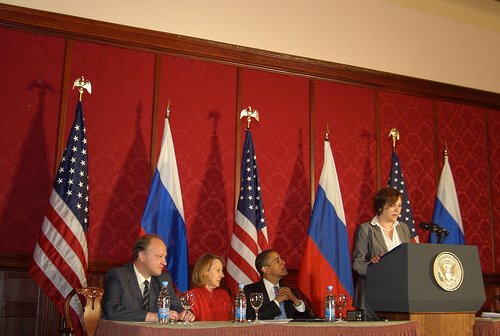
Esther Dyson’s Flickr account shows a July 7 photo of her sitting next to President Obama at the speaker’s table for a meeting in Russia. Her next appearance — a rare one, in her hometown — is Thursday, July 9, at the Princeton Chamber lunch, 11:30 a.m., at the Forrestal Marriott.

It’s hard to describe Esther Dyson, because she has so many interests, but here is a bio cadged from several sources:

Esther Dyson is a journalist and commentator on emerging digital technology, a founding member of the digerati, an entrepreneur, and a philanthropist. She has been highly influential for the past 20 years on the basis of her insights into online/information technology markets and their social impact worldwide, including the emerging markets of Central and Eastern Europe and Asia. In 1994 she wrote a seminal essay on intellectual property for Wired magazine and three years alter wrote Release 2.0: A Design for Living in the Digital Age.

Born in Switzerland in 1951, she grew up in Princeton, where her father, physicist Freeman Dyson, is at the Institute for Advanced Study. She majored in economics at Harvard, worked as a reporter at Forbes, then did investment research and bought a company, renaming it EDventure Holdings.

In 2004 she sold it to CNET Networks, the US-based interactive media companym and now operates as an independent investor and writer under the reclaimed name. An active investor as well as an analyst/observer, she participated in the sale of Flickr to Yahoo! and of Medstory to Microsoft, and her other investments included Del.icio.us, BrightMail, and Orbitz. Her primary activity is investing in startups and guiding many of them as a board member, including 23andMe (US), Airship Ventures (US), Evernote (US), Boxbe (US), Eventful.com (US), Meetup Inc. (US), NewspaperDirect (Canada), CVO Group (Hungary), Voxiva (US) and Yandex (Russia).

She is also active in public affairs and was founding chairman of ICANN, the domain name policy agency, from 1998 to 2000. She currently sits on the board of the Sunlight Foundation, which advocates transparency in government.. She is one of 10 initial volunteers in Harvard’s personal genome project. She has serves as a trustee of, and helped fund, such emerging organizations as Glasses for Humanity, Bridges.org, the National Endowment for Democracy, and the Eurasia Foundation (which co-hosted the 7-7-09 Civil Society Summit in Moscow). . She is also a board member of the Long Now Foundation, a trustee of the Santa Fe Institute, and hosts the Flight School in Aspen.

She is a close follower of the post-Soviet transition of Eastern Europe and is amember of the Bulgarian President’s IT Advisory Council. Last year she trained as the backup astronaut for Charles Simonyi’s Space Adventures trip aboard the Soyuz. In January she received the Aenna Burda award, for women in the media who successfully implement their extraordinary visions.

Here is the link to Michele Alperin’s article in U.S. 1 on July 8.


Those at the luncheon will have a chance to get Dyson’s take on their particular interests. She will speak briefly on “How can you weave together Silicon Valley, genomes, Russia, and space into a single talk” and then take questions.


Princeton’s Esther Dyson on July 9


Bogus privacy concerns keep us from having access to our own healthcare records, said Esther Dyson in the Huffington Post last month. As Quicken was to our money (it unlocked our financial records) we need the technology to get a look-see at our doctors’ records. That’s the message from a new advocacy group, www.healthdatarights.org.

Dyson, a Princeton native, speaks at the Princeton Chamber this Thursday, July 9, at an 11:30 lunch at the Princeton Forrestal Marriott on (take a breath) “How can you weave together Silicon Valley, genomes, Russia, and space into a single talk?” She’s in great demand among the digerati for her forecasting expertise, but she is also known for being able to explain puzzling technology to the non-techies of the world.
“Good health (not just healthcare) starts with individuals managing their own health and understand the impact of their own conditions and behavior,” writes Dyson. I can think of several Princeton-based companies that have staked their future on that proposition, among them, Princeton Living Well.
We need to be able to control our own data, and if the banks can figure out how to do it, the “privacy” excuse is a sham. If we can access our bank accounts online, why not our vaccination records?

Racial Profiling — It Happens Here

When I asked white friends to attend Not in Our Town’s workshop, presented and co-sponsored by the Princeton Public Library in April, on “Exploring White Privilege”, the answer was sometimes “I’m not privileged, I came up from nothing, I don’t believe in that concept.” Some replied, and it was a good answer, that the white privilege concept wrongly implies that all white people are alike (they aren’t) and that it visited the sins of the fathers on the sons.

I didn’t have a good answer then, I do now. Donald Roscoe Brown, a lawyer who lives in Ewing, wrote an oped published in today’s Times of Trenton (Thursday, June 18, page A-15). Brown’s words were kind to the Lawrence police officer who stopped him “after seeing me for all of five seconds” because he “might not have been wearing his seat belt.” Brown said he was “perhaps poorly trained.”

I too have been stopped for suspicion of not wearing my seat belt, but under much more controlled circumstances, i.e. a seat belt checking station. Brown was simply driving through Brunswick Circle, enroute from Trenton Municipal Court, where he was working on a case involving an unconstitutional stop and search.

To my white friends who don’t acknowledge their white privilege – you will never have to go through the jeopardizing experience of “Driving While Black.”

As a member of Princeton United Methodist Church, I belong to Not in Our Town, a faith congregation-based social action group. It offers continuing opportunities to combat racism and bias in Princeton. For information, comment here or E-mail niot-princeton@gmail.com.

Stimpson: Road Guide to Happiness

Everyone, no mattter how rich or powerful or seemingly well adjusted, is insecure, said Rev. Peter K. Stimpson, speaking to the Princeton Chamber on Wednesday at the Nassau Club. Stimpson heads the Trinity Counseling Service, pens advertorials for Town Topics, and has just written a book of short essays, “Map to Happiness.” (The counseling service, by the way, has its gala on July 11 at Bedens Brook.)

At that moment, I didn’t feel insecure. Who me? I had just unearthed my summer seersucker jacket, paired it with cream slacks, a red tee, and snazzy red shoes. I wasn’t insecure. I was hot stuff.

Then afterward Linda Kibrick (who is herself a counselor at Crossroads for Health and Wellness) commented how nice I look and I found myself (no, no, don’t do it, aargh you did it) responding negatively, confiding that the blue and white seersucker jacket didn’t really go with cream pants, that the pants should really be white.

Caught in insecurity.

Stimpson says that when we let insecurity take over, we are giving power to other people. Your employer does not define your worth. If you get a bad grade or a less than ideal rating or even if you are laid off, that’s a bad outcome but you, yourself, are good and have good qualities. Forgive yourself for mistakes.”

“Take back the power,” he says, telling of a 7th grader, a notoriously bad baseball player, who – one day — made a miraculous catch that won the game. He ran home to tell his father, and his father’s only response was, “Did you get a hit?” The boy was shattered. “Don’t give the power to other people,” says Stimpson.

And, “Reach for things that will last. What you attain doesn’t go with you to the next life. What you decide to become does go with you. How you interact is how you grow.”

I’m still going to try to lose three pounds so I can fit into the white pants that go with that jacket. But I’ll forgive myself if I don’t make it.

Enough About Me: Michael Goldberg

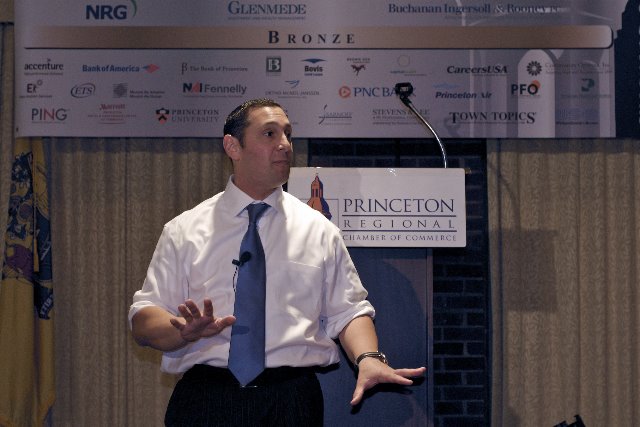
It is Never About You, said Michael Goldberg, giving the Pool Rules of Networking to a Princeton Chamber audience on June 4. “It is always about them until they make it about you.” An adjunct professor at Rutgers who makes his living as a conference speaker, he has an online newsletter and blog, Building Blocks to Success. (Photo by Stephanie F. Black)

Having read the article in U.S. 1 Newspaper, I came to the lunch figuring I knew the tips he would give, but no, there were lots more. For openers, instead of “what do you do,” try “Do you like what you do?” or “What about it do you love, and what don’t you like.”

Goldberg said he likes about one-third of the people he meets. What about the rest?

Say: “It was great hearing about your business, but I’m going to let you go. I don’t want to waste your time.”

If you like the person but can’t help them, say, “Who are you looking to meet?” and then try to introduce them (and introduce them with passion, tee them up.)

If you like the person and CAN help them, say, “Tell me how I can help you. Who’s a good client for you?”

And then plan to follow up. “It sounds as though we have a lot to talk about.” Exchange cards and ask permission to jot a note on the back of their card, or use an index card.

When it’s “all about them” and you have helped them all you can, you might hear someone say, “Enough about me.” That’s your cue.