Tips on common basement flooding causes and how to fix them 
Guest post by A&E; Construction

Checking Your Basement’s Flooding Capacity

Most basement flooding problems are simply drainage problems on the outside of your house. Therefore, the first step is to start on the outside by examining the exterior perimeter. Check that you have a good slope in place to direct water away from the foundation walls.

Also check your gutters to make sure that they are not clogged and that downspouts are directed away from the house so that discharged water will flow away, rather than towards your home.

After observing the perimeter of your house, if you happen to note any ground depressions or water puddling near the foundation, there are 3 basic steps that you can take to correct this.

How to Correct the Inflow of Water towards your House:

1. Rake back any mulch and then add new top soil that is tamped and sloped away from your house.

2. Install 3” of landscape plastic around the perimeter of your home. Following this, rake back mulch or stone to reduce erosion (this will also add nice curb appeal to the look of your home).

3. Another tip that will reduce drainage issues is connecting your down spouts with underground pipes to lower areas away from the foundation.

Preventing Flooding: A Guide to Sump Pump Installation

If water still accumulates in your basement after you’ve addressed drainage problems, sump pumps will need to be included in your drainage strategy.

What to be Aware of Before Installing:

In order for your sump pump to work well, there must be good communication under and around the basement concrete slab. Most houses today are currently built with the sump pit installed before the basement concrete slab is poured so that the crushed stone and perimeter pipe tie into the sump pit.

Older homes often have sump pump problems because their basements do not include either open or closed perimeter drains (sometime referred to as “French Drains”).

An open French drain is simply a slot of concrete cutout to the subsoil level around the outside of the basement that routes water to the sump pit for pumping to the outside of the house.

A closed French drain is designed the same way but may include drilling of the lower wall block to relieve water pressure. Closed French drains are also effective because they contain corrugated plastic that captures and directs water into the trough slot. Another non-drainage benefit of the closed French drain system is that it contains possible radon gas.

A basement without the French drain system is prone to poor drainage under the concrete slab. The concrete slabs in older basements generally lack good communication to the sump pit because they are poured directly on top of subsoil.

Setting Up your Sump Pump System:

If you have good drainage to the sump pit, we have a few steps to guide you in setting up your system. For an emergency backup system to be effective, it requires a consistent setup.

We recommend 2 submersible pumps, set at 2 levels with 2 separate discharge pipes and on 2 separate electrical circuits. Setting up your system like this can protect your basement from the many pitfalls that result in sump pump failure.

How this Works:

Installing 2 sumps at different levels protects your house against single pump failure and doubles the pumping capacity if flooding should occur.

Putting 2 separate discharge pipes in protects against possible line blockage from snow, ice or leaves. These pipes will also increase the water discharge volume by reducing back pressure in the case that flooding occurs and both pumps are running.

Plugging each pump into a separate electrical circuit protects your home against electrical failure. If your pump should fail, you run the risk that it will likely trip the circuit breaker. Should this happen when your pumps are connected into just one circuit, you will lose both pumps.

Purchasing a portable electric generator and several long extension cords are key to being able to run your pumps and refrigerator during a power outage. A portable generator is often a better idea than a battery backup system because most battery backup systems don’t have the same longevity or amperage required to pump water for a significant amount of time.

Once you install your sump pump, a final recommendation is contacting your homeowner’s insurance company and having them add “Backup of Sewer & Drains Rider” to your policy (costs approximately $50-$75 more each year). This added insurance covers your house in the event that electrical power goes out and/or your sump pump fails due to some mechanical failure.

Rita McGrath: Thrive in a Complex World


Rita McGrath offers a free webinar on Wednesday, September 28, at noon on Learning to Live with Complexity. Princeton Regional Chamber members met McGrath, when she spoke at a lunch in October. 
McGrath, a Columbia Business School professor who lives in West Windsor, most recently co-wrote, with Ian Macmillan,  “Discovery Driven Growth: a breakthrough process to reduce risk and seize opportunity.”  


note added at 11:45 Click here to try to sign up for the webinar  Apparently the link I has posted expired.


“Business has always been unpredictable and surprising, and the systems in business have always been complex,” suggests the press release. “But due to the IT revolution, complexity affects everything–products, supply chains, organizations. This makes managers’ jobs far more difficult. It is harder to make sense of what is going on, make predictions about the future, and place bets.”


In a recent HBR article, McGrath suggests four fundamental changes. One (hold your breath, all you gurus who use fancy algorithms to make predictions) is to mitigate your risk by reducing the need for accurate predictions. If the environment is unpredictable, why try to predict?


HBR. I am careful to note, does not endorse this position of “no predictions please,” and in fact a prediction guru will speak at a free webinar next week. On Monday, October 3, Tom Davenport (a business analytics expert) will tell how to gain advantage by using analytics to predict the future. 


Another person who makes his living with predictions, however precarious, is Charles Steindel, chief economist of the New Jersey Department of the Treasury. He will speak at the Princeton Regional Chamber meeting on Thursday, October 6, at 11:30 a.m. at the Princeton Forrestal Marriott.


Sorry for the late notice about McGrath’s webinar — we’ve been on a road trip to Vermont. I’ve not had time to figure out why HBR is doing these webinars for free. Somebody who can figure that out, please let me know. 


**** Late breaking announcement ****


I just read in today’s Times of Trenton — but can find no notice of it anywhere else — that Princeton Power Systems is having a demo today from 10 to noon at 201 Washington Road (that’s Sarnoff/ SRI) with a workshop and openhouse from 1:30 to 3 p.m. at 3175 Princeton Pike, Lawrenceville. I think this must have been arranged by the NJEDA because it’s not even on the company’s website. I just called and it’s on. The founder, Darren Hammell, spoke at the Princeton chamber in February, 2010. 


Also, Dan Conley asks for publicity re the Marconi Foundation Scholars and Heroes Festa Italiana event in Somerset on October 7, $50, so here it is http://www.marconilanding.org/


Something New on Nassau

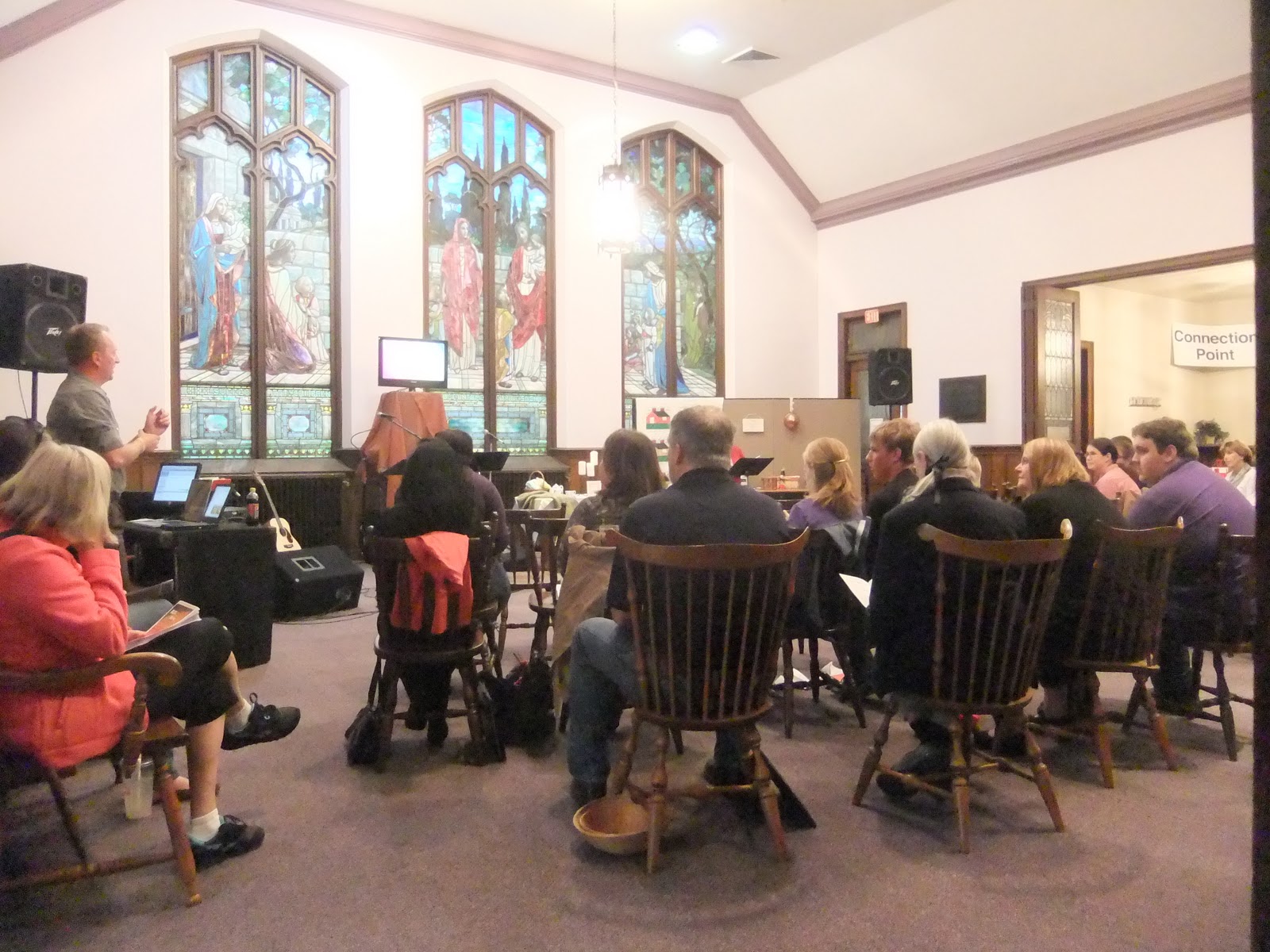
If you hear music as you stroll down Nassau Street at about 5 p.m. today, it’s coming from Princeton United Methodist Church, at the corner of Nassau and Vandeventer. The church has launched a series of Saturday Evening Worship Gatherings,  non-traditional services in the Sanford Davis Room (pictured left) and the door opens onto Nassau Street.

“We will praise and experience God through contemporary music, and hearing and responding to the message,” says Rev. Jana Purkis-Brash. And of course, it being a Methodist church, there will be refreshments. Parking is free on weekends at the Princeton Universitylot off of Williams Street. The traditional Sunday services are at 9:30 and 11 a.m., and  Sunday School for all ages is at 9:30. www.princetonumc.org.
Full disclosure (isn’t it obvious?) I’m a member of this church– perhaps I’ll see you there! 

September is Mark Your Calendar Month

Meet everyone and their sister at the 30th annual Princeton Regional Chamber trade fair and culinary showcase at the Princeton Westin on Monday, September 26.  free to all with a business card. Schmooze or lose! 


That night, Monday, September 26 at 7 p.m., Tom Pitts tells the Princeton Public Library crowd how to promote yourself (lots of us have trouble with this) by selling your strengths. Also at the PPL on Thursday, October 6, at 6:45 p.m, Alan Yarnoff reveals the secrets of promotion and advertising for small business. 


ACG New Jersey meets at the Westin on Tuesday, September 27, to talk with Soren Hastrup, CEO of Telestro Group about his “Successful Entrepreneur Marriage” (his wife is the COO). 


On Friday, September 30, for a breakfast, meet with Eileen Sinett’s “Speaking that Connects” group to discuss “Connecting with Clients,” RSVP needed. .


Looking forward to October, NJEN begins it with a lunch on Wednesday, October 5 on Strategic Alliances: Partnering for Profit. 


The Princeton Regional Chamber hears from Charles Steindel, Chief Economist of the New Jersey Department of the Treasury for its lunch on Thursday, October 6, and from Dale Caldwell, CEO of Strategic Influence, at the breakfast on Wednesday, October 19.  Caldwell uses influence-based strategies to  help people attain success in work and life and help corporations maximize their profitability. 


On the evening of October 6, New Jersey CAMA tells how to use social, mobile, and local marketing to drive customers and profits. 


Princeton University’s Keller Center opens its admirable series that juxtaposes two e words, entrepreneurs and engineering, with a lecture on Tuesday, October 11, at 5 p.m., followed by, as always food and networking. Stanford’s Stephen Barley will discuss virtual work. Another free lecture, open to the public, is Wednesday, October 26, at 4:30 p.m., with Ricardo Levy (’67), founder of Catalytica, on “The Essence of an Entrepreneur.” 


 The NJEF session on Thursday, October 13, 4 to 6 p.m., will focus on accurate pre-money enterprise valuations. In other words, before you get any investors, how much is your business worth. Market research is supposed to help you build accurate assumptions. 


On Wednesday, October 19, as part of  Trenton’s Small Business Week, the Mercer County chamber holds its fall expo and the Princeton chamber co-sponsors a forum on how your company can benefit from tapping Trenton’s appeal as a tourist magnet.  

The Montgomery Township Economic Development Commission will hold its annual Fall Business Networking Forum on Oct. 25, 6 to 8 p.m., at the newly opened Tusk Restaurant located at 1736 Route 206 South in Montgomery.


If that’s not enough places to go, check out U.S. 1 Newspaper or its database on the Princetoninfo.com events page or the Einstein Alley event page. And there is also an unpublished event on October 6 open only to techie entrepreneurs. If you think you are one, contact Marion Reinson, who wrote this guest blog.

Hedge Fund Wunderkind, Five Years Later

After I talked to Bill Martin for U.S. 1 Newspaper five years ago — he’s in the news now for his Raging Hedge Fund — I met him at a social function. So I asked him for some free advice. “Stay out of the options market, don’t buy commodities,” he said. Good advice.

This week’s U.S. 1 story by Scott Morgan tells of another high-roller, John Frankel, who speaks in Whippany on How to Survive and Even Gain from the Coming Internet Bubble on Tuesday, September 27, at noon at the Marriott Hanover. Cost $75. Visitwww.vanj.com.


Frankel is an investor in Klout.com, which measures influence. Quoting the story,  “Google started a revolution by page-ranking the web,” Frankel says. “Klout is starting a revolution by ranking people.” A Klout score of 50-to-55 puts someone among the best influencers. Frankel’s score is 60. And, by the way, the name of Frankel’s company, ff Venture Capital, is a shrewd play on the Twitter hashtag #ff — an abbreviation tweeters use to denote “forward Fridays” or “follow Fridays” in order to draw attention to other Twitter users.

Klout is far from the only tech company in which Frankel and ff are invested. Frankel is the director of 500px, an online photo portfolio site; Infochimps, which sells data sets from music to crosswords; Phone.com, a virtual phone answering service for businesses, and six other technology companies.

You want to work for a hedge fund but not commute to New York? Get some insights into Bill Martin’s personality with that 2006 story in the U.S. 1 Newspaper archive.

Bill Martin is the wunderkind who founded Raging Bull in the late ’90s while still an undergrad at UVA.  His company, now called Princeton Ventures, is still at the same location, close at hand to the Community Park basketball courts and soccer fields where he and his team famously let off steam at lunch time. His hedge fund just topped $100 million. And it’s here in Princeton on Witherspoon Street. 


Guest Blog: Green Building in the Alley


Green 2.0 – Green Building in the Alley
Notes on the May 10, 2011 Einstein Alley Entrepreneurs Collaborative Gathering
by Marion Reinson with Steven Georges

The Einstein Alley Entrepreneurs Collaborative is a community of Central Jersey entrepreneurs established by Steven Georges and John Romanovich in 2003 as a grass roots effort to bring “entrepreneurial-minded” people together. The goal is to provide a fertile ecosystem for the germination of ventures in Central Jersey (similar to Silicon Valley and Rt. 128) as well as a venue for those interested in helping entrepreneurs to grow successful businesses. Meetings are informal and provide a safe haven for entrepreneurs to share their ideas. 

Over the seven-year history of the Einstein Alley Entrepreneurs Collaborative, we’ve hosted about 37 gatherings. At times we’ve measured the success of an event by the number of members in attendance. By that measure, our last event “Green 2.0 – Green Building in the Alley,” which attracted 16 human (and one canine) participants to the Green Living and Building Center (GLBC) in Lambertville, NJ, was not one of our greatest successes.

However, the powerful and thought-provoking presentation those attending witnessed and the feedback that we’ve received since tells a very different story. One member of the EA leadership commented that the gathering might have been the best ever. An attendee from the financial sector, who had been skeptical about the economics of Green, said this event was eye opening. A third, who came thinking that the Green economy might be dead, now believes that we are only in the early pioneer stages of the game. Given this feedback, I thought you might enjoy learning about what was discussed and my own takeaways from the meeting. Why take the time to read on? Because, I have seen the future and it is green.

The evening’s three presenters co-founded the GLBC with the shared belief that cost effective green living, building and commerce is achievable today given the right leadership team working with an integrated approach. Their focus is primarily upon green buildings because, 1) People spend 90% of their time in buildings, 2) buildings use 65% of all electricity, and 3) buildings are responsible for 39% of all green house gas emissions. Collectively, they presented a compelling argument that the transition to a green economy has already begun, and it has a positive ROI.

To get a real sense of these optimistic business sentiments I strongly recommend that you view this short film “High Performance Building – Performance and Practice” prepared in a partnership between the Rocky Mountain Institute and the U.S. Green Building Council. The GLBC partners gave a copy to the EAC attendees at the gathering. I watched the DVD and was blown away to see senior executives of Goldman Sachs, Adobe, Toyota, Cushman and Wakefield and many other corporate giants powerfully promoting the business case for their companies’ investments in new and retrofitted-LEED-certified facilities. The 18 minute film , which can be viewed on YouTube, (http:// www.youtube.com/watch?v=EYeoDHE38eg) ends with the following powerful statement by the late Ray Anderson, founder and chairman of Interface Inc:

“I believe businesses will be left in the competitive dust if they don’t respond as the public, as the market demands. The power is with the people and there is not a CEO worth her or his salt who will ignore the voice of the marketplace.”


The evening’s first presenter, Lia Nielsen is the day-to-day manager of GLBC and runs Gaia’s Way Inc, a consulting firm providing Product/LEED (Leadership in Energy and Environmental Design) expertise. Her presentation, “What Makes A Business Green,” provided a case study of Method, a privately-held home cleaning products company started in 2001. Method is one of now 416 certified “B Corporations” that use the power of business to solve social and environmental problems.

Jason Kliwinski, a LEED-certified architect and co-founder of the NJ Chapter of the US Green Building Council, is Director of Sustainable Design at the Spiezle Corporation and founder and president of Designs for Life. Citing specific case studies from a number of recent LEED-certified buildings that he has helped to design, Kliwinski stated that construction does not have to cost any more to be Green and, in fact, such buildings can provide an annuity of ongoing operating cost savings to the building owners and net energy to the grid.

To achieve a positive financial return several pre-conditions must be met: 1) green elements must be integrated in the design and not added as an after-thought, 2) available incentives and financing must be fully-taken advantage of, and 3) the architect must collaborate with the builder and subcontractors throughout the project. Jason said that many contractors would like to build green, but don’t, only because they have
never done it before. Consequently, he spends much of his time both on the job, and as a frequent speaker at industry conferences educating contractors as well as the public about cost-effective environmentally-responsible design. Jason strongly believes that green building is the future and not just a fad and provides the numbers to back it up. Between 2005 and 2010, a period when many architectural and construction companies went out of business, he showed that expenditures on Green building increased from
$10 to $60 billion.

The GBLC presentation continued with Robert Politzner, president of Greenstreet Building and early pioneer in the field of green building, speaking from the point of view of the general contractor. Robert is a passionate believer that the cost of a unit of carbon-based energy sources has been kept artificially low when compared to renewable energy sources. This is a result of continuing government subsidies to fossil fuel energy sources along with powerful industry opposition to a carbon tax that would seek to include the cost of externalities, such as pollution, in the price of a unit of gas. Politzner agreed completely with Kliwinski’s assertion that the most critical requirement for successfully building green on a budget is integration.

Politzner also mentioned several additional reasons for the generally accepted, but no longer accurate, notion that green building is expensive and a luxury that only the affluent can afford. These reasons included, until recently, a shortage of building trade workers with experience using green materials; combined with the fact that a general contractor typically has a three-week period in which to bid on a construction job. As a
result of this lack of experience and compressed time frame for bidding, the contractors are tend to be conservative about making what could be a costly error, especially if they are not well versed in green construction.

Politzner believes that over the past several years a critical economic tipping point has occurred. The recession and the resulting surplus of unemployed trade workers has increased the supply of skilled providers of solar panels and other green products. This has increased the willingness of contractors to take a risk and build green. Combined with improvements in solar panels and efficiencies that have lowered the cost of their manufacture, the cost of solar energy production has decreased from $8k-10k to $4k-5k per Kw over the past five years. As a result, in the past two years Politzner and Kliwinski reported seeing a market shift where the cost of solar in the northeast is now cheaper than traditional sources. Kliwinski said there are regional cost differences, but in the northeast, integration of geothermal, solar, green roofs and rain water catchment can and do make strong financial sense.

Jason and Robert concluded the team’s presentation saying that that the cost of building new green buildings will continue to fall, but ultimately, if climate change is to be reversed the existing building stock must also be made more energy efficient. Jason said that we know how to do this cost-effectively today with a short payback period. However one big problem is financial because the “cap-ex and op-ex people do not
speak to each other.” He said investors who understand this are making returns of 5-6% per year.

In addition to designing and building high performance buildings, the three partners kept stating that the primary purpose of the GLBC is education and collaboration. I believe that there are a number of opportunities for EAC members to collaborate with the GLBC leaders, and the resulting entrepreneurial opportunities may be among the most financially rewarding available today, So If you are an EAC member who is working to develop businesses offering CHP or other alternative energy cost savings to building owners, I strongly recommend that you explore collaborating with the founders of GLBC. I also believe there is a big financial reward awaiting the financial/banking entrepreneur who develops and successfully markets the investment mechanism to finance the green retrofitting of the existing commercial building stock.

Acknowledging the left-leaning political connotation that the word “green” has acquired, Politzner suggested that the word, “smart,” should be substituted for “green,” because the emerging business case for building green is “as American as apple pie.”
R U e? I am e!

Two years ago at a conference in Philly  I picked up the T-shirt that says “R U e? The second year, the T-shirt said
“I
am
e!”
And on the back it has these words: educated, 
enabled, 
engaged,
 electronic, 
expect,
 equipped, 
expressive,
empowered.
Next Tuesday I plan to pick up the third T-shirt, above.
“e” in this context means “e-Patient” and the conference is e-Patient Connections 2011, run by Kevin Kruse of Kru Research. At first e-Patient meant “internet savvy patient,” but now that most everyone is savvy, it has the additional connotations. Paulo Machado is one of the locals who will attend. He’s quite active on Twitter (PJMachado) and as I write this he is live-tweeting a national conference on this subject, Medicine 2.0 (Twitter #med2). 
It’s a very exciting field, chronicled in part by a blog, http://e-patients.net/ run by the Journal for Participatory Medicine. Lots of folks in the Princeton area, in addition to Kruse, are at play in this field. 
One of my favorites, Rick Weiss of Viocare, just happens to be speaking at the Princeton Regional Chamber this Wednesday, September 20, at 7:30 a.m. (breakfast is at 8 for the lazybones). He won Princeton’s entrepreneur of the year award last year, and you may know him as the guy behind Princeton Living Well, that amazing NIH-funded beta test website where you can log-in your exercise and other healthy habits to get “points” to spend at area merchants. One of Rick’s winning habits is that he works hard to know what everybody else, in his field, is doing. 
No surprises for him.

Don’t let the e-Patient movement take you by surprise. If you are a patient, know your rights and your opportunities. If you are in the pharma or health field, get with it.

Postscript: this just in from Joe Montemarano at Princeton University 
On October 12th, the NSF Engineering Research Center on Mid-InfraRed Technologies for Health and the Environment (MIRTHE) will host an Investment Focus Group Workshop on Medical Applications of Mid-IR Technologies at Princeton University. This event is intended to engage a diverse and multi-disciplinary group of individuals and stakeholders to help speed the adoption of emerging technologies by defining the market applications and opportunities. We are working with the Cleveland Clinic to increase visibility and understanding among clinicians and other medical personnel, and are reaching out to private and corporate VCs, and other investors interested in the medical/healthcare field.
Joseph X. Montemarano

Executive Director, MIRTHE
Director for Industrial Enterprise, PRISM
Princeton University

Do You Know a Woman, New in Town?

Let’s be honest, Princeton can be an intimidating town, and I mean greater Princeton, not just the two square miles or the zip code. I called myself a writer when I lived in Pittsburgh but when I moved here 30 years ago I was so intimidated by Famous Writers (think John McPhee)  that I relinquished that claim and lost my ‘writing voice’ for a good long while.

Recently I talked to a former Princeton resident who had just moved back from a stint overseas, and I wasn’t surprised to hear her say that she felt like an outsider, because, in another country, English speakers band together to support one another. If you are used to that camaraderie, you feel rebuked by soccer moms who watch the game in clumps and ignore a stranger’s attempt to say hello. If you come here from another part of the country as a traveling spouse, it takes “a good long while” to get the kids settled — and when it’s time to look for a job you start at square one. You don’t know the turf.

Northerners, I must admit, can be particularly unfriendly. Whatever you might think about the south, Southerners cultivate at least an appearance of friendliness. Because I went to a school in North Carolina, I experienced this first hand, so now when I meet a woman who has just moved to Princeton from the south, I’ll say “how does it feel to be in Cold Unfriendly Yankeeland” and inevitably she’ll burst out with “How-did-you-know-how-lonely-I’ve-been-feeling.)

(I realize I’m stepping on everybody’s toes here — north, south, what’s left? Of course these stereotypes don’t apply to everyone, but I’m trying to make a point.)

Ladies — when you encounter a woman who has recently moved to Princeton, particularly one who is not in the workforce (they’re the lonesomest kind) reach out to her. Realtors —  you are doing this all the time. It’s part of your job to get the wives settled in a new community. You often  refer them to the Newcomers Club at the YWCA, but may I suggest another resource?

A new friend of mine, Cheryl Mart, offers a weekly study “Moving On after Moving In” for women who are new to the community or just plain in transition. It’s a non-denominational Christian study, based on a Susan Miller book and video, that will be given at Princeton United Methodist Church on Tuesdays, starting September 20, at 7 p.m. Cheryl just moved here from Texas and knows whereof she speaks. For more information click here. or email movingon@princetonumc.org, or call 609-921-0730.  Women do not need to attend church to come to the free study.  (Disclosure — I’m a member at PUMC).

Perhaps the “Moving On after Moving In” study is “right” for the newcomer you know. Or maybe another resource is the best one. The Women in Business subset of the Princeton chamber comes to mind. In any case, the very best resource is probably YOU. Make time. Reach out. Have coffee.

PS. If you are a Christian and don’t go to church because Sunday mornings are for the reading New York Times, I hear you. PUMC (the church on the corner of Nassau & Vandeventer) now has a Saturday Evening Worship Gathering at 5 p.m. (609-924-6213, http://www.princetonumc.org). Realtors — if you have to show houses on Sundays, or Soccer Moms and Dads, maybe this is for you.

A Community Creates Change

Yesterday, speakers at 9/11 commemoration services observed about how collective goodness can triumph over evil. Tonight (Monday, September 12) we can see another example of this, how an extreme case of bullying and its terrible result caused an entire town to rise up and create change.


Tonight at 7 p.m., Not in Our Town (Princeton) — in partnership with the Princeton Public Library and the Latin American Legal Defense and Education Fund — will screen a preview of the national NIOT’s documentary film ‘Light in the Darkness.’ It is the first session in what NIOT hopes will be a year-long change-campaign against bullying, and it will be followed by a discussion.


To start everyone thinking, those attending will be given a card and this opportunity: 
On one side describe your “Experience of Bullying” as either a victim/perpetrator/ 
or bystander, consider:

1) Write briefly how you or someone else you remember was bullied


2) How did it make you feel?


3) Did anyone help you then, or later? How?

On the other side write your “Responses to Bullying,” consider: 
1) Did you ever offer help to a victim of bullying or to the bully?


2) How do you think a family or friends can help?


3) What are some positive things that a community can do?

If you have had no direct experience with bullying please share any thoughts you might have on what steps individuals and communities can take to prevent and heal these behaviors. 


We would like to collect the cards after the program.


You may be thinking — Princeton is such a ‘good’ liberal town, we don’t have a problem with racism or bullying of any kind. Not so. You will learn about that tonight. And we’re working on it. 


You are warmly encouraged to contribute your ideas. If not tonight, perhaps by email (niotprinceton@gmail.com) or by comment on the NIOT (Princeton) blog .

And if you can’t come tonight, “Light in the Darkness” will premiere on PBS stations on Wednesday, September 21, at 10 p.m. It is suitable for adults and older teens.   


Full disclosure: As a representative of an NIOT member congregation, Princeton United Methodist Church, I serve on the steering committee of Not in Our Town (Princeton). 

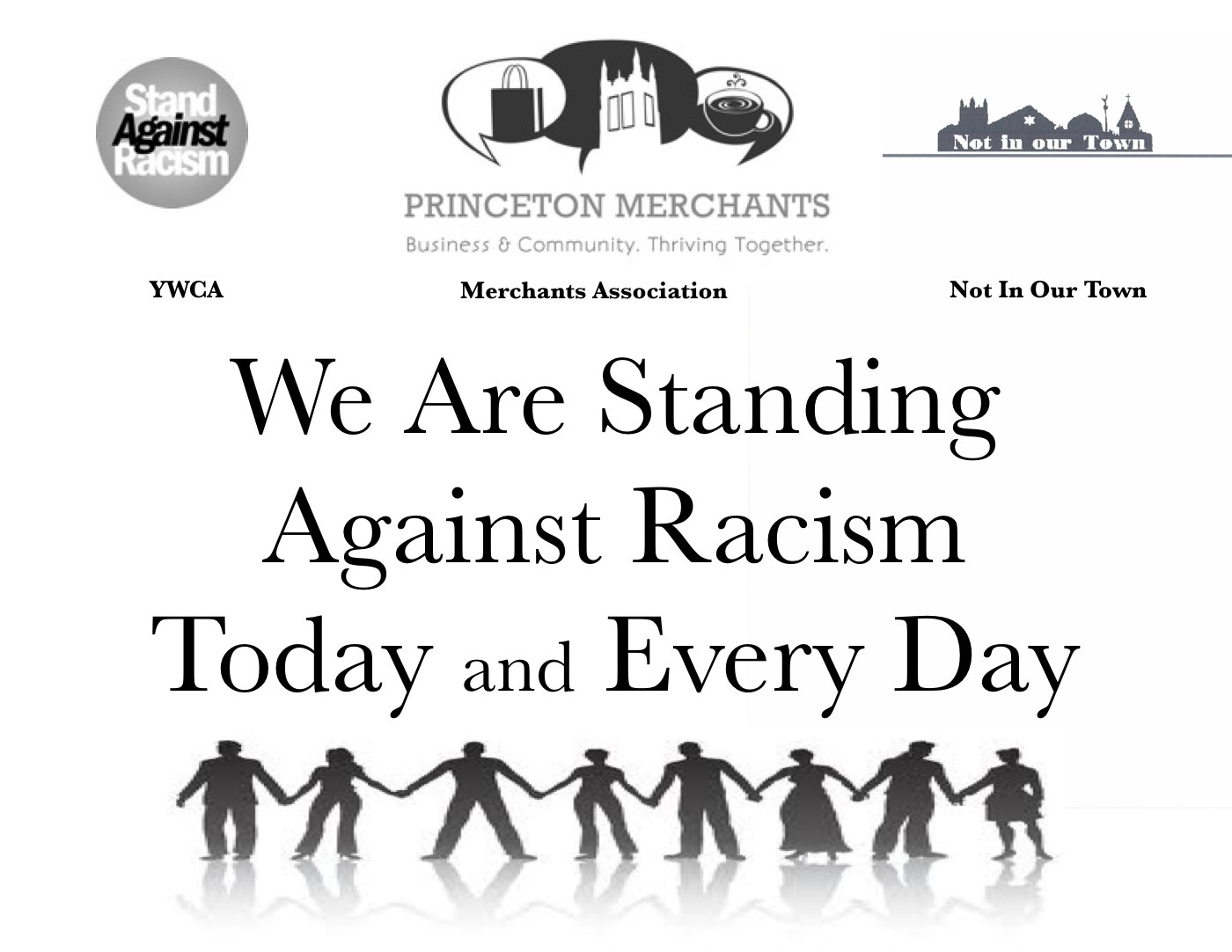
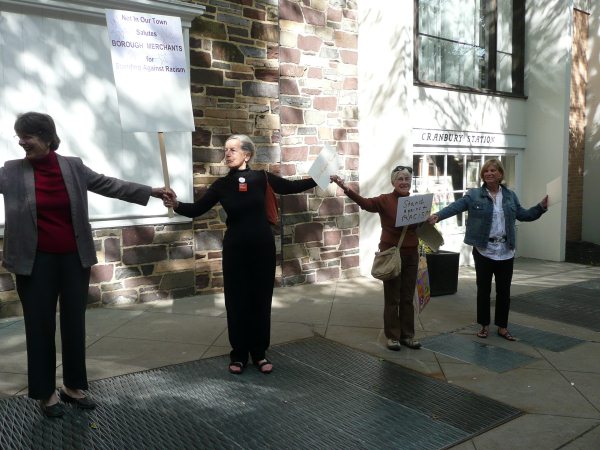
. Thanks to the cooperating merchants who are displaying these posters.

Not in Our Town (Princeton) is an interracial, interfaith social action group in Princeton committed to speak truth about ‘everyday racism’ and other forms of prejudice and discrimination. We seek reconciliation, mutual respect and open and honest truth telling among our diverse communities. We support and promote social justice, economic justice and educational equity for all. Our hope is that Princeton will become a town in which the ideals of friendship, community and pride in diversity will prevail.

Button, Button — They’ve got ’em in Titusville

Brighten up a gloomy weekend by visiting a button show — yes, a button show. Bet you didn’t know that folks collect buttons like they collect stamps, postcards, coins, and matchbooks. But I venture that buttons are prettier than any of these. You can choose Victorian black glass buttons, or metal picture buttons (think Aesop’s fables), or uniform buttons, or china buttons, or plastic buttons, or celluloid buttons, or horn, or ivory, or …. any of dozens of categories.

Some cost a lot of money, some don’t, but all are fun to look at.

Today (Saturday, September 10, 9 to 4 p.m.) the New Jersey Button Society puts its best buttons forward in a show in Titusville (at the Union Firehouse, 1396 River Road, at the intersection of Route 29 and Park Lake Avenue, Titusville 08560). Admission $2.

What will you see? At 1:30 a glassblowing demonstration is scheduled, subject to the weather of course. The chief attraction however is cards and cards and cards of buttons. Dealers from all over the East Coast set up their tables and button-eers peruse their wares, looking for just the right button to add to their collection — or to enter in the next contest. (Image courtesy of the National Button Society.)

Winners of the contests will be on display at 1:30 p.m. Among the contests — Alternative Energy: buttons that picture windmills, water mills, and the sun. Who said that button collecting was old fashioned?

It’s a little tricky to get there, because Route 29 (River road) is flooded in parts, so take Exit 3 at Scotch Road, then turn left on 546, and right on Route 29. Pass It’s Nuts (it’s a restaurant) and a stand of trees and the Union Firehouse will be on your right.

Escape from 10th anniversary broadcasts and travel back in history, through the history of buttons. I’ll see you there!