Tag Archives: Princeton University

Faith and Ethics in the Executive Suite: Staying Grounded while Flying High

faith and work

Staying Grounded While Flying High: Marc Allen — a press release

This Friday is the spring finale of the “Faith & Ethics in the Executive Suite” series, hosted by the Princeton University Faith & Work Initiative. The Princeton Faith & Work Initiative will host a conversation with Marc Allen ’95, Senior Vice President at The Boeing Company and President of Boeing International, on May 29, 2015 at 3:00 pm, in the Frist Campus Center, in the lower ground Multipurpose Room A. The event is scheduled as part of Princeton Reunions Weekend; it is free and open to the public.                                                       

Professor David W. Miller, director of the Princeton University Faith & Work Initiative, will interview Allen about his perspective on issues related to business ethics and leadership, particularly in today’s highly global and competitive marketplace. They will also explore what role his faith tradition plays in shaping and informing his leadership style, ethical foundation, and approach to business.                                                                                                        

Prior to joining Boeing, Allen graduated summa cum laude from Princeton University in 1995, earned a J.D. from the Yale Law School, practiced law at Washington, D.C.-based law firm Kellogg Huber, and clerked for U.S. Supreme Court Justice Antony Kennedy.

Behind the Political Bubble: McCarty

“Behind every financial crisis lurks a “political bubble”–policy biases that foster market behaviors leading to financial instability”

“Just as financial bubbles are an unfortunate mix of mistaken beliefs, market imperfections, and greed, political bubbles are the product of rigid ideologies, unresponsive and ineffective government institutions, and special interests”

That’s the description of the new book, published by Princeton University Press, Political Bubbles: Financial Crises and the Failure of American Democracy, co-authored by Nolan McCarty and Howard Rosenthal (both of Princeton University) and Keith T. Poole of the University of Georgia. They “shed important light on the politics that blinds regulators to the economic weaknesses that create the conditions for economic bubbles and recommend simple, focused rules that should help avoid such crises in the future.”

Simple, focused rules? Bring ’em on!

Danielle Allen: canceled — but — wait!

The Princeton chamber lunch on Thursday with Danielle Allen has been cancelled, due to weather — but you have another chance to hear her.  She will speak at Labyrinth bookstore on Tuesday, March 10,  at 6 p.m. With Melissa Lane she will discuss Lane’s new book the “The Birth of Politics: Eight Greek and Roman Political Ideas and Why They Matter.”

Here is Diccon Hyatt’s interview with Allen in the current issue of U.S. 1  This interview focused on her reading of the Declaration of Independence, whereas I was more interested in her direct declaration of how she advocates for bridging cultural divides, as reported by Not in Our Town Princeton here.

The chamber lunch will not be rescheduled, but Allen will stay in Princeton till June. Perhaps she be persuaded to talk about intercultural dialogue here, before she goes to Harvard.


Commentary on “Alan Turing: The Enigma”

2014 feb 1 leech, BC beard

For this post I asked my husband, George Fox, to read “Alan Turing: The Enigma” by Andrew Hodges and write about Turing’s Princeton connections. Princeton University Press had sent the book, issued at the same time as the The Imitation Game movie now playing at the Garden Theatre, but I didn’t have time to plow through all 768 pages. Like many engineers and programmers, George is a Turing admirer, and he obliged. As here:

In 1935 at age 22 Alan Turing was the first of his year group to be elected a Fellow at Cambridge and receive a fellowship which paid 300 pounds a year for three years. His focus area was mathematics and his first paper was a small improvement to a paper by John von Neumann.

John von Neumann happened to be spending a summer away from Princeton and gave a lecture course at Cambridge on the subject of ‘almost periodic functions’ – which provided Alan an opportunity to meet him.

Turing decided to apply for a visiting Fellowship at Princeton for the following year – 1936.

He did not receive the Princeton Fellowship but left for Princeton in September 1935 – spending 1936 and ’37 at Princeton.

The next year he was awarded the prestigious Procter Fellowship at Princeton. William Cooper Procter (of Procter and Gamble) was Princeton Class of 1883 and a significant benefactor to Princeton and to the Graduate College.  (The term Ivory Tower originates in the Song of Solomon but the Graduate Tower at Princeton is sometimes jokingly referred to as the Ivory Tower – a reference to William Procter.)

The birth of the modern computer

In the meantime (1935) Turing continued at Cambridge. He was a long distance runner and one day while running he had an inspiration to approach the mathematical problem of “provability of any mathematical assertion presented”.

Turing’s approach to the problem was published in 1936 in a paper titled “Computable Numbers.”

He had to abstract the quality of being determined and apply it to the manipulation of symbols.

His inspiration was to envision a machine which at any time would be one of a finite number of possible states with an exact determined behavior in each state. His inspiration was based on the typewriter which he had seen his mother using when he was a child.

He imagined the input to his machine as being a form of tape marked off into unit squares such that just one symbol could be written on any one square. Thus his theoretical machine was finitely defined but allowed an unlimited amount of space on which to work. The theoretical machine would scan a single square and could read, write and erase the symbol on the square but could only move one square to the left or right at a time.

The entire process could be done without human intervention.

All the information associated with a given machine could be written out as a table which completely defined the machine. There could be an infinite number of unique machines – each associated with only a single table.

Each table could be identified with a corresponding number. From this followed the idea of a universal machine which when presented with a given table could do the unique function associated with the table.

. In Computable Numbers Turing used binary numbers – which make it possible to represent all of the computable numbers as infinite sequences of 0’s and 1’s.

Turing began to think of Turing machines as comprised of combinations of electromagnetic relay switches. Off or on, 0 or 1, true or false. Thus the logical processes of Boolean algebra and binary arithmetic could be implemented in a physical process.

Alan Turing received his PhD from Princeton in June, 1938.

Turing and cryptanalysis

In 1937 while Turing was working on his PhD thesis at Princeton he became interested in cryptanalysis.

By 1937 Turing could see the growing tension with Germany and the value of code breaking.

The Enigma machine

The Enigma machine was an electro-mechanical rotor cipher machine invented by a German engineer at the end of World War I and was used for enciphering and deciphering secret messages.

Three Polish cryptologists are credited with reverse engineering the Enigma machine in 1932.

In 1939 British and French Intelligence were briefed on the Polish work with Enigma and were promised a Polish reconstructed Enigma. This machine became a vital basis for British continuation of the code breaking effort.

Alan Turing and his Universal Machine soon became deeply involved in British Intelligence and the continuing work in code breaking the Enigma.

The story of Turing’s work in breaking the German code is told in the movie “The Imitation Game.”

Note: Princeton Echo’s February issue features W. Barksdale Maynard‘s  complete account of Turing and the birth of computing in Princeton, first printed in the Princeton Alumni Weekly.

Above:  ALLEN “Downton Abbey” LEECH, BENEDICT CUMBERBATCH and MATTHEW BEARD star in THE IMITATION GAME
Photo by Jack English courtesy of Black Bear Pictures


The alternative energy czaress –Emily Carter, in charge of the new Andlinger Center at Princeton University —  has plenty of opinions on various aspects of global warming, as you might expect. But you might be surprised at what she says about hydrofracking. She’s the subject of the cover story, by Diccon Hyatt, in this week’s U.S. 1.

1-28 Cover & Front (1-7).indd

Finance guru  William J. B. “Bill” Brady III  will speak Tuesday, December 9, 4:30 p.m. at the Friend Center. He is vice chairman, Credit Suisse Chairman, Global Technology Group. This Beckwith lecture is co-sponsored by the Bendheim Center and the Keller Center. A reception follows.

Brady was a hockey star at Princeton (Class of ’87). He has a low social media profile but was in the news for paying $26 million for two condos in the West Village. In that pink-colored building, Palazzo Chupi,  Richard Gere had been an owner.  Pink? Some say the building is red.


Ed Felten warned against the Mosaic Effect in testimony on November 20 before the federal Privacy and Civil Liberties Oversight Board. The feds could protect our privacy by changing the rules.

I was thinking that I might have bamboozled the snoops by combining my buying account with my husband’s. Just let them try to figure out the profile of someone who buys toys and lug wrenches and also lipsticks.

In case I am not as smart as I think, maybe I should consult with Ed.

“Distracted from distraction by distraction”

That line of T.S. Eliot was a favorite of mine in my more desperate times as a college senior. So when I am feeling desperate more than 50 years later, I know it did not come as a consequence of old age. The distractions are different, but my readiness to put up with them is probably in my DNA.

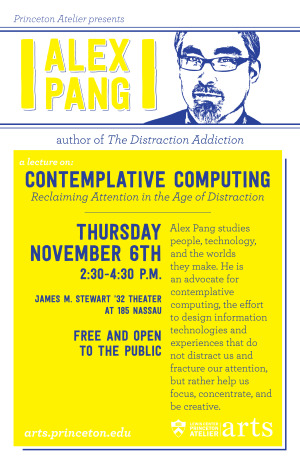
alex-pang-poster-300x0-c-defaultI am putting November 6 at 2:30 p.m. on my calendar,  to hear an expert on calming technical distractions (Alex Pang) speak to a Princeton University Atelier lass on “Contemplative Computing: Reclaiming Attention in the Age of Distraction.

Pang wrote The Distraction Addiction, with one of the subtitles “Taming the Monkey Mind.”

I just wonder if, after so many years, my distractable simian mind even wants to be tamed.

Surveillance Knights: Doctorow and Felten

doctorow hermann felten

Liberation can turn into surveillance, they warned. Two anti-surveillance knights of the internet, science fiction author Cory Doctorow and Princeton University tech guru Ed Felten, spoke at Labyrinth Bookstore today, co-sponsored by the Princeton Public Library.

The Internet is the nervous system of the 21st century, said Felten. Just as language helped cave men collaborate, the Internet helps us organize at lower costs. It transcends what a single person can do. It is a mistake to try to control the Internet and fit it into something small, said Felten. “It was architected to let people try things and discover what worked.” If over controlled and regulated, we will lose that freedom.

YouTube needs to be free from regulation. Every minute, 96 hours of video are uploaded onto YouTube, most of it personal, says Doctorow, and that’s OK. Each of the seemingly banal interactions  — like the ubiquitous cute cat videos — is important. “Relationships are built up on these little moments,” said Doctorow.

What these like-minded experts said can be found in their writings, but Felten used a homey example to explain his objection. When the Keurig coffee maker patent expired, you could buy private label pods. Then Keurig engineered its new coffee makers so only its own pods worked. “That’s like patenting shoelaces, so you need European rights to tie your shoelaces in Germany.”

Doctorow cited software that can deactivate engines if the car is stolen. It might be sold to vendors of subprime car loans. Wireless pacemakers can be hijacked. For instance, one demo showed a pacemaker hooked up to a strip of bacon — and it fried the bacon.

As efficient and valuable as the Internet is, the Doctorow/Felten meeting demonstrates that nothing beats personal networking. PPL’s Janie Hermann (between Doctorow, on the left, and Felten) encountered Doctorow at a library convention over two years ago and learned that he was a buddy of Felten’s. Since that meeting several attempts were made to bring the two together for a conversation in Princeton, but schedules never matched. Three weeks ago Hermann learned that not only did Doctorow have a new book coming out but that he would be in the area for New York City Comic Con. She zoomed in on the rare opportunity and with very little notice was able to connect Doctorow and Felten at last, but the library’s community room was not available. Dorothea von Moltke from Labyrinth Books stepped in to offer her space for what turned out to be a standing room only event.


The Pinking of Princeton: Salary Gap?

Maria Klawe was named dean of engineering at Princeton University — soon after Princeton had its first female president.  Unafraid to be ‘different‘ (she doodled and knitted at faculty meetings), she left after three years to be president at Harvey Mudd and to raise a feminist ruckus when appropriate.

Now, as reported in the New York Times today, she contends that because she (typical woman?) did not negotiate her salary, she was paid $50k less than she should have been. Wow.

The article “Microsoft Chief Sets of a Furor on Women’s Pay” is on the controversial statement by Satya Nadella that women “who do not ask for more money … would be rewarded in the long run when their god work was recognized.” His mea culpa refers to some other HR axioms that you may or may not agree with.

Meanwhile, if you want to see what this woman looks like, just go to the Friend Center, to the big room with the portraits of the deans, painted in oils by distinguished artists. All except one. Klawe’s is a watercolor, and it is a self portrait. Below.

klawe DSCF1695