All posts by bfiggefox

Mix cricket with honey – or eat crow

Alternate 11-9 Cover & Front (1-8).indd

“In Trump’s America, don’t look for lurid conspiracies in the shadows. Beware of the dull ones that are right out in the open.” 

So says Diccon Hyatt in a column about conspiracy theories in a November 16 column in U.S. 1 Newspaper one of the more rational of the florid post-election conversations. “The Podesta e-mails revealed a truth that was much more frightening than a conspiracy. Most of the e-mails were routine campaign strategizing, and it is in these e-mails that a picture emerges. The campaign had no idea how to beat Donald Trump.”

Richard K. Rein also commented on the national politics on November 9 and November 16. 

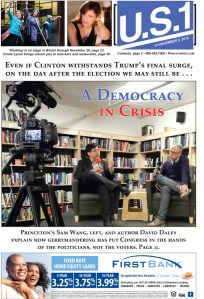
Politics?? I tell people I meet,  at the chamber and elsewhere, that U.S. 1 “doesn’t do politics” and then I have to add “except when it does.” Back in the day we did a cover story on Rush Holt. And though the issue went to press on the DAY of the election Tuesday, Rein put prognosticators Sam Wong and David Daley on the cover.wang_pic

Wang has always been one of my favorite researchers to listen to and write about. As a Princeton University neuroscientist, and the author of books with broad appeal like “Welcome to Your Brain,” he doesn’t put on airs. One of his several passions is his effort to expose the bad effects of gerrymandering. “So no matter what the outcome of the national election, Rein wrote, “expect Wang to continue his work on the gerrymandering issue, which he shares with the public at gerrymander.princeton.edu.

The cobbled-together story in U.S. 1 combined excerpts from Wong’s blog at Princeton Election Consortium with quotes on Wong from David Daley’s book on gerrymandering plus bits from Wong’s lectures to alumni. But it was a way to cover national politics from a Princeton perspective,  so it worked.

Wrote Rein: “So if Wang is wrong in this tumultuous year, he will not only eat a bug (as he promised to do in 2012 if Romney had upset Obama), but he will surely go back to the statistical drawing board, to figure out where and what he and the collective public opinion polls had missed.”

Here is the New York Times column today where he explains why he had to eat the bug. Here is the CNN video of Wang eating the bug. It was a cricket, mixed with honey, as Wang noted, in the style of John the Baptist. Would it be unkind to suggest that his sources, the pollsters, eat crow?


Beethoven: An edge of aggression and danger

beethoven

For Princeton University Concerts today, the Takacs String Quartet played for a stage-full of people who came to meditate while listening to Beethoven. This session — free including sandwiches afterward — helped to celebrate the 6-concert Beethoven cycle. The quartet played the first movement of Beethoven’s Opus 18 #2 (it was on the first program, Tuesday) and the adagio from the E-Flat Major quartet, Opus 127, which is scheduled for the 4th program, January 19.

Princeton’s classical music audience is generally quite respectful. No unwrapping of candy, no shuffling of feet, coughers are embarrassed, sneezers more so. But rarely have I been in a listening group where everybody tried so hard to sit still. Today at Richardson Auditorium an overflow crowd filed into the auditorium, onto the stage, for Mindfulness and Music, a guided meditation. The posters overhead celebrated the Takacs quartet’s six-concert Beethoven cycle. The quartet was surrounded with people sitting on chairs and kneeling on pillows. Matthew Weiner of the Office of Religious Life explained the rules and struck a gong three times. Long silence. More long silence. We all meditated our hearts out. Than the quartet began to play.

First violinist Edward Dusinberre said later that it was a whole new experience to begin from silence — no entering with adrenaline pumping, no prep to get ready, just — lift the bow and break the silence. “It was a fragile moment,” he said.

Andras Fejer, cellist, confirmed that – with this meditation group, so receptive, in such an intimate space, the quartet felt they could just present the music, with no need garner attention by ramping up dramatic contrasts.

Geraldine Walther, the violist, was nearly overcome with emotion as she described how, as she played (and I hope I’m being accurate here), she feared for the values that she held dear. Yet she knew that these values have survived since Beethoven’s time, for 200 years, and she found comfort in that.

Mary Pat Robertson, one of my long-time friends in the dance community, had this response. It was so moving to be able to experience chamber music up close, and with a group of people coming to the experience with a specific desire and intentionality to their listening.”

Robertson offers a way to think about how Beethoven can help us get through what many of us believe will be a period of national and international turmoil:

“When we think about music to meditate to, we might think of anodyne “spa” music.  Beethoven’s music has an edge of aggression and danger that are far from that.  It is music made in a time of uncertainty and political instability, declaring the power of the individual soul.”

beethoven-poster-img_2213“We have been living (up until now) in a time of great peace and prosperity, relative to his era.  Those of us who shared this experience together took away a heightened sense of the risk-taking of great art, and the importance of sharing our emotions with each other with the materials of spirit that are uniquely given to each of us.” 
“As one of the quartet said, “we are only the vessels.”


Top Two Buttons? Rein and Hilfiger

tommy-three-tommy-and-rich-rein
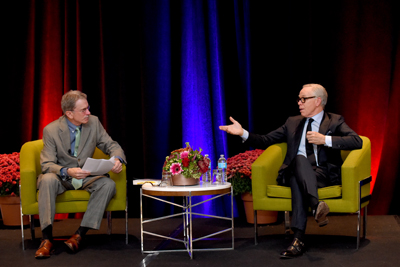
Rich Rein and Tommy Hilfiger (photo by DiGiovanni Photography)

I have my own story about meeting a celebrity at the Princeton Chamber event at the Hyatt but Rich Rein’s is better.

He interviewed Tommy Hilfiger about his book American Dreamer and muses on that experience in his U.S. 1 Newspaper column last Wednesday.  .

For the occasion, Rein had outfitted himself in a T.H. shirt and tie from Macy’s, but apparently that wasn’t enough.

You’ll have to ask me in person about my own embarrassing story, it’s not something I want in print. But I can heap praise on the spectacularly displayed goodies at the VIP reception

food2031and the enthusiastic crowd of 400 that filled the Hyatt ballroom to capacity. Fashion students from Philadelphia, attending on free tickets but buying Hilfiger’s book, were thrilled to be there, along with many many on the Chamber email list, some U.S. 1 readers, and people who heard about it on the radio (I polled those standing in the booksigning line that curled around the room.)philly-students-imgp2045

To my somewhat surprise, since I am not a fashionista, I liked the book, a tale of derring do. I particularly liked the part where one of his buddies recognized that the river would flood the town of Elmira, so they enlisted everybody — family and fellow high school students — to move inventory from the basement to the top floor. After the flood, the Hilfiger stock was the only dry clothing for sale in submerged Elmira. Everybody — grandparents and teens alike — bought and wore his tie-dyed shirts.

Hilfiger’s is a Horatio Alger story of overcoming — not poverty, but dyslexia. It’s just amazing how talent and focus — and maybe a little luck and grace — can conquer disability.

You’ll have to read Rein on the top two buttons. I can’t tell it as well as he did.


Nancy Duff: adding her Christian voice

nancy-duff-better-cropped
Nancy J. Duff, associate professor of Christian Ethics at Princeton Theological Seminary, speaks at the United Methodist Men’s breakfast at the Princeton United Methodist Church Fellowship Hall on November 13, 2016 on “Called by God”

Nancy J. Duff quoted Leonard Cohen’s Anthem yesterday.

I can’t run no more/with that lawless crowd/ while the killers in high places
say their prayers out loud/ But they’ve summoned, they’ve summoned up a thundercloud/ and they’re going to hear from me.

2016-november-umm-duffDuff, the Stephen Colwell Associate Professor of Christian Ethics at Princeton Theological Seminary, had a warm reception from old and new friends at Princeton United Methodist Church. (Her husband, David Mertz, had been the assistant pastor here.)

She talked about how Christians are ‘called by God to glorify God in all that we do,” quoting the well-known saying about how a shoemaker can make shoes to glorify God. “We are called into being for a divine important purpose — and we are called to make a space where others can glorify God.”

But, she cautions, if we go to far in claiming a divine calling, ‘this could keep us from being self-critical.”

Her response to the election turmoil — her call —  is to establish her own public voice.

She writes: I know that lots of Christians who are afraid of the policies that are about to hurt people – and are already hurting people – are going to find their voice. But we need to speak individually as well as collectively.

Here is the link to her very first post on her brand new blog, Speaking Up. 

Christians who disagree with those  radically conservative evangelicals who support Trump need to speak up. This blog will be my effort to add my Christian voice to the public realm.

Some write, some discuss publicly, some engage privately, some protect, some  demonstrate — each of us, no matter what our faith, can find a way. We all crave a community.   .

Waking up in America on November 9.

The worst of it, said 17-year-old Ziad Ahmed, ” is waking up in America after crying yourself to sleep, and not feeling safe. (If you don’t feel that way, you don’t get to belittle how millions of us are feeling.)

Here is his essay in the Huffington Post , linked to the web page at NIOTPrinceton, where he is a board member.

Tomorrow is another day, says Ahmed. “But tomorrow, I will continue to rise as a proud American-Muslim teenager, and I will not let anyone take that away from me no matter what tomorrow holds. Tomorrow, we rebuild. We have to.”


Capital Networking Group: November 8

tommy-peter2034
High Level Networking: Tommy Hilfiger (in pinstripes) greets Princeton Regional Chamber CEO and board chairman Richard Coyne (Alice Barfield looking on) at the Hyatt ‘s VIP reception downstairs before he was interviewed upstairs by Richard K. Rein for 400 eager fans about his book “American Dreamer.”

Election morning — how did I do this? – I am scheduled to speak at 7 a.m. at the Capital Networking Group at my own church, Princeton United Methodist, at Nassau & Vandeventer.

Upstairs,  the church is a polling place for District 10. Downstairs, in Fellowship Hall, I guarantee no politics. Only stories. 

For the entrepreneurs in this group, which meets every Tuesday morning for breakfast (good bagels!)

I’ll talk about how to promote your business or nonprofit, based on my experience as senior editor for U.S. 1 Newspaper and, after retirement, doing pro bono public relations for Princeton United Methodist Church, Not in Our Town Princeton,  the United Front Against Riverblindness, and the New Jersey State Button Society. For info, email: CJerry@jerrylaw.com but if you just show up that’s ok too. Check the website.

The items below popped up in my news feed this week and may find their way into the stories I’ll tell.

The first seven words matter. In person, you may make your first impression in a millisecond, the blink of an eye, according to Princeton psychologists Janine Willis and Alexander Todorov (Association for Psychological Science) July, 2006.

“If you can’t be funny, be interesting.” Harold Ross, founder of The New Yorker magazine, from The Writer’s Almanac.

“If it’s familiar but has a certain something that sets it apart, you’ve got a hit,’ Tommy Hilfiger, American Dreamer, p.131

“Millennials expect transparency, sophisticated storytelling, and technical savvy.” Nicholas Fandas, “Beyond Money,” New York Times, 11-3-16

“The pay phone measured time in quarters, the Internet in taps and clicks.” In There’s Nobody Here by That Name, by Steve Bryant via Medium Daily Digest.

SO, you might ask, why did I use my photo of Tommy Hilfiger for this post? 

BECAUSE I COULD! Any good PR person knows never to miss a chance to tag along on celebrity coat tails, however slim the connection.

Of course — all the media attention to a certain celebrity is what got us to this point in the election cycle.

But, I promised, no politics.

New Lens for Racial Literacy

firstSurely Michele Alperin’s superb October 19 cover story in U.S. 1 Newspaper on Ruha Benjamin helped to enhance awareness of the value of Racial Literacy. Benjamin’s first lecture drew an enthusiastic standing-room-only crowd at the Princeton Public Library, and on Tuesday, October 25, at 6:30 p.m. she will facilitate the discussion at the Garden Theatre’s screening of the three-part documentary “Race, the Power of an Illusion.”

This first segment, “The Differences Between Us,” examines the science -including genetics – that challenges the assumption that human beings can be bundled into three or four fundamentally different groups according to their physical traits.

Racial literacy is a much-needed, often neglected skill that — in the 21st century — we all need in order to live and work successfully in a diversifying society. But conversations on race are not easy to have. But as Benjamin said in her lecture,  “Racism doesn’t belong to few bad apples; it is coded in our psyches and institutions. Pretending we don’t see it is not a cure.”

The five-part Racial Literacy series is cosponsored by Not in Our Town Princeton, Princeton Public Library, and the Garden Theatre. It continues with Benjamin’s second lecture at the library on Tuesday, November 1 and film screenings on Monday, November 7 and Tuesday, November 15, all starting at 6:30 p.m. In the coming months, Not in Our Town Princeton will continue its monthly “Continuing Conversations on Race and White Privilege” on first Mondays at 7 p.m. at the library. For details go to niotprinceton.org.For social media, use #Racial Lit and tag partner organizations, @PrincetonPL, #niotprinceton, and @PrincetonGarden

As quoted in Alperin’s article,  Benjamin aims to help people put on a new pair of spectacles and see that “what I’ve learned about this is actually wrong.” Who among us does not need new lenses?

Momentary Quartet October 29

jane-buttars-quartetExperience the excitement of music created live! The Momentary Quartet plays Saturday, October 29, at 7:30 p.m. at the Unitarian Universalist Church, 50 Cherry Hill Road,  in Princeton. Tickets at the door, $15.   Experience the excitement of music created live! Jane Buttars, piano, Harold McKinney, trombone, Patrick Whitehead, trumpet, and Lin Foulk, horn, improvise in styles from classical to blues to world music. With Daniel Harris, poet, and Aurelle Sprout, dancer. 

To continue in this vein, Buttars offers a workshop on Sunday, October 30, 1-3pm.   Enjoy inventing music with others in a fun, supportive atmosphere. Beginners to professionals welcome. $10 donation suggested. 

www.MomentaryQuartet.wordpress.com, 609-683-1269, janepiano2@comcast.net


Day of Dance October 30


outlet-dance-project

Science scribe speaks 10-10-16

roach-and-krulwich
Mary Roach and Robert Krulwich. Photo by Stephanie Black 

New York  Times science writer Mary Roach talks  talked with Radio Lab’s Robert Krulwich tonight at Princeton University’s Friend Center 101 at 7 p.m.

Because I grew up with the smell of formaldehyde, I’ve long admired her for her best seller “Stiff,”  which dissects the truth about human cadavers. She’s on tour now for Grunt: the curious science of humans at war. 

Bon mots captured on my Twitter feed:

She positions herself as the ‘bottom feeder’ of science writers.

“Since I don’t have a science background I write (simply) for a roomful of me.”

To get her material, she said she does ‘random groping’ at start of her research and yes the word was deliberate.

“I don’t look for anything specific but I know when I find it’

Use vulgar words sparingly for best effect when you do use them, as in ‘A maggot breathes through it’s  – ss’