Mayor of Princeton Liz Lempert, Police Chief Nicholas Sutter, Rabbi Adam Feldman of the Jewish Center, and Rev. Matthew Ristuccia of Stone Hill Church invite the entire community to join them in an important event in response to the recent police shootings of African-American men and the sniper attacks on police in Dallas.On Wednesday, July 27, 2016 at 7:00pm, in the John Witherspoon Middle School auditorium, 217 Walnut Lane, Princeton, NJ 08540, members of the Princeton community will be gathering together to process our reactions to the deep fissures exposed by these national tragedies. The bulk of the evening will be devoted to hearing from a representative of the African-American community as well as a representative of the law enforcement community, giving them the opportunity to share their personal perspectives. In listening to these stories, we as a community will be challenged to examine our own narratives, and to put a human face on the statistics and headlines that have confronted us in recent weeks. Such a challenge is a vital first step in building bridges and taking positive steps toward real reconciliation and growth in our community and our nation.Join us for this evening of grieving together as we acknowledge the pain and fear engendered by these events, and as we strive for hope and forward movement as a community.
A shout out to Telequest who produced this great video for Isles on how to fight dust with effective house cleaning methods. Watch it if you need motivation to use a vacuum cleaner more often. I just found the video and like the tip about getting an extra damp mop bucket instead of using the kitchen sink.
HERE’S A DUAL POST — FROM ME AND GUEST WRITER EILEEN N. SINETT. EILEEN GOES FIRST...
“Stories Still Matter: In Print and Online” was the theme of the Princeton Chamber’s Business before Business breakfast networking meeting this morning. Richard K. Rein, founding editor of U.S. 1 Newspaper, shared stories that only dig-deeper news people would know. His speech was informative, entertaining and well-delivered.
As a Speech Coach, I was especially taken by his smart opening which was void of verbiage. Yes, Rein opened with silence, four seconds worth (as the audience later learned). He created the “verbal white space”™ that level-sets audience attention and highlights opening remarks. Silence is often scary for societies that talk a lot.I noticed one or two people in the audience getting antsy after 2 seconds of quiet, but saw the other 90 people in the audience palpably poised to listen and patiently await the stories that would soon unfold.
Starting a speech with silence makes perfect sense. It can feel risky and uncomfortable at first, but the positive impact is quite rewarding. Silence is to speech, what margins are to writing. The ability to be present without words in speaking and in life, can be a strong differentiator.
Narratives can change opinions, said Rein, citing the late John Henderson (a former reporter who built his real estate business on the lyrical descriptions of his listings) and Jerry Fennelly, who issues real estate analytics in story form. Long form narratives can also clarify the thinking of the writer (as well as the of the reader) and help establish credibility for both writer and subject.
Barbara Fox with Richard K. Rein and freelancer Michele Alperin
Then it was story time: Rein told of almost-missed stories about Colin Carpi, lawyer Bruce Afran, and Muhammed Ali (as written by himself and fellow Princetonian sports writer Frank Deford) and he related a bit of gossip about Larry L. King. (Based on observing Ted Kennedy at a party, King vowed to do everything he could to keep that Kennedy from being president.)
In a lively Q&A Irv Urken asked about the value of print in a digital world: Brandishing the articles he used in his speech, he said, “you don’t have to worry about your batteries going down.” He also cited “the science of touch” and suggested that some presentations and pictures “require a bigger screen.” That print media has a limited space means that somebody must edit it to fit the space, and when editors get to do more than just run a spell check, readers read more carefully. Then Rein gave a shout out to Urken’s offspring who have media careers — one works for Newsweek and Street, the other for Yahoo.
Hurley-Schubert
Former reporter Vickie Hurley-Schubert (now with Creative Marketing Alliance) asked which was his favorite story. Hard to pick, but Rein cited one early in his career, for New Jersey Monthly, on the scandal surrounding Circle of Friends.
I liked his answer about whether the media has a liberal bias: “When you spend time with people, you begin to assimilate their values. Media does have an ego, but it also bends over backwards to present other points of view.”
So — down with ‘scooplets,’ which, as Rein explained, are what Jill Abramson calls the focus on quick content that spawned $1.9 billion in free publicity to the Trump campaign.
Up with narrative journalism. Long live the long form stories in the likes of U.S. 1 and Princeton Echo.
Rich Rein (Princeton, Class of ’69) will speak at the Princeton chamber breakfast on Wednesday. I’m looking forward to my former boss telling stories old and new. And I also like the tradition, at the breakfasts, that everyone gets to stand up and introduce themselves. Perhaps I’ll see you there?
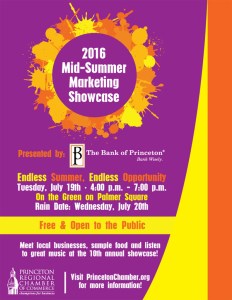
The day before (Tuesday) is the chamber’s Midsummer Marketing Showcase starting at 4 p.m. In past year’s it’s been plagued with weather cancellations, but predictions are good for tomorrow. And it’s one of my favorite Princeton Regional Chamber events, in part because it’s free.
A beloved high school English teacher, Frances Shores Meginnis, died at the age of 95. She gave me some low grades in English composition, which let me know, appropriately, that I wasn’t as smart as I thought I was. As one student recalled, “You quickly realized she was asking you to be better than you were, and there were lots of challenges.”
Her obituary was featured in the Baltimore Sun (among the few remaining newspapers that honors the art of good obituaries).
Jackson Bush (left) and Cris Hrabar ‘at the ready’ for Open Door Valet
Two problems solved with one pop-up business — where can townies can park at the eatery nexus near Hoagie Haven, and where can tourists can park downtown?. Douglas English founded the Philadelphia-based Open Door Valet in 20o9 and Chris Hrabar (above right) joined him a year later. His car parkers serve such restaurants as the Peacock Inn and Eno Terra and he opened this freestanding location of Open Door Valet in mid June.
Park your car yourself across from the Ivy Inn (the parking lot behind 245 Nassau Street) and pay $5. (What? no more snitching a parking place to pick up a Number One?) Valet park at Hinds Plaza and it costs you $15, $10 on a slow night like July 2 when two stones-throw-away garages had lots of space.
Even better deal: Park it yourself, go pub hopping or people watching, and “text-2-retrieve,” they will pick you up wherever you happen to be. Tips? (“They usually give us a $20 bill and say keep the change.”
A townie inside tip: Ivy Inn couldn’t get permission to expand because it didn’t have enough parking. Will paid parking get the town fathers/mothers to reconsider?
Valet services: definitely not for townies. We parked behind 185 Nassau (free on weekends). And we walked.
A newspaper’s depiction of Juba performing at Vauxhall Gardens in London in 1848. Credit Illustrated London News
With Shuffle Alongclosing on Broadway (yes, did you hear, Audra Macdonald is pregnant and ticket sales had slumped) I assuaged my disappointment (I meant to see this reincarnation of the historic black musical, but never did) by picking up a book at the Princeton Public Library’s youth section.
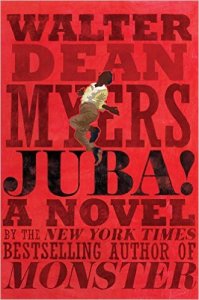
The engrossing and poignant “Juba: A Novel” by Walter Dean Myers is a must-read page-turner for young people interested in dance history and anyone interested in black history. Juba was both the name of a dance and the name of a legendary dancer, William Henry Lane, known as Master Juba, the first black man to dance for white audiences. Read about Juba in the New York Times Magazine account of Shuffle Along.
Myers describes how Juba danced for Charles Dickens, who famously wrote about him. In Juba’s (imagined) words, “I let the music take me over and sweep me across the floor. I spun, I moved across the floor on one leg and back on the other, I double-stepped, slid on one leg as I moved backward, switched to a six-beat clog step. I danced faster than I had ever danced, and with more precision than I ever had before, and with more joy in my heart. When the piano player got to the last chorus, I was tired and exhausted, and as happy as I had ever been in my life.”
The dancing part is the fun part. The being black in the 19th century is the hard part, but for youthful readers, Myers makes it OK.
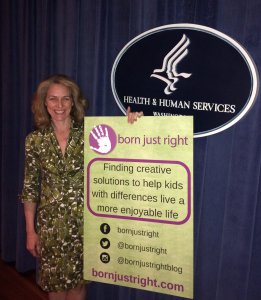
#bornjustright: making her own prosthesis with Project Unicorn
Making your own prosthetic hand? Sounds impossible, but kids are doing it with 3-D printers. I read about this on the program at the Maker Fair this week in DC, sponsored by the MedS
Susannah Fox, CTO of HHS, at the Maker Faire 6/23/16
Here’s a shout-out to attorney Liz Zuckerman, interviewed by Diccon Hyatt for this week’s U.S. 1 Newspaper cover story on the new overtime laws, read it here. It’s a complicated issue, explained well, with the “opposite side” presented well by John Sarno of the Employer Association of New Jersey.


 Rich Rein (Princeton, Class of ’69) will speak at the Princeton


 loor. I spun, I moved across the floor on one leg and back on the other, I double-stepped, slid on one leg as I moved backward, switched to a six-beat clog step. I danced faster than I had ever danced, and with more precision than I ever had before, and with more joy in my heart. When the piano player got to the last chorus, I was tired and exhausted, and as happy as I had ever been in my life.”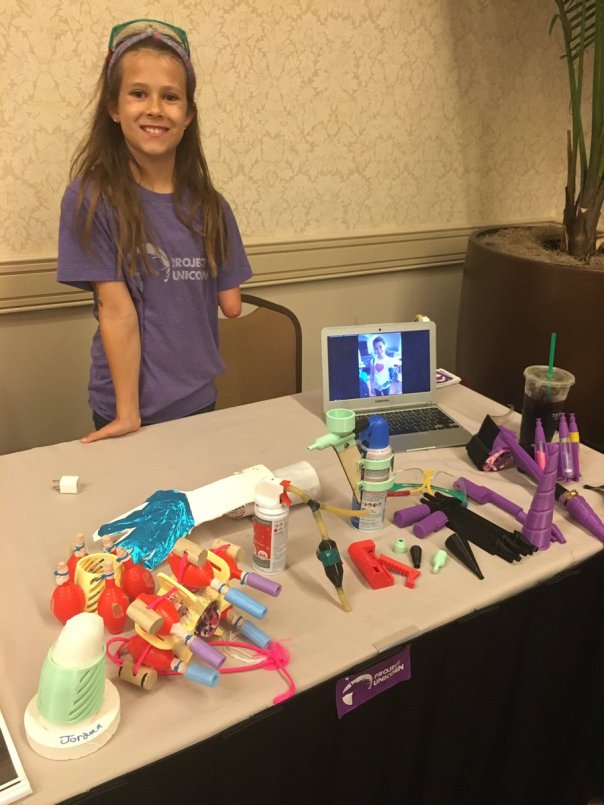

 Princeton Comment