All posts by bfiggefox

“Ask Me About Riverblindness”


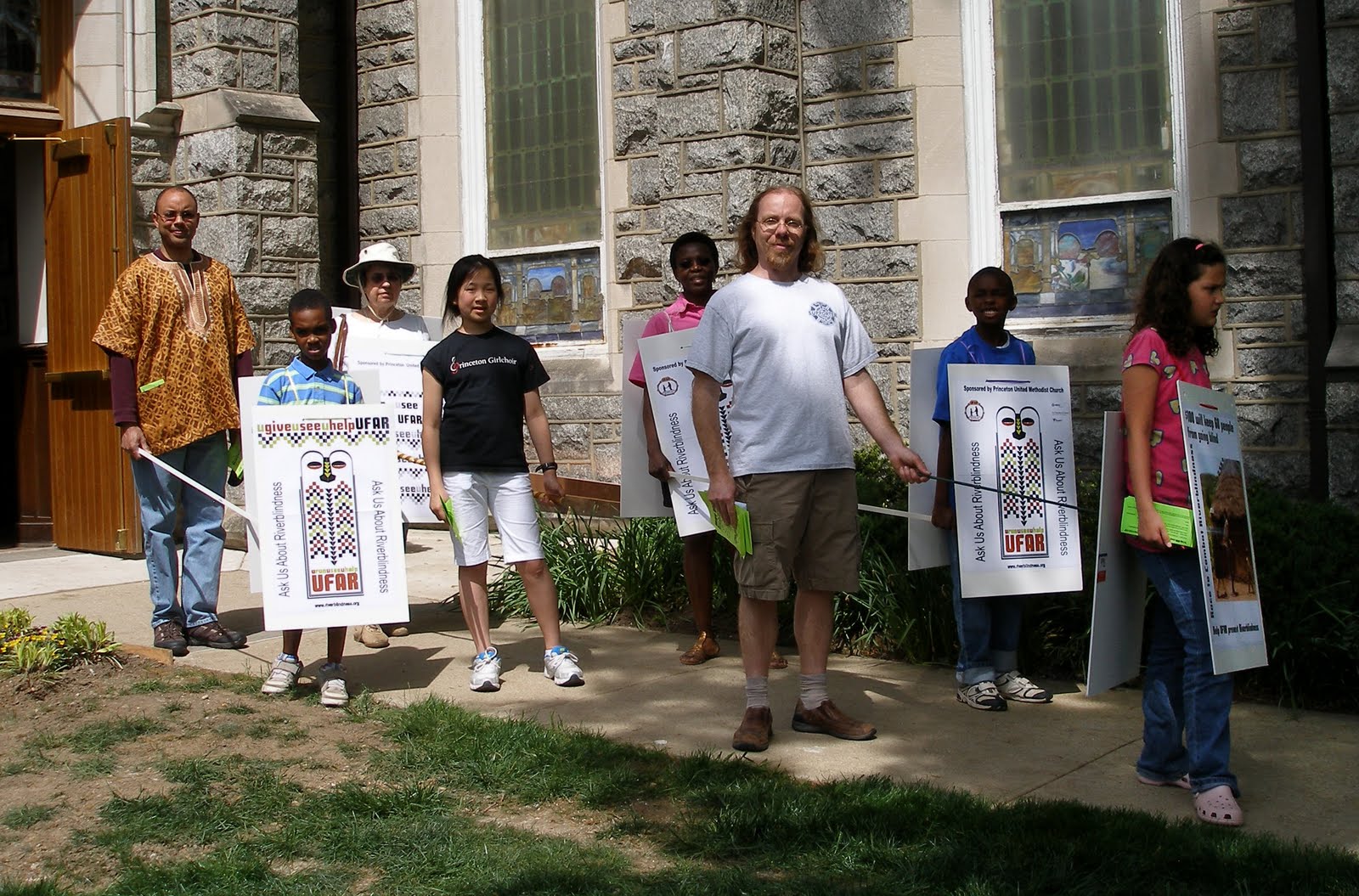
In what situation can a child make a witness statement where an adult cannot? When Princeton United Methodist Church (PUMC) re-enacted what happens to riverblindness victims in the Democratic Republic of Congo. Children from the church paraded through the streets

of Communiversity today, leading adults with sticks, wearing sandwich boards, and handing out United Front Against Riverblindness material with slogans like “Just $10 saves six people from going blind” and “
When an adult goes blind, the child must leave school, so riverblindness takes two lives.”

We went with two teams of children and adults, and we had a real good response. People took note and took our brochures, and the Princeton TV station filmed us.

A lot was going on at the church corner as well — a bake sale for the Appalachian Service Project was very successful, as was a display and craft activity for Vacation Bible School.

PUMC plans four events to benefit UFAR. Following the April 25 Afternoon Tea at PUMC, the May Day 5k to Combat Riverblindness is May 1. Hyosang Park gives a solo handbell concert on Saturday, May 15, at PUMC, and the African Soiree is Saturday, May 22 at the Carl A. Fields Center. (609-924-2613).

Eight young people participated today; they were needed. Adults could not have filled those roles.

Group photo by Pat Hatton.

Stand Against Racism on April 30


More than 10 organizations in Princeton will observe Stand Against Racism day, a YWCA initiative set for Friday, April 30. The day aims to bring people together from all walks of life, across the country, to raise awareness that racism still exists.

Cranbury Station Gallery on Palmer Square, owned by Kathleen Maguire Morolda, will be an official site for the YWCA Stand Against Racism event from 9:30 to 10 a.m. She will be joined by members of the Princeton Merchants Association. Not in Our Town Princeton will distribute pins, saying “Princeton: let friendship and pride in diversity prevail.”

“It is my hope that the community/merchants/employees/friends will join us and show their support for this worthwhile event,” says Morolda. “Participants are invited to gather and join hands, where we will form a “human chain,” stretching throughout the town, sharing a vision to eliminate racism and celebrate the richness of the diversity in this community. Please contact me at 609.921.0434, if your business would like to join us.”

Also participating in Stand Against Racism day are two other Mercer County businesses: Mercadien Asset Management and Rue Insurance. For the event schedule, click here.

From 5 to 6 p.m. Not in Our Town Princeton and the Minority Education Committee (MEC) will hold a rally in front of Tiger Park – Nassau Street and Palmer Square. Everyone is invited to join the rally.

I am one of the Princeton United Methodist Church representatives for Not in Our Town, a grassroots interracial, interfaith social action group committed to speak truth about everyday racism and other forms of prejudice and discrimination. The Minority Education Committee advises the board of the Princeton Regional Schools.

To quote the YWCA: Racism can take many different forms. These can include, but are not limited to:
– Discrimination
– Personal attacks of any kind, including violence
– Written or verbal threats or insults
– Damage to property, including graffiti

To quote Not in Our Town Princeton: Let friendship and pride in diversity prevail.

Dance on Campus: Next Three Weekends


This weekend, a tanztheater performance staged by a Princeton University senior: “Liminal,” inspired by the lives of the author Pilar Castro Kiltz ’10, and her cast; with original music by Vince di Mura. Performances are April 23-24 and April 27- 28 at 8 p.m., plus Saturday, April 24 at 10:30 p.m. and Sunday, April 25, at 2 p.m. It takes place in the black box theater at 185 Nassau Street. Tickets needed; call 609-258-9220.

Then look at the compatibility of Judaism with modern dance, also with music by diMura. Sydney Schiff choreographed “Context Preconstructed” as “a profusion of psycho-somatic experiences from sarcasm to sex.” See it at the Patricia and Ward Hagan ’48 Dance Studio 185 Nassau Street on Thursday May 6, Friday May 7, and Saturday, May 8, all at 8 p.m. plus a Saturday matinee at 2 p.m. Free and open to the public.

On May 29 and 30, Janell Byrne celebrates her 30th year with the Mercer Dance Ensemble.

Lots of dancing, some of it good, will be on view at Communiversity on Saturday, April 24. Look for me among the re-enactors from Princeton United Methodist Church. In support of the United Front Against Riverblindness, adult and child pairs from will wear “Ask Me About Riverblindness” signs and hand out brochures. To demonstrate what happens when an adult in the Democratic Republic of Congo goes blind — the child must leave school to tend the adult — the children will lead the adults, using poles. Call it guerrilla theater. The street fair runs noon to five, has so much to see and hear.

Zschau: Entrepreneurship is for everyone

This post has been corrected from the version posted on April 21. In that version, I credited Ed Zschau with opposition to the Dodds bill, as mentioned in an earlier post. He has not gone on record to oppose the bill.

Who knew Ed Zschau could sing? I’d have given anything for a video camera when the former Silicon Valley Congressman, now a Princeton University professor, belted out his “Old Risk Capital Blues,” which he wrote and recorded in the Beach Boys studio in 1978. He burst into song halfway through a speech to the Princeton Regional Chamber at the Nassau Club this morning (April 21), a speech that touched my heart and gave me courage to “keep on keeping on” trying to make a difference in this world.

I had predicted Zschau would talk about the Dodds bill, which aims to overhaul Wall Street restrictions. Instead he told a story about how he engineered the Steiger Hansen bill in 1978, which halved the capital gains tax.

Zschau and his entrepreneurial cohorts realized that the 50 percent capital gains tax stymied investment and prevented small companies from growing big enough to pay taxes worth 30 cents on every dollar’s profit. “We were killing the goose that laid the golden egg.” At that time he was president of a powerful trade association, and he lobbied Congress until he found Wisconsin’s Congressman, William Steiger, who said “get me a bill.” Zschau not only found the lawyer to write the bill, he named the bill, wrote Steiger’s introduction speech, and found a senator (Clifford Hansen of Wyoming) to sponsor it as well. Composing and recording the song contributed to the package that senators and representatives could use to persuade their constituents to support the Steiger Hansen bill.

President Jimmy Carter opposed the bill but signed it. Result: Venture capital investment ballooned from $50 million a year to $1.1 billion in 18 months and grew to $4 billion a year. “Jobs were created. Lesson to be remembered – Selling assets is discretionary. People weren’t selling in order to avoid paying the capital gains tax. And it changed the nature of the debate from ‘who should pay’ to ‘what will be the impact on the economy.’ “

In all my coverage of Zschau for U.S. 1 Newspaper, I hadn’t dug into his political views. He revealed more of them in the Q&A; period:

*He opposes trade restrictions, even at the expense of sending jobs overseas. “Every time the government tried to restrict trade, it hurt our economy.”

*The U.S. needs to increase the percentage of jobs focused on innovation (now just four percent, a percentage not helped by the fact that many Princeton engineering students take jobs on Wall Street).

*The stimulus plan is too targeted to work well and “you don’t make money with money, you make money by coming up with technology products and services with value to customers.” But “you can’t force innovation. You’ve got to create the environment for innovation.”

Supporters hailed the Steiger/Hansen bill as how a democracy is supposed to work: Come up with solutions. Provide facts and information that indicate the impact. “Each of us, every one of us, has the capability and responsibility to play a positive role in the governance of the country. But you have to be involved,” says Zschau, who is Class of 1961 at Princeton and would have every right to put his feet up, but isn’t.

The Steiger/Hansen bill was the third story of a three-story speech that recounted the Hewlett-Packard company’s founding and values (customer service, personal and professional employee growth, contribution to the community, and of course profit making.) Some of the keys to HP success included frugality and help from university professors. (Of course academe is not always helpful. The founders of Federal Express and Nike both got bad grades on their business plans in business school.)

Zschau’s concepts are surely not lost on the 300 of his 1,300 so-far students in his high tech entrepreneurship class at Princeton who have pursued entrepreneurial paths. He has just finished his 25th class and with some colleagues has helped endow a visiting professorship for entrepreneurial experts. “We are creating a Princeton brand of entrepreneurship, an approach to life of how to make good things happen,” he said.

The take-away for me – I’m not a techie and I’m not an entrepreneur – is Zschau’s challenge: “Be an entrepreneur in whatever you choose to do. Just like Packard and Hewlett, who created something from scratch. Just like Steiger, who seized an idea, take an idea and make it happen. If you live your life as an entrepreneur, you will make an impact on the world and experience the greatest satisfaction in life that a human being can experience – to see something that didn’t exist before and know that it is here now, just because of you.”

Powerful. He could have been speaking from a pulpit instead of a podium.

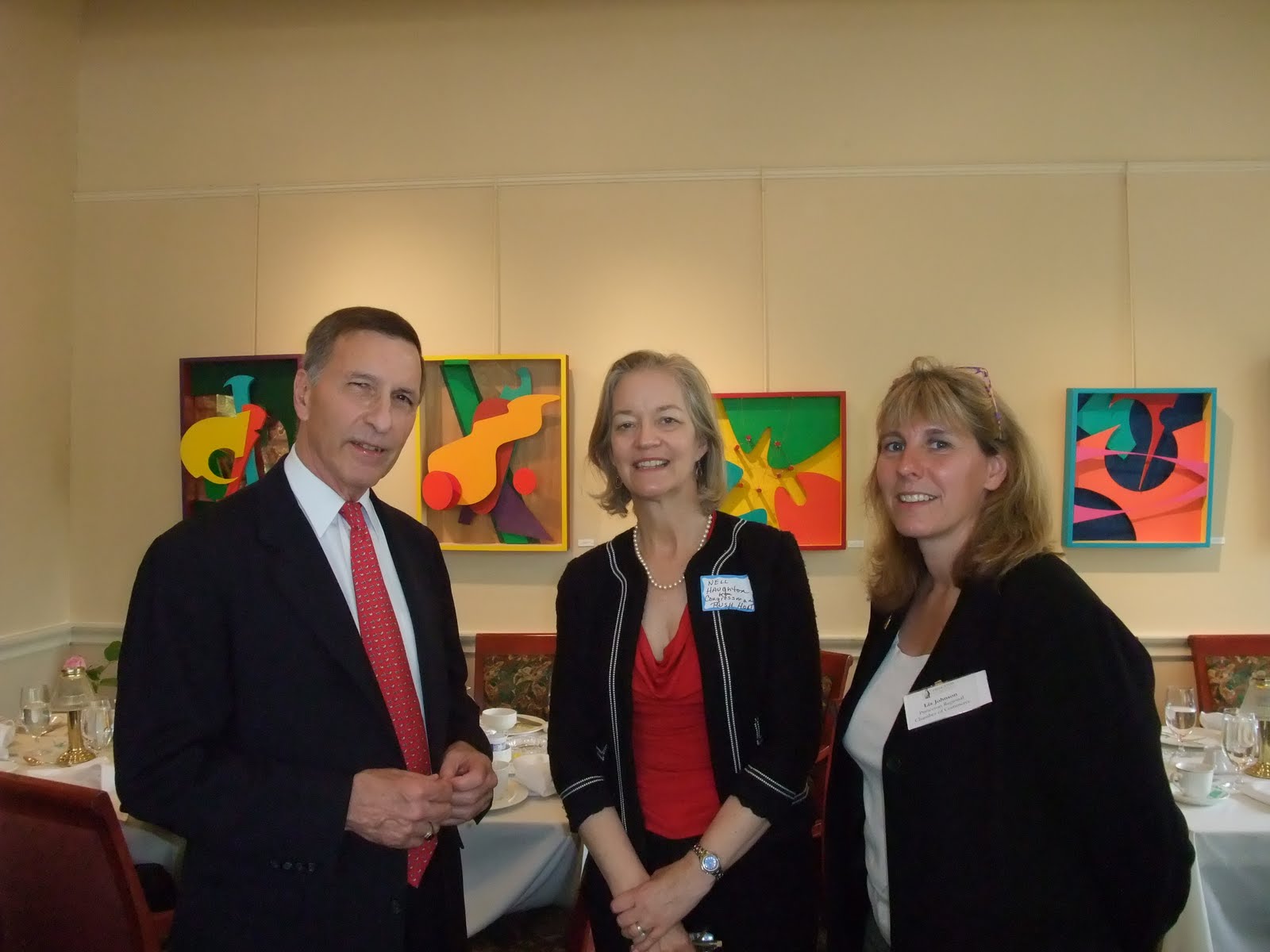
Photo: From left, Ed Zschau, Nell Haughton (special project coordinator for U.S. Representative Rush Holt), and Liz Johnson, the just-appointed business development coordinator for the Princeton Regional Chamber.

Kamen on Anticipatory Angst


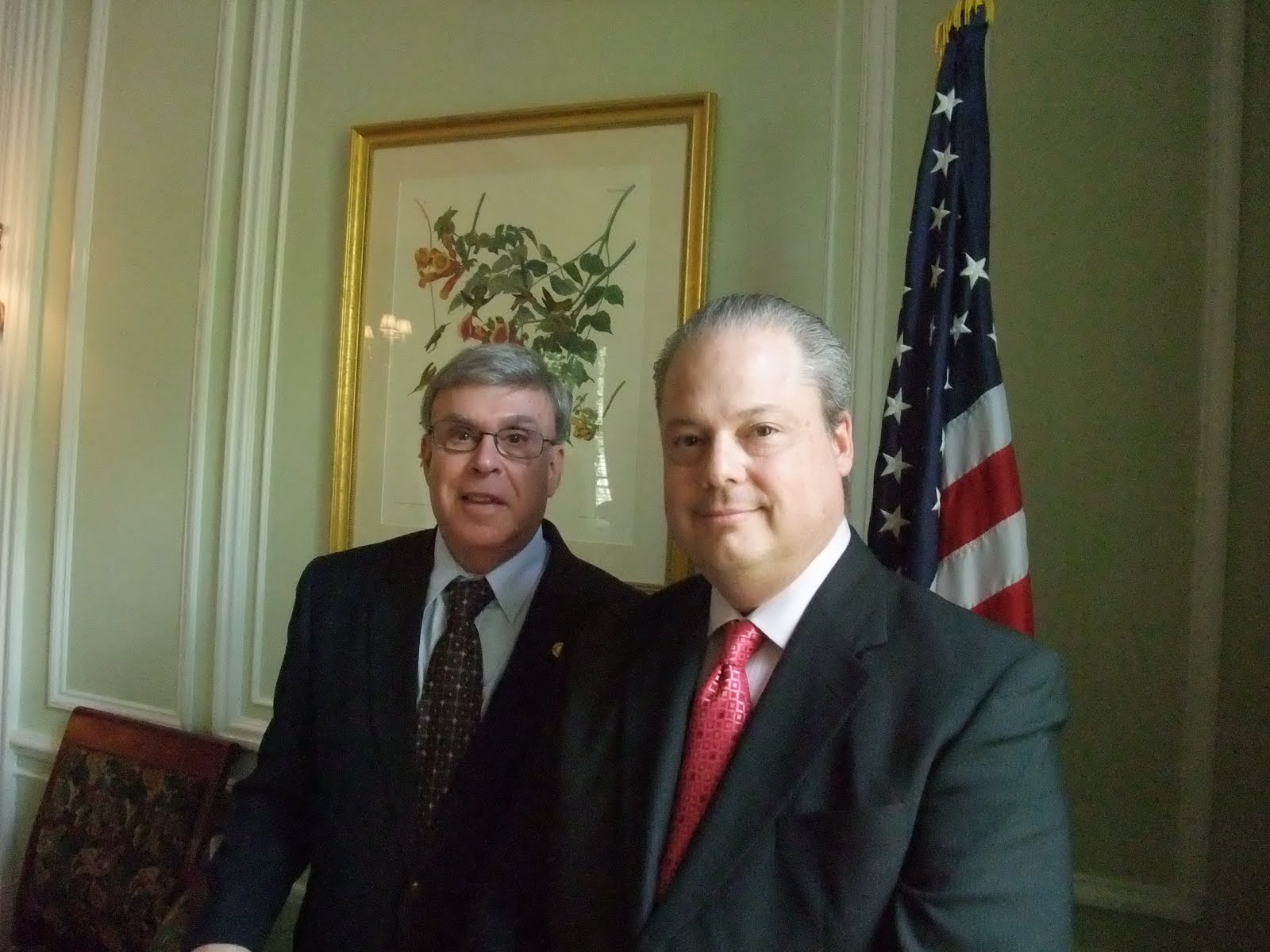
The SEC hasn’t changed its laws since 1940, Ken Kamen warned, and it won’t be easy for legislators (most of whom aren’t financial experts) to make sweeping changes in a hurry. Kamen (above right) is president of Mercadien Asset Management. He was hosted by Rotarian Jack Fein, a principal at Mercadien (above left), when he spoke at the Princeton Rotary meeting at the Nassau Club on Tuesday, April 20.

Kamen has an unusual credential, thanks to having sold his previous business (Princeton Securities) and needing to “sit out” for two years. Not only was it a good two years to be out of the market (2000-2002) but he had was tapped to advise Congress on the ins and outs of finances during the period of the Enron meltdown.

Congress won’t be helped by the media, he predicts, because when business reporting was in its infancy, newspaper modeled their business coverage after sports reporting (with its endless minutiae of statistics and personalities) or weather reporting. “The media covers volatility, not issues,” he said. “If Pfizer wins, then that must mean Bristol-Myers Squibb is losing. We need the long view, not the temperature of the day.”

Don’t let your business suffer and be paralyzed because of “anticipatory angst” about what the regulatory changes will look like, he said. In the end, everybody will agree on about 90 percent of the final legislation and will fight over five percent of the proposed legislation on the left and five percent on the right. “They disagree only on the periphery. Find out what they agree on, and make your bet before there is a bill.”

Dance Trumps Tech in Statistics

Just looked at this blog’s statistics from February through today and they delight me. A couple of dance reviews, including one that was weeks old, reaped the highest number of hits and the most new visitors over the last two months. I guess all the dancers sent it to each other and to their mothers. There were 202 visitors that day and 150 new visitors, only 52 returning visitors.

Second most popular were two posts relating to Ed Zschau, significant because Zschau speaks tomorrow at the Princeton Chamber. (Full disclosure: I’m on the committee that invited him — we knew he’d be a terrific speaker.) One was on a panel that Zschau chaired and the other referenced him as the guru of high tech entrepreneurship.

The third most popular day, February 8, had a much different ratio, with 188 visits and 132 returning visitors, only 56 new visitors. There were two posts that day, one on Darren Hammell of Princeton Power Systems, touting my cover story in U.S. 1. The other one, perhaps the real draw, was a gossipy piece on a little-known celebrity interviewed in the Daily Princetonian and picked up by Mimi of Princeton Tours.

Since I’m not trying to monetize this blog I don’t spend a heckuva lot of time slicing and dicing stats. The Zschau entry’s popularity bodes well for Ed Zschau’s speech tomorrow.

But since I started my career as a dance writer, and since dance is always at the bottom of the totem pole in editorial priorities nationally (only opera is below it) I’m delighted when, every once in a while, dance gets a good response.

Now if some techie out there can clue me in on how to install an RSS feed, I might be able to increase those stats…

Afternoon Tea: $15 Saves the Sight of Nine


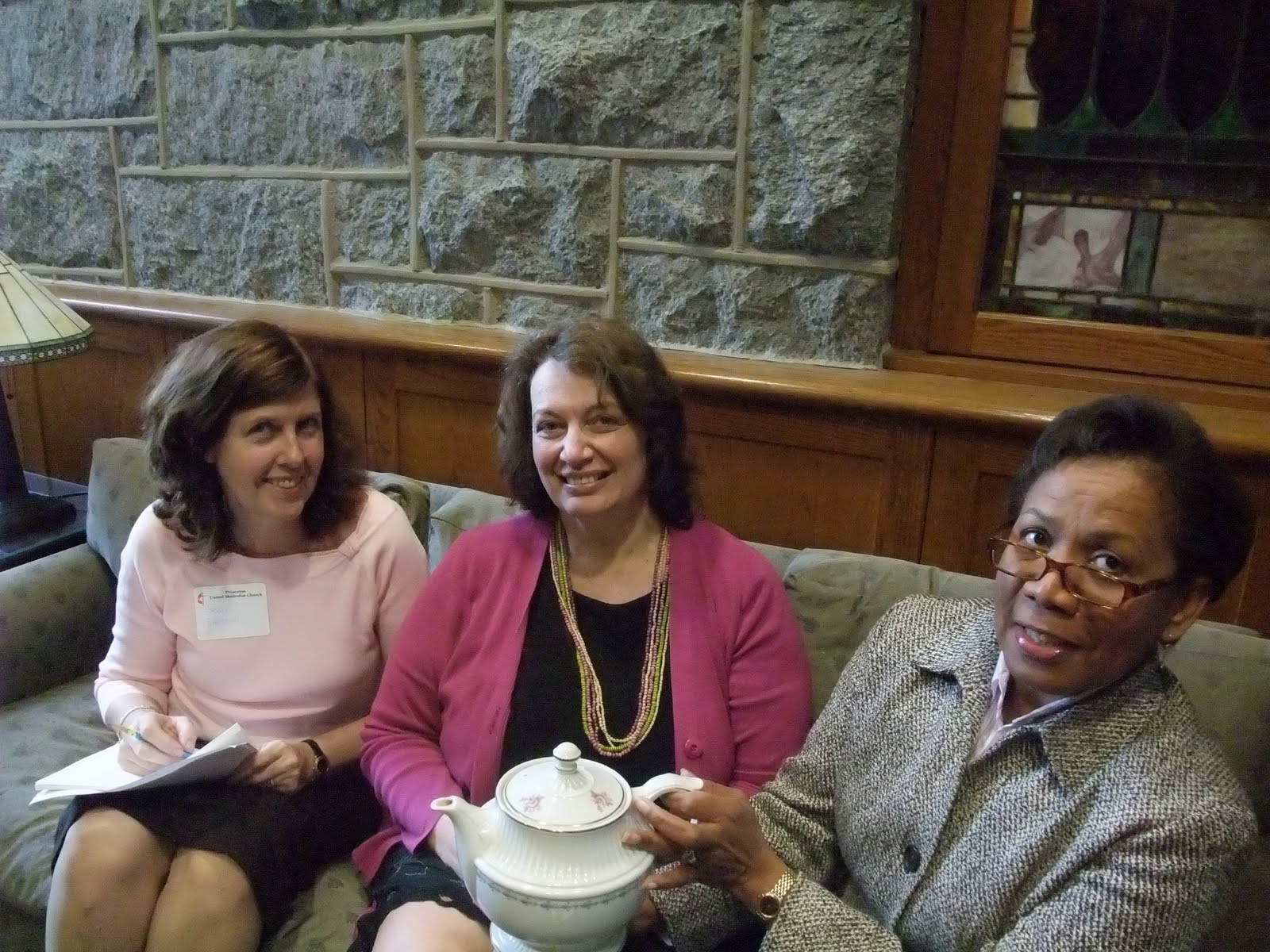
When the co-owner of a restaurant co-chairs a food event, you know the food is going to be yummy. Anne Fikaris (center) co-owns, with husband Danny, two eateries on Nassau Street – Zorba’s Grill and Zorba’s Brother. Fikaris and her cohorts (Susan Davelman, left, and Ulanda Frisbee, right) are putting on an Afternoon Tea on Sunday, April 25, at 2 p.m. It’s at Princeton United Methodist Church (yes, that’s my church, the one at the corner of Nassau & Vandeventer). The $15 ticket benefits PUMC’s mission to support the United Front Against Riverblindness in the Democratic Republic of Congo. Call 609-924-2613 for reservations or just show up.

The tea is one of several events to support the church’s mission trip to help UFAR. They include a May Day 5 K Race on May 1 at Princeton Theological Seminary, a solo handbell concert at the church on Saturday, May 15, at 7 p.m. and a community-wide African Soiree on Saturday, May 22, at Princeton University’s Carl A. Fields Center, complete with authentic African food, music, and entertainment (www.riverblindness.org). Tickets for the Soiree are $50 ($25 for students).

Riverblindness starts with a rash and leads to sight loss. More than one-third of the 60 million people in the Democratic Republic of Congo (DRC) are at risk of contracting this socially disruptive disease, which takes two lives, the life of the parent who goes blind and the life of the child who must care for the parent. The drug for riverblindness is provided free by Merck & Co., and UFAR is having remarkable success in getting the drug to where it is needed and ensuring that every person takes the drug once a year for at least 10 years.

In fact, every $15 ticket sold will keep nine people from going blind. “In addition to helping a wonderful cause, it will be an interesting and fun-filled afternoon,” says Fikaris. The chamber orchestra from Rutgers Preparatory School, directed by Robert Saunders, will play, and church women will give international cooking demonstrations. Jie Hayes will make a steamed Chinese fish dish, Kathleen Garber will make an English trifle. Susan Victor will demo an Indian Chapatti & Channa dish, and Jamie Huang will make sesame noodles and vegetables. Plus of course delicious teacakes and cookies will accompany the tea.

I can’t wait to taste the baklava. Perhaps I’ll see you there?

Zschau’s Horses: Worth Riding

This post was changed on April 23: See below.

Fourteen years before Ed Zschau came to Princeton to teach high tech entrepreneurship, he told Inc. magazine interviewer Tom Richman that his heart’s desire was to run a diner in some college town, where he could serve up greasy hamburgers and talk philosophy with hirsute students.

That dream or one pretty close to it came true, except that Zschau doesn’t have to wash dishes and flip burgers. In 1997 Zschau staked out a spot at Princeton University’s EQuad to teach high tech entrepreneurship. Translated: the philosophy of business success.

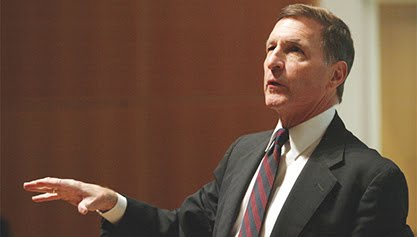
Zschau (photo by Frank Wojciechowski) speaks at the Princeton Regional Chamber breakfast on Wednesday, April 21, at 7:30 a.m. at the Nassau Club on what makes universities fertile ground for business. Cost: $25 for members, $40 otherwise. Call 609-924-1776 or go to http://www.princetonchamber.org

Richman observed, “What is more likely, however, is that he will own the diner, maybe a whole chain of them, or that he will be teaching philosophy at the college, probably as head of the department. Zschau is a person — we all know one or two of them — whose biggest problem seems to be coping with an excess of success.”

How true. Zschau has had more than his share of success. At the time of the Inc. interview he was 43 years old and serving the first of two terms as Congressman from Silicon Valley. He had three majors at Princeton (math, physics, and philosophy, Class of ’61), earned an MBA and PhD at Stanford, and taught at Stanford and Harvard. He was founder and CEO of System Industries, a Silicon Valley computer products company, from 1968 to 1982,and general manager of IBM’s Storage Systems Division from 1993 to 1995.

Since Zschau came to Princeton in 1997 he has taught his one-
semester course
24 times to about 1,300 students. Each year he selects about 50 students to take it, though some years it’s as few as 35 and as many as 70. Based on the students who have contacted him to give updates, he figures that from 250-350 have pursued entrepreneurial paths.

U.S. 1 Newspaper has covered Zschau and the young companies in his stable since he arrived in Princeton, most recently concerning Princeton Power Systems. Darren Hammell, the founder of that firm, spoke for the chamber in February. Zschau says, of the ups and downs of PPS: “I never thought that the company would fail. I’d been in situations with young companies before, including the first company that I started in 1968 that became public in 1980, and I was confident, based on the talents and dedication of the team and the strength of the company’s technology and reputation with key customers, that the company would get through the knothole, survive, and succeed. They did, and they will.”

I’m not the only Zschau enthusiast in this town; they are legion. Steven Georges (serial entrepreneur, formerly with Princeton Server Group) at an Einstein’s Alley Entrepreneurial Collaborative meeting, noted that Zschau operates in an idea factory – to listen, coach, criticize. And he quoted Zschau’s favorite maxim: “Always be on a horse worth riding in a race worth winning.”

On April 23 I eliminated the original ending of this post because I learned that apparently someone else by the name of Ed Zschau started a Twitter account to oppose the Dodds bill’s restrictions on angel investment. The tweet referred to a Huffington Post article So, for the record, Ed Zschau has made no comments about the Dodds bill.

An Actress’s Sleight of Hand: Anna Deavere Smith


Cultivate your stamina for doubt, advised Anna Deavere Smith, answering an earnest Princeton University undergraduate. And she quoted her grandfather: “If you say a word often enough, it becomes you.”

She gave the J. Edward Farnum lecture on Tuesday night: “The Song Inside of What They Said to Me: On Performing.” You may know Deavere Smith for her Condi Rice role on West Wing, but her real métier is the many-character, one-person documentary dramas, such as “Fires in the Mirror” (which I saw at McCarter), “Twilight in Los Angeles” (re the Rodney King trial) and “Let Me Down Easy” (about the healthcare debate.) She does her own interviews, like a reporter, and writes and performs her own script.

“By listening closely and capturing precisely the idioms of personality revealed in gesture, intonation, and expression, Anna re-animates people who deserve the public platform she offers,” said Jill Dolan, in the introduction. Her talent allows her to “not just take the temperature of the nation, not to just put her hand to its feverish forehead, but to describe the infections under the country’s skin.”

In the Q&A;, when a student unblinkingly asked where was the song when there was no music, Deavere Smith patiently suggested that the rhythm of the character’s voices constitutes a song, and she dropped into one, and then another of the handful of characters she had performed that evening. Six tone poems, an actress’s sleight of hand: the young Lubovitch housewife in Crown Heights, the Korean woman whose store was destroyed in LA, Rev. Peter Gomes of Harvard, a survivor of Rwanda genocide, a white doctor in a New Orleans charity hospital after Katrina, and Ann Richards, Texas governor.

(To console yourself because you missed this, here is a link to good TedX YouTube video.)

Her title was Justice, but the underlying theme was Grace.

Better Late Than Never: What She’s Having

I sit here at 6 p.m. on a Saturday night trying not to be disgusted with myself. Soon I will leave to see a dance concert, and I had made a vow not to see the next dance concert before writing about the previous one. Nationally known dances get excepted. I did see Paul Taylor on March 31 and dreamed my way home. Yet unwritten is the March 20 “I’ll Have What She’s Having” program that I really did want to write about. Events (trips, grandchildren, work) intervened. I have the program. I carried it and my small brown Moleskin notebook full of scribbled notes with me on two transcontinental trips, trying to fool myself that I would write on the plane, write on the train, write in the car, somehow write.

But no. And now of course I can’t find that notebook, though I have its sextuplet siblings, all looking alike. Memo to self: in the future draw designs on each empty Moleskin with in colored markers.

Anyway, here’s what I’ve got in my head about this concert, exactly four weeks later, and I hope dusty thoughts are better than no thoughts. If I find my notebook, I’ll add to it – and I solicit comments from anyone who was there. One friend, Barbara Palfy, has already done that, and I’ve put her additions in italics. So here goes.

If you thought you’d see something sexy, from looking at the title, “I’ll Have What She’s Having,” referring to the Meg Ryan film where she fakes an orgasm in public to prove that women do and can, and the lady at the next table over says (well now you know what she says) you were correct. In “Translations” Shari Nyce, one-upped herself from last year’s concert. She used a children’s story, read by her father, as a metaphor, and she added Henri Velandia. With her signature end-over-end tumbling movement style, the pair had some unusual couplings and did an effective roll in the hay duets. (If I were her choreography teacher I would seek to extend her reach by requiring her to do a pavane. She seems to be a Johnny One Note.) You gasp at the derring-do of the gymnastics but as that’s pretty much all there is, it palls, even the cutesy country gamine overlay. Problem: the story is one of those cumulative “bump-on-a-log” tales and goes on faaaar too long for the paucity of movement invention.

On the sex theme, Marie Alonzo took her cue from LaTraviata in “Passion and Fire,” referencing “the story of a doomed love affair between a famous courtesan and the writer, Alexandre Dumas, author of the original “Dame aux caméllias.” I’m not that familiar with the boudoir of courtesans, but this looked more like a bordello. Not in the least ladylike. I guess if you want to be extremely sexy in concert dance and get away with it, just invoke opera and set it not to Verdi but to hot salsa music. Still it was an effective scenario and more power to Alonzo; the piece worked and it captured one’s attention, if only for the all-out dancing of the principals.

Indeed it seemed like everyone improved from last year. Alison Maxwell, she of the ladylike and detailed épaulement, choreographed and danced a soulful elegy in a purposefully circumscribed space, “Esprit Libre,” and a duet with Gonzalo J. Aniano Porcile to “Georgia on My Mind,” made for them by Ilana Suprun, that was a little reminiscent of Tudor’s Judgement of Paris. Both good. I liked Suprun’s seven-dancer eponymous homage to Bach, so pleasant to the eye, and her solo “Farewell,” also an elegy. I seem to remember that Claudine Raniere’s “A Girl in the Green Dress” to the Barber Adagio, was deceptively simple-seeming but actually ever-so-detailed, an incantatory and passionate tribute to modern dance as we knew it. I want to see more of her.

Olivia Galgano and Needle in collaboration with composer Dr. Linda Marcel put together “BRCA1/Genome,” “exploring the complexity of the BRCA1 breast cancer gene [and its] diagnosis and treatment.” The piece was dedicated to all survivors. Complex it was, and pointedly ballet based — the second part showed an actual, if disjunct, ballet class. A series of op-art projections made great backdrops and the dancers were polished, but the three parts needed a fourth to make a powerful conclusion.

Two big works were exciting. Susan Tenney’s “Je me reviens…” (translated, “I remember”) begins with a lineup of eight dancers age 71/2 to 65, stock still, standing in rows. Using no décor and minimal props it had overtones of the cemetery in “Our Town.” A little girl takes a watering can and waters the feet of a couple of dancers and the scene comes to life. I took detailed notes, frantically trying to jot things down so I could figure it out later and of course we know where those notes are(i.e., we don’t). But some images are vivid. I knew at the time what it was about. Goings and comings with an emphasis on going and saying goodbyes. At one point Gary Echternacht flops rigidly to the ground. He’s definitely dead, as far as I’m concerned. We’re saying goodbye to him. There’s lots of joy here and I get the idea that it is remembered joy. Lines of dancers doing jetés on the diagonal. Clumps of dancers going east-west and west-east across the stage. A solo that seems, yes, like another elegy. (It would be the evening’s third.) Or perhaps this whole piece is an elegy. Yes, that’s what it was, an elegy not to a person but to a remembered past. It has layers and layers of meanings. If there’s a narrative, intended or not, you bring it with you. I want to see it again. And again. These dancers aren’t Paul Taylor dancers but they are as eloquent. Yes!

Forest, by Lynn Needle, was a premiere and an eyeful. Dancers on pointe in deep second plié, Bugaku style, hands down on the floor, like predatory spiders, all against a jungle backdrop. Three dryads, one languorous but muscled faun, one very willing nymph. Oh for my notes! But I remember thinking, this is Nikolais all the way and sure enough the program bio reveals that Needle toured with Alwin Nikolais, indeed. She has some gorgeously trained dancers. A wonderful piece. Nikolais on pointe.

Thanks, BP, for your help.