Category Archives: Dance and the other arts

Wishing It Were August Again?

October-2nd-Save-the-Date-Website-644x1024

Wednesday morning I’m looking forward to hearing from James Steward, the Gee-Whiz-How-Does-He-Do-It director of the Princeton University Art Museum. In his short tenure he has partnered with all kinds of organizations to bring new audiences to one of the best kept secrets on campus. He’s at the Princeton Chamber breakfast ($25 for members at the door).

Thursday I’m going to learn how to wrestle with Google Plus, when NJ CAMA (stands for advertising and marketing etc.) hosts Lynette Young on the university campus. If you have added me to your Google Plus circle, I have not added you. I don’t embrace what I can’t understand.

Friday it’s off to Rider University to see the opening concert of American Repertory Ballet and its gorgeous young dancers (it repeats Saturday). Also on Friday, Philadanco comes to TCNJ. And the next day, Saturday, September 21, dancers dance for world peace at the Princeton YWCA.

What drives all this activity? Volunteers, of course. Volunteers in general, and some specifically, will be honored in a gala, staged by Volunteer Connect, on Wednesday, October 2, at Grounds for Sculpture, as you see at the top of the post. Volunteer Connect helps non-profits get skilled help, and helps professionals develop their skills.

Somewhere in between I’m talking to Folks That Know about technical innovations in Mercer County. I’m writing a preview for the October 4 “Mercer Makes” seminar. That’s only three Fridays away — perhaps pencil it in.

Septembers are always busy, but does this one seem more so?

It’s Button Show Time!

enamel fop

Today, if you read this on Saturday, is the New Jersey State Button Show and Competition, where you will see some very gorgeous enamel buttons, like the 19th century French fop on the left. One of the competitions is for enamels.

Uniform buttons will be prominent too — there’s a talk on them at 1:30 p.m. Admission $2.

The show runs 9 to 4 p.m. on Saturday, September 7, at the Union Fire Company fire hall, 1396 River Road (Route 29), Titusville, NJ 08560. buttonlady@optonline.net or http://newjerseystatebuttonsociety.org

You don’t have to buy any of the pretty buttons, but you will be tempted to!

Ears See It in a New Way: William Klenz

In 1959, Dr. William Klenz required his undergraduate music history students at Duke University to unlock the secrets of baroque music by studying original texts for what led up to it — social dances of the Renaissance, as taught by dance master Thoinot Arbeau  in his Orchesographie.

Tapping dance sources is now a small but recognized niche (NYT, 9-4-13).

I believe Klenz — who never wore a watch because he didn’t want to be the slave of time, and insisted that all of his students sing “A” upon arising in the morning so that they would be in tune with the world — was an unrecognized genius.


Ralph Schlegel: Retrospective

Ralph chair 2

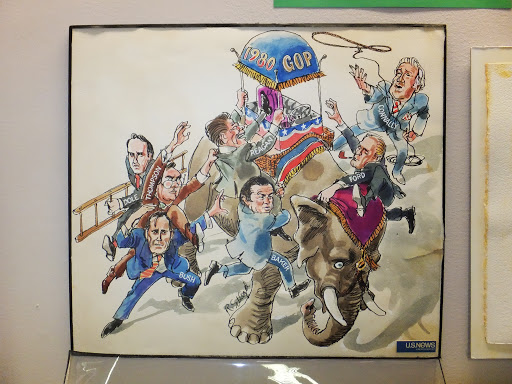
A visual thinker I’m not, so I am always amazed by how an illustration can indeed be worth a thousand words. For years I looked forward to the editorial cartoons by Ralph Schlegel in the Sunday edition of the Times of Trenton. I freelanced there in the early ’80s and his wife Sharon, Times columnist, is a dear friend.

Now that he is retired, I have to stifle the impulse to look at that page first, because I will miss the visceral energy of his caricatures, his sly wit, and his finely tuned jabs — some gentle, some acerbic — at the folks who run our city and state. As U.S. 1’s Dan Aubrey wrote, these images “scream of recurring political shenanigans and the constant need for a free press to keep an open eye.”

draw usnews gop<

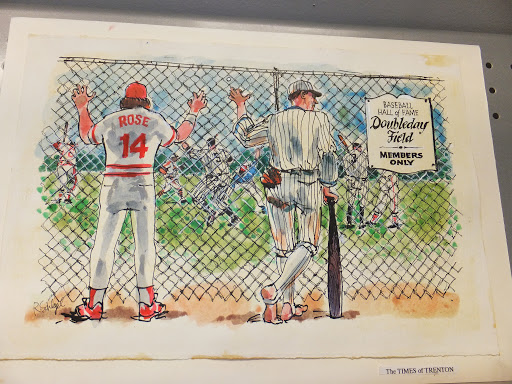
Through August, Lawrence Library has an exhibit of Schlegel’s work, not just his editorial cartoons for the Trenton newspaper, but also his freelance work for such publications as the New York Times, Business Week, and U.S. News & World Report. Go for a good chuckle, or for nostalgia, but you will also come away with a new appreciation for how an illustration can get closer to the real truth than words can.

draw Rose<

Plucked from Obscurity: Lou Draper at MCCC

draper girl

I may have written the first ever first press release on Louis Draper’s photography at Mercer County Community College. I was working in MCCC’s PR department at the time, 1981 to 1984. Now an article on Draper is among the most emailed stories in the New York Times.

Entitled “Louis Draper: Plucked from Obscurity…” the article credits Mercer County Community College’s Gary Saretzky with jumpstarting the attention to Draper’s photographic eye.

At the time of his death, his extensive collection of photographs, negatives and slides was not an archive in any meaningful sense. It was an unorganized mass of material that nearly overwhelmed his office at Mercer County Community College, where he had led the photography program. The task of bringing order to chaos fell to his friend Gary Saretzky, an archivist and photographer, with the assistance of John Sunkiskis, a colleague at the college.

He taught at MCCC for 20 years. We at the college knew we had a treasure. So did his students. He told me then that “The Family of Man” was his inspiration and the photographs in the forthcoming book will be show that.

Photo by Louis Draper, date not known

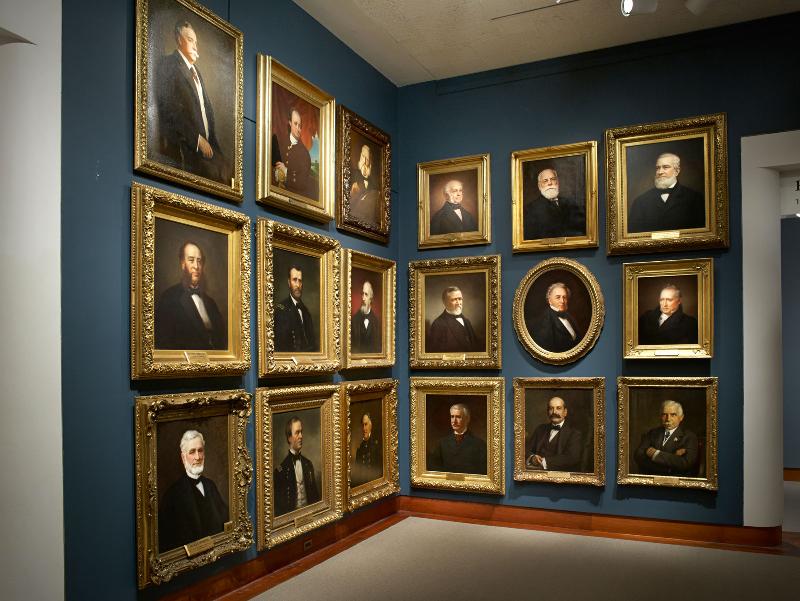
prince-2menFor just one day, at the Princeton University Art Museum, you can compare 19th century oil portraits of old, white (add two more adjectives, powerful and rich) men with 20th century portraits, photographs.

Shared Vision: The Sondra Gilman and Celso Gonzalez-Falla Collection of Photography has just opened and it highlights the enigmatic child pictured above.

Sunday, June 30, is the last day for Picturing Power: Capitalism, Democracy, and American Portraiture, brought to Princeton by courtesy of the Scheides (Judith and William). Your jaw will drop at the tier upon tier display of portraits of important men. These portrait painters knew their stuff — you can discern the personalities of the Carnegies, the Mellons, the Rockefellers, the Edisons.

The portraits used to hang at the chamber of commerce in New York until the display got so embarrassing (no diversity of sex or race) that the chamber sold it off.

When the portrait is on a wall, you can return the stare.


Not Just Old White Men

Image

That someone in the Medici family had African heritage may come as a surprise, but that’s what we learn in Revealing Presence in Renaissance Europe, on view through Sunday at the Princeton University Art Museum. When Alessandro de Medici, the out-of-wedlock son of Pope Clement VII and an African maid in the Medici household., became the Duke of Florence, there were no full-face portraits of him. Contemporary portraits showed him with a hood. After his death the portrait was painted that hangs on banners all over campus to promote the exhibit. Look here for an intriguing art history puzzle, about the picture next to it. The label on the picture reveals the sad fact that Alessandro was no popular favorite, “tyrannical,” is the word they use.

It’s definitely worth trying to get there before this exhibit closes on June 9. And it makes an intriguing juxtaposition to the four walls of shoulder to shoulder portraits of Old White Powerful Men, the former portrait collection of the New York Chamber of Commerce.  J. Pierpont Morgan, William H. Vanderbilt,  Grover Cleveland — these portraits are fascinating because the  personality of each man shows through.

This exhibit has a different title from the one I used, but the bottom line is — that when the need for diversity came along, i.e. the idea  that women and people of other races might possibly be admitted to the great halls of business, the paintings needed to go. As the New York Times review says, “old white men did not fit in with the chamber’s commitment to diversity. ” They are now owned by Credit Suisse and on view in Princeton through June 30.

If you think that in 2013 nobody makes politically incorrect comments about race, or gender, think again. Today in the racing column of the New York Times, in a discussion of a filly that will run in the belmont, a veterinarian was quoted as saying, “It takes a special filly, one that is willing to stare down the boys and say, ‘No this one is mine.’  It’s so much about personalities and intimidation when these horses match up. I think it’s the same reason women don’t have as much, and the same kind of success, as men in the workplace.”

I would be more outraged, except that the person quoted was a woman.

Moshe Budmor’s retrospective

Moshe Budmor is one of my favorite people.  In the ’80s, I reviewed the multimedia works that he and his amazing wife, Katya Delakova, staged.  He is having a retrospective concert on June 15 and a writing buddy of mine, Michele Alperin, did this terrific profile.  by Michele Alperin. I like the one Michele wrote for the Packet, even better (am waiting for it to go online). A concert of his music is June 15, 7:30 p.m., Bristol Chapel, Westminster Choir College. The concert is free. Call SAndy Sussman at 609-921-7334 or ssussman@princeton.edu.

Meanwhile two wonderful bits of his ever-so-wise advice: When you go to an interview, he was advised, “it means they like what they see and you can only spoil it through talking. if you let them talk, they feel that they had a wonderful conversation.” Continue reading Moshe Budmor’s retrospective

Muzzle Not the Ox: Crowd Funding for the Arts

Something sudden swept over her? That phrase is from the title of Susan Tenney’s new collaboration with her brothers, a work that premieres in New York on June 5. But it wasn’t sudden. She’s done marvelous Tenney and Company collaborations for years. And she is crowd-funding the production on the Web, as is entrepreneurial actor/singer/composer Scott Langdon. 
Susan Tenney

Steven Mark Tenney wrote the script for Something Sudden Swept Ov3r Me (and the 3 is not a typo) with a plot that goes like this: Norbit Ufowatchin is a graduate student about to leave the field of Advanced Alien Artifacts, assume a prestigious residency, and write The Novel of His Life, when his professor entrusts him with a powerful device capable of changing planetary history. Who is the professor really, and who is his beautiful daughter?

It runs at varying times, a,Planet Connection production, from June 5 to June 16 at the Robert Moss, 440 Lafayette Street. Another brother, David Tenney, has provided music. Susan Tenney is raising money for the production through the New York Live Arts website.


In contrast, Langdon is looking to the far future for his productions, because currently he is in “Mame” at the Bucks County Playhouse with Andrea McArdle.  Some of his projects are faith-based, such as the wonderful one-man versions of “All Eyes on the Cross” and “According to Mark.” Some are secular, like a one-man version of Charles Dickens “A Christmas Carol” that he toured to wide acclaim.  

For what he calls the Scott Langdon Project, he aims to “crowd fund” through Indiegogo. His goal: “to enrich the lives of all people, everywhere, by presenting audiences with transformative performing arts pieces through which people are challenged to see the world, and their role in it, in new and exciting ways” 
Potential contributions start at $10 and $25 (for which you get an old-fashioned, paper mailed thank you note plus a CD of the Dickens evening.)
Support your local artists and you get it back in delight. As my father used to say, quoting Deuteronomy 25, Muzzle not the ox that treadeth out the grain. Just because actors and dancers love their work, they still need to be paid.

RIP Merrill Brockway: He Brought Dance to America

Other than grants from the National Endowment for the Arts, the single best Good Thing that happened to dance in the ’70s and ’80s was Merrill Brockway, who began producing dance for public television in 1976 with Dance in America. 

Millions of Americans got to see the greats — we really had great, seminal choreographers then. Graham, Balanchine, Cunningham, Robbins, Taylor. Because I was a dance critic from ’78 to ’86, PBS would send me  the review tapes. What treasures! Until then, dance history scholars and would-be dance critics had to hover around 16 mm projectors in darkened rooms. These tapes — we could play them over and over again until the dances were etched in our DNA.

He taped his programs so the dancers could be ‘full figure,’ not showing “dancing feet” as was the custom until then.

And our “sisters and our cousins and our aunts” in Kalamazoo and Great Neck and Puddle Jump Illinois now knew what we were talking about when we talked about Balanchine.

Brockway died at 90 on May 2 in Santa Fe, New Mexico. Here is the New York Times obituary.