Category Archives: Healthcare

Job Fair for a Friendly Place

Tara Graham is the HR Director at Stonebridge at Montgomery

I am fortunate to be able to live at Stonebridge at Montgomery, a Continuing Care Retirement Community. That means that no matter what my state of health, I am home here. Now I’m in “Independent Living” but there’s also Assisted Living, Skilled Nursing, and memory care.

Recently I shared an elevator with a CNA, a Certified Nursing Assistant, and asked her why she was working here. “Because everyone is so friendly here,” she said. Of course I was glad to hear that. So I’m passing on this info to anyone looking for a job – not just nurses, but all kinds of jobs. Springpoint (the parent nonprofit company for Stonebridge) is having a Job Fair here on Tuesday, March 25, 10 to 2 p.m.

The posters say: RNs, LPS, and CNAs are invited to find out about the excellent benefits including sign on and referral bonuses at the Job Fair at Stonebridge at Montgomery, 100 Hollinshead Spring Road.  Other jobs and various internships are also available.  For the complete job list, go to springpointssl.org/careers. Or contact Mikhaila Watters at mwatters@springpointsl.org.

I have a little cottage here, just north of Princeton. I’m always (well, most always) happy to have visitors. Drive north on 206 past the ShopRite and turn right on Montgomery Road at the bus stop. The campus is on the left. Ask the concierge to ring me.

Joseph Pilates, Anthony Rabara — and Jacqueline Winspear

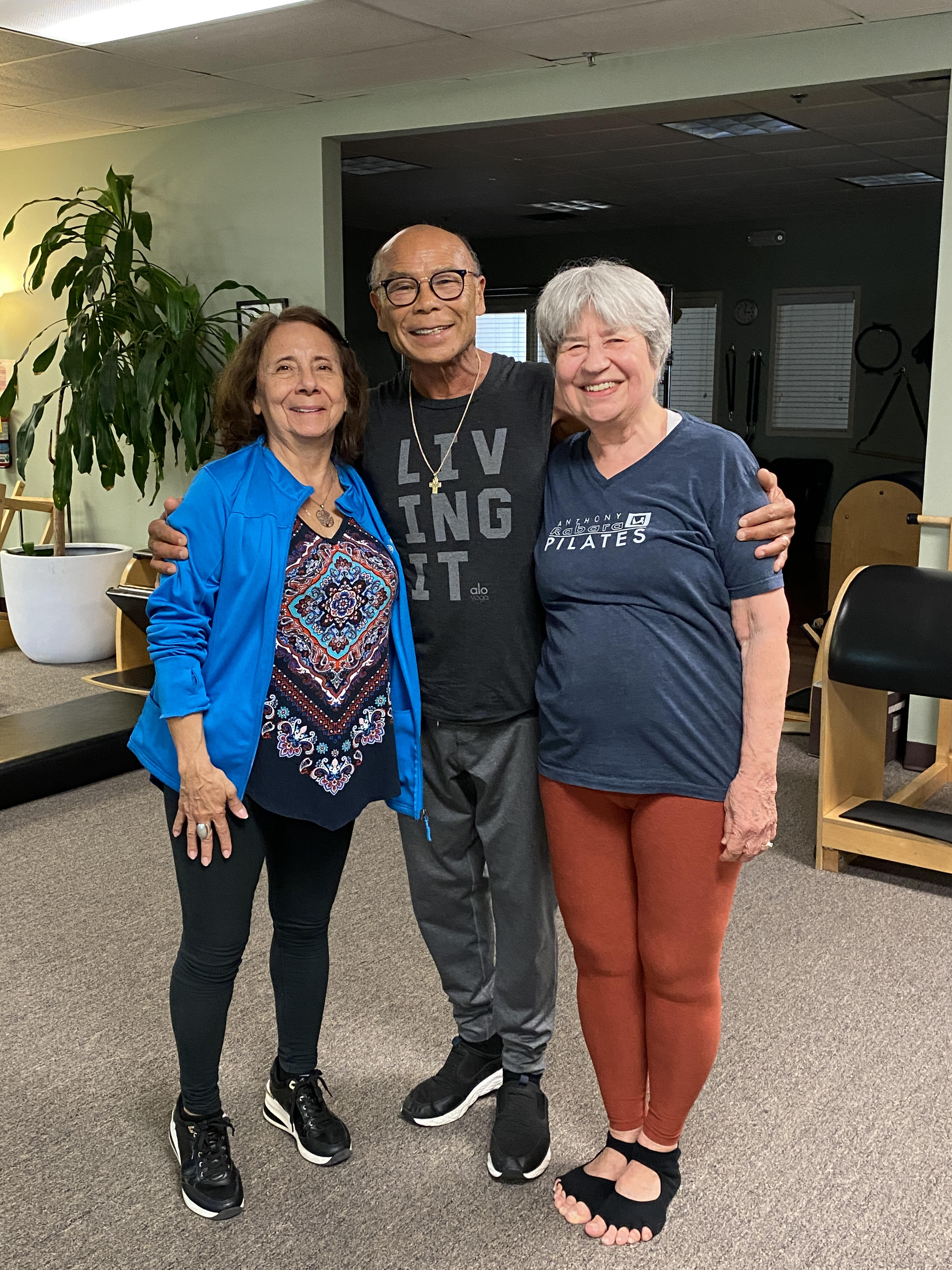
Sari Mejia Santo, Anthony Rabara, Me

I’ve been taking classes in the Pilates Method ever since Anthony Rabara brought it to Princeton in the ’90s. He teaches the purest form of the now famous body work devised by Joseph Pilates. Back then, this method was known mostly in the New York dance community. Rabara was one of the first eight trainers certified by Joseph Pilates’ protegee, the late Romana Kryzanowska.

Thanks to Rabara and his studio’s expert teachers – they go through more than 600 hours of training — my severe arthritis is held at bay. With discerning eyes they can spot the slightest misalignment and cue the corrections that prevent injury and strengthen muscles that you didn’t know you had.

This week I had the very exciting opportunity to study with Romana’s daughter, Sari Mejia Santo. She leads Romana’s Pilates International, which operates a global instructor network in 40 countries and 30 U.S. States. My lesson turned out to be a demo for a dozen instructors in the room. It was challenging, to say the least, but she made it fun.

In a delightful coincidence, I had just come across a passage in a Maisie Dobbs mystery by Jacqueline Winspear that mentions Joseph Pilates, who developed his technique on wounded soldiers during World War I. In “Birds of a Feather,” set in England between the wars, Maisie’s assistant, Billy, gets to “study exercises and movements to counteract the lingering effects of war time injuries.”

“What ‘e says, Miss, is that I’m increasing my core. . .

“Your core?” Maisie watched Billy brush out the mane of a mare with an enviable track record…

“There are all these different exercises, some to stretch me legs, some me arms, and me middle, and some are really small movements right ‘ere,” Billy pointed to his stomach with the curry comb, “which is me core.”

“Well, it seems to be doing you a lot of good. I saw you walk across the stable yard with barely a limp.”

“The main thing is that the pain ain’t what it was.”

So says Billy. The main thing, for me, is that going to the Rabara studio is fun – and the “really small movements,” as Billy puts it, keep me feeling young.

:

Dear dear Dr. Ruth

Here’s my confession: I’m such a Dr. Ruth fan. A couple of decades ago, when I was scheduling an interview with her, she left a message on my phone mail that I kept for weeks, delighting in that throaty signature voice.

Here is Dr. Ruth Westheimer’s prescription for Covid positivity, published in the AARP newsletter. Memo to freelancers: she pitched her own story. It wasn’t the editors’ idea but they bought it. Memo to photographers and stylists: This is how to make an elder look good!

Mem

I

Helping One Helps All

Best Buy’s landmark employee handbook

Reading this post I watched an interview with a nationally known HR guru on how taking care of caregivers can help everyone – including the employer.

Charles Montreuil, SVP of Human Resources at Best Buy, was interviewed by Alexandra Drane, co-founder and CEO of Rebel Health and ARCHANGELS, a national movement that recognizes and honors caregivers.

Montreuil broke new ground in ways for a corporation to care for its workers who are caregivers, and as both a recipient of care and a caregiver myself, his ‘corporatized empathy’ has special meaning for me.

Charles Montreuil and Alexandra Drane

At minute 23 came my AHA moment about why my church’s new arrangements for “taking care” are so meaningful. Montreuil says that having a caregiving system in place will reduce stress — not only for the employee caregiver — but also for everyone who works with or who knows that person. Stress for one person affects those around her. When the employee’s friends – her team – know that she can get help if she needs it — they can relax too.

I tend to carry a lot of that kind of stress. As an empath and a diagnosed worrywart, I am prone to worrying about who isn’t being taken care of. Ten years ago I helped manage an informal team to look after a beloved church member who lived alone but had dementia and other health problems. Refusing to move from her fourth floor walk-up Palmer Square apartment, she charmed everyone in sight, inspiring them to help her. But it took 10 of us to manage all aspects of her care.

What org”>Princeton United Methodist Church lacked then was an organized system of tracking who else needed care. We did have had other formal systems in place. In addition to the pastors, they included:

Stephen Ministry, which I knew pretty well since my late husband worked, as the lay leader, with then -pastors Rev. Jana Purkis-Brash and Rev. Catherine Williams and the lay team of Stephen Ministers — caring Christians trained to walk alongside those in need for as long as necessary to provide emotional and spiritual care.

From Stephen Ministry grew a caring group for widows and widowers, called Love Lives On.

The Prayer Chain, for as long as I can remember, offers solace to many. To be able to say “our prayer warriors will pray for your loved one” seems to help even those (perhaps especially those) without a firm faith.

Until Covid, several 12-step groups had, for decades, found a warm and welcoming meeting home in the church’s building on the town’s main drag. (After Covid, they will return).

Then. last year, Pastor Ginny Cetuk and an experienced lay member, Laverna Albury, put together a program, Circle of Care, to try to ensure that no one in our flock would “fall through the cracks.” This 12-member team “provides services and support to individuals or families who find themselves in acute distress due to illness, injury or family stress. ” When Covid came along, Circle of Care was in place and ramped up its efforts.

My AHA moment: When Best Buy’s HR guy, Montreuil, acknowledged that help for a stressed out caregiver could reduce the stress among that worker’s associates. “When you take care of one employee you are influencing the rest of the store. ‘Look at how this store takes care of us.'” Just knowing that respite care is available for the co-worker makes everyone breathe easier.

Yes! I realized. With the Circle of Care in place I can put that particular worry, that particular reason to be anxious, on a shelf. Other folks are in charge!

Full disclosure: I found this video on the website of my daughter, Susannah Fox. She bills herself as an “internet geologist” who helps people navigate healthcare and technology. At the end of her post she gave a link to Best Buy’s caregiver handbook.

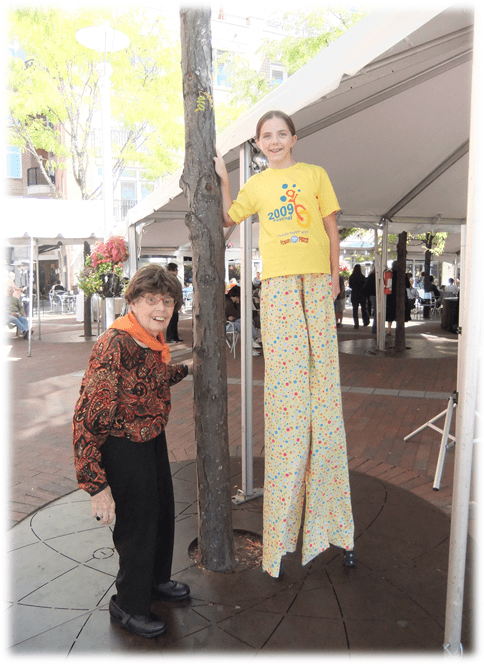
The photograph below shows the elder in the fourth floor walkup, barely able to walk herself, charming a 10-yea-old stilt walker.

Guilty Pleasures Needed

loneliness
by Tracy Lee for NPR

“Guilty pleasures” are good for our health says psychologist Dan Gottlieb on WHYY today. He says there is a good study suggesting these guilty pleasures do help loneliness. So, to combat loneliness, grief, and the fear of tomorrow, do something you enjoy at least every day. This will nurture social capital.

Another tip from NPR, this from a May 10 segment on Quarantine Blues:  Don’t miss the opportunity for small touch points throughout the day. Even sharing a joke over text can make you feel less alone, says  Judith Moskowitz, of Northwestern University.

Got questions? Dr. Barile has answers

logoKnowledge is power. Information reduces stress.
Join Dr. David Barile on a weekday to get your questions answered. He sends this invitation: 
Here in NJ we are facing the very real possibility of a shortage of respirators, PPE and ICU beds. Just today we had additional positive tests reported bringing our state’s total cases to 8,825 with 108 deaths. We are working with several of our Coalition partners to address some of the unmet needs.
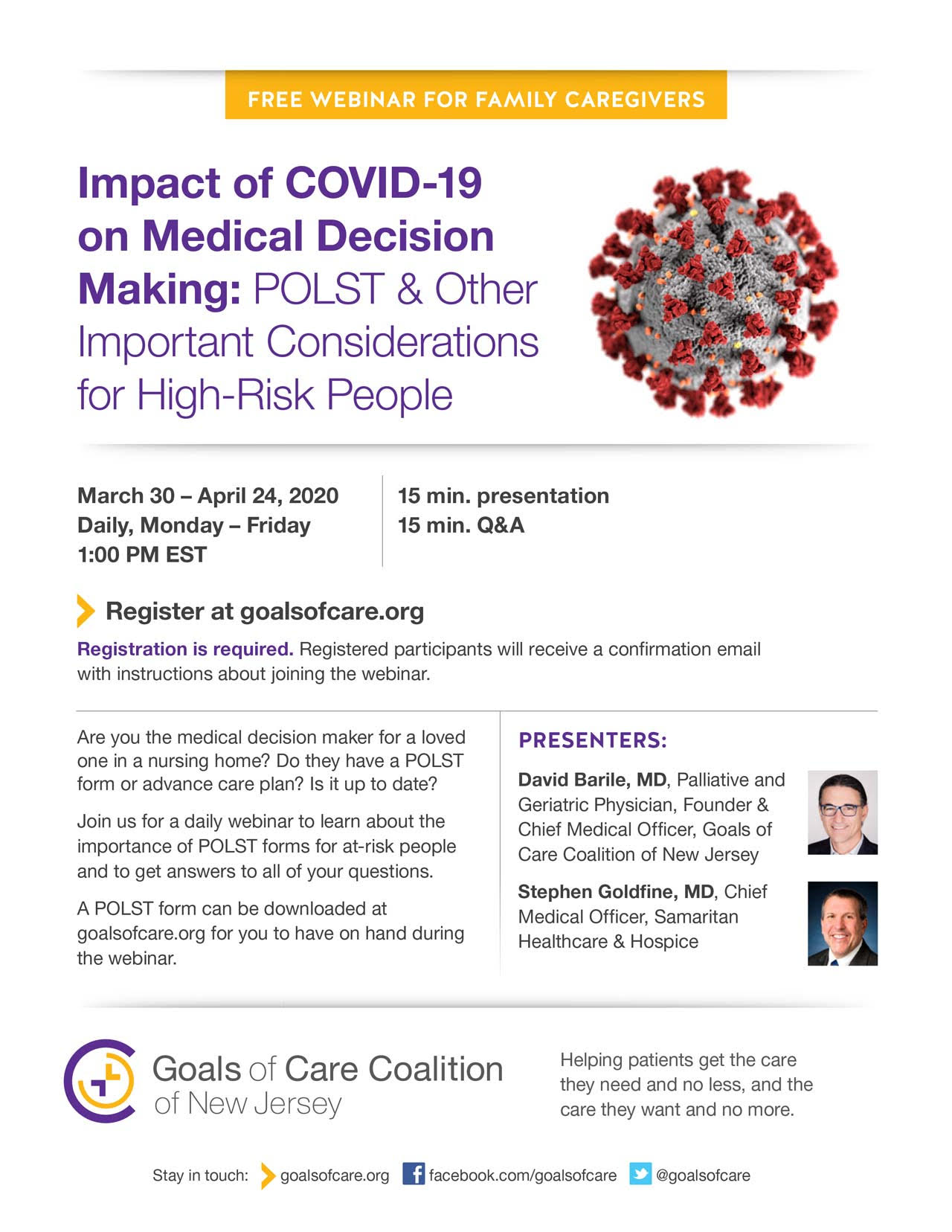
Toward that end, from Monday 3/30 to Friday 4/24, Goals of Care Coalition of New Jersey (GOCCNJ) will be launching a daily webinar M-F at 1:00pm to help educate people and address their questions regarding POLST and advance directives for the populations at high-risk for complications of COVID-19 (nursing home populations, frail elders, people with underlying medical concerns, etc.) and/or their family decision makers/healthcare proxies. Visit the GOCCNJ website, www.goalsofcare.org, to register for the webinar.

Please share the attached flyer with your networks and let people know this resource is available. We have more information and resources online at our website www.goalsofcare.org. We would be so grateful if you help spread the word!

Many thanks and please stay healthy and safe!

Best,

David R. Barile

Founder & Chief Medical Officer
Goals of Care Coalition of New Jersey
webinar flyer

Clarity of purpose trumps knowledge: Clayton Christensen

christensenDisclosure: I had never heard of this man, Clayton Christensen, until my daughter noted his obituary and said that he had had a big influence on her life.

When I read this excerpt of his words in the Weekend Reader* — the fact that Christensen  is so devoted to God’s purpose for him, and that he has managed to impart this to the secular business community, ‘blew my mind.”

For me, having a clear purpose in my life has been essential. But it was something I had to think long and hard about before I understood it  … Clarity about (a business person’s)  purpose will trump knowledge of activity-based costing, balanced scorecards, core competence, disruptive innovation, the four Ps, and the five forces…

If you study the root causes of business disasters, over and over you’ll find this predisposition toward endeavors that offer immediate gratification. If you look at personal lives through that lens, you’ll see the same stunning and sobering pattern: people allocating fewer and fewer resources to the things they would have once said mattered most…

If you want your kids to have strong self-esteem and confidence that they can solve hard problems, those qualities won’t magically materialize in high school. You have to design them into your family’s culture—and you have to think about this very early on. Like employees, children build self-esteem by doing things that are hard and learning what works. 

I also really liked this principle, one that I learned from Rev. Paul Couch when he pastored Redeember Moravian Church:

The lesson I learned from this is that it’s easier to hold to your principles 100% of the time than it is to hold to them 98% of the time. If you give in to “just this once,” based on a marginal cost analysis, as some of my former classmates have done, you’ll regret where you end up. You’ve got to define for yourself what you stand for and draw the line in a safe place. 

Rev. Couch said over and over again — if you slip once, it will be easier to do it again.

My daughter, Susannah Fox, posted about listening to Christensen in 2014. 

Then, his remarks targeted health care.  Her comment: “Great thinkers can … take you on “a helicopter ride and point out new patterns in a familiar landscape.”

Perhaps that is because he was, by definition, humble. (May I point out that great spiritual leaders, from Paul Couch to Fred Rogers are, by definition, humble?

Said Christensen:

 And if your attitude is that only smarter people have something to teach you, your learning opportunities will be very limited. But if you have a humble eagerness to learn something from everybody, your learning opportunities will be unlimited.

My interpretation of how teach humble is to offer good preschool care. Self esteem matters.

Generally, you can be humble only if you feel really good about yourself—and you want to help those around you feel really good about themselves, too. When we see people acting in an abusive, arrogant, or demeaning manner toward others, their behavior almost always is a symptom of their lack of self-esteem. They need to put someone else down to feel good about themselves. 

Here’s the takehome, for both business leaders and the rest of us.

Think about the metric by which your life will be judged, and make a resolution to live every day so that in the end, your life will be judged a success.   

 *Note: Maxwell Anderson, who blogs as The Weekend Reader, is a Princeton seminary graduate and can be counted on to take a God-centered view of every issue. If curious, subscribe here.  I borrowed the image from his blog post.

Grandma Lives Far Away?

AARP has this excellent advice for managing the care of a loved one from afar.  I am noting it here for everyone’s future reference.

Concerned Caucasian woman sitting on sofa This image comes from the AARP website.


JGI/JAMIE GRILL/GETTY IMAGE

‘Don’t let the failure of your imagination limit your ability to serve your customers’

close-up-person-cutting-cheese-with-knife-round-chopping-board_23-2148166558

My friend Hugo Campos, writes Susannah Fox, is originally from Brazil and taught me a lovely phrase in Portuguese about someone who holds all the cards, who seems to have all that they need to create change: “Está com a faca e o queijo na mão.” It means: He holds the cheese and the knife. This person has what they need to execute their vision. You want to be that person.

Details here. 

Image credit:
<a href=”https://www.freepik.com/free-photos-vectors/food”>Food photo created by freepik – http://www.freepik.com</a&gt;


The care they need – the care they want

video_THUMB-16x9-iCare_4

If any part of health care in New Jersey needs reform, it’s end-of-life healthcare. Patients here are likely to undergo more intensive medical care, in their final days, than in any other state. All this treatment rarely helps the patients; likely it just makes them uncomfortable.

David Barile MD, palliative care specialist, founded NJ GoalsofCare,  a non-profit, to help everyone — lay people and medical people — achieve their goals for this stage of life that is often feared and ignored.  “We’re working to set a new standard by helping healthcare providers, patients, and families make medical decisions that genuinely reflect a person’s wishes,” says Barile. He created educational materials and documents to ensure that patients would receive the care they need and no less, and the care they want and no more.

In our family, we have had examples of too much care, too little care, and just the right amount of care. The “just the right amount,” no coincidence, was supervised by Dr. Barile. 

GOCCNJ-logo-01

Now his small organization has coalesced into The Goals of Care Coalition of New Jersey. Its partners are healthcare providers, government agencies, and community organizations.  Founding members are an impressive list:  NJ Hospital Association, the Medical Society of NJ, the NJ Association of Health Plans, the Health Care Association of NJ, HQSI, the Home Care & Hospice Association of NJ, LeadingAge NJ, the NJ Health Care Quality Institute, the NJ Palliative Care APN Consortium, the VNA Health Group, Samaritan Healthcare & Hospice, the NJ Association of Health Care Social Workers and the NJ Association of Mental Health and Addiction Agencies.

From Robert Wood Johnson Foundation it has a one-year grant, $195,000, to address disparities in access to palliative care for minority populations living in New Jersey. It also landed a $75,000 matching grant, and here’s where I — and maybe you — come in. I’m donating, and I invite you to contribute. You can do it through a Facebook fundraising page or directly through GoalsofCareNJ website. 

Talking about the end-of-life does not come easily! That’s why I believe both the medical people and lay people need the GoalsofCare materials.

Bottom line: When it’s time to say goodbye to someone you love, it’s such a comfort to know that the caregivers are following the patient’s wishes.